
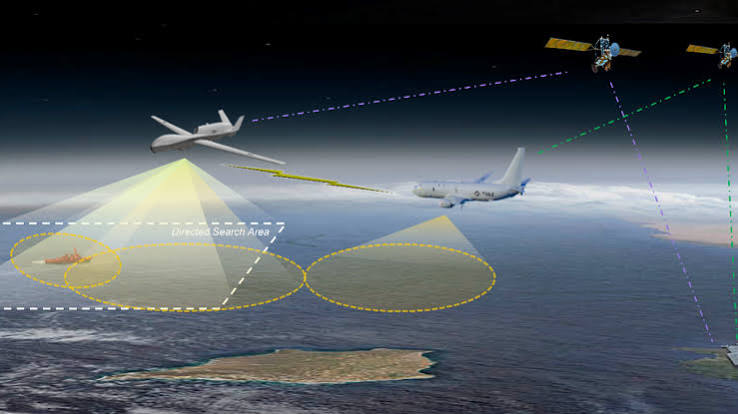
On 05 Aug 26, Boeing and Northrop conducted a lab demo test teaming the manned P-8A Poseidon maritime patrol aircraft and the unmanned MQ-4C Triton high-altitude long-endurance (HALE) ISR platform.
The P-8A operator sent machine-readable/machine-actionable mission tasking to a simulated Triton. The Triton then autonomously planned and executed the mission (e.g., transit to an area, collect intelligence with its sensors), processed data onboard via AI algorithms, and returned processed intelligence to the Poseidon.
The demo showed the first automated collaboration using an open systems architecture and the Universal Command and Control Interface. The announcement’s emphasis on universal standard interfaces is significant. Rather than using proprietary, platform-specific software, standard interfaces allow different systems to exchange information more easily.
Even though the P-8A and MQ-4C are both surveillance platforms, they have very different strengths.
P-8A Poseidon. Manned, multi-mission platform optimised for anti-submarine warfare (ASW), anti-surface warfare, response/agility (including lower-altitude operations), high-resolution imagery, weapons delivery, and rapid prosecution of contacts. Its crews operate in a dynamic tactical environment.
MQ-4C Triton. Unmanned HALE platform for persistent, wide-area maritime domain awareness. It has long endurance of more than 24 hours, and operates at high altitude (50,000+ feet). It has broad sensor coverage including multi-int radar, EO/IR, SIGINT.
Key Benefits for Operators
The key idea in teaming them up is about letting each do what it does best. Instead of both independently searching the same ocean, the Triton can automatically detect and cue the Poseidon. It reduces the workload on human operators.
It would reduce operator workload, speed up decision-making, enable more flexible and responsive manned-unmanned teaming, and leverage their complementary strengths for broader, more efficient maritime ISR and related missions. Key benefits would be: –
Reduced Workload and Cognitive Burden. The demonstration focuses on automating tasking, planning, execution, and the use of onboard AI. As a result, P-8 operators will no longer have to manually coordinate all the individual aspects or depend on ground stations when making routine intelligence requests or assigning tasks. Instead, they will be able to concentrate on higher-level mission management, tactical decisions, and using the fused picture, rather than closely monitoring the unmanned asset. This reduces the operator’s workload and speeds up the intelligence cycle.
Faster, More Responsive Decision-Making and Targeting. Direct machine-to-machine exchange delivers processed maritime intelligence much faster. This supports quicker cueing for follow-on actions. In contested or time-sensitive environments, this improves the overall kill chain decision speed.
Direct In-Flight Tasking and Greater Tactical Flexibility. Currently, Tritons are typically controlled from distant ground stations. The demo establishes a foundation for P-8 crews to issue tasking and receive results in flight (via realistic links such as satellite relay) without routing everything through the ground control station. This extends the Poseidon’s effective reach, allows dynamic retasking based on the manned aircraft’s real-time situational awareness, and improves the composite battlespace picture under the control of the airborne crew.
Better Use of Complementary Capabilities Without Redundancy. Triton handles the long-endurance, broad-area “look” mission persistently. Poseidon handles responsive, close-in, multi-mission work (including ASW that Triton does not perform). Automated teaming lets them operate more seamlessly as a unit rather than operating in relative isolation or with slower human-mediated coordination. Shared standards also ease training synergies (some operators cross-qualify) and common operating pictures.
Broader Interoperability and Future Scalability at Lower Cost/Risk. Use of universal/open standards rather than proprietary links allows collaboration with other platforms. This makes integration easier and more cost-effective, and also supports evolutionary upgrades on existing fleets.
Summary
By combining the two surveillance platforms, the team created a more closely integrated system. The operators gain in efficiency (because there is less manual coordination), in speed (since the intelligence and decisions can be made more quickly), in reach and flexibility (through direct control from the air) and in effectiveness (due to the continuous coverage and the ability to carry out a variety of missions in a responsive manner). This is especially valuable in the case of large areas of responsibility over seawater where both persistence and rapid response are essential. The demonstration carried out in the laboratory represents an initial stage in the way these capabilities can be put into operational use.
Please Add Value to the write-up with your views on the subject.
For regular updates, please register your email here:-
References and credits
To all the online sites and channels.
Pics Courtesy: Internet
Disclaimer:
Information and data included in the blog are for educational & non-commercial purposes only and have been carefully adapted, excerpted, or edited from reliable and accurate sources. All copyrighted material belongs to the respective owners and is provided only for wider dissemination.