764: CHARIOTS OF THE BATTLEFIELD: COMBAT HELICOPTERS


Article published in the  Issue 9 – 2025 e-magazine of the

SP’s Aviation


Combat helicopters have become vital assets in modern warfare, revolutionising military operations with their versatility, agility, and firepower. They provide critical capability across a wide range of combat scenarios. Their ability to hover, manoeuvre in complex terrains, and operate at low altitudes allows them to engage targets with unmatched precision, often in environments inaccessible to fixed-wing aircraft. Combat helicopters enhance battlefield dominance, while their real-time intelligence-gathering capabilities bolster situational awareness. In asymmetric warfare, they counter insurgent threats by delivering swift, targeted strikes. However, vulnerabilities to advanced anti-aircraft systems pose a challenge. As militaries integrate unmanned systems and network-centric warfare, combat helicopters continue to evolve, incorporating cutting-edge technologies to maintain their strategic relevance. Their adaptability and lethality ensure they remain a cornerstone of modern military doctrine, shaping the dynamics of contemporary battlefields.


Main Roles of Combat Helicopters

Helicopters have revolutionised modern warfare, offering unparalleled mobility, versatility, and firepower. Their adaptability allows them to serve in various roles, ensuring operational success in dynamic combat environments. In combat, attack helicopters have redefined battlefield tactics. Their agility and firepower make them indispensable for suppressing threats. Modern technological advancements have further enhanced the capabilities of combat helicopters. Night vision systems, stealth features, and advanced avionics allow them to operate effectively in diverse conditions, from deserts to dense urban landscapes. Their roles include:-

    • Armed Reconnaissance. Scouting enemy positions with advanced optics, providing targeting data.
    • Suppression / Destruction of Enemy Air Defences (SEAD/DEAD). Neutralising enemy radar and surface-to-air missile sites with precision weapons to create safe corridors.
    • Air Interdiction. Disrupting enemy logistics, troop movements, and supply lines by striking behind enemy lines.
    • Escort Operations. Shielding utility helicopters during assault or insertion missions, suppressing enemy air defences and ground fire.
    • Counter-Insurgency & Counter-Terrorism. Executing precision strikes in mountainous and jungle terrains, supporting rapid insertion/extraction and surgical attacks against insurgents or terrorists.
    • Battlefield Air Support (CAS). Delivering direct firepower (rockets, cannons, guided missiles) to support ground troops in battle, targeting enemy infantry, bunkers, armoured vehicles, and fortifications.
    • Anti-Tank / Anti-Armour Operations. Attack helicopters equipped with anti-tank guided missiles (ATGMs) are crucial for countering enemy armour in high-intensity conflicts.
    • Combat Search and Rescue (CSAR). Extracting downed aircrew or trapped soldiers from hostile zones under fire, often providing covering fire with advanced sensor support.
    • High-Altitude Operations. Operate in low-oxygen environments at high altitudes, ensuring mobility and firepower in the toughest terrains.
    • Urban Warfare Support. Offering precision and agility for fire support, hard-target destruction, and support to fast-moving urban operations in close quarters.


Difference between Attack and Armed Helicopters

These two terms are often used interchangeably, but they refer to distinct categories based on design, purpose, and combat capabilities. Attack helicopters are specialised platforms built for offensive combat, whereas armed helicopters are modified utility helicopters equipped with weapons for secondary combat roles. Understanding their differences is key to appreciating their roles.

Attack Helicopters.  These aircraft are purpose-built for combat, designed to engage targets on the ground and in the air. These helicopters are equipped with heavy armaments, including the 30mm/20mm guns, rockets and (Hellfire/Helina) missiles.   Equipped with advanced avionics, including radar, FLIR, and night-vision systems, they excel in high-threat environments. Attack helicopters prioritise firepower and armour over utility, typically featuring a two-crew configuration (pilot and gunner) and lacking troop-carrying capacity, making them expensive and maintenance-intensive yet highly effective in combat roles.

Armed Helicopters.  These are modified utility helicopters adapted for combat while retaining multi-role capabilities. Unlike attack helicopters, armed helicopters have lighter armour and simpler avionics, relying on agility rather than heavy countermeasures. Their cost-effectiveness and flexibility enable the air forces to deploy them in diverse roles; however, they are less suited for high-intensity combat compared to dedicated attack platforms.

The Indian Air Force (IAF) employs both attack and armed helicopters to fulfil diverse operational needs, from precision strikes to multi-role support.


Survivability and Viability of Combat Helicopters in Contested Airspace

Combat helicopters remain essential in modern warfare; however, their survivability and viability in contested airspace are getting increasingly challenged due to the proliferation of advanced air defences (MANPADS and SAMs). The Russia-Ukraine War highlights these vulnerabilities. Their vulnerability lies in operations at low altitudes and speeds. MANPADS account for significant losses, which are compounded by GPS jamming and small arms fire in urban or mountainous terrain.

Countermeasures to enhance survivability include infrared suppressors, laser-based systems such as Northrop Grumman’s CIRCM, and armoured fuselages. Stealth features, such as radar-absorbent materials, enhance evasion but add weight and complexity to the design. Manned-Unmanned Teaming (MUM-T) with drones for reconnaissance and strikes reduces exposure, while AI-driven sensor fusion improves threat detection.

Tactically, helicopters require a favourable environment with Suppression of enemy air defence systems. Additionally, robust protection and air cover are necessary. Short-duration sorties, night operations, terrain masking and nape of the earth flying profile further mitigate risks; however, poor tactical discipline can prove fatal.

Ultimately, helicopters remain indispensable for specific missions but demand thorough planning, multi-layered defences, and joint force integration. Without radical innovation, their role might evolve from being the primary attackers to supporting roles in multi-domain operations. This change necessitates balancing their unique capabilities with the challenging and often dangerous realities of contested airspace.


Combat Helicopter in the IAF.

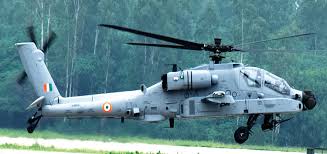
India’s fleet has evolved from legacy Soviet Mi-24/35 Hind helicopters to modern systems, including the Boeing AH-64E Apache and indigenous helicopters such as the HAL Light Combat Helicopter (LCH) Prachand and Rudra. While Apache, Prachand, and Hind fall into the attack helicopter category, Rudra and Mi-17 are armed helicopters.

AH-64E Apache. Cutting-edge imported attack helicopters, with advanced sensors, Hellfire missiles, Stinger AAM, and 360° radar, used in offensive strike, BAS, anti-armour, escort, and SEAD roles.  

HAL LCH (Prachand).  Indigenous aircraft with stealth features, good high-altitude performance, networked avionics, and advanced survivability.  Used in Anti-armour, SEAD, CSAR, SHBO escort, and Anti-Armour roles.

Mi-24/Mi-35.  Russian heavily armoured gunship, a legacy system with diminishing use and soon to be phased out, used for troop lift, heavy attack, BAS, and COIN.

 HAL Rudra.         Weaponised ALH Dhruvs with Integrated EW,   EO sensors, Mistral AAM, Helina ATGM, used for multirole missions like recce, troop transport, anti-tank, BAS, COIN, and escort

Mi-17. A versatile Russian-origin helicopter, primarily for transport but occasionally armed for combat roles. The Mi-17V-5 variant can be equipped with rocket pods, machine guns, and anti-tank missiles for light attack missions. Used in counterinsurgency operations and disaster relief, these helicopters support troop transport and casualty evacuation, while also providing fire support.


Force Structuring and Capability Enhancement

Combat helicopters are pivotal to flexible air combat across diverse terrains, from deserts to the mountains.  The Indian Air Force inducted 22 Boeing AH-64E Apache attack helicopters in 2019 to replace its ageing fleet of 15 Mi-24/Mi-35 gunships, acquired from Russia in the 1980s and 1990s. The Apache’s induction enhanced precision strikes and night-fighting capabilities, modernising India’s aerial combat effectiveness.

In the Indian context, combat helicopters play a critical role in high-altitude operations, particularly in the Himalayan regions along the borders with China and Pakistan. Operating at altitudes above 15,000 feet, such as in Ladakh or Arunachal Pradesh, presents unique challenges due to the thin air, extreme weather conditions, and rugged terrain. The Light Combat Helicopter (LCH) Prachand was developed in response to lessons learnt from the 1999 Kargil War. It is uniquely capable of operating at 20,000 feet with a full weapon load, making it critical for high-altitude warfare in regions such as Siachen and Ladakh. These helicopters remain vital for deterrence, rapid response, and maintaining operational superiority in India’s high-altitude battlefields. They are being inducted by both the Indian Air Force and the Indian Army.

The Indian Multi-Role Helicopter (IMRH), a 12.5-tonne twin-engine platform being developed by Hindustan Aeronautics Limited (HAL), is conceived as a versatile replacement for the ageing Mi-17 fleet. The IMRH reportedly would excel in high-altitude operations, troop transport for up to 24 personnel, combat search and rescue, evacuation, and under-slung cargo carriage of 5 tonnes. Its advanced avionics, automatic flight controls, and modular mission systems would enable seamless adaptation to utility, armed, and Special Forces roles, enhancing the IAF’s tactical battlefield operational capability.

The development and induction of ALH Rudra, LCH Prachand, and IMRH in the future indicates a push towards indigenisation, aiming for self-reliance, addressing challenges in scaling production, and reducing import dependency.  All these platforms also enhance the high-altitude operation capability.


Future Trajectory of Combat Helicopters

The future of combat helicopters in fast-evolving aerial warfare hinges on their ability to adapt to rapidly advancing technologies, shifting battlefield dynamics, and emerging threats. As militaries worldwide integrate artificial intelligence (AI), unmanned systems, and network-centric warfare, combat helicopters and future platforms must evolve to remain relevant. Their traditional strengths, versatility, precision, and manoeuvrability in complex terrains will be augmented by cutting-edge innovations to counter increasingly sophisticated adversaries.

One significant trend is the integration of AI and autonomy. Future combat helicopters may operate in tandem with unmanned aerial vehicles (UAVs) through manned-unmanned teaming (MUM-T). This would allow helicopters to control drones for reconnaissance, targeting, or electronic warfare, reducing risks to human pilots. AI-driven systems will enhance situational awareness by processing vast amounts of sensor data in real-time, enabling faster decision-making in dynamic combat zones. For instance, advanced targeting systems could autonomously identify and prioritise threats, improving response times.

Another critical evolution is in stealth and survivability. Modern air defences, including surface-to-air missiles (SAMs) and directed-energy weapons, pose significant threats. To counter these, next-generation helicopters would have to incorporate low-observable designs, advanced electronic countermeasures, and adaptive camouflage. Upgraded propulsion systems, such as hybrid-electric engines, promise greater speed, range, and fuel efficiency, enabling operations in contested environments. Additionally, modular designs will allow rapid upgrades of avionics, weapons, and sensors, keeping pace with technological advancements without requiring entirely new platforms.

Cyber and communication security will also play a pivotal role. As helicopters become nodes in networked battlefields, protecting their systems from cyber-attacks is paramount. Robust encryption and resilient communication links will ensure operational integrity.


Conclusion

Combat helicopters remain crucial in modern warfare, offering exceptional versatility, accuracy, and mobility to control various battle zones. They perform critical functions such as delivering precise strikes, deploying troops quickly, and supporting reconnaissance, air interdiction, and counterinsurgency missions. Although they face threats from advanced air defences, innovations such as AI, stealth, and Manned-Unmanned Teaming (MUM-T) enhance their survivability and performance. In India, platforms such as the Apache, ALH Rudra, LCH Prachand, and the emerging IMRH highlight a move toward indigenisation and high-altitude capability. As warfare advances, combat helicopters will incorporate state-of-the-art technologies to maintain their importance in multi-domain operations.


Please Add Value to the write-up with your views on the subject.


1879
Default rating

Please give a thumbs up if you  like The Post?


For regular updates, please register your email here:-

Subscribe


References and credits

To all the online sites and channels.

Pics Courtesy: Internet

Disclaimer:

Information and data included in the blog are for educational & non-commercial purposes only and have been carefully adapted, excerpted, or edited from reliable and accurate sources. All copyrighted material belongs to respective owners and is provided only for wider dissemination.


References:-

Bolkcom, C. (2005). Combat helicopters: Roles and capabilities in modern warfare. Congressional Research Service.

Jane’s Information Group. (2023). Jane’s All the World’s Aircraft: Development & production. IHS Markit.

Singh, R. (2021). Indian Air Force modernisation: The role of indigenous combat helicopters. Journal of Defence Studies, 15(3), 45–67.

Smith, J. A., & Brown, T. R. (2022). Manned-unmanned teaming in aerial warfare: Emerging trends. Military Technology Review, 28(4), 112–130.

Northrop Grumman. (2022). Common Infrared Countermeasures (CIRCM): Next-generation helicopter survivability.

Yadav, A. (2020). HAL’s Light Combat Helicopter: India’s answer to high-altitude warfare. Air Power Journal, 15(2), 89–104.

Army Technology. (2023). Attack helicopters: Roles, technologies, and future developments. GlobalData Plc.

Boeing Defence. (2020). AH-64E Apache Guardian attack helicopter fact sheet. Boeing.

Cordesman, A. H. (2016). The Changing Role of Air Power in Modern Warfare. Center for Strategic and International Studies (CSIS).

Rupprecht, A. (2022). Helicopters in high-altitude warfare: Lessons from the Himalayas. Jane’s Defence Weekly.

Singh, V. (2021). Evolution of India’s combat helicopter fleet. Observer Research Foundation Defence Capsule.

Yadav, P. K. (2022). HAL Prachand: India’s first indigenous light combat helicopter. Indian Defence Review, 37(3).
763: TEJAS MK 1A TAKES FLIGHT FROM NASHIK


This article is a compilation of news excerpts of the event.


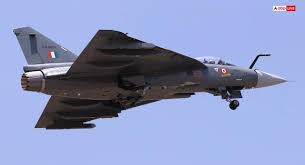
On October 17, 2025, India’s aerospace ambitions soared to new heights as the Tejas Mk1A, the country’s indigenously developed Light Combat Aircraft (LCA), completed its maiden flight from Hindustan Aeronautics Limited’s (HAL) Nashik production facility in Maharashtra. This landmark event, inaugurated by Defence Minister Rajnath Singh, marked not only the successful test flight of the first Tejas Mk1A built entirely at Nashik but also the formal launch of HAL’s third dedicated production line for the aircraft, alongside a second line for the HTT-40 basic trainer aircraft. The skies above Ozar Airport buzzed with pride as the Tejas Mk1A, accompanied by a flypast featuring the HTT-40 and Su-30MKI, received a ceremonial water cannon salute, symbolising a pivotal moment in India’s journey toward self-reliance in defence manufacturing.

The Tejas Mk1A is a 4.5-generation multi-role fighter jet, designed by the Aeronautical Development Agency (ADA) and manufactured by HAL. It represents a significant leap forward from its predecessor, the Tejas Mk1, with enhanced avionics, an advanced EL/M-2052 Active Electronically Scanned Array (AESA) radar, an electronic warfare suite, air-to-air refuelling capabilities, and integration with indigenous weapons like the Astra missile and laser-guided bombs. With over 64% indigenous content, the aircraft is a cornerstone of India’s ‘Atmanirbhar Bharat’ (Self-Reliant India) initiative, aimed at reducing dependence on foreign defence imports and bolstering the Indian Air Force’s (IAF) operational capabilities.

The maiden flight from Nashik underscores HAL’s efforts to scale up production to meet the IAF’s pressing needs. The IAF currently operates 29 squadrons against a sanctioned strength of 42, with ageing MiG-21s being phased out. The Tejas Mk1A is positioned to fill this gap, offering superior air superiority, ground attack, and maritime strike capabilities. HAL Chairman DK Sunil emphasised the aircraft’s significance, stating, “The Tejas Mk1A’s advanced electronics and avionics make it a 4.5-generation powerhouse, vastly superior to the MiG-21 Bison it replaces.”

The Nashik production line, established in April 2023 at a cost of over ₹150 crore, is a state-of-the-art facility designed to complement HAL’s two existing lines in Bengaluru, which together produce 16 Tejas Mk1A jets annually. The Nashik line starts with a capacity of 8 aircraft per year, with plans to scale up to 10 within two years through additional assembly jigs and advanced tooling. This expansion brings HAL’s total production capacity to 24 jets per year, with ambitions to exceed 30 through partnerships with private sector players like VEM Technologies (fuselages) and Larsen & Toubro (wings).

The Nashik facility’s inauguration was a spectacle of national pride. The flypast, featuring the sleek Tejas Mk1A alongside the rugged HTT-40 trainer and the formidable Su-30MKI, showcased HAL’s integrated production capabilities. The water cannon salute, a traditional gesture reserved for significant aviation milestones, added a touch of grandeur to the occasion, resonating deeply with defence enthusiasts and the public alike.

The journey to this milestone was not without challenges. The Nashik facility, launched in 2023, initially targeted its first aircraft rollout by May 2025. However, supply chain disruptions and technical refinements pushed the timeline forward. Key milestones included:

    • April 2023: Nashik facility inaugurated, with a focus on rear fuselage assembly and integration.
    • March 2025: First rear fuselage delivered; rollout delayed to April due to avionics integration tweaks.
    • May 2025: Adjusted plans aimed for a June rollout, but supply chain hurdles persisted.
    • June 2025: Delivery target set for end-June, with mid-July maiden flight plans postponed.
    • August 2025: Cabinet Committee on Security approved an additional 97 Tejas Mk1A jets, valued at ₹66,500 crore, bringing the total order to 180 (83 initial + 97 new).
    • September 2025: Contract signed for ₹62,370 crore; GE F404 engine deliveries resumed, with 12 expected in 2025-26.
    • October 17, 2025: Maiden flight achieved, with ongoing trials for weapons and radar integration.

These milestones reflect HAL’s resilience in overcoming logistical and technical hurdles, including delays in GE F404-IN20 engine supplies from the United States. With 99 engines contracted in 2021, HAL has had to rotate engines for testing due to supply constraints. Nevertheless, the successful flight on October 17 signals that production is stabilising, with formal IAF induction expected soon, pending validation of key integrations like the Astra missile and ELTA radar.

The Tejas Mk1A is a game-changer for the IAF, which has long grappled with squadron shortages and reliance on ageing Soviet-era aircraft. The aircraft’s versatility—capable of air-to-air combat, ground strikes, and maritime operations—makes it a critical asset in modern warfare. Its AESA radar enhances situational awareness, while the electronic warfare suite provides robust defence against enemy threats. The integration of indigenous Astra missiles and laser-guided bombs further strengthens India’s strategic autonomy, reducing reliance on foreign weaponry.

The IAF’s order of 180 Tejas Mk1A jets, valued at over ₹128,870 crore, reflects the government’s commitment to modernising its air force. The Nashik facility’s role in ramping up production is crucial, with HAL targeting 16-24 deliveries in 2025-26 and full-scale output of 24-30 jets annually from 2026-27. This pace is essential to replace retiring MiG-21s and maintain operational readiness against regional threats.

Despite the triumph of the maiden flight, challenges remain. Engine supply delays from General Electric have been a persistent bottleneck, forcing HAL to manage with limited units. The validation of critical systems, such as the AESA radar and weapons integration, is ongoing, with formal induction into the IAF expected within months. Additionally, HAL must navigate supply chain complexities and ensure quality control as it scales up production across multiple facilities.

Looking ahead, the Tejas Mk1A serves as a bridge to more advanced platforms like the Tejas Mk2 and the Advanced Medium Combat Aircraft (AMCA), India’s fifth-generation stealth fighter under development. The success of the Nashik facility also paves the way for greater private sector involvement, with companies like VEM Technologies and L&T playing pivotal roles in component manufacturing. This collaborative model could set a precedent for future defence projects, aligning with India’s vision of a robust domestic defence ecosystem.

The maiden flight of the Tejas Mk1A from Nashik is more than a technical achievement; it is a testament to India’s growing prowess in aerospace and defence innovation. The event has sparked widespread enthusiasm,  capturing the public’s imagination. Videos of the flypast and water cannon salute have gone viral, accompanied by comments praising the aircraft’s sleek design and HAL’s dedication to self-reliance.

Defence Minister Rajnath Singh, addressing the gathering, called the Tejas Mk1A “a shining example of India’s resolve to build a strong, self-reliant defence ecosystem.” The aircraft’s success reinforces India’s position as an emerging global player in aerospace, capable of designing, building, and deploying advanced fighter jets to meet its strategic needs.

The successful maiden flight of the Tejas Mk1A from Nashik on October 17, 2025, marks a defining moment in India’s defence journey. With its advanced capabilities, indigenous design, and growing production capacity, the Tejas Mk1A is poised to strengthen the IAF and reduce reliance on foreign imports. As HAL overcomes challenges and scales up output, the aircraft will serve as a cornerstone of India’s air defence strategy, paving the way for future innovations like the Mk2 and AMCA. This milestone, celebrated with a flypast and national pride, underscores India’s unwavering commitment to ‘Atmanirbhar Bharat’ and its ascent as a global aerospace power.


Please Add Value to the write-up with your views on the subject.


1879
Default rating

Please give a thumbs up if you  like The Post?


For regular updates, please register your email here:-

Subscribe


References and credits

To all the online sites and channels.

Pics Courtesy: Internet

Disclaimer:

Information and data included in the blog are for educational & non-commercial purposes only and have been carefully adapted, excerpted, or edited from reliable and accurate sources. All copyrighted material belongs to respective owners and is provided only for wider dissemination.


References:-

Aramane, G. (2023, April 5). Foundation stone laid for HAL’s third production line for Tejas Mk1A at Nashik. The Economic Times.

Aviation A2Z. (2025, August 21). India approves $7.1 billion for 97 new fighter jets for its air force. Aviation A2Z.

Business Standard. (2025, August 20). Final nod for ₹62,000 crore deal to procure 97 more Tejas Mk1A jets. Business Standard.

Defence News India. (2025, October 2025). Nashik facility overcomes delays to roll out first Tejas Mk1A. Defence News India.

ET Now. (2025, September 25). Defence Ministry signs contract for 97 Tejas aircraft with THIS company worth Rs 62,370 crore – DETAILS. ET Now.

Eurasian Times. (2025, September 25). LCA Tejas: India signs $7B deal for 97 ‘Made In India’ Mk-1A fighter jets that will replace MiG-21 aircraft. Eurasian Times.

Free Press Journal. (2025, October 17). Tejas Mk-1A takes maiden flight from Nashik, indigenous-built fighter jet to boost IAF’s capabilities after formal induction; WATCH. Free Press Journal.

HAL India. (2025, October 17). HAL Nashik facility achieves first Tejas Mk1A flight [Press release]. Hindustan Aeronautics Limited.

Hindustan Times. (2025, October 17). HAL’s Nashik line boosts Tejas Mk1A production; IAF eyes 24 jets annually. Hindustan Times.

India Today. (2025, October 15). Tejas Mk1A maiden flight delays due to engine supply issues. HAL production update. India Today.

Indian Express. (2025, October 17). Tejas Mk1A maiden flight marks milestone for Atmanirbhar Bharat. The Indian Express.

Mathrubhumi. (2025, September 25). HAL secures ₹62,370 cr contract to supply 97 Tejas Mk-1A jets to IAF. Mathrubhumi English.

Ministry of Defence, Government of India. (2025, October 17). Tejas Mk1A maiden flight strengthens India’s defence ecosystem [Statement]. Ministry of Defence.

New Indian Express. (2025, August 20). CCS approves Rs 67,000 crore project for production of 97 improved Tejas Mk1A jets. The New Indian Express.

Overt Defence. (2025, August 28). India approves $7.4 billion HAL Tejas Mk1A fighter jet deal. Overt Defence.

Republic World. (2025, October 10). Big day, HAL’s Light Combat Aircraft Tejas Mk1A to take maiden flight on October 17. Republic World.

The Hindu. (2025, October 17). LCA Tejas Mk1A, manufactured in the Nashik plant of HAL, completes maiden flight. The Hindu.

The Hindu. (2025, August 20). Cabinet panel on security clears project to procure 97 LCA Mark 1A fighter jets for IAF. The Hindu.

The Times of India. (2025, October 17). First Tejas-Mk1A from Nashik completes maiden flight; gets water cannon salute — Watch. The Times of India.

The Week. (2025, September 25). Mega LCA Tejas Mk1A deal signed: Indian Air Force to add 97 fighters to its fleet from 2028. The Week.

Times Now [@TimesNow]. (2025, October 17). Tejas Mk1A Gets Water Cannon Salute After Maiden Test Flight In Nashik. [Post]. X.

Zona Militar. (2025, September 25). India confirmed the purchase of 97 new LCA Tejas Mk1A fighter jets to replace its MiG-21s, which will soon be retired. Zona Militar.

762: AZM-E-ISTHEKAM: PAKISTAN AND AFGHANISTAN AT WAR


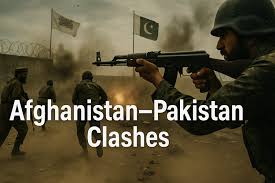
In October 2025, the volatile border between Pakistan and Taliban-ruled Afghanistan once again erupted into violence, marking the sharpest escalation seen since the fall of Kabul in 2021. Years of mutual suspicion, militant activity, and punitive cross-border actions have culminated in a conflict that threatens to redraw the region’s security landscape and deepen humanitarian tragedy. At the heart of the crisis lies Pakistan’s longstanding grievance over militant sanctuaries in Afghanistan, alongside the Afghan Taliban’s fury at perceived violations of sovereignty. What started with airstrikes and border raids has grown into a war of retaliation.


Genesis. Beyond the militant issue lies a deeper, century-old source of tension, the Durand Line, the 2,600-kilometer boundary drawn by British colonial authorities in 1893. Afghanistan has never formally recognised it as an international border, arguing that it unjustly divides ethnic Pashtun communities between the two countries. Pakistan, on the other hand, insists that the border is internationally recognised and non-negotiable. This disagreement frequently sparks clashes, especially when Pakistan attempts to fence or fortify sections of the frontier. In recent years, Islamabad has built extensive fencing and new security posts, moves that the Afghan Taliban view as unilateral and illegitimate. For local tribes who straddle the border, these disputes have disrupted trade, travel, and traditional social networks, fuelling resentment on both sides.


A Legacy of Mistrust. The irony of the current conflict is striking: for years, Pakistan was seen as one of the Taliban’s key supporters. Islamabad maintained close ties with the group during the U.S. war in Afghanistan, providing political and logistical backing while officially denying direct involvement. Many in Pakistan’s security establishment believed a Taliban-run Afghanistan would ensure a friendly, stable neighbour, one that would curb Indian influence and maintain strategic depth. Yet since 2021, the opposite has occurred. The Taliban’s rise to power has not translated into reliable cooperation. Instead, the Afghan government’s reluctance to act against the TTP has deepened Islamabad’s insecurity. Meanwhile, Taliban leaders have accused Pakistan of bowing to Western pressure and violating Afghan sovereignty with repeated cross-border strikes.


The Refugee and Humanitarian Dimension. Another flashpoint is the treatment of Afghan refugees in Pakistan. For over four decades, Pakistan has hosted millions of Afghans who fled war and instability. However, as domestic economic challenges mount and security incidents rise, Islamabad has hardened its stance. In 2023 and again in 2025, Pakistan announced mass deportations of undocumented Afghans, citing concerns that militants were using refugee camps for cover. Kabul condemned the policy as collective punishment, arguing that most refugees are innocent civilians. The crackdown has strained relations further, with human rights groups warning of humanitarian crises as thousands of Afghans are forced to return to an unstable homeland.


Aggressive Pakistan Strategy. Pakistan’s “Azm-e-Isthekam” campaign, launched in mid-2025, signalled a shift: no longer would Pakistan rely solely on defensive border policing. Instead, Islamabad adopted a new deterrence framework, crossing into Afghanistan with targeted military operations aimed at chronic safe havens. This bold approach antagonised the Taliban, who see themselves as sovereign rulers rather than proxies for Pakistani interests.


Escalation: From Airstrikes to Border War. The immediate trigger for this round of fighting was a series of Pakistani airstrikes on October 9, 2025, targeting Pakistani Taliban (Tehreek-e-Taliban Pakistan, or TTP) leaders, including Noor Wali Mehsud, in Kabul and several Afghan provinces. Islamabad cited security concerns, claiming TTP was using Afghan territory as a staging ground for attacks inside Pakistan. The Afghan Taliban called these actions unprovoked aggression, denouncing civilian deaths and promising retribution. Days later, Taliban fighters shelled Pakistani outposts along the Durand Line, with both sides exchanging heavy fire, drone strikes, and artillery barrages, resulting in dozens of military and civilian casualties on both sides.​


The Battles. Clashes have centered on traditional flashpoints: Spin Boldak and Chaman, major crossings on the Afghanistan-Pakistan border, and Kurram and Khyber districts further north. Taliban fighters shelled Pakistani posts, killing soldiers and reportedly seizing weaponry. Islamabad responded with precision airstrikes, claiming to destroy Taliban military compounds and inflict significant casualties. Afghan sources, however, report large-scale civilian deaths and widespread displacement, including in Kandahar and Paktika, triggering renewed calls for restraint by international agencies.​ The scale and intensity of the fighting surpassed previous border skirmishes. Both sides deployed drones, tanks, and heavy artillery in what some analysts described as “border war” conditions, closing major trade crossings and halting cross-border movement. Satellite images confirmed destroyed military infrastructure and burning market stalls; hospital reports cited dozens of injured women and children.​


Ceasefire Attempts. Amid mounting casualties and economic paralysis along the border, international actors intervened. Saudi Arabia and Qatar, both regional stakeholders, urged restraint and pushed for a diplomatic ceasefire. On October 15–16, a temporary 48-hour truce was announced, brokered with back-channel Pakistani and Afghan talks. Yet, even as fighting subsided briefly, mutual distrust simmered. Both parties continued to exchange accusations over border violations and destabilisation, threatening to reignite hostilities.​ Diplomatic channels remain open, with China, Qatar, and the Organisation of Islamic Cooperation (OIC) playing potential mediating roles.


Humanitarian and Economic Impacts. The militarisation of the border is causing a profound humanitarian crisis. Trade has collapsed at major crossings, disrupting food and fuel supplies throughout southern Afghanistan and Balochistan, Pakistan. Tens of thousands have been displaced; hospitals report surging casualties amidst shortages of medical supplies. Businesses suffer as markets fall under shellfire, and civilians fear raids and bombings. The economic cost, layered on political instability and poverty, further erodes any prospect for peace.​

Geopolitical Ripples. The escalation has regional consequences. India, long marginalised by the Taliban, is signalling renewed diplomatic interest in Afghanistan, such as the reopening of its Kabul embassy. The Taliban government’s recent diplomatic outreach to New Delhi, including trade talks and security meetings, has made Islamabad uneasy. China, a major investor in Pakistan through the China-Pakistan Economic Corridor (CPEC), is worried that instability could threaten its infrastructure projects and trade routes. Beijing has quietly urged both sides to restore calm. The evolving security equation, characterised by shrinking American influence and rising intra-regional rivalries, makes the crisis especially combustible.​


Future Outlook. For the Taliban, maintaining sovereignty and legitimacy means resisting external control, whether from Pakistan, the U.S., or others. For Pakistan, ensuring border security and suppressing militant threats are non-negotiable national interests. The clash between these priorities makes compromise difficult. If the violence continues, the consequences could be severe: destabilisation of border regions, humanitarian crises from refugee flows, and the potential for militant groups to exploit chaos on both sides. While the recent truce offers a temporary pause, most analysts believe it is unlikely to hold unless both sides address the root causes. Pakistan wants concrete action against the TTP and assurances that Afghan soil will not be used for attacks. Afghanistan demands an end to cross-border strikes and respect for its sovereignty.


Conclusion. As the fragile ceasefire holds, there is little optimism for a durable peace. The deep mistrust over terrorism, sovereignty, and historic grievances remains unresolved. Pakistan faces an emboldened TTP, increasingly sheltered by Kabul, while Afghanistan bristles at cross-border airstrikes and civilian deaths. Diplomats warn that only sustained dialogue, regional mediation, and genuine efforts to address militant sanctuaries can halt the drift toward wider war. Ultimately, the Pakistan-Afghanistan conflict is not just a border dispute or a fight against militancy; it is a test of whether two neighbouring Islamic republics, each grappling with its own legitimacy and governance crises, can find a path toward coexistence in one of the world’s most volatile regions. Developments indicate that old alliances and new doctrines are insufficient in the face of deep-rooted mistrust and shifting power. The need for comprehensive security solutions and humanitarian support grows ever more urgent, as the fate of the region hangs in the balance.


Please Add Value to the write-up with your views on the subject.

1879
Default rating

Please give a thumbs up if you  like The Post?


For regular updates, please register your email here:-

Subscribe


References and credits

To all the online sites and channels.

Pics Courtesy: Internet

Disclaimer:

Information and data included in the blog are for educational & non-commercial purposes only and have been carefully adapted, excerpted, or edited from reliable and accurate sources. All copyrighted material belongs to respective owners and is provided only for wider dissemination.


References:-

  1. Durani, Mohammad Usman, and Asad Khan. “Pakistan-Afghan Relations: Historic Mirror.” Journal of the Pakistan Historical Society, vol. 63, no. 4, 2023, pp. 1–35.
  2. Johnson, Thomas H., and M. Christine Fair. “The Durand Line: History and Problems of the Afghan-Pakistan Border.” Asian Affairs, vol. 40, no. 2, 2009, pp. 177–195. (A historical survey of border negotiations and ongoing disputes.)
  3. Usman, Muhammad, and Muhammad Khan. “Dynamics of Trust and Mistrust in the Afghanistan–Pakistan Relationship.” Asian Perspective, vol. 45, no. 2, 2021, pp. 295–317.
  4. Gul, Imtiaz. “Heavy Clashes Erupt Along Pakistan-Afghanistan Border.” The Guardian, 11 October 2025.
  5. “Border Clash Between Afghanistan and Pakistan Threatens a Wider Conflict.” The New York Times, 12 October 2025.
  6. Shah, Syed Akhtar Ali, et al. “Pakistan, Afghanistan Agree to Temporary Truce After Fresh Fighting, Airstrikes.” Reuters, 15 October 2025.
  7. “‘New Normal’: Is Pakistan Trying to Set New Red Lines with Afghan Taliban?” Al Jazeera, 15 October 2025.
  8. “Uncertainty Torments Afghan Refugees Facing Deportation From Pakistan.” The New York Times, 31 March 2025.
  9. “Pakistan Accelerates Deportation of Afghans: UN.” Al Jazeera, 15 April 2025.
  10. Rashid, Ahmed. Taliban: Militant Islam, Oil and Fundamentalism in Central Asia. 2nd ed., Yale University Press, 2010.
  11. Yousaf, Mohammad, and Mark Adkin. The Bear Trap: Afghanistan’s Untold Story. Leo Cooper, 1992.
  12. Khan, Shahnaz. Afghanistan and Pakistan: Conflict, Extremism, and Resistance to Modernity. Rowman & Littlefield, 2011.
English हिंदी