
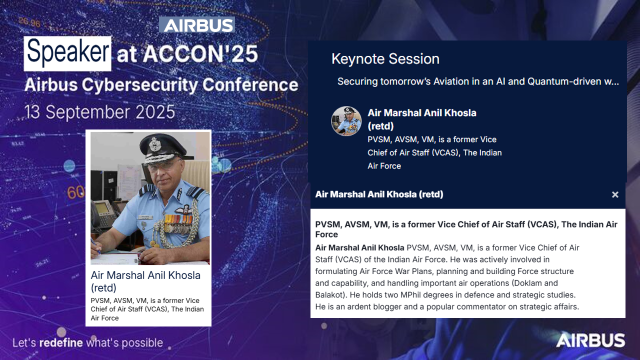
ACCON 2025 KEYNOTE ADDRESS
Shared my views on the subject.
The march of computing power from the mechanical Wright Flyer of 1903 to the AI-powered, quantum-enabled systems of today has revolutionised aviation by heightening efficiency, automation, and connectivity.
Artificial intelligence (AI) is well embedded in aircraft operations, while quantum computing (QC) is still experimental but set to change design and logistics.
But these developments bring with them profound safety and security threats, and need to be addressed with strong mitigation measures.
Development of Computing Power in Aircraft
Pre-Computing Period (1903–1950s): Mechanical and Analogue Systems
1903 (Wright Flyer). No computing; manual operation through mechanical linkages and simple analogue instruments (e.g., compass, altimeter). Pilots relied on visual indicators.
1930s–1940s. Early commercial aircraft (e.g., Douglas DC-3) employed analogue instruments and ground radio beacons for navigation, with no computational processing.
Late 1940s. Analogue computers, such as gyroscopic autopilots in fighter aircraft, employed vacuum tubes for simple stabilisation.
Early Digital Computing (1950s–1970s): Analogue to Digital Shift
1950s. Analogue computers had stabilised but were heavy and restrictive.
1960s. Transistors allowed for digital avionics in military aircraft (e.g., F-4 Phantom) for simple navigation and radar. Commercial aircraft (e.g., Boeing 707) were still analogue-dominated.
Late 1960s–1970s. Integrated circuits (ICs), which borrowed from the Apollo Guidance Computer, featured limited digital processing on aircraft such as the Concorde (1969) with analogue fly-by-wire.
Digital Revolution (1980s–1990s): Fly-by-Wire and Glass Cockpits
1980s. Microprocessors created digital fly-by-wire (FBW) for the Airbus A320 (1987), utilising redundant processors (e.g., Intel 8086) to eliminate mechanical controls.
Glass Cockpits. Aircraft such as the Boeing 767 (1982) combined flight, navigation, and engine information on CRT screens.
Flight Management Systems (FMS). In the 1980s (e.g., Honeywell FMS), these utilised 16-bit processors to automate fuel management and navigation, lessening pilot workload.
Advanced Computing (1990s–2010s): Integration and Automation
1990s. PowerPC processors and GPS navigation in aircraft such as the Boeing 777 (1995) improved autopilot, diagnostics, and navigation.
Integrated Modular Avionics (IMA). The Airbus A380 (2005) integrated functions into centralised processors, enhancing efficiency.
Safety Systems. TCAS and EGPWS employed 32-bit processors (about hundreds of MIPS) for real-time collision avoidance and terrain clearance.
Current Period (2010s–2025): High-Performance Computing and AI
2010s. Multi-core processors (e.g., Intel/ARM) in planes like the Boeing 787 and Airbus A350 provided real-time weather analysis, predictive maintenance, and flight optimisation.
ADS-B (2020). Mandatory GPS-based position broadcasting necessitated high processing for traffic management.
Integration with AI. In 2025, AI systems (e.g., DARPA’s ALIAS, Boeing’s Loyal Wingman) will digest terabytes of sensor data for predictive maintenance, anomaly detection, and semi-autonomous flight.
Connectivity. High-bandwidth onboard servers are used to handle operational and passenger data.
Future Trends (2025 and beyond)
Quantum Computing. Research looks into QC for air traffic control and aerodynamics, with potential by the 2030s.
Sustainable Systems. Electric/hybrid aeroplanes (e.g., Airbus E-Fan X) use advanced battery management with real-time computing.
Autonomous Flight. AI-based systems with GPU/TPU accelerators handle petabytes of information for complete autonomous flight.
Influences of AI and Quantum Computing on Civil Aviation
Artificial Intelligence (AI)
Predictive maintenance. AI enables the evaluation of sensor data to predict failures, which increases reliability and reduces expenses.
Flight optimisation. AI improves fuel consumption by 10% and emissions by optimising routes and managing outages.
Autonomous Flight and Pilot Support. AI autopilot and co-pilot technologies take care of standard functions and optimise emergency responses, decreasing pilot workload.
Airport Performance. AI optimises check-in, baggage handling, and air traffic control, enhancing passenger journeys.
Design Innovation. Generative AI shortens aerodynamic and material design cycles.
Market Expansion. The AI aviation market is expected to expand at a 22.6% CAGR by 2030.
Quantum Computing (QC)
Advanced Simulations. QC optimises computational fluid dynamics (CFD) and structural analysis for light, efficient airframes.
Operational Optimisation. QC optimises difficult logistics issues (e.g., routing, cargo loading), potentially saving billions.
Sustainable Aviation. QC simulates new materials and fuels for hybrid/electric propulsion.
Future Potential. NASA and Boeing studies suggest QC advantages by the 2030s, in spite of existing error-rate limitations.
Effects of Computing Progression
Efficiency. FMS and route optimisation save billions in fuel costs each year.
Automation. Automated takeoffs, landings, and cruise allow for a single pilot, or sometimes autonomous flight, particularly in the case of military aviation.
Maintenance. Predictive maintenance, which relies on AI for the analysis of data, helps to reduce costs and delays.
Connectivity. Global data routed in near real-time enhances operations and passenger services.
Safety. With redundancy and real-time analysis (for example, TCAS, EGPWS), the accident rate has decreased more than 80% since the late 1970s.
Key Air Force AI Applications
Autonomous Combat Drones and Loyal Wingmen: AI-controlled UAVs, such as the U.S. Skyborg, Russia’s Okhotnik-B, and India’s CATS Warrior, conduct autonomous targeting, reconnaissance, and electronic warfare. Loyal wingmen (e.g., Boeing’s MQ-28 Ghost Bat) assist manned aircraft, minimising dangers to pilots.
AI-Assisted Air Combat. AI systems, as indicated in DARPA’s AlphaDogfight Trials, outcompete human pilots in dogfights through quick decision-making and optimal tactics.
AI Co-Pilot Systems. AI helps pilots with instant threat analysis, flight route optimisation, and weapons control, as in the U.S. Air Force’s ACE program.
Predictive Maintenance and Logistics. Artificial intelligence systems like CBM+ allow for the prediction of equipment failure, which reduces downtime and optimises allocation of resources, leading to improved fleet readiness and lower costs.
Air Defence Systems. AI allows for improved target detection and target engagement in air defence systems like Israel’s Iron Dome and Russia’s S-500 systems, allowing for a faster response to threats that are detected.
Electronic Warfare (EW). AI jams hostile radar independently, learns about threats, and defends assets against cyber and electromagnetic attacks.
Mission Planning. AI processes battlefield information to produce optimal plans, dynamically realigns plans, and incorporates multi-source intelligence for data-driven decision-making.
Swarm Warfare. Swarms of drones controlled by AI overwhelm defences, perform ISR, and jamming, with nations such as the U.S., China, and India developing this capability.
Benefits.
Better Decision Making. AI manages sizeable amounts of data for real-time intelligence and speed of reaction.
Reduction in Pilot Workload. Automators allow pilots to engage in tactically focused functions versus technically focused functions.
Improvement in Combat Effect. AI and drones enhance targeting.
Reduction in Collateral Damage. UAVs fly missions with high risk, ultimately reducing civilian casualties.
Creating levels of logistics. Predictive maintenance continues to reduce both operational downtime and costs.
Challenges & Ethical Issues
Autonomy versus Control. Fully autonomous systems raise a question of who is responsible.
Cybersecurity and Operational Risk. AI systems can be hacked and/or manipulated.
Bias and Mistakes. Incorrect target identification may result in unwanted collateral civilian casualties.
International Arms Race. The Race for sophisticated AI weapons systems potentially destabilises international security.
Prospects in the Future
Greater Autonomy. UCAVs will function independently in high-risk operations.
Hypersonic Weapons. AI will improve missile accuracy and velocity.
Quantum Integration. Artificial intelligence and quantum computing will transform data processing used in predictive analytics and threat detection.
Counter-AI Warfare. Armed forces will devise methods for nullifying adversary AI capabilities.
Ethical Regulation. Strong guidelines must be put in place to deal with ethical and strategic issues.
Security and Safety Risks to Aviation
Security Risks
Data Poisoning and Adversarial Attacks: AI inputs can maliciously be manipulated and affect flight controls, navigation, or airport functionality.
System Vulnerabilities. Ageing infrastructure can be susceptible to AI-based cyberattacks (e.g., ADS-B hijacking) and needs strong firewalls and intrusion detection.
Generative AI Threats. AI might be used to create deceptive data or evade security.
Encryption Threats. QC algorithms (e.g., Shor’s) might compromise public-key cryptography (RSA, ECC), endangering data breaches or spoofed signals in avionics and communications.
Harvest Now, Decrypt Later. Threats may carry encrypted flight data for later decryption, compromising flight plans and military communications.
Complex Attack Surfaces. Multiple layers of interconnected networks and avionics increase threats that are capable of quantum attacks.
Safety Risks
Algorithmic Errors. AI bias or misinterpretation can lead to incorrect commands for autopilot or navigation decisions, resulting in accidents.
Over-Reliance. AI reliance may negatively impact pilot proficiency; however, in-flight analysis can strengthen safety.
Transparency. Black box AI channels pilot interpretation and overt truth.
Semi-Autonomous Systems. The likelihood of a failure of autonomous operations in rare cases is significant.
Simulation Errors. QC’s current error rates could lead to defective designs exposed via QC, and lead to unsafe airframes.
Cyber-Driven Safety Critical Hazards. Quantum cyberattacks may disrupt avionics and navigation, leading to failures and unsafe operations.
Navigation Upgrades. Quantum sensors could provide fixes for navigation, but have not been adopted universally.
Mitigation Strategies
Post-Quantum Cryptography (PQC). Shift to quantum-resistant algorithms (e.g., lattice-based cryptography) to protect avionics, communications, and air traffic control. NIST is developing PQC standards.
Quantum Key Distribution (QKD). Use QKD for unbreakable encryption in high-priority systems such as ADS-B.
Resilient AI Governance. Build explainable AI (XAI) frameworks, ongoing validation, and adversarial testing to make it transparent and minimise errors.
Redundant Systems. Keep classical backups to counteract AI or QC failures.
Regulatory Harmonisation. Enhance global aviation standards for AI and QC certification with a priority on safety, interoperability, and training of the workforce.
Security by Design. Implement quantum-resistant architectures, identity-first safeguarding (e.g., biometrics, zero trust), and layered cyber defence in avionics and communications.
Automated with Human in the Loop. Implement AI-enabled automation (such as SOAR) to enhance response time while leveraging a human in the process in order to limit escalation.
Cloud Resilience. We need to balance our distributed cloud configurations and our sovereignty needs, imparting trust with these secure and reliable practices.
Conclusions
The computing capacity of mechanical devices in 1903 transitioned to AI-driven quantum systems by 2025. This change has transformed and continues to transform airline operations, enabling unprecedented levels of safety, efficiency, automation, and connectivity. AI is playing an ever-expanding role by improving The Boeing Root Cause Analysis for Maintenance, efficiencies in flight planning, and improving passenger experiences, with a projected 22.6 % CAGR growth to 2030. Quantum computing is yet largely experimental, but it is expected to have significant impacts on the way we design and logistics in the 2030s. We must study our speed of evolution against the risk and governance required with these technologies. AI has vulnerabilities either as a function of adversarial attacks or software imperfections, while quantum computing has the potential to break our encryption and create weaknesses in avionics and data integrity. There are safety risks we need to contend with, including failures in algorithms and problems in design from quantum technologies. The risk controls in the aviation environment require support for the cybersecurity principles established within ACCON’25, also known as the National Aerospace Cybersecurity Strategic Plan. These controls include Post-Quantum Cryptography (PQC), Quantum Key Distribution (QKD), Explainable AI (XAI), Redundant systems, Security-by.
Please Add Value to the write-up with your views on the subject.
For regular updates, please register your email here:-
References and credits
To all the online sites and channels.
Pics Courtesy: Internet
Disclaimer:
Information and data included in the blog are for educational & non-commercial purposes only and have been carefully adapted, excerpted, or edited from reliable and accurate sources. All copyrighted material belongs to respective owners and is provided only for wider dissemination.
References:-
- Sawyer, D. R. “Autonomous Weapons and Military Ethics”, Journal of Military Ethics, 14(1), 51-65, 2015.
- “History of Flight: Avionics, Passenger Support, and Safety”, Britannica, Published August 1, 2025.
- “Examining over 100 years of flight automation and the history of the autopilot”, AeroTime, published April 4, 2025.
- “Artificial Intelligence (AI) in Aviation Market: Forecast 2030”, Knowledge Sourcing Intelligence.
5.”Quantum Computing Applications for Flight Trajectory Optimisation.” arXiv, Published April 27, 2023.
- “Airbus’ quantum computing challenge may fundamentally change aircraft development.” SAE International, Published January 23, 2019.
- “Autonomous Drones Will Not Replace Fighter Pilots, They Will Be Their Wingmen”, Belfer Centre, Published June 1, 2025.
- “Addressing the Dual Challenge of AI and Quantum Computing”, arXiv, Published March 19, 2025.
- “Cyber Security Implications of Quantum Computing: Shor’s Algorithm and Beyond”, Figshare, Published February 1, 2025.
- “Quantum Computing Threat to Cryptography.” Just Security, Published May 28, 2025.
- “Adversarial Data Poisoning Attacks on Quantum Machine Learning Systems”, arXiv, Published November 21, 2024.
- “Article on Post Quantum Cryptography Impact on the Aviation Industry”, Published March 13, 2025.
- “Quantum-Resilient AI Security: Defending National Critical Infrastructure in a Post-Quantum Era” Cyber Defence Magazine, Published July 2, 2025.
- “AI in Aviation Cybersecurity: Maximising Opportunities and Mitigating Risks Through Collaborative Risk Analysis”, Cyber Senate, Published October 11, 2024.
- “Navigating AI in Aviation: A Roadmap for Risk and Security Management Professionals,” ISACA, Published December 23, 2024.
- “The Growing Impact Of AI And Quantum On Cybersecurity”, Forbes, Published July 31, 2025.