
181: Knowing China Better:  Chinese Social Score System


China’s social credit system isn’t a world first but  it is unique.
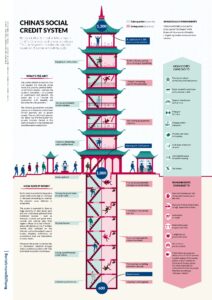
Pic courtesy:https://www.bertelsmann-stiftung.de/fileadmin/files/aam/Asia-Book_A_03_China_Social_Credit_System.pdf

The Social Credit System is part of Xi Jinping’s vision for data-driven governance. 


The goal of the China social credit system is to provide a holistic assessment of an individual or a company’s trustworthiness.


The China social credit system, is an extension of existing social rankings and ratings in China which have existed for millennia.


The Social Score is a system that collects all kinds of data about citizens and companies, sorts, analyses, evaluates, interprets and implements actions based on it.


In concrete terms, this means that if you wait at a red light, you get plus points. If you pay your taxes and bills on time, you get plus points. If you are socially involved and accept the rules, you also get plus points.


If you have a good Social Score, you get unsolicited benefits for your social behaviour. These include, for example, faster visa application processing and more freedom to travel. When dating online, algorithms higher prioritize the own profile. Banks offer lower interest rates for company loans or private real estate purchases. People with a high Social Score are promoted faster and get better job offers.


However, people who go red, cut off someone while driving, spit on the street or stick their chewing gum under their seat get minus points.


Anyone who criticizes the state in social media or pays their bills too late also receives minus points.


The consequences of a poor social credit score could be serious. It may affect travel prospects, employment, access to finance, and the ability to enter into contracts. On the other hand, a positive credit score could make a range of business transactions for individuals and corporations much easier.


It is essential that any foreign business consolidating or establishing their presence in China seek professional advice for managing a social credit score. This applies both to individual scores, and the corporate social credit score. 


Machine (AI) based Implementation

Every country has laws, cultural norms, social morals and social agreements. The police, courts, politicians, administrations, media and citizens are involved in a constant dialogue; it determines what we define as right or wrong.


In China, this task has partly been taken over by Artificial Intelligence based machine i.e. controlling and managing the society – with machines instead of people. The machine decides on correct and incorrect behaviour.


Inputs are obtained from:

  • Financial Data
  • Digital Data (Internet websites, apps, videos and pictures visited/browsed)
  • Mobile Data (Calls and messages)
  • Health Data


The data is used to make individual profiles (Behaviour, movement and content).


Based on the profile credit scores are allotted and reviewed.


Based on the credit score the privileges are granted or curbed.


Ethical Issues

This system raises a lot of ethical questions related to freedom and privacy.


  • Who monitors the score, who imports the data and who configures the system?


  • How ethical and moral aspects (if any) are integrated?


  • Who monitors the system to prevent manipulation, and abuse of power?


  • What data is collected? Who has access to it?


  • How is the privacy of citizens and companies ensured?


  • Are only Chinese citizens monitored or all people on Chinese territory?


  • Does the government also collect data on Chinese people abroad?


End piece

Collecting data and setting up administrative systems to ensure protection, freedom and security for all concerned is a legitimate tool for states. However, as surveillance increases, privacy must be respected as long as the welfare of society is not affected.


Titbits

In China everyone’s movements are monitored continuously. In the AI based monitoring system besides face recognition, even gait recognition has been introduced to make it more fool proof.


Question

Do you approve of such a system?


Suggestions and value additions are most welcome


For regular updates, please register here

Subscribe

References

 https://www.wired.co.uk/article/china-social-credit-system-explained

 https://merics.org/en/report/chinas-social-credit-system-2021-fragmentation-towards-integration

 https://nhglobalpartners.com/china-social-credit-system-explained/

 https://www.bertelsmann-stiftung.de/fileadmin/files/aam/Asia-Book_A_03_China_Social_Credit_System.pdf

179: Knowing China Better: sha zhu bang (Kill Pigs List)


People fear fame like pigs fear growing fat.

– Chinese saying


Most countries have a list of the wealthiest people and it is considered as an honour to feature on the list.

In China, these lists have a colloquial name: sha zhu bang: “kill pigs list.”

In the last fifteen years, China has produced greater overall wealth than any other country. The number of its billionaires has gone from a mere 15 to around 250 in just six years.

But for a number of these people this elevated status is short-lived. Majority of those on the list end up in the court or the jail. Some even get executed.


Regulatory Realignment

Over the last year, China has seen a struggle between state regulators and entrepreneurs as the government tries to bring technology companies increasingly in line with the strategic goals of the Chinese Communist Party.

China’s regulators need to discipline their country’s tech companies goes beyond normal concerns to a broader sense, that the companies’ interests aren’t sufficiently lined up with the Chinese Communist Party’s industrial policy or its goal of achieving technological self-sufficiency.

The campaign has continued apace in 2021 with an intensifying series of antitrust crackdowns and data security probes into the major tech firms (by fining for anti-monopoly violations, penalising for price dumping, and app dumping from app stores etc.)


XI’s Directives

  • Xi has made it clear what he expects from tech executives. A 2017 directive called for measures to “strengthen the sense of loyalty” among entrepreneurs and to strengthen the authority of the party leadership over them.
  • In July 2020, Xi told entrepreneurs that they should emulate “patriotic entrepreneurs” from Chinese history.
  • Another set of directives released in September 2020 said that “ideological guidance” should be strengthened to “create a core group of private sector leaders who can be relied upon during critical times.”
  • Most recently, Xi presided over a meeting of the Communist Party’s Central Committee for Financial and Economic Affairs at which officials outlined plans to adjust excessive income and “encourage high-income groups and enterprises to give back to society more.”


Voices of dissent

 Alibaba founder Jack Ma gave a speech last October harshly criticizing China’s regulatory system. His speech was like a punch on the face.”

Ma told the assembled members of China’s financial, regulatory, and political establishment that the regulatory system was stifling innovation and needed to be reformed to fuel growth.


“Chinese banks, operate with a pawnshop mentality”

“To innovate without risks is to kill innovation,”

“There’s no innovation without risks in the world.”

– Jack Ma


In giving the speech, Ma took a big risk for himself. His words were a clear signal to regulators that tech companies would fiercely resist any imposition of red tape on them, no matter how reasonable.

The speech reportedly infuriated the leadership in Beijing and prompted Xi to take drastic actions.


Towing the line: Pre-emptive Philanthropy

The tech executives have seen the writing on the wall. Now some of China’s richest entrepreneurs have embraced philanthropy in a bid to stave off unwelcome government attention.

One day after Xi emphasized the virtue of philanthropy, tech conglomerates and China’s rich are pledging billions of yuan towards common prosperity, social, environmental, education and science initiatives.

The sudden outburst of philanthropic activity is part of an effort to court public opinion and polish their reputations before they find themselves in deep trouble.

Some chief executives have even decided to move completely out of the limelight by stepping down from their positions at the top of their companies.


Is it Weeding out Corruption?

Arrests and prosecutions like these make one believe that China has begun to take corruption more seriously. However, arbitrary and selective targeting points otherwise.

China’s legal culture thrives on the principle of ‘killing the chicken to scare the monkeys.’ If the Chinese authorities want they can probably find grounds for accusing any one of them for bending or breaking the rules.


Is it to Crush the Perceived Potential Competition?

China’s billionaires and tech giants are seen as potential rival centers of power and influence in the country.

The party and the party president feels if not put in place, they can emerge as alternative powers.

Your views and value additions are most welcome

For regular updates, please register here

Subscribe

References

https://www.theatlantic.com/international/archive/2013/01/why-do-chinese-billionaires-keep-ending-up-in-prison/272633/

https://warontherocks.com/2021/08/china-takes-on-its-tech-leaders


177: Technology: Future Trajectory of Artificial Intelligence


AI is going to change the world more than anything in the history of mankind.

– Kai-Fu Lee


 Artificial Intelligence (AI) has permeated into all aspects of our lives. AI tools are everywhere we look. AI is  delivering tangible benefits across every  industry one can think about.


  • Transportation: Although it could take a decade or more to perfect them, autonomous cars will one day ferry us from place to place.


  • Manufacturing: AI powered robots work alongside humans to perform a limited range of tasks like assembly and stacking, and predictive analysis sensors keep equipment running smoothly.


  • Healthcare: In the comparatively AI-nascent field of healthcare, diseases are more quickly and accurately diagnosed, drug discovery is sped up and streamlined, virtual nursing assistants monitor patients and big data analysis helps to create a more personalized patient experience.


  • Education: Textbooks are digitized with the help of AI, early-stage virtual tutors assist human instructors and facial analysis gauges the emotions of students to help determine who’s struggling or bored and better tailor the experience to their individual needs.


  • Media: Journalism is harnessing AI, too, and will continue to benefit from it. Bloomberg uses Cyborg technology to help make quick sense of complex financial reports. The Associated Press employs the natural language abilities of Automated Insights to produce 3,700 earning reports stories per year — nearly four times more than in the recent past.


  • Customer Service: Last but hardly least, Google is working on an AI assistant that can place human-like calls to make appointments at, say, your neighbourhood hair salon. In addition to words, the system understands context and nuance.


Future Trajectory

Most AI applications today are classified as “narrow” or “weak” AI, meaning that they usually carry out a specific task they are designed for.  

AI is only just getting started. Computers will get smarter, quicker, and increasingly become capable of tasks that traditionally are carried out by humans, such as making complex decisions or engaging in creative thought. Truly intelligent entities would not be designed for one specific task but would be able to carry out many number of tasks.

A Quantum Powered AI

 Computing power is the engine of AI.

Quantum computing, along with other next-level processing capabilities such as biological and neuromorphic computing, is likely to unlock even more possibilities.

Quantum computing is basically, ability of sub-atomic particles to exist in more than one state at the same time. It is theoretically capable of completing some calculations up to 100 trillion times faster than today’s fastest computers.

In order to continually evolve to become smarter, machine learning models will inevitably become larger.

 Additionally, more processing power means we will be able to create larger amounts of “synthetic” data for training purposes, reducing the need for collecting real data to feed into algorithms for many applications.

Other technologies like neuromorphic computing would be able to mimic the “elastic” capabilities of the human brain to adapt themselves to processing new forms of information.

Creative AI

 These days we can see art, music, poetry, and even computer code is being created by AI.

This has been made possible by the ongoing development of “generative” AI i.e. when Ai creates new data rather than simply analyzing and understanding existing data.

With generative AI, analyzing and understanding is the first step of the process. It then takes what it has learned and uses it to build further examples of the models that it has studied.

This ability to create synthetic data will lead us into an era where machines will be doing things we simply haven’t seen them do before.

Ethical and Accountable AI

 At the moment, much of the inner workings of today’s AI is not transparent due to proprietary algorithms or complexity involved.

This creates a trust deficit and reluctance to let machines make  decisions that affect people’s lives.

If AI is going to live up to its potential, then the smart machines of the near future will have to be more transparent, explainable, and accountable than the ones we’re familiar with now.

Legislative and regulatory changes are likely to be put in place in future.


Interesting

Intel recently unveiled its Loihi processing chip, packed with more than two billion transistors, which is one application that was able to identify ten different types of hazardous material by smell alone – more quickly and accurately than trained sniffer dogs.


Titbits

Adversial Model – AI vs AI

The most impressive results available today are usually obtained when this is done via an “adversarial” model – effectively, two AIs are pitted against each other, with one tasked with creating something based on existing data and the other tasked with finding flaws in the new creation. When these flaws are discovered, the creative network (known as the “generator”) learns from its mistakes and eventually becomes capable of creating data that its opponent (the “discriminator” network) finds increasingly hard to distinguish from the existing data.


Value additions are most welcome


For regular updates, please register here

Subscribe

References

https://builtin.com/artificial-intelligence/artificial-intelligence-future

https://futureoflife.org/background/benefits-risks-of-artificial-intelligence/

https://www2.deloitte.com/us/en/pages/consulting/articles/the-future-of-ai.html

English हिंदी