

Pic Courtesy: France 24
Emerging class of missile technologies include manoeuvrable vehicles that carry warheads through the atmosphere at more than five times the speed of sound. Hypersonic glide vehicles (HGVs), like all weapons delivered by medium and longer range rocket boosters, can travel at speeds of at least Mach 5, or about 1 mile per second. The key difference between missiles armed with HGVs and missiles armed with ballistic re-entry vehicles (i.e., those that travel on a ballistic trajectory throughout their flight) is not their speed, but their ability to manoeuvre and change course after they are released from their rocket boosters. Hypersonic weapons can be classified into two distinct categories:
- Hypersonic cruise missiles. These operate much like typical sub-sonic and supersonic cruise missiles (using air-breathing engines to power themselves through the atmosphere) but fly at higher speeds. They cannot match the speeds or ranges achievable by boost-glide vehicles.

Pic Courtesy: PTs IAS Academy
- Hypersonic boost-glide Vehicles. They are accelerated to extremely high velocities on rocket boosters similar to those used to launch ballistic missiles. They then proceed to glide, unpowered, through the upper atmosphere until reaching their target.
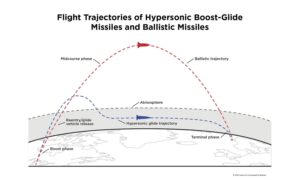
Pic Courtesy: Union of Concerned scientists
The flight of hypersonic boost-glide vehicle is divided into six stages: boost, ballistic, re-entry, pull-up, glide, and terminal phases. In the boost phase, a rocket booster accelerates the missile carrying the hypersonic vehicle until the booster exhausts its fuel, at which point it detaches from the glide vehicle and falls back to Earth. In the ballistic phase, the vehicle travels above the atmosphere on a ballistic trajectory under only the influence of gravity. Both of these phases are comparable to a ballistic missile launch. Hypersonic trajectories diverge from those of ballistic missiles in the re-entry and pull-up phases. Here, the vehicle pierces the upper atmosphere, then slows its descent to enter a stable glide trajectory. In the glide phase, the vehicle generates aerodynamic lift to sustain near-level flight. Finally, in the terminal phase, the glider dives toward its target.
These weapons outperform existing missiles in terms of delivery time and evasion of early warning systems. Their flight characteristics are distinct from those of typical ballistic missiles, which spend most of flight above the atmosphere and are capable of only limited manoeuvrability, and from those of subsonic or supersonic cruise missiles, which travel through the atmosphere but fly more slowly.