
818: REVISITING DOKLAM: FROM STANDOFF TO STRATEGIC CONTEST


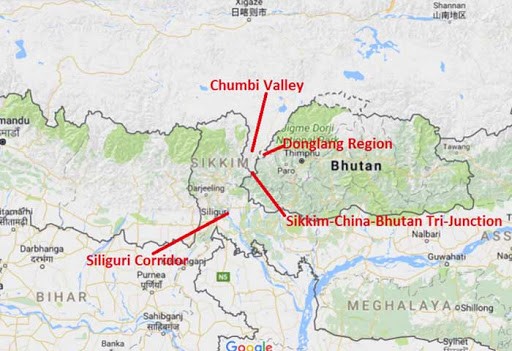
In 2017, India and China had the most dangerous bilateral confrontation since 1962 at the Doklam Plateau. Disengagement took place after a 73-day standoff. The face-off ended without a formal agreement or any resolution of the underlying territorial contest. Both sides claimed a measure of satisfaction. India had stopped the road. China had not been forced to concede anything publicly. Seven years later, the situation has taken an entirely different direction.  From a temporary military standoff, it has become a permanent grey-zone contest in which the instruments of Chinese pressure are increasingly civilian, infrastructural, and juridical rather than uniformed and kinetic. Understanding what has happened at Doklam since 2017, what China is now doing in the Amo Chu Valley, and what India must do in response is not an exercise in historical analysis. It is the most pressing operational and strategic question facing India’s eastern defence architecture in 2026.


Indian Redline. A specific act at a specific location triggered the 2017 standoff.  Chinese road construction at a point on the Doklam plateau where the road, if completed, would have given the People’s Liberation Army direct vehicular access to the Jampheri Ridge. That ridge is the dominant high ground overlooking the Siliguri Corridor. The corridor is a narrow strip of Indian territory, barely 22 kilometres wide at its narrowest, that constitutes the sole land link between the northeastern states and the Indian mainland. Control of the Jampheri Ridge does not merely threaten the Siliguri Corridor; it commands it. Artillery or missiles positioned there can interdict the Corridor without crossing into Indian territory.


Post 2017 Changes.

Alternate Road. What India stopped in 2017 was a road to a specific point via a specific route. What China has since done is build a different road to the same strategic destination. Satellite imagery analysed by multiple independent research organisations confirms that China has completed a road approximately 5 kilometres long through the Amo Chu Valley. The route has been redesigned to circumvent the specific location of India’s red line rather than to challenge it directly.  This road allows PLA forces and vehicles to approach the Jampheri Ridge area without crossing the precise point where Indian troops halted Chinese construction in 2017. The strategic objective of access to the high ground above the Siliguri Corridor remains unchanged. 

Demographic Alteration. The Amo Chu road is the kinetic component of a broader strategy, the most significant element of which is the construction of permanent settlements. China’s Xiaokang village programme has placed villages in strategically selected locations (previously uninhabited or seasonally used by Tibetan herders) across the Himalayan frontier. They have been created to establish a permanent Chinese presence. Continuous occupation supports territorial claims under international norms. These villages are not primarily civilian in purpose, irrespective of their formal designation. These settlements house border defence forces alongside civilian residents. They are connected by road infrastructure that provides the PLA with access and logistics. And they are designed to make any Indian military response to Chinese encroachment diplomatically and legally costly, because attacking or displacing a civilian settlement carries international consequences that interdicting a military road column does not. In the Doklam area, the village of Pangda, situated in the Amo Chu Valley, is the most significant of these.


Indian Options

The appropriate Indian response to the situation at Doklam is not a military operation. It is the construction of a comprehensive active deterrence architecture that operates across the same grey-zone spectrum that China is exploiting, while reinforcing the conventional deterrent that limits China’s escalatory options. This architecture has several components.

Military Bases to Hardening the Chicken’s Neck. The Siliguri Corridor’s strategic vulnerability is a serious problem. Still, it can be substantially mitigated through layered defensive depth. The completion of the Lachit Borphukan Military Station at Dhubri, combined with new military stations at Chopra and Kishanganj, would provide overlapping defensive coverage across the approaches to the Corridor from multiple directions simultaneously. These stations would create a defence-in-depth.  The stations would also provide forward basing for the UAV, electronic warfare, and air defence assets that active deterrence in this theatre requires.

Military Technology Utilisation. China’s principal tactical advantage in the Chumbi Valley is logistical.  The road network and infrastructure investment that gives the PLA the ability to position and sustain significant forces in terrain where India’s own logistics are comparatively constrained. The answer is making that logistics infrastructure a liability rather than an asset. The deployment of advanced surface-to-air missile systems (S-400), supplemented by the Rafale’s organic electronic warfare capability and the Su-30MKI’s air-to-air performance, would provide an asymmetric advantage.   The A2AD architecture is not merely about shooting down aircraft; it is about denying China the confident expectation of air superiority that any escalation to conventional conflict would require.

Demographic Counter. The most direct counter to China’s Xiaokang village strategy is India’s own Vibrant Villages Programme. Chinese villages in border areas serve military functions precisely because they are permanently inhabited. India’s border hamlets in Sikkim and Arunachal Pradesh, many of which have experienced significant depopulation as residents migrate to urban centres for economic opportunity, present the opposite picture. The Vibrant Villages Programme aims to reverse the trend. A Combination of 5G connectivity, all-weather roads, economic incentives, and livelihood support is designed to reverse this depopulation. Permanently inhabited Indian villages along the Sikkim and Arunachal borders would assert Indian sovereignty and serve as a HUMINT asset.  The pace of the programme’s implementation must be accelerated.

Tourism as Sovereignty. The relationship between civilian presence and territorial claim is well established in international practice, and India has underutilised the tourism instrument as a form of continuous sovereign assertion. Tourism is not merely an economic activity. Active promotion of border tourism (facilitated by improved road connectivity, accommodation infrastructure, and streamlined permit processes) would create a continuous civilian presence that directly challenges any claims of vacant territory. Tourism is also a form of territorial assertion that is simultaneously visible, documentable, and internationally legitimate.

Deepening the Bhutanese Engagement. The India-Bhutan relationship is crucial. In 2021, China proposed resolving the broader Bhutan boundary dispute through a “three-step roadmap”.  It was Beijing’s strategy of using Bhutan-China bilateral negotiations to achieve favourable outcomes while circumventing Indian involvement. India’s response must go beyond security assurances and treaty obligations. A Bhutan that is economically prosperous and strategically confident is a far more resilient partner in resisting Chinese pressure than a Bhutan that perceives its security relationship with India as its only alternative to accommodation with Beijing.

AI-Driven ISR to Counter Grey-Zone Activities.  The central operational weakness that grey-zone salami-slicing exploits is the gap between periodic observation and continuous surveillance. Patrolling schedules, satellite revisit intervals, and human intelligence collection cycles all create windows of unobserved time during which incremental changes can be made and completed before India’s intelligence system registers them. By the time the change is observed, it is a fact on the ground. Contesting it requires either the military action that grey-zone methodology is designed to deter or acceptance of the new reality. The answer lies in eliminating the observational gaps through AI-driven continuous monitoring. AI-assisted change-detection processing applied to the continuous imagery feed identifies variations in the physical landscape within hours of their occurrence, rather than days or weeks. This is the single most important capability investment India can make in this theatre.

Digital Border Ledger. China’s grey-zone methodology depends on narrative ambiguity.  The counter to narrative ambiguity is documented transparency. The answer lies in a publicly accessible Digital Border Ledger. A regularly updated database of satellite evidence showing Chinese construction activity, vegetation clearance, road extension, and settlement development along the LAC and the Bhutan-China boundary, with time-stamped imagery and geographic coordinates, would transform the information environment in which Chinese grey-zone operations proceed. A systematic publication of such documents would counter Beijing’s deniability.


Concluding Thoughts

The Doklam plateau is a strategic red line for India, as it overlooks the Siliguri Corridor. Chinese activities in the Chumbi Valley, such as the making of Amo Chu Road and the establishment of Pangda Village, are not isolated actions. They are part of a deliberate strategy to incrementally improve China’s position on the high ground. India’s answer must be equally patient, persistent, and multi-dimensional.

The prevention that worked at Doklam in 2017 was the product of decisions made years before the standoff. Forward basing decisions, ISR investments, force posturing, and treaty relationships that were in place when the crisis arrived. The deterrence required at Doklam in the years ahead must be built now, before the next crisis defines the terms of the contest.


Please Add Value to the write-up with your views on the subject.


1924
Default rating

Please give a thumbs up if you  like The Post?


For regular updates, please register your email here:-

Subscribe


References and credits

To all the online sites and channels.

Pics Courtesy: Internet

Disclaimer:

Information and data included in the blog are for educational & non-commercial purposes only and have been carefully adapted, excerpted, or edited from reliable and accurate sources. All copyrighted material belongs to the respective owners and is provided only for wider dissemination.

 

647: BANGLADESH: SHIFTING ALLIANCES, STRATEGIC PROJECTS, AND INDIA’S CONCERNS


My Article published on The EurasianTimes website on 14 Apr 25.


During his four-day visit to China from March 26 to 29, 2025, Muhammad Yunus, the Chief Adviser of Bangladesh’s interim government, made provocative statements against India. Speaking in Beijing, Yunus referred to India’s northeastern states, known as the “Seven Sisters,” as a “landlocked region” with “no way to reach the ocean.” He positioned Bangladesh as this region’s “only guardian of the ocean.” He suggested that this geographical situation presented a “huge possibility” for China to expand its economy through Bangladesh. He proposed that China could “build things, produce things, market things, bring things to China, and distribute them to the rest of the world,” effectively framing Bangladesh as a strategic gateway for Chinese economic influence.

These offensive remarks triggered strong reactions in India. They underscore the “persistent vulnerability narrative” associated with India’s strategic Siliguri Corridor, or “Chicken’s Neck,” a narrow strip connecting the Northeast to the rest of the country. These statements reflect a deeper strategic consideration and longstanding agenda. Yunus’s pitch came during a time of strained India- Bangladesh relations, following the ouster of Sheikh Hasina’s government in August 2024 and his decision to prioritise China over India for his first state visit. His comments were seen as an attempt to leverage Bangladesh’s geographic position to attract Chinese investment. This shift in Dhaka’s alignment toward Beijing potentially complicates regional security dynamics, especially given the Northeast’s proximity to the sensitive Chicken’s Neck corridor. Prime Minister Narendra Modi later cautioned Yunus during a meeting on April 4, 2025, at the BIMSTEC Summit in Thailand, urging him to avoid rhetoric that “vitiates the environment” and emphasising the need for constructive bilateral ties.


Political Upheaval and Anti-India Sentiment. The fall of Sheikh Hasina’s Awami League government marked a turning point in Bangladesh’s domestic and foreign policy. Hasina’s administration had fostered strong ties with India, emphasising economic cooperation, security partnerships, and infrastructure development. However, her ouster, driven by student protests and political unrest, brought to power an interim government that has adopted a less conciliatory tone toward India. Anti-India utterances have gained traction under the new regime. Additionally, public and political discourse in Bangladesh has seen a rise in criticism of India, often centered on issues like water-sharing disputes and perceived interference in Bangladeshi politics. These sentiments are partly rooted in historical grievances and domestic pressures to assert sovereignty but have strained bilateral ties.


Cozying Up to China

Bangladesh’s deepening relationship with China is a significant development under the interim government. Beijing has long sought to expand its influence in South Asia, and Bangladesh’s strategic location makes it a key partner in China’s Belt and Road Initiative (BRI). The Yunus government has actively courted Chinese investment, signaling a shift from Hasina’s cautious balancing act between India and China.

China’s involvement in Bangladesh spans infrastructure, trade, and defence. In March 2025, Dhaka welcomed Chinese participation in multiple projects, including modernising Mongla Port and expanding the China Economic and Industrial Zone in Chattogram. Bilateral agreements signed during Yunus’s visit to Beijing included cooperation in the blue economy, maritime dialogue, and a potential Free Trade Agreement. These moves indicate Bangladesh’s intent to leverage China’s economic might to bolster its development agenda.

However, this pivot toward China has raised eyebrows in New Delhi. India views China’s growing presence in Bangladesh as part of a broader strategy to encircle it through the so-called “String of Pearls” – a network of strategic assets in the Indo-Pacific. The shift is particularly concerning given Bangladesh’s proximity to India’s northeastern region, which is connected to the mainland by the narrow Siliguri Corridor, colloquially known as the “Chicken’s Neck.” The potential threat of China’s growing presence in Bangladesh is a cause for concern in India.


The Teesta River Project: A Geopolitical Flashpoint

The Teesta River, which originates in Sikkim, flows through West Bengal and enters Bangladesh, has long been a point of contention between India and Bangladesh. The river is vital for irrigation and livelihoods in both countries, but disagreements over water sharing have persisted for decades. Bangladesh accuses India of restricting water flow through upstream barrages, particularly during the dry season, affecting millions in its northern districts like Rangpur, Lalmonirhat, and Kurigram.

The Teesta River Comprehensive Management and Restoration Project, estimated at $1 billion, has emerged as a new arena for Sino-Indian rivalry. Under Hasina, Bangladesh had leaned toward India for the project, with New Delhi expressing interest in funding it to counter China’s earlier proposal. However, the interim government has shifted course, inviting Chinese participation. In February 2025, Bangladesh’s Ministry of Environment announced plans to collaborate with China on a master plan for the river’s conservation, involving dredging, embankment construction, and township development. This decision was framed as a response to public demand, with hearings held to build consensus.

For India, Chinese involvement in the Teesta project is alarming. The river’s proximity to the Siliguri Corridor means that Chinese personnel or infrastructure near the border could provide Beijing with strategic leverage. India fears that data on water flow or the presence of Chinese engineers could be used to monitor or influence the region’s security dynamics. The project’s geopolitical implications underscore the delicate balance Bangladesh must strike between economic development and regional stability.


The Lalmonirhat Airfield Project: A Security Concern

Another development raising red flags in India is Bangladesh’s plan to revive the World War II-era airfield in Lalmonirhat, located just 10 kilometers from the Indian border. Reports suggest Dhaka has sought Chinese assistance to transform the abandoned site into a modern airbase, with discussions reportedly held during Yunus’s China visit. While Bangladesh frames the project as part of its military modernisation under the Forces Goal 2030 initiative, India is wary of its potential implications.

The location of the Lalmonirhat airfield, near the Siliguri Corridor, presents a sensitive issue. If developed with Chinese support, the airbase could serve as a dual-use facility, potentially hosting Chinese military assets disguised as civilian infrastructure. The mere prospect of Chinese involvement so close to India’s border is viewed as a provocative move, particularly in light of Bangladesh’s recent overtures to Pakistan, another rival of India.


The Chicken’s Neck: India’s Strategic Redline

The Siliguri Corridor, or Chicken’s Neck, is a narrow strip of land in West Bengal, approximately 20-60 kilometers wide, which connects India’s mainland to its northeastern states. Bordered by Nepal, Bhutan, Bangladesh, and China, it is one of India’s most strategically located regions. The corridor is a lifeline for trade, communication, and military logistics to the northeast. Any disruption in the Chicken’s Neck could isolate the northeast, a scenario India has long sought to prevent. The corridor’s importance has prompted New Delhi to bolster its defences, deploying advanced assets like Rafale fighter jets, BrahMos missiles, and the S-400 air defence system.

Bangladesh’s moves to involve China in projects near the corridor – particularly the Teesta River and Lalmonirhat airfield – are seen as direct challenges to India’s security. A Chinese presence in these areas could enable intelligence gathering, influence local dynamics, or even give Beijing a foothold to pressure India in a crisis. The corridor’s proximity to the Chinese-controlled Chumbi Valley, where tensions flared during the 2017 Doklam standoff, further heightens India’s concerns.


Improving Connectivity: Kaladan Project

The Kaladan Multi-Modal Transit Transport Project is a significant infrastructure initiative to enhance connectivity between India and Myanmar, foster economic growth, and strengthen bilateral ties. Launched in 2008 under India’s Act East Policy, the project seeks to connect Kolkata’s seaport with Sittwe in Myanmar’s Rakhine State by sea, then link Sittwe to Paletwa through the Kaladan River, and finally extend from Paletwa to Zorinpui on the India-Myanmar border in Mizoram by road. Spanning approximately 539 km by sea, 158 km by river, and 110 km by road, it offers an alternative route to India’s northeastern states, bypassing the narrow Siliguri Corridor and reducing travel distance by about 1,328 km.

Fully funded by India at an estimated cost of $484 million, the project faced numerous challenges, including delays due to political instability in Myanmar, the Rohingya crisis, conflicts involving the Arakan Army, and logistical issues like monsoons and rugged terrain. While the Sittwe port and Paletwa jetty were completed by 2017, with dredging finalised, the road from Paletwa to Zorinpui remains under construction. Recent control of Paletwa by the Arakan Army has raised concerns about the project’s viability, though assurances of cooperation have been made.

The project promises substantial economic benefits, boosting trade and development in India’s landlocked Northeast by providing sea access to Southeast Asian markets. Strategically, it enhances India’s regional influence, countering China’s presence. However, ongoing conflicts and coordination issues underscore the need for diplomatic engagement with local stakeholders to ensure timely completion, making the Kaladan Project a critical yet complex endeavour for regional connectivity and economic integration.


Indian Concerns and Regional Implications

India’s concerns about Bangladesh’s recent trajectory are multifaceted. First, the rise in anti-India rhetoric threatens to erode the goodwill built over decades of cooperation. Projects like the Akhaura-Agartala rail link and India’s $8 billion in credit lines for Bangladeshi infrastructure underscore the depth of bilateral ties, but these are now at risk due to political uncertainty.

China’s growing footprint in Bangladesh challenges India’s influence in its immediate neighbourhood. New Delhi fears that Bangladesh could become a key node in China’s regional strategy, undermining India’s role as a counterweight in the Indo-Pacific. With planned visits by its foreign minister and secretary in April 2025, Pakistan’s involvement adds another layer of complexity as Islamabad seeks to capitalise on Dhaka’s shift.

Further, the strategic projects near the Siliguri Corridor raise immediate security concerns. India has responded by enhancing its military posture but recognises the need for diplomatic engagement. The meeting between Yunus and Prime Minister Narendra Modi on the sidelines of the BIMSTEC Summit in April 2025 was described as “constructive,” with discussions on water sharing, border issues, and minority rights. However, tangible progress remains elusive.


Indian Retribution.

Since 08 April, India has terminated a transhipment facility that allowed Bangladesh to route export goods through Indian ports, airports, and land customs stations to third countries. Established in 2020, the arrangement had facilitated cost-effective and efficient trade, particularly for Bangladesh’s garment industry, which relied on Indian infrastructure to reach markets in Europe and the Gulf.

India cited logistical challenges, including port and airport congestion, as the primary reason for the withdrawal. Indian exporters, especially in apparel, had long complained that the facility strained capacity, inflating costs and delaying shipments. However, the timing suggests a strategic response to Bangladesh’s growing alignment with China, raising regional security and influence concerns. Exceptions were made for exports to Nepal and Bhutan, aligning with World Trade Organization obligations for landlocked nations. The move disrupts Bangladesh’s trade logistics, forcing reliance on longer, costlier routes through its ports like Chittagong.


Conclusion

Bangladesh’s recent developments reflect a complex interplay of domestic priorities and geopolitical ambitions. The interim government’s outreach to China and anti-India rhetoric have set off alarm bells in New Delhi, particularly regarding the Teesta River and Lalmonirhat airfield projects. The Chicken’s Neck remains a critical concern, with India taking no chances to secure its lifeline to the northeast. As Bangladesh navigates its path, it must balance economic imperatives with regional stability, while India grapples with the challenge of maintaining influence in a rapidly changing neighbourhood. The coming months will test the resilience of India-Bangladesh relations and the broader dynamics of South Asian geopolitics.


Please Add Value to the write-up with your views on the subject.


1924
Default rating

Please give a thumbs up if you  like The Post?


For regular updates, please register your email here:-

Subscribe

Link to the article on the website:-

Bangladesh Tries Creating Thorns In India’s Achilles Heal, A Region Defended By Rafale, BrahMos, S-400


References and credits

To all the online sites and channels.

Pics Courtesy: Internet

Disclaimer:

Information and data included in the blog are for educational & non-commercial purposes only and have been carefully adapted, excerpted, or edited from reliable and accurate sources. All copyrighted material belongs to respective owners and is provided only for wider dissemination.


References: –

  1. The Economic Times, April 6, 2025: “Chinese airfield plan in Bangladesh district close to Chicken’s Neck area raises Indian concerns.”
  1. The Diplomat, May 22, 2024: “Teesta River Project Pushes Bangladesh into China-India Cold War.”
  1. The Hindu, March 28, 2025: “Bangladesh welcomes China to participate in Teesta project.”
  1. Business Today, April 8, 2025: “India Alarmed as Bangladesh Plans Strategic Base near Chicken’s Neck with China’s Help.”
  1. Indian Defence Research Wing, April 8, 2025: “Bangladesh Seeks China’s Assistance for Lalmonirhat Airbase: A Strategic Concern for India.”
  1. Pant, Harsh V., & Sahu, Premesha. “China’s Strategic Entrenchment in Bangladesh: Implications for India.” ORF Issue Brief, 2021.
  1. “Bangladesh’s Foreign Policy Balancing Act: Navigating India-China Rivalry.” ISAS Insights, 2022.
  1. Ganguly, Sumit. “India’s Neighborhood First Policy: Rhetoric or Reality?” Carnegie India, 2021.
  1. “Bangladesh’s Mega Projects and the BRI Footprint: Analyzing the Economic and Strategic Layers.” SAM Analysis, 2023.
  1. “China’s Belt and Road Initiative in South Asia: Strategic Implications for India.” CSIS Briefs, 2021.
English हिंदी