
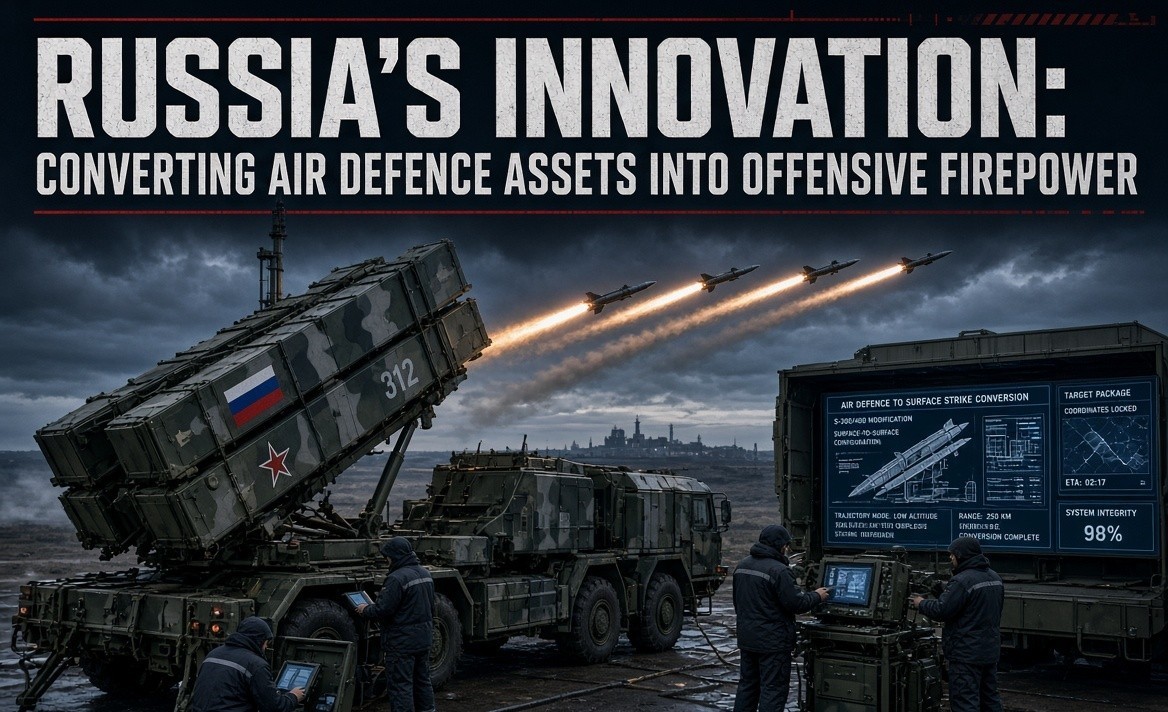
Russia is increasingly finding new ways to expand its ballistic-missile arsenal without relying entirely on purpose-built systems such as the Iskander-M. According to Ukraine’s Defence Intelligence Directorate (DIU), Russia has modified up to 17 S-400 launchers to fire RM-48U missiles against ground targets.
The modified launchers have reportedly been organised into five specialised missile groups deployed in Russia’s Bryansk and Rostov regions. Their emergence highlights a broader Russian effort to turn existing air-defence hardware and missile stocks into additional offensive capabilities.
At first glance, 17 launchers may seem relatively small. But their significance lies less in the number than in what they represent: Russia is creating another layer of ballistic strike capacity by repurposing weapons and equipment originally intended for air defence.
From Interceptor to Strike Missile
The RM-48U is essentially a ground-attack adaptation of missiles from the 48N6 family associated with the S-300 and S-400 air-defence systems. Instead of intercepting aircraft or other aerial targets, these missiles can now hit ground targets.
The conversion gives Russia a way to extract additional military value from an existing inventory. Older air-defence missiles that might otherwise remain in storage, require expensive maintenance or reach the end of their service life can potentially be refurbished and adapted for a different role.
The concept itself is not entirely new. Russia has previously used S-300 and S-400 air-defence missiles in ground-attack roles. What matters about the RM-48U development is the apparent effort to institutionalise that conversion rather than rely on improvised battlefield use. Ukrainian officials have confirmed the existence of specially modified S-400 launchers intended for these missiles.
Ukrainian intelligence assesses that the RM-48U is substantially cheaper than the purpose-built 9M723 ballistic missiles used by the Iskander-M system. Russia is also reported to hold a stockpile of roughly 400 RM-48U missiles.
A Cost-Effective Advantage
The most obvious advantage is cost, which makes the RM-48U attractive for sustained missile campaigns. Ukraine’s Defence Intelligence says Russia is using RM-48U missiles partly because they are significantly cheaper than the 9M723 ballistic missiles employed by the Iskander-M system. Ukrainian intelligence estimates Russia held around 400 RM-48Us in mid-2026, while production reportedly continued at roughly 50 missiles per month, with more than 480 planned for production during 2026.
A country conducting large-scale strikes does not need to attack every target with its most expensive or scarce missile. Purpose-built ballistic missiles such as the Iskander’s 9M723 are valuable assets, and using them against every target would place greater pressure on Russia’s stockpile and production capacity.
The RM-48U provides another option. Russia can therefore use a mixed arsenal: more capable or expensive missiles for some targets while employing converted air-defence missiles for others. The result is a larger pool of weapons that can contribute to a ballistic strike campaign.
Seventeen Launchers
The figure of 17 does not mean that the number of missiles is limited to 17. A launcher can fire, reload, and fire again. The real limitations are more likely to be missile availability, reload procedures, logistics, supply chain, and operational tempo rather than the headline figure of 17 launchers.
Russia reportedly possesses around 400 RM-48U missiles, making the size and replenishment of the missile stockpile more important for understanding the programme’s potential scale than the number of launchers.
If production and employment rates continue to rise, the missile stockpile becomes the key factor. Russia is simultaneously working to replenish that stockpile, meaning the conversion programme is not necessarily limited to older missiles already sitting in warehouses.
The modified launchers have reportedly been grouped into five specialised missile units positioned in Bryansk and Rostov oblasts, locations that provide practical reach toward Ukrainian territory.
Scalability with Existing Ecosystem
Another advantage is the existing launcher architecture. Russia already operates the S-400 system at scale. Its military-industrial sector can manufacture new launchers and modernise existing equipment. Ukrainian intelligence has identified Almaz-Antey and MKB Fakel among the principal companies associated with the S-400 system. In contrast, the Avangard Moscow Machine-Building Plant and AviaTek in Vyatka are identified as manufacturers of RM-48U missiles.
This means Moscow does not have to create an entirely new missile-launching ecosystem. The basic architecture already exists: launch vehicles, transport and handling equipment, personnel, logistics and command structures associated with the S-400 family. Modifying selected launchers to support the ground-attack mission can therefore be considerably more straightforward than developing a completely new operational missile system.
This is an important feature of Russia’s wartime adaptation. Rather than treating its enormous legacy inventory as obsolete, Moscow is looking for ways to turn existing stocks into new capabilities.
Augmentation of Missile Capability and Capacity
The RM-48U should not be viewed as a replacement for the Iskander-M. Russia still prioritises production of 9M723 missiles for Iskander-M, and Ukrainian Defence Intelligence has reported that Russia can produce more than 200 cruise and ballistic missiles of various types per month. Its estimates put monthly 9M723 production at around 60 missiles, with July production reportedly reaching 65.
The more logical interpretation is that Russia is attempting to expand the depth of its ballistic arsenal. A military does not necessarily need one weapon system to perform every task. It can be more effective to create several overlapping categories of missiles, each with different costs, capabilities and levels of availability.
The RM-48U fits neatly into that strategy. Instead of allowing older 48N6-family missiles to remain stranded in storage, Russia can convert them into offensive weapons. Instead of consuming an Iskander missile for every ballistic-strike requirement, Russian forces can draw on a second pool of missiles. And instead of developing an entirely new launcher, they can modify part of an existing S-400 infrastructure. The result is additional capacity without requiring every element of the system to be newly developed.
A Broader Look at the Russian Adaptation
The conversion of S-400 launchers illustrates a broader feature of Russia’s war effort: the attempt to squeeze additional combat value from existing inventories while expanding new production. The strategic importance of the RM-48U programme is therefore not simply that Russia has 17 modified launchers. It is that Russia appears to be building a second echelon of ballistic strike capability.
The missiles may be cheaper than Iskanders, the launchers are derived from an existing system, the missile stockpile is substantial, and production is continuing. The same basic concept could potentially be applied to large inventories of older air-defence weapons.
For Ukraine, this complicates defence against Russian missile attacks. The more diverse Russia’s strike arsenal becomes, the harder it is to predict which missile types will be used in a particular attack and how rapidly Russia can replenish weapons after a major strike.
Concluding Thought
The RM-48U programme should be seen not as Russia giving up on the Iskander, but as an attempt to expand its ballistic-missile stock. Instead of keeping the air-defence systems, Moscow is turning them into an offensive reserve. Although the 17 altered launchers are the obvious aspect of this initiative, the more significant point is the fundamental principle that when missiles already in existence can be refurbished and then combined with the modified launchers and used against ground targets, weapons which were originally intended to defend Russia’s airspace can be made into a further source of offensive capability.
Please Add Value to the write-up with your views on the subject.
For regular updates, please register your email here:-
References and credits
To all the online sites and channels.
Pics Courtesy: Internet
Disclaimer:
Information and data included in the blog are for educational & non-commercial purposes only and have been carefully adapted, excerpted, or edited from reliable and accurate sources. All copyrighted material belongs to the respective owners and is provided only for wider dissemination.
References: –
1. Defence Express, “Russia has up to 17 S-400 launchers adapted to fire RM-48U missiles at Ukraine”, 27 Aug 26.
2.Center for Strategic and International Studies, “S-400 Triumf. Missile Threat” 06 Jul 26.
3.Dotsenko, A, “Kyiv under S-400 fire: How Russia has turned air defence missiles into a weapon of terror and why they keep coming”, Ukrainska Pravda, 09 Aug 26.
4.Ukrainska Pravda, “Ukraine’s Defence Intelligence provides Ukrainska Pravda with data on Russia’s missile stockpiles and production rates”, 20 Aug 26.
5.Critical Threats Project, “Russian offensive campaign assessment”, American Enterprise Institute, 20 Aug 26.
6.Bronk, J, “Analysis of Russia’s use of converted surface-to-air missiles as an additional ballistic-strike capability”, Royal United Services Institute (RUSI), 2026.