(Open-source compilation triggered by a doctoral research query from a Ph.D. candidate at the University of Quebec in Montreal and Université Paris Panthéon-Assas)
India’s strategic culture has undergone a significant transformation since independence. In the early decades after 1947, Indian foreign and security policy was strongly influenced by Jawaharlal Nehru’s emphasis on non-alignment, strategic autonomy, diplomacy and restraint in the use of military power. Military force was generally viewed as an instrument of last resort, while economic development, international cooperation and the preservation of India’s independence in foreign policy remained central priorities.
Over time, however, changing regional security conditions, repeated conflicts with Pakistan and China, the emergence of nuclear weapons, and persistent cross-border terrorism exposed the limitations of an approach based primarily on restraint. India gradually developed a more pragmatic understanding of the relationship between diplomacy, military power and deterrence. This did not mean abandoning strategic autonomy or diplomatic engagement. Rather, it reflected a growing willingness to use military force when political and security interests were directly threatened.
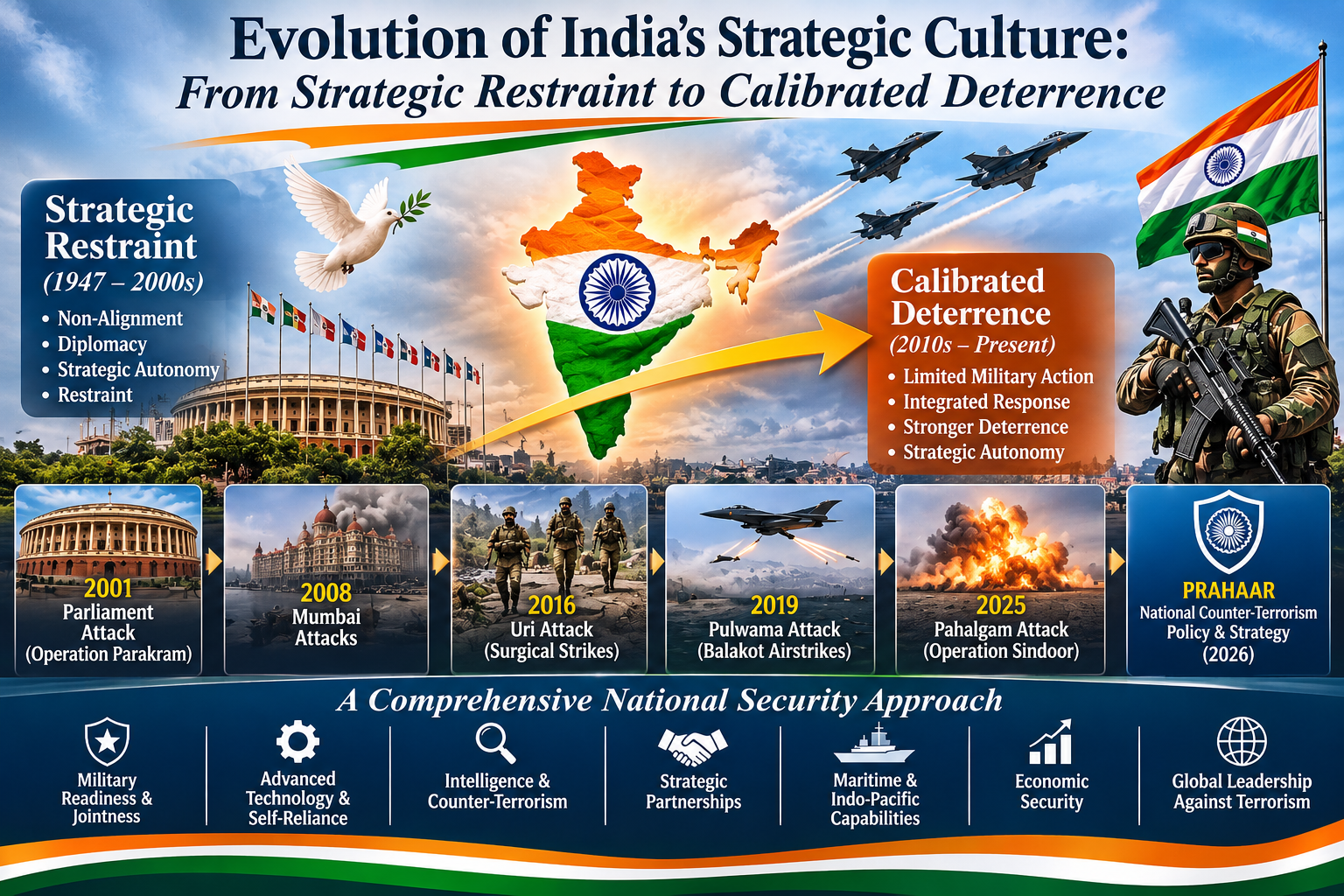
The change has been particularly visible in India’s response to terrorism originating from or supported by groups operating in Pakistan. The 2001 Parliament attack, the 2008 Mumbai attacks, the 2016 Uri attack and the 2019 Pulwama attack each influenced India’s assessment of the costs and limitations of its earlier responses. The surgical strikes across the Line of Control in 2016 and the Balakot airstrikes in 2019 established important precedents for limited cross-border military action. The 2025 Pahalgam attack and Operation Sindoor marked a further expansion of this approach, bringing military operations together with diplomatic, economic, technological and information-related measures.
These developments point to a more assertive approach to deterrence, one that is designed to impose costs on those who commit terrorism whilst still having the ability to control the scale and duration of any military response. India’s strategic culture hasn’t simply moved from restraint to the use of force. The concept of restraint itself has been redefined.
The Foundations and Evolution of India’s Strategic Culture
India’s strategic culture reflects a combination of historical experience, civilisational influences, political traditions and institutional practices. Kautilya’s Arthashastra, with its emphasis on statecraft, power, strategic calculation and the management of relations among competing states, is frequently cited as one of its intellectual foundations. The experience of colonial rule and the vulnerability of the newly independent state also shaped India’s preference for strategic autonomy and resistance to external domination.
India’s strategic thinking, however, has never followed a single, clearly defined tradition. Three broad strands have influenced the development of India’s strategic culture.
The first is the Nehruvian tradition, which dominated the early decades after independence. It emphasised non-alignment, peaceful coexistence, diplomacy, international law, civilian control of the armed forces and caution in the use of military power. Strategic autonomy was central to this approach, as India sought to avoid dependence on either Cold War bloc. Economic development and the consolidation of the country’s political institutions were considered essential to building India’s international standing.
The second is the realist or Kautilyan tradition, which places greater emphasis on military preparedness, power balancing, regional interests and the practical requirements of national security. India’s response to the 1971 crisis in East Pakistan and its subsequent military intervention illustrates this more pragmatic dimension of Indian statecraft. The decision demonstrated that India was prepared to use force when its political, strategic and humanitarian interests were considered sufficiently important.
The third is a more assertive nationalist approach, which has become increasingly visible in Indian political and strategic discourse since the 2010s. It places greater emphasis on national sovereignty, civilisational confidence, military capability and a more uncompromising response to security threats. This approach has influenced the political presentation of India’s counter-terrorism policy.
These traditions coexist rather than replace one another. Strategic autonomy remains an important principle, as does India’s reluctance to enter exclusive military alliances. At the same time, the country has become increasingly willing to employ military power in defence of its security interests.
The Evolution of India’s Counter-Terrorism Approach Towards Pakistan
For much of the post-independence period, India relied on diplomatic engagement, international pressure, intelligence gathering, border security and domestic counter-terrorism measures to address attacks linked to Pakistan-based militant organisations. Military retaliation was generally avoided because of concerns that even limited action could trigger a larger conventional conflict between two nuclear-armed states. Repeated terrorist attacks did, however, lead to questions as to whether this was in fact a sufficient deterrent. The inherent limitations of sustained military build-up and diplomatic pressure eventually led to Indian policymakers considering more direct and more limited military options.
The 2001 Parliament Attack and Operation Parakram. The attack on the Indian Parliament in December 2001 led directly to Operation Parakram, which was a massive build-up of Indian forces along the India-Pakistan border. The government was quite clearly willing to respond to an attack on one of the most important democratic institutions in the country. Although India did not undertake sustained cross-border military operations, the experience generated an important debate about the need for faster mobilisation, improved intelligence coordination and more flexible conventional responses below the threshold of full-scale war. The period also contributed to institutional changes in India’s security architecture. The recommendations of the earlier-constituted Kargil Review Committee and the subsequent Group of Ministers process encouraged improvements in intelligence coordination, defence management, and inter-service cooperation. These reforms contributed to the development of structures such as the Integrated Defence Staff. Subsequent counter-terrorism measures included stronger investigative capabilities and the establishment of the National Investigation Agency in 2008. Operation Parakram was therefore a significant transitional phase. It showed India’s political resolve to respond with force but also highlighted the limits of being able to impose costs through large-scale mobilisation without actually going to war.
The 2008 Mumbai Attacks and the Strengthening of Internal Security. The November 2008 Mumbai attacks exposed serious weaknesses in India’s intelligence, coastal security and emergency response mechanisms. The attacks demonstrated that terrorist operations could exploit gaps between intelligence agencies, law-enforcement organisations and specialised security forces. The initial response was very much focused on domestic security rather than any form of military retaliation against Pakistan. The NSG was beefed up, more operational cells were created, coastal surveillance was improved, and intelligence sharing was enhanced. The attacks also reinforced the importance of police modernisation, specialised counter-terrorism capabilities and coordination among central and state agencies. The principal lesson was that terrorism could not be addressed through conventional military power alone. Effective counter-terrorism requires good intelligence, a capacity for rapid response, secure borders, specialist police and institutional co-ordination. The experience influenced the internal security reforms that accompanied India’s subsequent move to a more assertive external posture.
The 2016 Uri Attack and the Introduction of Surgical Strikes. The 2016 attack on an Indian Army installation at Uri was a watershed moment in India’s response to cross-border terrorism. India carried out surgical strikes across the LoC at terrorist launch pads. The operation was of far greater significance than just the military objective itself. It was the first time India had made public the concept of limited cross-border military reprisal in response to a major terrorist attack. The operation went a long way to shatter the notion that the risk of escalation between two nuclear-armed states would preclude India from taking military action across the LOC. It also set a political precedent in terms of the direct costs that could be imposed on the terrorist infrastructure. The 2016 strikes were thus a move towards deterrence via limited punishment. India was trying to make the point that you could have a terrorist attack and still have some form of consequence without it necessarily escalating to a full-blown conventional war.
The 2019 Pulwama Attack and the Balakot Airstrikes. The Pulwama suicide blast in February 2019 (which killed 40 Indian security personnel) led to a further escalation of India’s military response. India then carried out airstrikes on a Jaish-e-Mohammed facility at Balakot in Pakistani territory. The Indian authorities characterised the operation as a pre-emptive strike against terrorist infrastructure. Balakot was important in that it was the first time India had responded to a terror attack with an air operation that went beyond the LoC. Nevertheless, Balakot set another important precedent in that it demonstrated that India was prepared to go beyond previously observed geographical boundaries in its strategy of punitive deterrence.
The 2025 Pahalgam Attack and Operation Sindoor.
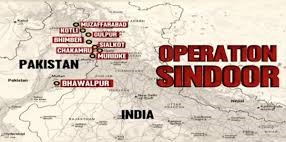
The 2025 Pahalgam attack and Operation Sindoor. The Pahalgam terrorist attack of 22 Apr 2025 was a major event in India’s counter-terrorism playbook. 26 civilians were killed in the attack, the vast majority of them being innocent tourists. India attributed the attack to terrorists of the Resistance Front (which it has in turn identified as a proxy of Lashkar-e-Taiba). India’s initial response was a mix of diplomatic and economic actions. This involved putting the Indus Waters Treaty on hold, reducing the level of diplomacy and introducing a number of trade-related restrictions. Subsequently, India launched Operation Sindoor with precision strikes on nine terrorist infrastructure targets in Pakistan and in Pakistan-occupied Kashmir. The operation, using long-range precision weapons, was aimed at terrorist infrastructure. Pakistan responded with drones, missiles and artillery attacks on Indian civil and military infrastructure. India, in turn, escalated its response to include Pakistani military installations. Hostilities went on for about four days before an agreement to cease hostilities was reached.
Operation Sindoor was important for a number of reasons.
-
- First of all, it showed India was willing to take direct military action against terrorist infrastructure in Pakistan. It confirmed the proposition that the possession of nuclear weapons would not in any way preclude India from taking action in response to a major terrorist attack.
-
- Secondly, the encounter was a demonstration of the expanding geographical and operational dimension of India’s military options. The response wasn’t limited to the LOC or to the terrorist launch pads in the border areas.
-
- Thirdly, the operation was a very clear demonstration of the growing importance of technology and multi-domain capability in modern warfare. Air power, drones, counter-drone, integrated air defence, electronic warfare, precision weapons, intelligence and surveillance were all part of the engagement. The wider response included a range of diplomatic, economic, maritime and information operations.
Indian PM described the emerging approach as a new normal. The political message was that large-scale terrorist attacks would have direct repercussions, that the Indian response would not be confined to the border areas and that India would prefer to deal with such situations directly rather than go through a third party. The key strategic development was not so much the scale of the operation as it was the attempt to establish a more predictable relationship between the occurrence of a terrorist attack and the prospect of a military response.
Institutional Reforms and the Changing National Security Architecture
PRAHAAR: India’s National Counter-Terrorism Policy and Strategy. In February 2026, India formally launched its counter-terrorism framework via PRAHAAR (the country’s first National Counter-Terrorism Policy and Strategy). The policy is built on seven pillars: Prevention through intelligence, swift and proportionate response, aggregation of capabilities through a whole-of-government approach, Human Rights and Rule of Law, attenuation of the enabling conditions (i.e. radicalisation), alignment of international efforts and recovery and resilience through a whole-of-society approach. The framework is all about intelligence integration, cutting off terrorist financing and propaganda, dealing with cyber networks and improving coordination between national and state agencies. It also makes it very clear that counter-terrorism in no way should be linked to any one religion. RAHAAR is an attempt to embed India’s increasingly assertive counter-terrorism posture into a wider institutional and preventive framework. Its relevance is in the realisation that military action in itself is not a panacea and that it must be complemented by intelligence, law enforcement, financial monitoring, international cooperation and societal resilience.
India’s changing strategic outlook has been accompanied by efforts to improve the institutions responsible for national security. The objective has been to strengthen coordination between political leadership, the armed forces, intelligence agencies, the diplomatic establishment and other government departments.
The National Security Council system (established in the late 1990s) provides the framework for the provision of national security advice and for coordination under the PM. The system is supported by the Strategic Policy Group and the National Security Advisory Board. The role of the National Security Adviser has grown considerably in terms of the importance of the role in the coordination of national security policy, and the Cabinet Committee on Security is still the highest political body in terms of decision-making in the event of a major security crisis.
The reforms within the armed forces have been focused on overcoming the problem of institutional fragmentation and improving joint planning. The establishment of the Chief of Defence Staff in 2019 and the Department of Military Affairs in 2020 were key steps in that direction. The intent has been to improve the way the three services work together, to improve joint logistics and joint procurement planning. It’s also been about recognising the growing importance of cyber, space, electronic and information domains.
India’s intelligence and counter-terrorism architecture has also expanded. The National Investigation Agency, Multi-Agency Centre, National Security Guard and police modernisation programmes form important elements of this system. Intelligence fusion has become increasingly important, particularly in the context of cross-border networks, terrorist financing, cyber activity and the use of unmanned systems.
The Future Direction of India’s Foreign and Security Policy
Security Concerns. China will remain a central long-term security concern, particularly because of the unresolved boundary dispute and the continuing military competition along the Line of Actual Control. India’s defence planning must therefore account for the possibility of simultaneous pressure from China and Pakistan, including the potential for strategic coordination between the two. Relations with Pakistan have undergone a different but equally significant transformation. India’s policy has moved from sustained dialogue despite terrorist incidents towards conditional engagement and, increasingly, punitive deterrence. Counter-terrorism is now closely connected with diplomatic relations, border management, military posture, trade, water policy, airspace and international diplomacy.
Balanced Approach. India’s emerging foreign and security policy is likely to combine greater military assertiveness with continued strategic autonomy. Rather than aligning itself exclusively with any major power, India has sought to maintain multiple strategic partnerships, including through the QUAD and its relationships with the United States, Europe, Russia, the Middle East and countries of the Global South. This approach reflects India’s desire to preserve flexibility in a changing international environment while expanding access to defence technology, investment, intelligence cooperation and diplomatic support.
Nuclear Stance. India remains committed to its declared No First Use policy and is at the same time working to bolster the credibility of its conventional military response. The 2025 experience is a clear example of the stability-instability paradox in South Asia. Nuclear weapons may well deter both sides from going to war at all, but they may also lead to the perception that limited military action can be taken below the nuclear threshold. This is a difficult strategic dilemma. India wants to show that Pakistan’s nuclear capability cannot in any way be relied upon to give them unlimited protection against conventional retaliation for terrorist attacks. At the same time, any military action has to be taken with the recognition that a limited action could in itself trigger a further retaliatory strike and so on and so forth.
Way Ahead. The challenge will be to maintain a credible deterrent without creating incentives for repeated escalation. Several priorities are likely to shape India’s security policy in the coming years. The central requirement will be to connect these priorities within a coherent national security framework. Military capability, economic strength, technological development and diplomatic influence cannot be treated as separate instruments. Their effectiveness will depend on how successfully they reinforce one another.
-
- Military Integration. Improving jointness among the three services and progressing towards effective theatre commands.
-
- Defence Technology and Industrial Base. Increasing indigenous production and reducing our critical dependence on foreign suppliers, particularly for advanced weapons systems, drones, air defence, and surveillance.
-
- Emerging Technologies. Increasing investment in artificial intelligence, cyber capabilities, electronic warfare, hypersonic systems and precision-guided weapons.
-
- Intelligence and Internal Security. Strengthening real-time intelligence fusion, counter-terrorism coordination, financial monitoring and efforts to prevent radicalisation.
-
- Economic Security. Bringing trade, critical infrastructure, energy security, technology and defence production into national security.
-
- Maritime and Indo-Pacific Capabilities. Building up India’s maritime presence and our partnerships across the Indian Ocean and throughout the wider Indo-Pacific.
-
- Diplomatic Engagement. Building international support against terrorism and strengthening cooperation to address its financing, logistical networks and external sources of support.
Concluding Thoughts
India’s strategic culture hasn’t simply moved from Nehruvian restraint to militarisation. It’s been a more complex evolution in which the very notion of restraint and its application has changed as the security environment has changed. The initial focus on diplomacy, non-alignment and strategic autonomy was a reflection of the priorities of a newly independent country which was keen to safeguard its sovereignty, promote its economic development and avoid getting caught up in the great power game. Those principles are still very much in play, though of course the repeated conflicts and the terrorist attacks have shown that diplomacy and restraint in themselves are not enough to guarantee India’s security.
The experience of 2001 and 2008 clearly demonstrated the limits of sustained military mobilisation and a purely defensive posture in the fight against terrorism. The surgical strikes of 2016 and the Balakot operation of 2019 were significant in terms of establishing the model of limited cross-border action. Operation Sindoor in 2025 took that model further by integrating the use of precision military strikes with a suite of diplomatic, economic, technological and information operations.
Institutional reform has gone hand in hand with this strategic shift. The evolution of the National Security Council system, better intelligence coordination, the creation of the Chief of Defence Staff and the Department of Military Affairs and the ongoing work on theatre-level integration are all manifestations of an attempt to turn political objectives into more coherent national security capabilities. The introduction of PRAHAAR in 2026 is yet another example of the attempt to build a full-fledged counter-terrorism framework which goes well beyond the mere act of military retaliation.
The emerging approach is best described as an attempt to extend India’s freedom of action whilst still maintaining control over the escalation ladder in a nuclearised regional context. It’s a combination of the old pursuit of strategic autonomy with a greater readiness to impose costs if one’s national security interests are in jeopardy.
The fundamental challenge for India will be to ensure that any increased military assertiveness actually contributes to long-term security rather than simply creating a continuing cycle of retaliation. Its future strategic culture will be determined as much by its political judgement, institutional coordination and diplomatic skills as it will be by its ability to use force in the first place. The key issue will be whether it can avoid the situation where a limited confrontation escalates into a wider one.
Please Add Value to the write-up with your views on the subject.
For regular updates, please register your email here:-
References and credits
To all the online sites and channels.
Pics Courtesy: Internet
References: –
- Basrur, R. M. (2001). Nuclear weapons and Indian strategic culture. Journal of Peace Research, 38(2), 181–198. https://doi.org/10.1177/0022343301038002004
- Tanham, G. K. (1992). Indian strategic culture. The Washington Quarterly, 15(1), 129–142. https://doi.org/10.1080/01636609209550082
- Ganguly, S., & Pardesi, M. S. (2009). Explaining sixty years of India’s foreign policy. India Review, 8(1), 4–19. https://doi.org/10.1080/14736480802665162
- Ganguly, S. (2014). India’s foreign and security policies. In R. Foot, S. Pekkanen, & J. Ravenhill (Eds.), The Oxford handbook of the international relations of Asia. Oxford University Press. https://doi.org/10.1093/oxfordhb/9780199916245.013.0021
- Kautilya. (1992). The Arthashastra (L. N. Rangarajan, Trans.). Penguin Books.
- Chaudhuri, R. (2018). Indian “strategic restraint” revisited: The case of the 1965 India-Pakistan War. India Review, 17(1), 55–75. https://doi.org/10.1080/14736489.2018.1415277
- Mukherjee, R., & Sagar, R. (2018). Pragmatism in Indian strategic thought: Evidence from the nuclear weapons debate of the 1960s. India Review, 17(1), 12–32. https://doi.org/10.1080/14736489.2018.1415272
- Ganguly, S. (2008). Nuclear stability in South Asia. International Security, 33(2), 45–70. https://doi.org/10.1162/isec.2008.33.2.45
- Sasikumar, K. (2019). India’s surgical strikes: Response to strategic imperatives. The Round Table, 108(2), 159–174. https://doi.org/10.1080/00358533.2019.1591768
- Kaura, V. (2020). India’s Pakistan policy: From 2016 ‘surgical strike’ to 2019 Balakot ‘airstrike’. The Round Table, 109(3), 277–287. https://doi.org/10.1080/00358533.2020.1760499
- Government of India. (2001). Reforming the national security system: Report of the Group of Ministers. Government of India. https://archive.pib.gov.in/archive/releases98/lyr2001/rmay2001/23052001/r2305200110.html
- Ministry of External Affairs, Government of India. (2025, May 7). Statement by Foreign Secretary: Operation Sindoor. Government of India.https://www.mea.gov.in/speeches-statements?dtl/39473
- Press Information Bureau, Government of India. (2025, May 12). Global solidarity with India: A united front against cross-border terrorism. Government of India. https://www.pib.gov.in/PressNoteDetails.aspx?NoteId=154451&ModuleId=3®=48&lang=2
- Ministry of Home Affairs, Government of India. (2026). PRAHAAR: National counter-terrorism policy and strategy. Government of India. https://www.mha.gov.in/files/policies_guidelines_document/PRAHAAREnglish-23022026-1.pdf
Disclaimer:
Information and data included in the blog are for educational & non-commercial purposes only and have been carefully adapted, excerpted, or edited from reliable and accurate sources. All copyrighted material belongs to the respective owners and is provided only for wider dissemination.