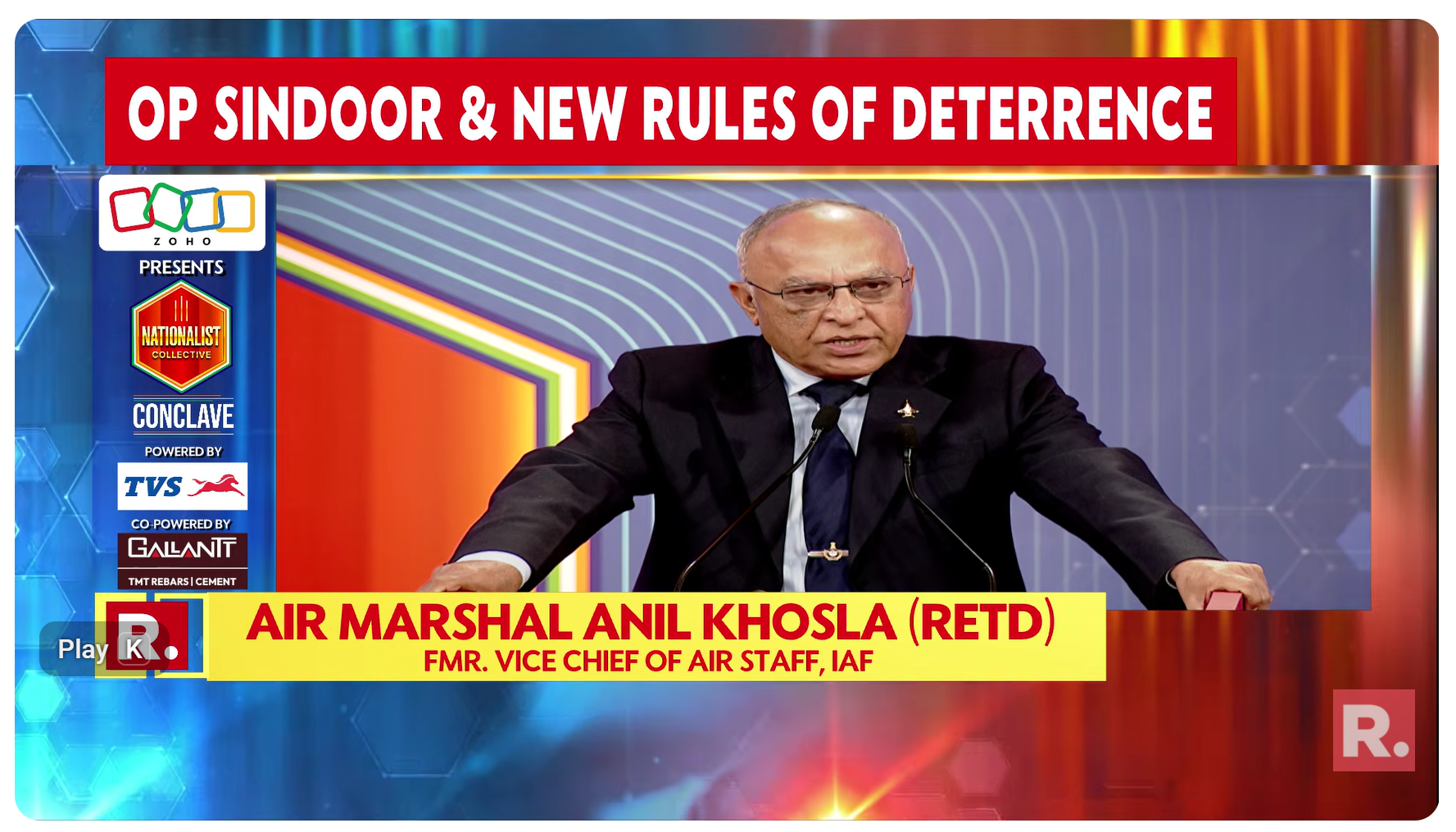
Keynote address at the Nationalist Collective Conclave
There is a persistent tendency in public discourse to treat national security as the exclusive concern of the uniformed services. This tendency is understandable. The nature of the threat has changed. The character of the battlefield has changed. And the consequence of that change is that the responsibility for national security has extended to every Indian, regardless of profession or age.
India today is the world’s largest democracy with a functional constitutional order. The last eight decades have seen it rise remarkably. The achievements include a continental-scale economy, a space programme of global ambition, and digital infrastructure that outpaces many advanced economies. Its armed forces have repeatedly demonstrated the ability to conduct complex multi-domain operations with precision and calibration. India’s rise in global economic rankings, its growing geopolitical weight, and its increasingly confident independent foreign policy have combined to place it in the top ranks of emerging powers. The world is watching it take its place.
But history does not reward nations for their potential. It rewards them for execution. The growth is also tested for resilience by hostile powers. India’s security imperatives, in this moment of ascent, are as demanding as they have ever been. Understanding those imperatives and every citizen’s role in meeting them is no longer optional. It is the defining obligation.
The External Environment
India’s external security environment is unique. No other nation concurrently confronts two nuclear-armed, territorially revisionist neighbours who are also engaged in active strategic convergence.
China. Roughly 3,488 kilometres of the undemarcated Line of Actual Control run with China through Ladakh, the Middle Sector, and Arunachal Pradesh. China’s strategy is patient and incremental. A road built today, a village established this year, a patrol pattern normalised over eighteen months. The cumulative effect of each individually deniable step is a slow but deliberate change in ground realities. The 2020 Galwan Valley clash has marked a genuine inflexion point. India’s response was measured but decisive. However, the posture has shifted from a protocol-based, treaty-reliant approach to one that explicitly anticipates contestation as the normal condition along this frontier. There is now a permanent deployment of troops, and defence expenditure has risen.
Pakistan. On the Western Front, Pakistan has sustained a doctrinally consistent posture for decades. An inability to compete conventionally, compensated through asymmetric means of cross-border terrorism, proxy warfare, and increasingly persistent information operations. India prefers peace, but is ready to respond resolutely if provoked. The Indian shift from strategic restraint to punitive deterrence shows its commitment to defending itself. The signals from Balkot and Sindoor are clear. There will be a high cost for violations, and nuclear deterrence won’t offer protection for sub-conventional terror attacks.
Collusivity. What sustains Pakistan’s conventional relevance beyond its own diminishing economic base is Chinese material support: fighter aircraft, frigates, air defence systems, and intelligence cooperation that keeps the Pakistani military artificially current. The two fronts are connected at the strategic level, and India’s planning must treat them as such. India’s response to this environment has evolved.
The New Character of the Battlefield
The most consequential shift in the security environment is the dissolution of the traditional boundary between the combatant-manned battlefield and the civilian hinterland. Further, war is no longer exclusively kinetic. It is in the domains of cyber, cognitive, economic, and informational. Further, it is continuous with no declaration, no armistice, no peacetime in the old sense. The competition between states now operates permanently below the threshold of conventional conflict, targeting not military assets primarily but the civilian infrastructure and social fabric on which a modern society depends.
A cyberattack on critical infrastructure can produce effects comparable to those of a conventional strike. The cognitive domain is even more treacherous than the cyber domain. Social media platforms enable adversaries to fabricate and amplify narratives that sow doubt among citizens. The enemy’s objective is to erode social trust and institutional confidence. The tools employed include fake news, deepfakes, and disinformation. The target is the fault lines of caste, religion, region, and language. A society that can be influenced to distrust its own armed forces, doubt its own judiciary, and view every fellow citizen through the lens of a manufactured grievance does not need to be invaded to be strategically weakened.
The Non-Negotiable Imperatives
Against this backdrop, India’s security imperatives span domains that cannot be managed in isolation.
Border Security Remains Foundational. Vigilance across land, maritime, and air domains is a necessary condition for everything else. The connectivity corridors of the northeast, the Siachen heights, and the sea lanes of the Indian Ocean are the geographic reality within which India’s security calculus must function every day. India is a maritime nation, with the bulk of its trade and energy supply transiting sea lanes in an increasingly contested ocean. Maritime security is an inseparable part of national security.
Technological Self-Reliance. Technological Self-Reliance is no longer a development aspiration but is now a survival requirement. Technological dependence translates directly into strategic vulnerability. A nation that relies on foreign platforms for its combat aircraft carries strategic dependency at the core of its deterrent. A nation without an indigenous satellite capability, a secure communications architecture, and artificial intelligence will fight the next war at a disadvantage. Self-reliance in defence production and critical technologies is a strategic necessity. The laboratories, the factory floors, and the engineering colleges have become central to national security. Innovation is the new arsenal of national power, and nations that create technology will shape the future while those that merely consume it will follow.
Strategic Autonomy. Strategic autonomy is the third imperative, and the most complex to sustain because it requires continuous calibration. Partnerships are valuable, and India has built a sophisticated network of defence and strategic relationships across the Indo-Pacific and beyond. But no partnership substitutes for indigenous capability, and no relationship should constrain Indian decision-making at the moment of national need. Sovereignty is non-negotiable. Partnerships are instruments of it, not substitutes for it.
Internal Resilience. Internal resilience is the fourth imperative and is directly dependent on citizens’ conduct. Strong institutions (the judiciary, civil service, independent press, and a functional electoral process) are the load-bearing walls of the democratic structure. The nation’s structural integrity is compromised if these institutions are undermined.
A Whole-of-Nation Effort
The Indian Armed Forces are among the finest in the world. The men and women who serve in them do so with a commitment that the nation owes it to itself to match in civic life. But armed forces alone cannot secure a nation in a security environment where the contest extends into every domain of national life. National security is a whole-of-nation effort. The strength of a nation is measured not only by the power of its military but by the resilience of its society. Citizens are force multipliers. A disciplined, informed, and vigilant public extends the reach of national security capability in ways that no institutional investment can fully replicate.
Youth. Youth is central to this calculus. India’s demographic dividend, i.e. its largest cohort of young people in the world, is a strategic asset. Young Indians will shape the future of national security not only in the armed forces but in classrooms, laboratories, startups, and the broader services sector. The question is whether they arrive at that role equipped with the strategic awareness, civic responsibility, and sense of national obligation that the moment demands. Education for citizenship is not supplementary to professional preparation. It is foundational to it.
Women Power. Women’s contribution to national security is no longer a matter of social equity alone. A nation cannot draw on the full depth of its human capital if half of that capital is structurally constrained. The increasing induction of women into combat roles in the armed forces is not merely a statement of inclusion. It is a recognition that the force multiplier India needs is the full talent of its population, deployed without socially created artificial limitations. Women-led development (in the economy, the defence industry, and strategic research, etc) is a core component of comprehensive national power.
Indian Diaspora. The Indian diaspora constitutes another dimension of a national strategic asset. Over thirty-five million people of Indian origin live and work in the institutions, economies, and capitals of the world’s major powers. Besides being a remittance engine, they represent a cultural, intellectual, and geopolitical presence. Their capacity to advocate India’s interests, counter anti-India narratives in foreign information environments, and channel investment into strategic sectors is an asset that national strategy should actively cultivate.
The Citizen’s Specific Responsibilities
The imperatives above remain abstractions unless they translate into concrete responsibilities for every citizen.
Social Cohesion. Social cohesion is the most immediately actionable and the most immediately threatened. Internal division is not a private concern, but is a public security vulnerability. Fault lines are created by manufacturing conflict between communities, fueling communal tension, amplifying regional grievances, and driving a wedge between citizens along lines of caste, religion, or language. The adversary can exploit these. The citizen’s responsibility is to recognise this dynamic and to refuse to amplify divisive narratives. Diversity is India’s identity, and our unity is India’s strength. No adversary can defeat a nation that refuses to be divided.
Responsible Digital Citizenship. The information environment today is saturated with questionable content. Fake news travels fast, and deepfakes are indistinguishable from authentic content to the untrained eye. The smartphone in every pocket is a potential instrument for influence operations. Every citizen needs to pause before sharing, verify before amplifying, and resist the emotional manipulation that disinformation is engineered to produce. Civic awareness and disciplined action constitute a meaningful and immediate contribution to national security.
Civic Preparedness. Civic preparedness for disaster readiness, basic cyber hygiene, emergency response awareness, and community resilience is the fourth dimension of citizen responsibility, and the one most amenable to practical preparation. A population that panics in crisis extends the damage that any adversary, natural or human, can inflict. Schools, colleges, local bodies, and community institutions that normalise security awareness build a population that is harder to destabilise and faster to recover.
India@2047: The Defining Question
The defining question is not whether India will rise. The evidence of that rise is already visible. India at the centenary of its independence in 2047 can be a nation that has fulfilled the promise of its founding. It can be a nation that is secure, prosperous, technologically sovereign, self-reliant, and socially cohesive. The conditions for that outcome are being assembled now. The trajectory is positive. But trajectories can be deflected by complacency, by division, and by the failure of citizens to understand their role in a contest that involves them, whether or not they choose to acknowledge it.
They are about the kind of nation we choose to be—a nation whose citizens understand that their daily choices and conduct are themselves a component of national power. A Viksit Bharat can be built through discipline, cohesion, and purpose.
Concluding Thought
The greatest strategic asset India possesses is not its missile inventory, its space programme, or its growing military power and reach, formidable as all of these are. It is 1.4 billion citizens who, if they understand what is at stake and accept their role in it, constitute a national resilience that no adversary can easily overcome. Every citizen is a stakeholder in India’s security. Every citizen is a force multiplier.
Please Add Value to the write-up with your views on the subject.
For regular updates, please register your email here:-
References and credits
To all the online sites and channels.
Pics Courtesy: Internet
Disclaimer:
Information and data included in the blog are for educational & non-commercial purposes only and have been carefully adapted, excerpted, or edited from reliable and accurate sources. All copyrighted material belongs to the respective owners and is provided only for wider dissemination.