

289: DJIBOUTI: TUG OF WAR BETWEEN USA & CHINA

Pic courtesy: Britanica


Djibouti

 Djibouti, is a small country in the Horn of Africa located on the southwest shores of the Gulf of Aden. It is adjacent to the narrow Bab el-Mandeb Strait (mere 18 miles wide at its narrowest point) the gateway to the Red Sea and the Suez Canal.


Djibouti is sparsely populated with a rocky landscape and harsh climate. It has minimal natural resources, limited arable soil or vegetation, and temperatures that reach 50 degrees plus.

Djibouti is governed by a neo-patrimonial system of government. A neo-patrimonial system is a form of governance in which all power flows directly from the leader.

Continue reading “289: DJIBOUTI: TUG OF WAR BETWEEN USA & CHINA”
284: Air Power in Counter Terrorism Operations

Keynote address at Seminar on Counter Terrorism organised by Indic Researcher’s Forum.


Bottom Line

Airpower has both visible and invisible roles in counter-insurgency role


Suggestions and value additions are most welcome


For regular updates, please register here

Subscribe

Disclaimer:

Information and data included in the blog are for educational & non-commercial purposes only and have been carefully adapted, excerpted, or edited from sources deemed reliable and accurate. All copyrighted material belongs to respective owners and is provided only for purposes of wider dissemination.

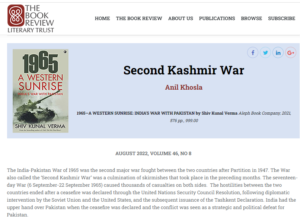
279: BOOK REVIEW: 1965 A WESTERN SUNRISE – INDIA’S WAR WITH PAKISTAN


Published by Book review literary Trust


BOOK REVIEW:

1965 A WESTERN SUNRISE

INDIA’S WAR WITH PAKISTAN

By Shiv Kunal Verma


Review by: Air Marshal Anil Khosla (Retd) PVSM, AVSM, VM

Former Vice Chief of Air Staff, Indian Air Force.

The Indo-Pakistani war of 1965 was the second major war fought between the two countries after the partition in 1947. The war also called the “Second Kashmir War”, was a culmination of skirmishes that took place in the preceding months. The seventeen-day war (06 Sep – 22 Sep 65) caused thousands of casualties on both sides.  The hostilities between the two countries ended after a ceasefire was declared through United Nations Security Council Resolution, following diplomatic intervention by the Soviet Union and the United States, and the subsequent issuance of the Tashkent declaration. India had the upper hand over Pakistan when the ceasefire was declared and the conflict was seen as a strategic and political defeat for Pakistan.

Continue reading “279: BOOK REVIEW: 1965 A WESTERN SUNRISE – INDIA’S WAR WITH PAKISTAN”

English हिंदी