Article published in the IIRF yearbook 2026
Defending national airspace has become far more demanding as military technology advances rapidly, bringing a new generation of threats—hypersonic missiles that can cross continents in minutes, stealth aircraft designed to slip past conventional radar, and swarms of unmanned aerial vehicles that can overwhelm defences through sheer numbers. Meeting these challenges calls for a fundamentally different approach towards air defence. Multiple sensors, interceptors, and command nodes must work as a single, coherent network. This is the essence of an Integrated Air Defence System, or IADS — a continuously operating shield that watches the sky, assesses every contact, and directs the appropriate response before a threat can cause harm. IADS gives commanders real-time awareness and the ability to act decisively by integrating detection platforms, command centres, secure communications, weapon systems, and electronic warfare assets into a unified whole. The result is a force capable of countering not only the familiar threats of manned aircraft but also the rapidly growing challenge posed by drones and ballistic missiles. For a growing number of nations, the IADS has become the cornerstone of national security — the means by which a state asserts sovereignty over its own skies at a time when technological parity can no longer be taken for granted. For many countries, IADS constitutes the core of national security.[1]
On 15 August 2025, Indian Prime Minister Shri Narendra Modi announced
one of the most significant national security initiatives. Mission Sudarshan Chakra is an air defence shield to protect India’s critical assets from multiple enemy threats. With a target of full operational capability by 2035, it aims to develop a wholly indigenous, multi-layered national security shield—a system capable of confronting evolving threats from ballistic missiles, drone swarms, cyber warfare, and the full spectrum of hybrid conflict.[2]
Concept: Integrated Air Defence
An Integrated Air Defence System (IADS) is a networked, orchestrated system that brings together the full range of a nation’s air defence assets — radars, interceptors, command centres, and communication links — to detect, track, engage, and destroy incoming aerial threats. Those threats may take the form of manned aircraft, unmanned aerial vehicles, cruise missiles, or ballistic missiles. What distinguishes an IADS from a collection of individual defensive units is its integration: instead of isolated batteries operating independently, every element feeds data to a common picture and acts on common instructions.[3]
Components. The effectiveness of any IADS rests on the performance of its constituent parts and, critically, on how well those parts work together. A modern IADS includes five capability categories.[4]
-
- Detection and surveillance systems form the system’s foundation. An array of ground-based radars, airborne early warning and control aircraft (AWACS and AEW&C), and space-based surveillance assets collectively provide wide-area monitoring. This multi-layered configuration provides comprehensive coverage and redundancy. Redundancy is essential as no single platform, however capable, should be the sole means of situational awareness.[5]
-
- Command and Control (C2) systems function as the intellectual core of the IADS. They transform raw sensor data into decisions. Modern C2 nodes are increasingly augmented by artificial intelligence. AI helps in threat assessment, computation of probable trajectories, and coordination of intercepts. These centers may be centralised or distributed, but in either configuration, they must provide continuous, reliable command authority over all elements of the system.[6]
-
- Communication networks form the backbone of the IADS. They link all components with secure, high-speed connections. These networks enable real-time data exchange even under challenging conditions (electronic attacks). [7]
-
- Weapon systems provide the means to act on the assessments the C2 node generates. Surface-to-air missiles (such as the Patriot and S-400) and Fighter jets (interceptor aircraft) add versatility by engaging threats beyond the reach of ground-based systems. [8]
-
- Electronic Warfare (EW) Units strengthen the IADS by disrupting enemy activities. Through jamming, deception, and the suppression of enemy radar and guidance systems, EW assets reduce the probability that incoming threats will find their targets, creating windows of opportunity for kinetic systems to exploit.[9]
Operational Mechanism. The operating logic of an IADS is built around layered defence — multiple overlapping rings of capability, each offering the chance to destroy a threat before it reaches the next. The Center for Strategic and International Studies has observed that the hallmark of an effective IADS is its ability to integrate real-time data, synchronise assets across multiple domains, and adapt dynamically as the nature of the threat evolves. In practice, this takes the form of a sequence of coordinated functions.[10]
-
- Early detection and monitoring begin the process. Radar systems, satellites, and airborne warning platforms maintain continuous surveillance, and any contact that departs from expected patterns triggers closer examination. The further out a threat is detected, the more time the system has to respond — making early warning not merely useful but decisive.
-
- Identification and classification: Once an object is identified, the system activates Identification and Classification procedures. IADS uses Identification, Friend or Foe (IFF) transponders, signal analysis, and ELINT to distinguish between friendly, neutral, and hostile targets.
-
- Threat assessment is then conducted at the command-and-control level. The command-and-control (C2) centres analyse factors such as speed, altitude, trajectory, and intent to determine the threat level. Based on these analyses, threats are prioritised so that the most urgent and dangerous targets receive immediate attention.[11]
-
- Engagement coordination translates the threat assessment into action. The command node selects the most suitable weapon system available — a SAM battery, anti-aircraft artillery, or an intercepting aircraft — and directs it to engage. The precision of this coordination and the speed with which it occurs largely determine whether the intercept succeeds.
-
- Post-engagement assessment closes the cycle. This phase reviews the outcome to determine whether the threat was successfully neutralised or if further action is necessary.[12]
Key Features. The key features of an Integrated Air Defence System (IADS) are vital in improving its ability to detect, track, and neutralise aerial threats.[13]
-
- Interoperability is essential to enable diverse platforms, weapons and systems to operate in a unified manner. This seamless integration and coordination enhance threat response times and situational awareness. [14]
-
- Another vital feature is redundancy and resilience. It ensures that the overall system remains operational, without performance degradation, even if some components are disabled. Backup sensors, alternative communication links, and multiple control nodes ensure the system continues to function.[15]
-
- A layered defence structure is crucial for assured protection. Long-range surveillance and engagement capabilities, along with medium- and short-range systems, are required to create overlapping defensive coverage. This multi-tiered strategy enhances the chances of detecting and neutralising threats at various stages
-
- Scalability allows the architecture to be sized and configured to the specific geography and threat environment it must cover. A system designed to protect a single military airfield and one designed to defend a country the size of India are built on the same principles but tailored to vastly different requirements. This flexibility is what allows IADS concepts to remain relevant across a wide range of national security contexts.
Global Developments
Israel’s IADS. Israel’s Integrated Air Defence System is one of the world’s most sophisticated and operationally proven. It has evolved over the years in a hostile threat environment that demands continuous adaptation. Israel fields three weapon systems. The “Iron Dome” is for the interception of short-range rockets and artillery projectiles. “David’s Sling” neutralises the medium-range threat posed by cruise and ballistic missiles. Lastly, the Arrow system provides the outermost layer of defence against long-range ballistic missiles. These layers are not merely co-located — they are actively integrated via a centralised command-and-control network that ensures rapid, coordinated response. Israel’s IADS has been tested repeatedly in live operations. Quite often, in countering large rocket barrages from Hamas and Hezbollah. Recently, in response to direct missile attacks launched from Iran. Israel’s system has integrated AI-driven automation and expanded its ability to counter emerging threats (including drone swarms and hypersonic weapons). Now, the directed-energy weapon Iron Beam is also being integrated into the IADS. The final result is an air defence system that simultaneously deters adversaries, protects the population, and preserves Israel’s strategic freedom of action in a volatile neighbourhood. [16]
Russian IADS. Russia’s Integrated Air Defence System is one of the most extensive and technically layered in existence, originally built to defend an enormous national territory against the massed air campaigns expected during the Cold War. The system includes long-range weapon systems (S-400 and S-500) that provide strategic depth at ranges beyond 400 kilometres. These systems can engage aircraft, cruise missiles, and ballistic missiles at high and medium altitudes. The medium-range layer and close-in threats are also covered. A dense early-warning radar network and dedicated electronic warfare units are integrated into a command structure that coordinates responses across the entire defended area. Russia’s IADS is concentrated most heavily around the centres of political and military gravity, but its reach extends across the country. In Syria, deployed Russian air defence systems demonstrated a real deterrent effect. In Ukraine, Russian air defences have engaged Ukrainian drones and missile strikes with notable frequency. Russia continues to develop next-generation interceptors, with the S-500 representing a significant step toward defeating hypersonic weapons. [17]
US IADS. The United States possesses the most globally deployed integrated air defence system. At the strategic end of its spectrum, the Ground-Based Midcourse Defence (GMD) system is capable of intercepting intercontinental ballistic missiles. Whereas THAAD (Terminal High Altitude Area Defence) offers theatre-level protection against short- and medium-range ballistic missiles. The Patriot system provides medium-range defence, whereas closer-range coverage is provided by the NASAMS (National Advanced Surface-to-Air Missile System), and Avenger SAMs (effective against drones and cruise missiles). NORAD (North American Aerospace Defence Command) ties the architecture together. The United States is actively investing in directed-energy weapons, AI-enabled threat assessment, and hypersonic interceptors to keep its IADS relevant against the next generation of adversary capabilities. [18]
Indian Approach
Necessity. India’s approach to Integrated Air Defence is shaped largely by a security environment unlike that faced by almost any other nation: two nuclear-armed adversaries sharing long, contested land borders, each actively modernising its aerial and missile capabilities, and each capable of threatening Indian territory with little strategic warning. India’s extensive territory and precarious security landscape necessitate robust air defence measures. Against this backdrop, a robust, multi-layered air defence capability is not a discretionary investment for India — it is a fundamental requirement of national security, underpinning both deterrence and the ability to respond effectively if deterrence fails.[19]
Existing Structure. India’s current IADS is a layered architecture that integrates domestically developed systems with platforms acquired from foreign suppliers, brought together under a common command framework.
-
- At the strategic level, the Integrated Air Command and Control System (IACCS) provide the command-and-control framework. IACCS nodes draw on radar data from a wide range of sources (including ground-based radars and airborne platforms). A near real-time air picture is generated, enabling continuous tracking and threat prioritisation.
-
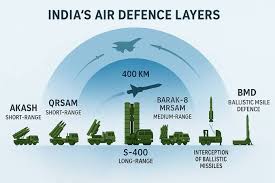
- At the operational level, India has a mix of indigenous and imported surface-to-air missile systems. The indigenous Akash missile system protects against low-flying threats. The Israeli SPYDER SR/MR and Barak-8 complement it for extended medium-range engagements. Gun systems address low-altitude drone threats. The induction of the Russian S-400 Triumf system has added significant strategic depth. It has created an engagement envelope extending beyond 400 kilometres. [20]
-
- India’s Ballistic Missile Defence (BMD) programme provides a further layer above the conventional IADS. The two-tier system — the Prithvi Air Defence (PAD) interceptor for exo-atmospheric engagements at high altitude, and the Advanced Air Defence (AAD) system for endo-atmospheric intercepts at lower altitudes — has undergone successful tests in recent years and is progressively advancing toward declared operational capability.[21]
Indian IADS Performance during Operation Sindoor. Operation Sindoor tested the Indian Air Defence System against a broad and simultaneous range of aerial threats. These included cruise missiles, fighter aircraft, drones, and loitering munitions. The system faced simultaneous multi-dimensional attacks (kinetic, electronic, and cyber). The system displayed a high degree of responsiveness, accuracy and robustness. Operation Sindoor validated the core architecture of India’s IADS while identifying areas where capability development must accelerate to stay ahead of evolving threats.
Challenges in India’s Integrated Air Defence Systems (IADS). Despite notable advancements, India’s IADS faces a few challenges that demand sustained, deliberate attention. India fields a diverse array of systems of Russian, Israeli, American, and indigenous origin. One of the foremost problems is ensuring interoperability and seamless integration. Investing in Electronic Counter-Countermeasures (ECCM) and hardening communications against electronic attack are integral to IADS effectiveness. Sustaining the network also imposes significant, recurring financial demands. It also requires a deep pool of technical expertise that must be built over time and continuously refreshed. Managing these constraints — allocating resources strategically, promoting indigenous production to reduce long-term import dependency, and planning for whole-of-life system sustainability — will determine whether India’s IADS remains modern and operationally effective in the years ahead. [22]
Mission Sudarshan Chakra: An Indigenous Multi-Layered National Defence Shield
In Hindu mythology, the Sudarshan Chakra is the weapon wielded by Lord Krishna. In the epics, the Sudarshan Chakra represents precision, protective power, and the capacity to strike when necessary. These are the same qualities the mission is designed to embody in the modern security environment. Mission Sudarshan Chakra is conceived as an integrated national security ecosystem. It encompasses surveillance, interception, electronic warfare, counter-strike capability, and the digital architecture that ties them all together. The programme aligns with India’s recent Atmanirbhar Bharat (Self-Reliant India) approach.[23]
Strategic Vision and Objectives.[24] The primary objective of “Mission Sudarshan Chakra” is to create a comprehensive national security shield. The shield is envisioned to defend India’s critical infrastructure against a wide range of threats. Single-threat-capable Air Defence systems are no longer adequate. To address contemporary threats, the Indian initiative aims to develop a multi-domain defence system integrating air, land, sea, space, and cyber capabilities. This networked system would enable real-time detection, tracking, interception, and retaliation against threats originating from multiple directions simultaneously. The program places major emphasis on protecting critical national infrastructure. This includes military bases and strategic installations, as well as economic assets.
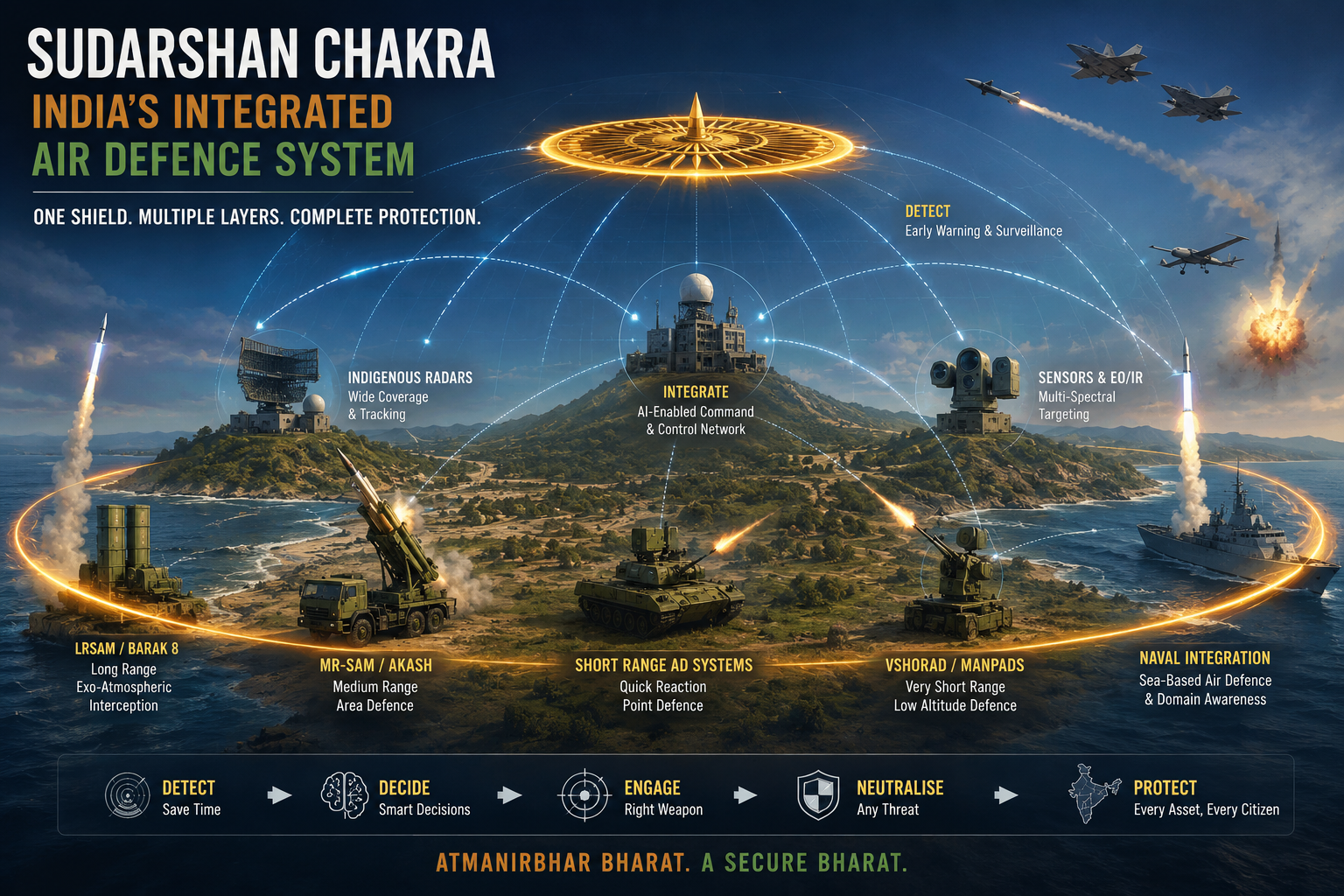
The Multi-Layered Defence Architecture.[25] At the heart of Mission Sudarshan Chakra lies a multi-layered air and missile defence shield designed to intercept threats at different ranges and altitudes. By deploying several defensive layers, the system increases the probability of successfully neutralising incoming attacks before they reach their targets.
-
- Outer Layer — Long-Range Threat Interception. The outermost layer is designed to engage long-range ballistic missiles, hypersonic glide vehicles, and high-altitude aircraft. These threats need to be intercepted as far as possible. Engagement at extended range protects not only the intended target but also reduces the risk of debris from destroyed missiles falling over populated areas. The planned capabilities for this layer centre on the Project Kusha long-range air defence system and India’s indigenous ballistic missile defence interceptors — the Prithvi Air Defence (PAD) system, which engages targets outside the atmosphere in the exo-atmospheric phase, and the Advanced Air Defence (AAD) system, which complements it at lower altitudes during the terminal descent phase.
-
- Mid-Layer — Medium-Range Air Defence. The second layer is tasked with engaging conventional combat aircraft, cruise missiles, and medium-range ballistic missiles that survive or bypass the outer ring. The Akash missile family, the Quick Reaction Surface-to-Air Missile (QRSAM), and the Medium-Range Surface-to-Air Missile (MRSAM) are the primary systems at this layer. Their mobility is a significant attribute: unlike fixed installations, these platforms can reposition to defend both static infrastructure and moving military formations, providing flexibility that a purely static architecture cannot offer.
-
- Inner Layer — Close-Range Protection. The innermost layer addresses the threat categories that have proved most consequential in recent conflicts. These include small, inexpensive drones operating individually or in swarms, loitering munitions, and short-range rockets. The mission plans to deploy the Very Short-Range Air Defence System (VSHORADS), high-power directed-energy weapons and specialised anti-drone electronic warfare systems.
The Command, Control, and Intelligence Backbone.[26] The weapon systems that constitute Mission Sudarshan Chakra’s visible face are only as effective as the architecture that directs them. Successful missile and air defence in the modern era requires ingesting and processing enormous volumes of sensor data—from ground radars, airborne platforms, satellites, and electronic intelligence sources—and translating that data into decisions and commands within seconds. The mission plans to build upon and substantially expand India’s existing IACCS, which already provides some multi-service integration and a common air picture. Under Mission Sudarshan Chakra, this network would be enhanced with advanced AI-enabled computing power. The envisioned command architecture would automatically identify probable threats, compute their trajectories, and generate interception recommendations—while retaining human authority over final engagement decisions. AI would systematise target prioritisation, one of the most cognitively demanding tasks in high-intensity air defence, ensuring the most dangerous contacts receive immediate attention regardless of the total number of simultaneous threats. Space-based assets would play a significantly expanded role, with military satellites equipped to detect the infrared signature of missile launches within seconds of ignition — providing early warning of attacks originating from far away.
Offensive Capability: The “Sword” Component.[27] Mission Sudarshan Chakra differs from conventional air defence in one key way: it does not stop at interception. Once an incoming attack is detected and traced to its point of origin, the system can direct a counter-strike against that source. This approach marks a shift in India’s active defence doctrine. The message it sends is unambiguous — any attack on Indian territory will not only fail to reach its targets, but will draw a precise and swift response against the hand that launched it.
Implementation
Integration with Existing Defence Systems.[28] Mission Sudarshan Chakra is designed explicitly as an umbrella framework rather than a clean-sheet replacement for India’s existing air defence inventory. India will not discard the substantial investments it has made in current-generation systems (S-400, Akash, PAD, AAD, SPYDER, Barak-8, and the IACCS, etc.). They are likely to be upgraded (where necessary) and integrated into the new architecture. All surveillance radars and interceptor weapons will connect to a unified data-sharing network that eliminates the current seams between independently operating systems. New interceptors capable of addressing hypersonic threats and drone swarms would be introduced alongside, and complementary to, existing platforms rather than replacing them. Advanced sensor systems — ground-based radars, electro-optical tracking devices, and satellite-based detectors — will collectively form a comprehensive surveillance grid that provides far greater coverage depth than the current system achieves. As military systems become more software-dependent and network-connected, an adversary’s ability to disrupt, deceive, or disable them through cyber means becomes as significant a threat as a physical attack. Cybersecurity would be embedded throughout the architecture as a fundamental requirement, not an afterthought.
Alignment with India’s Self-Reliance Strategy.[29] Historically, India has relied heavily on foreign suppliers for advanced weapons systems. Mission Sudarshan Chakra is likely to be committed to indigenous development. The government has indicated that research, design, and manufacturing for the system will largely take place in-house. A collaborative approach is being envisaged among national research organisations, defence agencies, and private technology firms. Mission Sudarshan Chakra aims to build a sustainable technological base to support long-term security needs. The initiative also has significant implications for India’s defence industry. Indigenous development could stimulate research and development in areas such as artificial intelligence, radar technology, directed-energy weapons, cybersecurity, and advanced materials.
Implementation Timeline.[30] By 2035, the government hopes to establish a nationwide defence umbrella. The program would be implemented in two phases.
-
- Phase One (2025–2030). This phase is likely to focus on developing key technologies, integrating existing systems, and conducting initial testing of the command-and-control architecture.
-
- Phase Two (2030–2035). This phase is likely to expand the defensive network to its full intended coverage, deploy advanced interceptors and sensor systems developed in Phase One, and achieve full operational capability.
Analytical Perspective
Strategic Importance.[31] Mission Sudarshan Chakra’s strategic significance extends well beyond the technical breakthrough. A functioning multi-layered air and missile defence system of this kind would materially strengthen India’s ability to protect its critical infrastructure against modern threats. By diminishing the expected effectiveness of missile and drone strikes, the system also strengthens India’s deterrent posture: the calculus of a potential adversary contemplating an aerial campaign against India would shift if that adversary could no longer rely on the ability to hold Indian cities or military installations at credible risk. The programme’s implications for India’s long-term technological standing are equally significant. Developing advanced defence systems of this complexity domestically requires, and simultaneously builds, expertise across the most consequential fields of twenty-first-century technology — artificial intelligence, aerospace engineering, robotics, semiconductor design, and cybersecurity. Investment at the scale Mission Sudarshan Chakra demands can generate technology transfer, industrial capability, and human capital that benefit India’s broader economy.
Challenges and Risks.[32] Mission Sudarshan Chakra faces several challenges.
-
- Technical Complexity. Creating a seamless network that integrates all the components (sensors, missiles, satellites, cyber defences, etc.) is extremely complex. Achieving real-time integration across multiple domains will require sophisticated software, secure communication channels, and extensive testing.
-
- Financial Costs. Large-scale missile defence systems are expensive to develop and maintain. India’s defence budget, while growing, must also fund a wide range of other modernisation priorities. Maintaining the financial commitment Mission Sudarshan Chakra requires over a decade will demand careful budgetary planning and sustained dedication.
-
- Geographic Challenge. India’s territory presents a uniquely demanding coverage challenge. The country has thousands of kilometres of contested land borders, two major maritime flanks, and critical infrastructure and large population centres distributed across highly varied terrain. Providing meaningful defensive coverage across this landscape is a complex, order-of-magnitude challenge.
-
- Timeline Uncertainty. The target date of 2035 provides a reasonable development timeframe. However, technological obstacles or budgetary constraints could cause delays. Many advanced defence programs worldwide have faced similar challenges during development.
Conclusion
India’s core proposition is that the country must design, build, and operate its own integrated, multi-layered national security shield, capable of defeating the full spectrum of emerging aerial and missile threats. The program’s three highlights are indigenous development, multi-domain integration, and offensive-defensive capability. Mission Sudarshan Chakra is the most ambitious defence modernisation initiative India has announced in decades. Whether one considers Mission Sudarshan Chakra as a shield raised to protect a billion people, or as a sword kept sheathed but within reach to deter those who might test it, the underlying message is the same: India is not leaving its security to chance.
Please Add Value to the write-up with your views on the subject.
For regular updates, please register your email here:-
References and credits
To all the online sites and channels.
Pics Courtesy: Internet
Disclaimer:
Information and data included in the blog are for educational & non-commercial purposes only and have been carefully adapted, excerpted, or edited from reliable and accurate sources. All copyrighted material belongs to the respective owners and is provided only for wider dissemination.
References:-
[1] Air Mshl Anil Khosla, “Integrated Air Defence Systems: Comprehensive Airspace Protection, 23 Jan 26.https://55nda.com/blogs/anil-khosla/2026/01/23/782-integrated-air-defence-systems-comprehensive-airspace-protection/
The first portion of the article on the “Integrated Air Defence System” is a rephrased, abridged version of the same author’s article that first appeared in the combined CAW USI Journal.
[2] “Every Citizen Must Feel Protected”: PM Modi Announces ‘Mission Sudarshan Chakra’, NDTV, Indo-Asian News Service, Aug 15, 2025
[3] Johnson, L. (2022). Integrated Air Defence Systems: A Global Perspective. Oxford: Oxford University Press.
[4] Smith, E. (2024). The Evolution of Air Defence Systems in Modern Warfare. Boston: Harvard University Press.
[5] Brown, T. (2023). Modern Air Defence: Technologies and Challenges. New York: Routledge.
[6] Lee, H. (2024). AI and the Future of Air Defence. Cambridge, MA: MIT Press.
[7] Wilson, K. (2023). Network-Centric Warfare and Air Defence Systems. Arlington, VA: RAND Corporation.
[8] Davis, M. (2022). Emerging Technologies in Air Defence Systems. London: Jane’s Information Group.
[9] Taylor, P. (2023). Electronic Warfare in Modern Air Defence. London: Routledge.
[10] Center for Strategic and International Studies (CSIS). (2023). Air Defence in the 21st Century: Challenges and Opportunities. Washington, DC: CSIS Press.
[11] Johnson, L. (2022). Integrated Air Defence Systems: A Global Perspective. Oxford: Oxford University Press.
[12] Brown, T. (2023). Modern Air Defence: Technologies and Challenges. New York: Routledge.
[13] Smith, E. (2024). The Evolution of Air Defence Systems in Modern Warfare. Boston: Harvard University Press.
[14] Wilson, K. (2023). Network-Centric Warfare and Air Defence Systems. Arlington, VA: RAND Corporation.
[15] Taylor, P. (2023). Electronic Warfare in Modern Air Defence. London: Routledge.
[16] Cohen, R. (2023). Israel’s Multi-Layered Air Defence Network. Tel Aviv: Institute for National Security Studies.
[17] Petrov, A. (2023). Russia’s Air Defence Network: Capabilities and Limitations. Moscow: Center for Military Analysis.
[18] Adams, J. (2024). U.S. Air Defence Systems: Evolution and Strategic Deployment. Washington, DC: National Defence University Press.
[19] Singh, R. (2023). India’s Integrated Air Defence System: Strategic Imperatives. New Delhi: Institute for Defence Studies and Analyses.
[20] Kumar, S. (2023). India’s Air Defence Strategy: Challenges and Opportunities. Strategic Studies Quarterly, 17(4), 55–70.
[21] Defence Research and Development Organisation (DRDO). (2024). India’s Ballistic Missile Defence Program: Progress and Prospects. New Delhi: DRDO Publications.
[22] Kumar, S. (2023). India’s Air Defence Strategy: Challenges and Opportunities. Strategic Studies Quarterly, 17(4), 55–70.
[23] Snehashish Roy, “Modi invokes Lord Krishna, announces Sudarshan Chakra Mission to boost security”, Hindustan Times, Aug 15, 2025.
[24] “CDS General Chauhan talks about Mission Sudarshan Chakra: How it will help defend India”, The Indian Express, Aug 26, 2025.
[25] Air Marshal P.K. Roy, “Mission Sudarshan Chakra: India’s Quest For a Multi-Layered Defence Shield”, Blog, 20 Aug 25.
[26] Vedansh Arora, “Mission Sudarshan Chakra: India’s Iron Dome-Inspired Defence Shield for 2035”, Georgian Defence academy, 07 Oct 25.
[27] Rajat Pandit, “Mission Sudarshan Chakra: Multi-layered air and missile defence shield integrated with offensive weapons”, The Times of India, 16 Aug 25.
[28] Issue Brief, “Mission Sudarshan Chakra and the India–Israel Special Strategic Partnership”, MPIDSA, 06 Mar 26.
[29] PM Modi announces ‘Mission Sudarshan Chakra’ to secure key establishments with indigenous technology” DD News, 15 Aug 25.
[30] Vinod Janardhanan, “Sudarshan Chakra will be ‘shield and spear’: Air Chief Marshal AP Singh reveals timeline of India’s own ‘Iron Dome’ defence system deployment”, 03 Oct 2025.
[31] Editor, “Modi’s ‘Sudarshan Chakra’ Vision – What is India’s Nationwide, Integrated Missile Shield”, Defence Star, 19 Aug 2025.
[32] Ritwik Sharma, “Sudarshan Chakra Mission: Shielding the nation from aerial attacks”, 22 Aug 2025.