656: FROM ESTRANGEMENT TO ENGAGEMENT: PAKISTAN AND BANGLADESH RECALIBRATING TIES


My Article published on The EurasianTimes website on 20 Apr 25


On April 17, 2025, Bangladesh and Pakistan held their first foreign secretary-level talks in 15 years in Dhaka, marking a significant step toward resetting bilateral ties: Bangladesh’s Foreign Secretary, Md. Jashim Uddin and Pakistan’s Foreign Secretary Amna Baloch led the Foreign Office Consultations. The discussions covered various issues, including trade, economic cooperation, regional matters, and historically unresolved disputes.

Bangladesh demanded a public apology from Pakistan for alleged atrocities committed during the 1971 Liberation War and sought $4.52 billion as its share of pre-1971 assets from undivided Pakistan. Other issues included the repatriation of stranded Pakistanis and the transfer of foreign aid funds related to the 1970 cyclone. Jashim Uddin emphasised resolving these issues to build a “solid foundation” for relations, while Baloch described the talks as “constructive” and focused on harnessing bilateral potential.

Pakistan acknowledged “outstanding issues” but did not confirm commitments to Bangladesh’s demands in public statements. The talks also explored boosting trade, with Bangladesh highlighting investment opportunities in jute and textiles. Both sides noted a January 2025 MoU for rice procurement from Pakistan. Bangladesh has eased visa restrictions for Pakistani nationals and launched direct shipping links, while Pakistan approved Fly Jinnah, a low-cost airline, to operate between the two countries. Baloch met Yunus and the Foreign Affairs Adviser, Md. Touhid Hossain, discussing the revival of SAARC and regional cooperation. Pakistan’s Deputy Prime Minister and Foreign Minister, Ishaq Dar, is scheduled to visit Dhaka on April 27-28, 2025, the first such visit since 2012, with expectations of signing agreements to strengthen ties further.

For over five decades, the relationship between Pakistan and Bangladesh has been defined by estrangement, rooted in the traumatic 1971 Liberation War, when East Pakistan seceded to form Bangladesh with India’s military backing. The war left deep scars, with Bangladesh accusing Pakistani forces of committing genocide, resulting in an estimated 3 million deaths and widespread atrocities. Under Bangladesh’s former Prime Minister Sheikh Hasina (2009–2024), ties remained frosty due to her government’s focus on war crime tribunals and alignment with India. However, the ouster of Hasina in August 2024, following a student-led uprising, marked a turning point. Under the interim government led by Muhammad Yunus, Bangladesh and Pakistan have embarked on a path of pragmatic engagement, driven by diplomatic, economic, and military cooperation. Unanswered questions include the drivers of this thaw, the challenges ahead, and the implications for South Asian geopolitics, particularly India.


Historical Context: A Legacy of Estrangement

The 1971 war remains the defining fault line in Pakistan-Bangladesh relations. Bangladesh’s narrative emphasises Pakistani military atrocities, including mass killings and the rapes, claims Pakistan disputes. Post-independence, Bangladesh’s early leaders, such as Sheikh Mujibur Rahman, sought to balance ties with Pakistan, attending the 1974 Organisation of Islamic Conference summit in Lahore. However, relations deteriorated after Mujib’s assassination in 1975, as subsequent Bangladeshi governments oscillated between secularism and Islamic identity, complicating reconciliation. During Hasina’s tenure, Bangladesh pursued war crimes trials, executing figures like Jamaat-e-Islami leader Motiur Rahman Nizami in 2016, prompting Pakistan’s condemnation and further straining ties. Visa restrictions, lack of direct flights, and minimal trade underscored the diplomatic freeze, with Pakistani goods often rerouted through third-party ports.


Catalysts for Change: The Post-Hasina Era

The political upheaval in Bangladesh in August 2024, which forced Hasina to flee to India, created a strategic opening for reconciliation. The interim government under Yunus adopted a “friendship to all” foreign policy, distancing itself from Hasina’s India-centric approach and opening doors to Pakistan. This significant shift in Bangladesh’s foreign policy can potentially reshape the region’s geopolitical dynamics.

    • Political Realignment. Hasina’s ouster reduced anti-Pakistan rhetoric, as her Awami League had leveraged 1971 grievances for political legitimacy. Yunus’s neutral stance prioritises economic and diplomatic diversification.
    • Strained India-Bangladesh Ties. Hasina’s exile in India and Bangladesh’s demand for her extradition have fueled anti-India sentiment, amplified by the “India Out” campaign in 2024. This has pushed Bangladesh to seek alternative partners like Pakistan to counterbalance India’s influence.
    • Economic Pressures. Both nations face economic challenges, including high inflation and global trade uncertainties. Bangladesh’s 6% GDP growth since 2021 and Pakistan’s “Uraan Pakistan” plan for 6% growth by 2028 incentivise trade expansion.
    • China’s Role. China’s strategic partnerships with both countries, including Bangladesh’s participation in the Belt and Road Initiative and Pakistan’s China-Pakistan Economic Corridor, encourage a trilateral alignment, raising concerns in India about the potential shift in power dynamics in the region.


Recent Engagements

Diplomatic Engagement. Diplomatic interactions have surged since August 2024. Yunus and Pakistan’s Prime Minister Shehbaz Sharif met twice—on the sidelines of the UN General Assembly in September 2024 and the D-8 Summit in Cairo in December 2024—discussing trade, cultural exchanges, and regional cooperation, including reviving the South Asian Association for Regional Cooperation (SAARC). A symbolic Eid al-Fitr phone call in March 2025 between the leaders underscored goodwill.

Economic and Trade Cooperation. Bilateral trade grew by 27% between August and December 2024, with both nations targeting a $3 billion trade volume within a year, over four times the current level. In November 2024, direct sea trade resumed after 53 years, with two Pakistani cargo ships docking at Chittagong Port carrying sugar and potatoes. Bangladesh also permitted Pakistani vessels at Mongla Port. Bangladesh scrapped mandatory 100% physical inspections of Pakistani goods in September 2024, reducing logistical costs. A memorandum of understanding signed on January 13, 2025, established a joint business council to boost private-sector ties. Bangladesh eased strict security clearances for Pakistani travellers, while Pakistan waived visa fees for Bangladeshis. Plans for direct flights, which have been absent since 2018, are underway.

Military Cooperation. Military ties have seen unprecedented growth, signalling a strategic shift. In January 2025, a Bangladeshi delegation led by Lt. General S.M. Kamrul-Hassan visited Pakistan, meeting Army Chief General Asim Munir to discuss joint exercises, training, and arms trade. Pakistan described the nations as “brotherly,” aiming to reshape South Asia’s security landscape. Bangladesh’s BNS Samudra Joy participated in Pakistan’s “Aman 2025” naval exercise in February 2025. This was the first major Bangladeshi warship deployment to Pakistan in over a decade, and the exercise focused on countering piracy and illegal fishing. Between September and December 2024, Bangladesh ordered 40,000 rounds of artillery ammunition, 2,000 rounds of tank ammunition, and 40 tonnes of RDX from Pakistan, tripling the previous year’s volume. Reports suggest interest in acquiring JF-17 Thunder fighter jets, co-developed by Pakistan and China, to support Bangladesh’s “Forces Goal 2030” modernisation. Pakistan will begin training Bangladesh’s army in February 2025, with a Pakistani Major General overseeing programs at Momenshahi Cantonment.

Cultural and People-to-People Ties. Shared cultural heritage has facilitated reconciliation, including Urdu-Bengali linguistic ties and a Muslim-majority identity. The 2024 visit of a Pakistani artist to Dhaka and the Bangladesh cricket team’s tour to Pakistan were celebrated as soft diplomacy successes. The “Bay of Bengal Conversation” seminar in November 2024, attended by Pakistani scholars, emphasised Track II diplomacy to rebuild trust.


Challenges to Sustained Engagement

Despite progress, several challenges persist. Bangladesh’s demand for a formal Pakistani apology and $4.2 billion in compensation for 1971 remains unmet, fuelling public opposition in Bangladesh, especially during Victory Day commemorations. While some Bangladeshis welcome renewed ties, others, particularly 1971 war survivors, oppose reconciliation without accountability. Further, Bangladesh’s economic reliance on India and shared counterterrorism goals may constrain its pivot toward Pakistan. Reports of a foiled coup in Bangladesh with alleged ISI backing raise concerns about Pakistan’s intentions, complicating military cooperation.


Implications for India

The Bangladesh-Pakistan thaw could reshape South Asian geopolitics. Given its ties with both nations, it may strengthen China’s regional influence, potentially forming a “trifecta” that concerns India.   Unresolved 1971 issues and India’s security concerns may limit the depth of this alignment. India, a key player in Bangladesh’s 1971 independence and a close ally under Hasina, views this rapprochement with alarm. The warming ties threaten India’s influence in South Asia, particularly given concerns over the Siliguri Corridor, the narrow 20-22 km strip connecting India’s northeast.

Prime Minister Narendra Modi met Yunus at the BIMSTEC Summit in Bangkok in April 2025, raising concerns about the safety of the Hindu minority and Hasina’s extradition. India’s High Commissioner Pranay Verma emphasised a “people-centric” approach, advocating for a “democratic, stable” Bangladesh. India has provided Bangladesh $7.862 billion in Lines of Credit to support infrastructure projects. However, it recently terminated transhipment facilities for Bangladesh’s cargo, signalling displeasure.

India has to bolster its 4,096-km border with Bangladesh, deploying technology and increasing Border Security Force inspections to counter infiltration and smuggling. Fears persist that Pakistan’s ISI could transfer weapons to insurgent groups via Bangladesh, threatening India’s northeastern states.


Conclusion

The recalibration of Pakistan-Bangladesh ties since August 2024 marks a significant shift from estrangement to engagement, driven by political changes, economic imperatives, and strategic realignments. Diplomatic, economic, and military cooperation, underpinned by cultural ties, reflects an approach to overcoming historical animosities. However, unresolved grievances, public sentiment, and India’s wary response pose challenges to sustained progress. For India, the thaw necessitates a recalibrated strategy to maintain influence in Bangladesh while addressing regional security concerns. As South Asia navigates this evolving dynamic, the Bangladesh-Pakistan rapprochement underscores the region’s complex interplay of history, geopolitics, and pragmatism. The coming years will test whether this engagement can transcend tactical gains to foster lasting reconciliation.


Please Add Value to the write-up with your views on the subject.


1879
Default rating

Please give a thumbs up if you  like The Post?


For regular updates, please register your email here:-

Subscribe


Link to the article on the website:-

Lost In 1971 War, Pakistan Attempts To Rebuild Ties With Bangladesh With China’s Help; Concern For India?

References and credits

To all the online sites and channels.

Pics Courtesy: Internet

Disclaimer:

Information and data included in the blog are for educational & non-commercial purposes only and have been carefully adapted, excerpted, or edited from reliable and accurate sources. All copyrighted material belongs to respective owners and is provided only for wider dissemination.


References:-

  1. AP News. “Bangladesh and Pakistan resume talks after 15 years, seek to mend strained ties.” April 18, 2025.
  1. DW. “How Bangladesh-Pakistan reconciliation impacts India.” December 31, 2024.
  1. India Today. “Pakistan moves to reset ties with Bangladesh as China factor grows.” April 9, 2025.
  1. Lowy Institute. “The revival of Bangladesh-Pakistan ties.” February 2, 2025.
  1. Modern Diplomacy. “Bangladesh-Pakistan Thaw and a Regional Realignment.” February 23, 2025.
  1. Moneycontrol. “With China in the wings, Pakistan-Bangladesh talks resume after 15 years.” April 17, 2025.
  1. NewKerala.com. “Bangladesh-Pakistan Ties: Implications for India’s Diplomacy.” February 2, 2025.
  1. South Asian Voices. “Bangladesh in 2024: Protests, Political Shifts, and a New Path Ahead.” December 19, 2024.
  1. South Asian Voices. “How Naval Diplomacy Could Rewrite Pakistan-Bangladesh Ties.” April 9, 2025.
  1. Takshashila Institution. “India-Bangladesh relations – Challenges and Opportunities.” October 22, 2024.
  1. The Diplomat. “Moonis Ahmar on the Future of Bangladesh-Pakistan Relations.” September 30, 2024.
  1. TRT Global. “Pakistan and Bangladesh: A thaw begins after decades of frosty relations.” April 16, 2025.
  1. World Economic Forum. “Pakistan’s path towards sustainable and inclusive growth.” January 21, 2025.
638: THE PETRO-RENMINBI CHALLENGE TO THE PETRO-DOLLAR


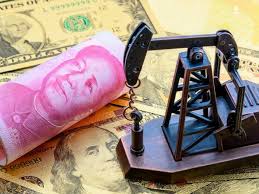
The petrodollar system has dominated the global oil trade for decades, primarily conducting oil transactions in U.S. dollars. This arrangement has reinforced U.S. financial dominance, strengthened the dollar as the world’s primary reserve currency, and allowed Washington to exert significant geopolitical influence. However, in recent years, China has actively pursued an alternative system: the petro-renminbi. By facilitating oil trade in its currency, China aims to reduce dependency on the dollar, challenge U.S. financial hegemony, and bolster its economic and geopolitical influence. This article explores the rise of the petro-renminbi, its impact on the petrodollar system, and the broader implications for global finance and geopolitics.


The Origins of the Petrodollar System. The petrodollar system was established in the 1970s following an agreement between the United States and Saudi Arabia. Under this arrangement, Saudi Arabia and other OPEC nations agreed to price and sell their oil exclusively in U.S. dollars. In return, the U.S. provided security guarantees and military support. This system had several key benefits for the U.S. Nations needed to hold large reserves of U.S. dollars to purchase oil, reinforcing the dollar’s status as the world’s dominant reserve currency. The U.S. could print money without significant inflationary consequences, as the global demand for dollars absorbed excess liquidity. The petrodollar system gave the U.S. considerable influence over global financial flows, enabling it to impose sanctions and restrict access to critical financial networks such as the Society for Worldwide Interbank Financial Telecommunication (SWIFT). While the petrodollar system remains dominant, cracks have begun to emerge as major economies, particularly China, seek alternatives.


Petro-Renminbi Strategy. China, the world’s largest oil importer, has demonstrated remarkable strategic foresight in its concern about its reliance on the U.S. dollar for energy transactions. The petro-renminbi strategy is a deliberate and well-thought-out effort by Beijing to internationalise the renminbi (RMB) and reduce its exposure to U.S. financial pressure. China launched yuan-denominated ‘crude oil futures’ on the International Energy Exchange in 2018, providing oil-exporting countries with an alternative pricing mechanism that does not depend on U.S. financial institutions. China has signed numerous agreements with oil-producing nations such as Russia, Iran, Venezuela, and Saudi Arabia, allowing them to settle oil transactions in the renminbi. To reassure oil-exporting nations hesitant to hold large amounts of yuan, China has provided an option to convert yuan payments into gold through the Shanghai Gold Exchange, thereby reducing counterparty risk and increasing confidence in the petro-renminbi system.


Key Supporters and Participants in the Petro-Renminbi System. Several countries have increasingly embraced the petro-renminbi system, either out of necessity due to U.S. sanctions or as part of broader geopolitical strategies. This shift could lead to increased economic cooperation and mutual benefit among major economies. Facing U.S. and European sanctions, Russia has shifted a significant portion of its oil trade to yuan-ruble transactions. Russia’s growing reliance on Chinese markets makes the yuan a natural alternative. The U.S. heavily sanctions Iran and Venezuela, and they have turned to China as a major buyer of their oil. Settling transactions in yuan helps them bypass the global dollar-based financial system. Saudi Arabia, while still closely aligned with the U.S., has shown growing interest in accepting yuan for oil sales to China. With China being its largest oil customer, Riyadh has economic incentives to diversify its financial options. With new members such as the UAE and Saudi Arabia, the expansion of BRICS suggests an increasing willingness among major economies to reduce dollar reliance in trade.


Challenges to the Petrodollar System. The rise of the petro-renminbi poses a direct challenge to the petrodollar system in several ways. If major oil-exporting nations increasingly price oil in renminbi, global demand for U.S. dollars will decline. This could lead to a gradual weakening of the dollar’s status as the dominant reserve currency. The U.S. has long used financial sanctions as a geopolitical tool. If more countries conduct energy trade outside the dollar system, Washington’s ability to enforce sanctions and economic restrictions will weaken. China and its allies are promoting alternatives to SWIFT, such as CIPS (China’s Cross-Border Interbank Payment System), reducing reliance on Western-controlled financial infrastructure.


Obstacles to the Petro-Renminbi’s Success. Despite its growing traction, the petro-renminbi faces several challenges that could limit its ability to replace the petrodollar fully. Unlike the U.S. dollar, which is freely convertible, the Chinese government maintains capital controls on the renminbi. This makes it less attractive as a global reserve currency. Many countries and financial institutions remain wary of China’s centralised economic policies and political interventions. Investors remain concerned about the stability and transparency of China’s financial markets. While Saudi Arabia is diversifying its financial partnerships, it still relies heavily on U.S. security guarantees. A full-scale shift away from the petrodollar would likely face significant pushback from Washington. These challenges, among others, underscore the complex dynamics at play in the global financial landscape.


Geopolitical and Economic Consequences. If the petro-renminbi continues to gain traction, the geopolitical landscape could undergo significant shifts. Reduced global demand for the dollar could increase inflationary pressures in the U.S. and make it more difficult for Washington to finance its debt through low-interest borrowing. However, this could also pave the way for a more balanced and equitable global financial system. Russia’s pivot to China for energy sales could accelerate the development of a yuan-based financial ecosystem, further eroding U.S. economic influence. Instead of a singularly dominant reserve currency, the global economy may move toward a multipolar system where multiple currencies (yuan, euro, gold-backed assets) play significant roles. Countries reliant on U.S. financial institutions may need to adjust their economic policies if alternative trade settlement systems become more widespread.


India and the Petro-Renminbi


The emergence of the petro-renminbi, China’s push to price oil in yuan instead of U.S. dollars, has significant implications for India. As the world’s third-largest oil importer, India relies on crude oil from the Middle East, Russia, and other major producers. If more of India’s key suppliers transition to the petro-renminbi model, New Delhi may have to make difficult choices regarding its financial strategy, trade policies, and diplomatic alignment. The shift toward yuan-based transactions could expose India to greater financial dependence on China, a country it sees as both an economic partner and a strategic rival. Given the history of border tensions, trade imbalances, and competing geopolitical ambitions, India would be cautious in allowing excessive yuan exposure in its energy transactions. While India has worked to diversify its energy sources and reduce reliance on any single power, the growing influence of the yuan in the global oil trade may force it to adjust its payment mechanisms, particularly with suppliers increasingly drawn into China’s economic orbit.


Beyond financial concerns, the petro-renminbi also presents strategic risks for India. If a significant portion of its oil imports shift to yuan-based payments, New Delhi’s economic vulnerability could be increased in any future diplomatic or military standoff with Beijing. Unlike China, which enjoys a trade surplus with most of its partners, India already faces a significant trade deficit with China. A move toward yuan-based oil payments would further entrench this imbalance, effectively deepening India’s reliance on the Chinese financial system. Moreover, a yuan-centric energy trade framework could push India closer to China’s Cross-Border Interbank Payment System (CIPS), which Beijing has promoted as an alternative to the U.S.-led SWIFT network. Given India’s strategic partnerships with the United States, Japan, and Europe, any shift toward China’s financial infrastructure could complicate its diplomatic positioning.


India has pursued several strategies to maintain financial and strategic autonomy. First, it has promoted rupee-based trade settlements, particularly with energy partners like Russia. Following Western sanctions on Moscow, India significantly increased its oil purchases from Russia and experimented with rupee-ruble transactions, although challenges remain due to currency convertibility issues. Second, India is strengthening its energy partnerships with non-China-aligned suppliers, such as the United States, Africa, and Latin America, to ensure a more diversified and secure oil supply chain. Third, New Delhi is accelerating investments in renewable energy and alternative fuels, such as green hydrogen, to reduce long-term reliance on imported oil. Lastly, India may seek to collaborate with other middle powers, such as the UAE and Saudi Arabia, to explore hybrid payment mechanisms that do not make it overly dependent on either the dollar or the yuan. While the yuan’s increasing presence in global energy markets is challenging, India’s best response will likely be a pragmatic, multi-aligned strategy that avoids excessive dependence on any one currency while ensuring its economic and geopolitical interests remain protected.


Conclusion. The rise of the petro-renminbi represents one of the most significant challenges to the petrodollar system. While it is unlikely to completely replace the U.S. dollar in global oil trade in the near term, its gradual adoption signals a shift in the international financial system. As China continues to deepen its economic ties with major oil-producing nations, the influence of the U.S. dollar in global trade may diminish over time. The outcome will depend on how effectively China addresses concerns over yuan convertibility, market confidence, and geopolitical tensions with the U.S. The U.S. may respond by strengthening its alliances, promoting the use of the dollar in other sectors, or developing new financial tools to maintain its influence. One thing is sure: the era of unquestioned dollar dominance is still facing its most serious challenge.


Please Do Comment.

1879
Default rating

Please give a thumbs up if you  like The Post?


For regular updates, please register your email here:-

Subscribe


References and credits

To all the online sites and channels.

References:-

  1. Eichengreen, Barry. Exorbitant Privilege: The Rise and Fall of the Dollar and the Future of the International Monetary System. Oxford University Press, 2011.
  1. Hudson, Michael. Super Imperialism: The Economic Strategy of American Empire. Pluto Press, 2021.
  1. Prasad, Eswar. The Dollar Trap: How the U.S. Dollar Tightened Its Grip on Global Finance. Princeton University Press, 2014.
  1. Cohen, Benjamin. “The Future of the Dollar: Dominance or Decline?” International Affairs, vol. 87, no. 3, 2011, pp. 621-636.
  1. Subacchi, Paola. The People’s Money: How China Is Building a Global Currency. Columbia University Press, 2017.
  1. Ghosh, Swapan-Kumar, and Acharya, Debashis. “De-Dollarization and the Rise of the Petro-Renminbi: Implications for Global Trade.” Journal of International Economics, vol. 45, no. 2, 2022, pp. 105-123.
  1. International Monetary Fund (IMF). The Role of the Renminbi in the International Monetary System. IMF Working Paper, 2020.
  1. Bank for International Settlements (BIS). Cross-Border Payments and Alternative Currency Systems. 2023.
  2. Bloomberg. “Saudi Arabia and China in Talks Over Petro-Yuan Oil Deals.” Bloomberg News, March 15, 2022.
  1. The Financial Times. “The Yuan’s Rise in Global Trade and the Push to Challenge the Dollar.” FT.com, September 12, 2023.
  1. The Economist. “The Petro-Dollar’s Future: Is the World Moving Toward a Multipolar Reserve System?” The Economist, July 8, 2022.
  1. Reuters. “China’s CIPS vs. SWIFT: A Growing Rivalry in Global Payments?” Reuters Business, August 4, 2023.
  1. The Wall Street Journal. “Why China Wants to Break the Dollar’s Grip on Oil.” WSJ, November 19, 2022.
  1. Foreign Affairs. “How the U.S. Dollar Still Dominates Despite Global Challenges.” Foreign Affairs, April 2023.

Disclaimer:

Information and data included in the blog are for educational & non-commercial purposes only and have been carefully adapted, excerpted, or edited from reliable and accurate sources. All copyrighted material belongs to respective owners and is provided only for wider dissemination.


636: PSYCHOLOGICAL WARFARE IN UKRAINE: SUCCESS OR FAILURE


My Article was published in the News Analytics Journal of Mar 25.


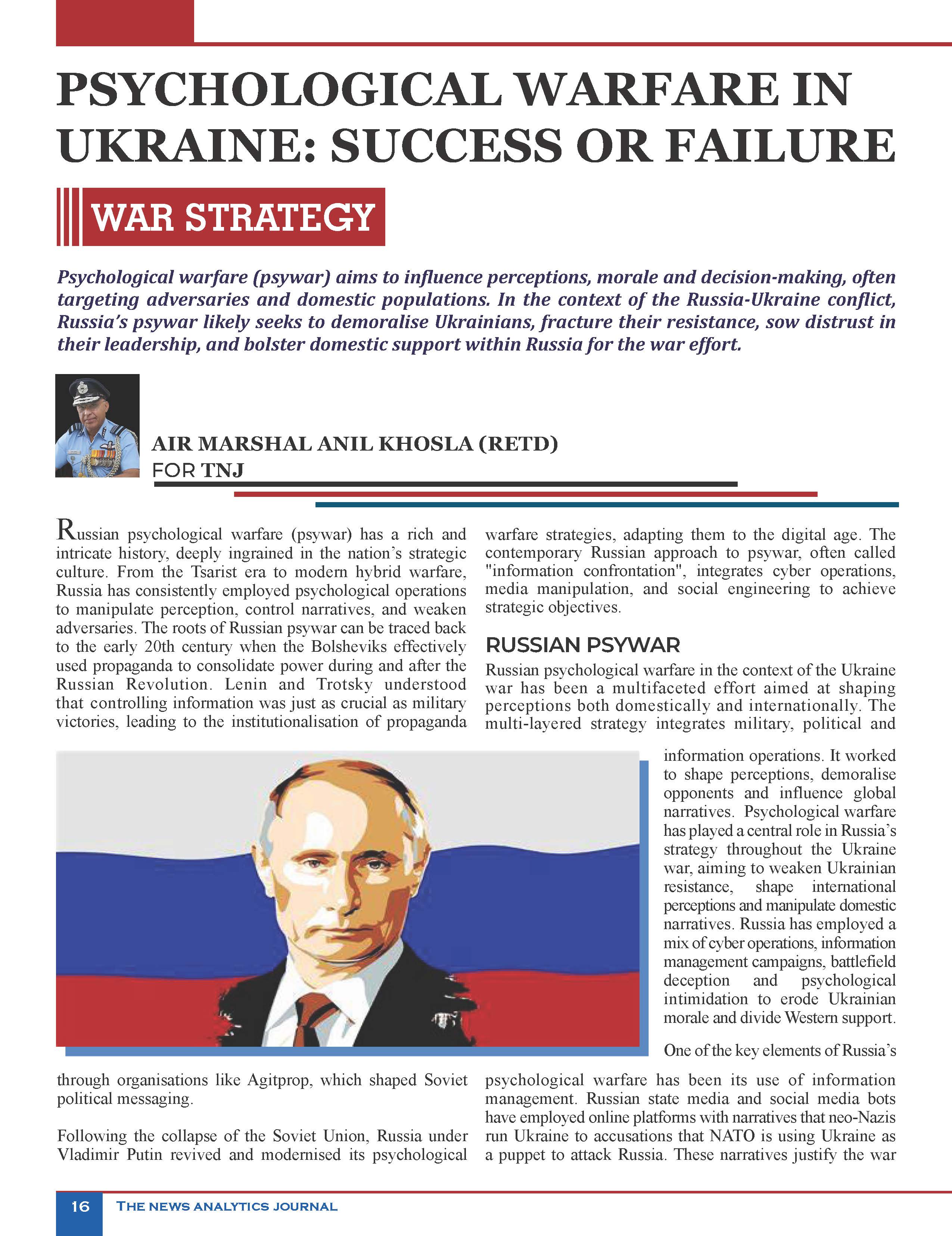
Psychological warfare (psywar) aims to influence perceptions, morale, and decision-making, often targeting adversaries and domestic populations. In the context of the Russia- Ukraine conflict, Russia’s psywar likely seeks to demoralise Ukrainians, fracture their resistance, sow distrust in their leadership, and bolster domestic support within Russia for the war effort. An evaluation of Russia’s psychological warfare (psywar) in Ukraine would need an assessment of its objectives, tactics, and measurable impacts based on available evidence and recent developments.  This paper argues that while Russia’s psychological warfare has succeeded in shaping domestic narratives and straining Western unity, it has failed to break Ukrainian resistance or achieve a decisive strategic victory.


Historical Perspective of Russian Psychological Warfare

Russian psychological warfare (psywar) has a rich and intricate history, deeply ingrained in the nation’s strategic culture. From the Tsarist era to modern hybrid warfare, Russia has consistently employed psychological operations to manipulate perception, control narratives, and weaken adversaries. The roots of Russian psywar can be traced back to the early 20th century when the Bolsheviks effectively used propaganda to consolidate power during and after the Russian Revolution. Lenin and Trotsky understood that controlling information was just as crucial as military victories, leading to the institutionalisation of propaganda through organisations like Agitprop, which shaped Soviet political messaging.

During the early Soviet period, psywar techniques were used not only to suppress internal dissent but also to influence communist movements worldwide. The concept of “reflexive control,” developed in Soviet military thought, became a key element of Russian psywar, aiming to manipulate opponents into making decisions that ultimately benefit Russian interests. By the time of World War II, Soviet psychological operations had evolved into large-scale deception campaigns, including the use of maskirovka (military deception) to mislead Nazi Germany. Throughout the Cold War, the Soviet Union refined these methods, launching extensive “Active Measures” under the KGB to manage information and exploit societal divisions in Western nations.

Following the collapse of the Soviet Union, Russia, under Vladimir Putin, revived and modernised its psychological warfare strategies, adapting them to the digital age. The contemporary Russian approach to psywar, often called “information confrontation”, integrates cyber operations, media manipulation, and social engineering to achieve strategic objectives.


Russian Psywar during the Ukraine War

Russian psychological warfare in the context of the Ukraine war has been a multifaceted effort aimed at shaping perceptions both domestically and internationally. The multi-layered strategy integrates military, political, and information operations to shape perceptions, demoralise opponents, and influence global narratives.  Psychological warfare has played a central role in Russia’s strategy throughout the Ukraine war, aiming to weaken Ukrainian resistance, shape international perceptions, and manipulate domestic narratives. Russia has employed a mix of cyber operations, information management campaigns, battlefield deception, and psychological intimidation to erode Ukrainian morale and divide Western support.

One of the key elements of Russia’s psychological warfare has been its use of information management. Russian state media and social media bots have employed online platforms with narratives that neo-Nazis run Ukraine to accusations that NATO is using Ukraine as a puppet to attack Russia. These narratives justify the war to the Russian population, confuse Ukrainian citizens, and create divisions within Western democracies by amplifying anti-war and isolationist sentiments. Russian narratives have also sought to exploit war fatigue in Western nations, emphasising that financial and military support for Ukraine is futile, expensive, or escalatory.

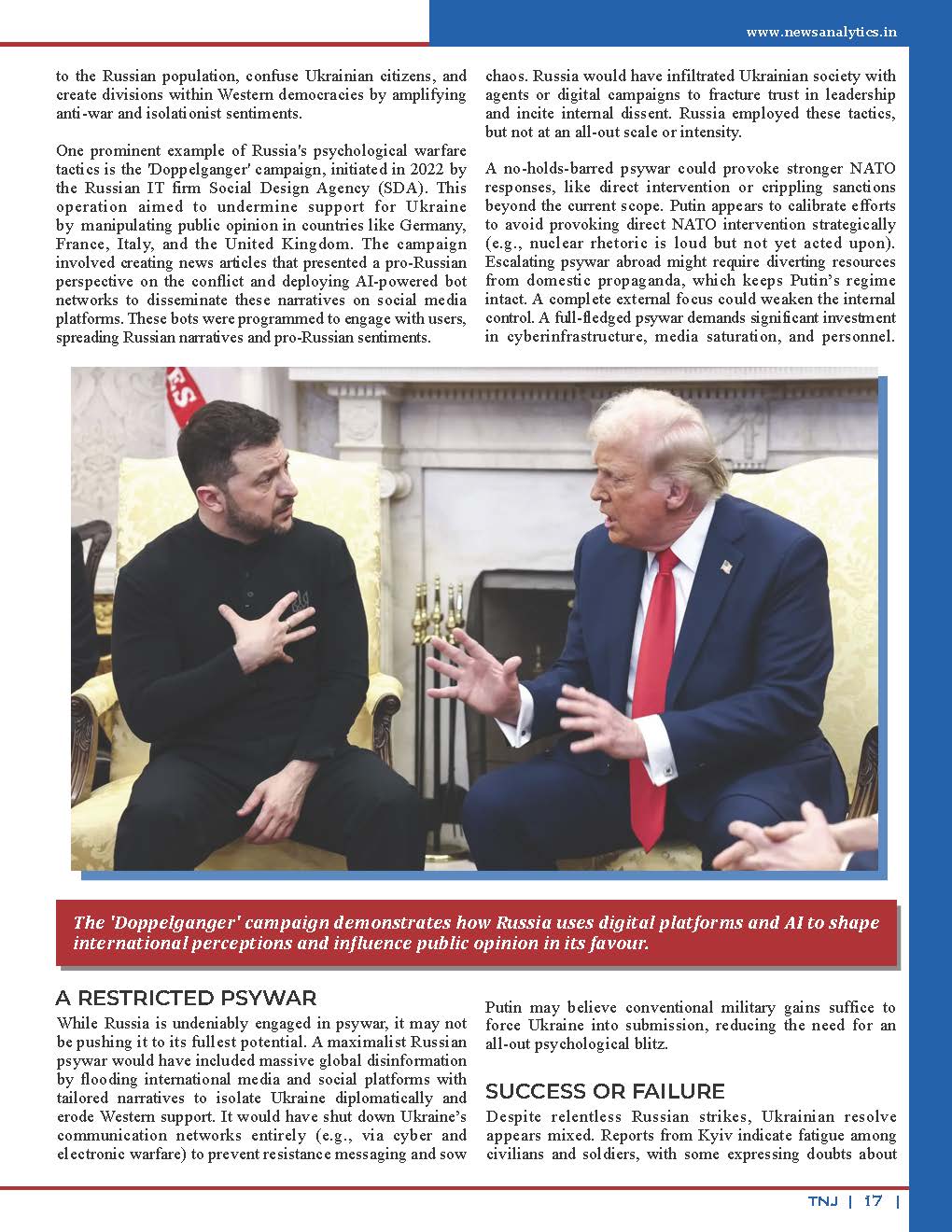
One prominent example of Russia’s psychological warfare tactics is the ‘Doppelganger’ campaign initiated in 2022 by the Russian IT firm Social Design Agency (SDA). This operation aimed to undermine support for Ukraine by manipulating public opinion in countries like Germany, France, Italy, and the United Kingdom. The campaign involved creating news articles that presented a pro-Russian perspective on the conflict and deploying AI-powered bot networks to disseminate these narratives on social media platforms. These bots were programmed to engage with users, spreading Russian narratives and pro-Russian sentiments. The ‘Doppelganger’ campaign demonstrates how Russia uses digital platforms and AI to shape international perceptions and influence public opinion in its favour.

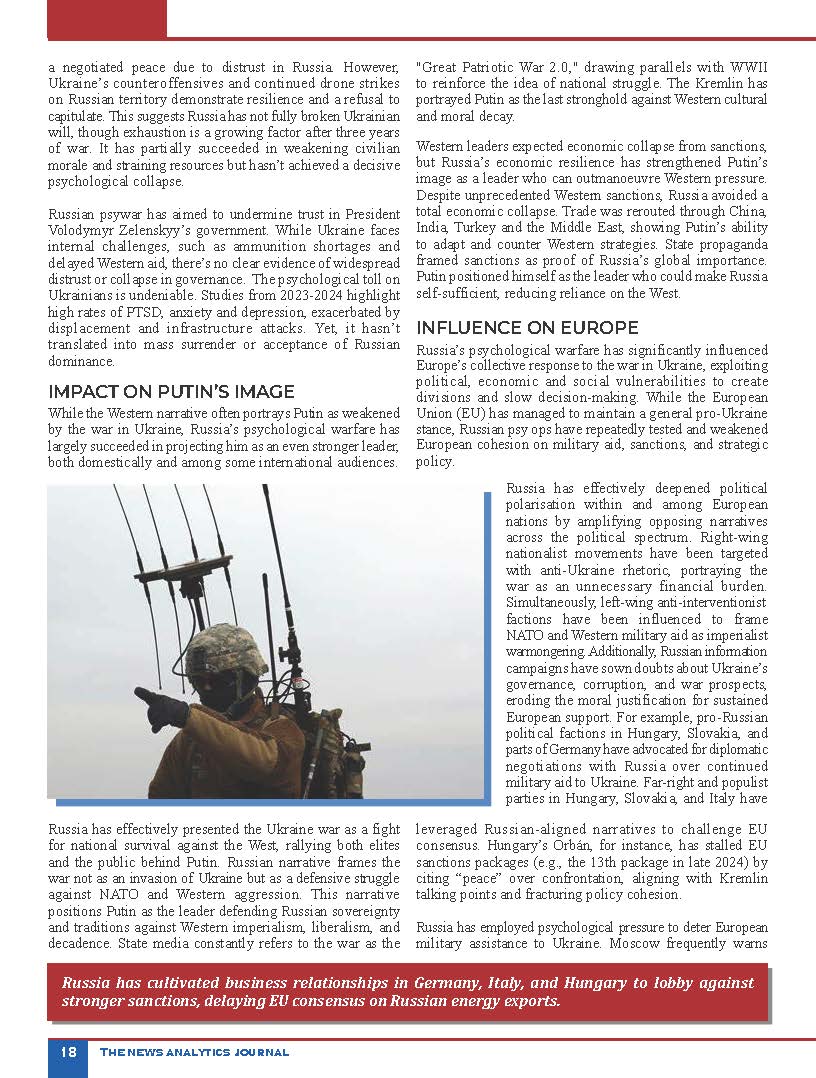
Cyber warfare has also been a critical psychological tool. Russian cyber groups have often launched cyber attacks on Ukrainian government institutions, banks, and critical infrastructure. Beyond disabling systems, these attacks serve a psychological function, creating uncertainty, fear, and the impression that Ukraine’s leadership cannot protect its citizens.  Russian cyber efforts extend beyond Ukraine, targeting Western institutions with cyber sabotage to weaken overall support for Kyiv.


All-Out or Restricted Psywar.

While Russia is undeniably engaged in psywar, it may not be pushing it to its fullest potential. A maximalist Russian psywar would have included massive global disinformation by flooding international media and social platforms with tailored narratives to isolate Ukraine diplomatically and erode Western support. It would have shut down Ukraine’s communication networks entirely (e.g., via cyber and electronic warfare) to prevent resistance messaging and sow chaos. Russia would have infiltrated Ukrainian society with agents or digital campaigns to fracture trust in leadership and incite internal dissent. Russia employed these tactics, but not at an all-out scale or intensity.

Russia isn’t indulging in a full-fledged war not because it’s unwilling but because strategy, resources, and context constrain it. The war’s hybrid nature means that psywar is a key component, but it’s subordinated to military and economic priorities rather than unleashed as a standalone juggernaut. Russia seems content with a steady, if not maximal, psychological pressure adequate to grind Ukraine down but not bold enough to gamble on total dominance.

Strategic Restraint or Compulsion.  A no-holds-barred psywar could provoke stronger NATO responses, like direct intervention or crippling sanctions beyond the current scope. Putin appears to calibrate efforts to avoid provoking direct NATO intervention strategically (e.g., nuclear rhetoric is loud but not yet acted upon). Escalating psywar abroad might require diverting resources from domestic propaganda, which keeps Putin’s regime intact. A complete external focus could weaken the internal control. A full-fledged psywar demands significant investment in cyberinfrastructure, media saturation, and personnel. Putin may believe conventional military gains suffice to force Ukraine into submission, reducing the need for an all-out psychological blitz.


Success or Failure

Despite relentless Russian strikes, Ukrainian resolve appears mixed. Reports from Kyiv indicate fatigue among civilians and soldiers, with some expressing doubts about a negotiated peace due to distrust in Russia. However, Ukraine’s counteroffensives and continued drone strikes on Russian territory demonstrate resilience and a refusal to capitulate. This suggests Russia has not fully broken Ukrainian will, though exhaustion is a growing factor after three years of war. It has partially succeeded in weakening civilian morale and straining resources but hasn’t achieved a decisive psychological collapse.

Russian psywar has aimed to undermine trust in President Volodymyr Zelenskyy’s government. While Ukraine faces internal challenges, such as ammunition shortages and delayed Western aid, there’s no clear evidence of widespread distrust or collapse in governance.  The psychological toll on Ukrainians is undeniable. Studies from 2023-2024 highlight high rates of PTSD, anxiety, and depression exacerbated by displacement and infrastructure attacks. Yet, it hasn’t translated into mass surrender or acceptance of Russian dominance.


Impact on Putin’s Image

While the Western narrative often portrays Putin as weakened by the war in Ukraine, Russia’s psychological warfare has succeeded mainly in projecting him as an even stronger leader, both domestically and among some international audiences.

Russia has effectively presented the Ukraine war as a fight for national survival against the West, rallying both elites and the public behind Putin. The Russian narrative frames the war not as an invasion of Ukraine but as a defensive struggle against NATO and Western aggression. This narrative positions Putin as the leader defending Russian sovereignty and traditions against Western imperialism, liberalism, and decadence. State media constantly refers to the war as the “Great Patriotic War 2.0,” drawing parallels with WWII to reinforce the idea of national struggle. The Kremlin has portrayed Putin as the last stronghold against Western cultural and moral decay. Messaging around traditional values, national pride, and resistance to globalisation strengthens his appeal among conservative Russians and foreign audiences in the Global South.  The War has allowed Putin to eliminate political threats, tighten control over society, and silence opposition, reinforcing his image as an unchallenged ruler.

Western leaders expected economic collapse from sanctions, but Russia’s economic resilience has strengthened Putin’s image as a leader who can outmanoeuvre Western pressure. Despite unprecedented Western sanctions, Russia avoided a total economic collapse. Trade was rerouted through China, India, Turkey, and the Middle East, showing Putin’s ability to adapt and counter Western strategies. State propaganda framed sanctions as proof of Russia’s global importance. Putin positioned himself as the leader who could make Russia self-sufficient, reducing its reliance on the West.


Influence on Europe.

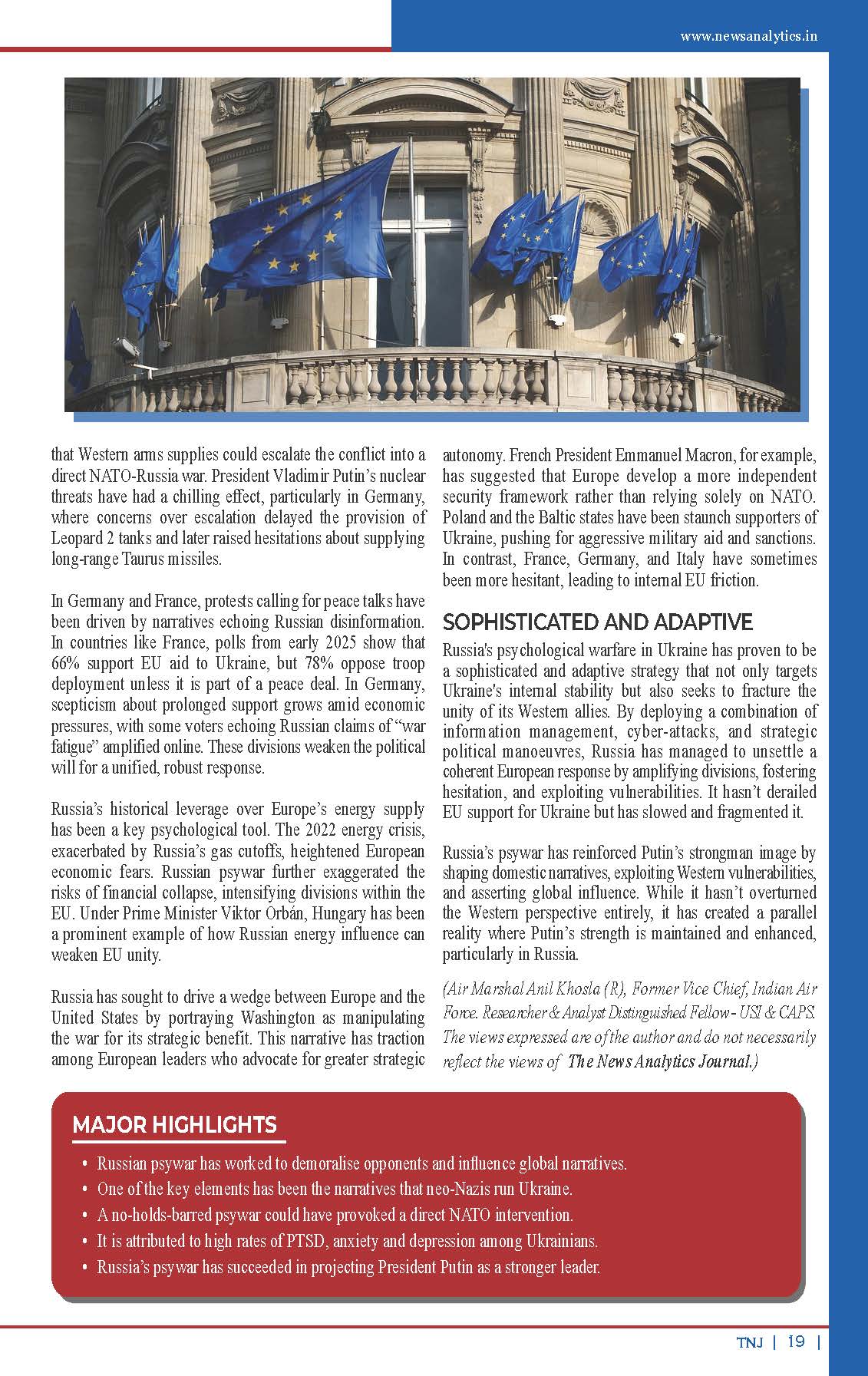
Russia’s psychological warfare has significantly influenced Europe’s collective response to the war in Ukraine, exploiting political, economic, and social vulnerabilities to create divisions and slow decision-making. While the European Union (EU) has managed to maintain a generally pro-Ukraine stance, Russian psy ops have repeatedly tested and weakened European cohesion on military aid, sanctions, and strategic policy.

 Exploiting Political Divisions in Europe. Russia has effectively deepened political polarisation within and among European nations by amplifying opposing narratives across the political spectrum. Right-wing nationalist movements have been targeted with anti-Ukraine rhetoric, portraying the war as an unnecessary financial burden. Simultaneously, left-wing anti-interventionist factions have been influenced to frame NATO and Western military aid as imperialist warmongering. Additionally, Russian information campaigns have sown doubts about Ukraine’s governance, corruption, and war prospects, eroding the moral justification for sustained European support. For example, pro-Russian political factions in Hungary, Slovakia, and parts of Germany have advocated for diplomatic negotiations with Russia over continued military aid to Ukraine. This has complicated EU-wide decision-making, as unanimous support is often required for major foreign policy measures. Far-right and populist parties in Hungary, Slovakia, and Italy have leveraged Russian-aligned narratives to challenge the EU consensus. Hungary’s Orbán, for instance, has stalled EU sanction packages (e.g., the 13th package in late 2024) by citing “peace” over confrontation, aligning with Kremlin talking points and fracturing policy cohesion.

 Weakening European Resolve on Military Aid. Russia has employed psychological pressure to deter European military assistance to Ukraine. Moscow frequently warns that Western arms supplies could escalate the conflict into a direct NATO-Russia war. President Vladimir Putin’s nuclear threats have had a chilling effect, particularly in Germany, where concerns over escalation delayed the provision of Leopard 2 tanks and later raised hesitations about supplying long-range Taurus missiles. Public opinion has also been a battleground for Russian influence. Moscow-backed media and social media campaigns have exaggerated the economic hardships caused by military aid, fuelling war fatigue. In Germany and France, protests calling for peace talks have been driven by narratives echoing Russian disinformation. In countries like France, polls from early 2025 show that 66% support EU aid to Ukraine, but 78% oppose troop deployment unless it is part of a peace deal. In Germany, scepticism about prolonged support grows amid economic pressures, with some voters echoing Russian claims of “war fatigue” amplified online. These divisions weaken the political will for a unified, robust response.

Economic Warfare and the Energy Weapon. Russia’s historical leverage over Europe’s energy supply has been a key psychological tool. The 2022 energy crisis, exacerbated by Russia’s gas cutoffs, heightened European economic fears. Russian psywar further exaggerated the risks of economic collapse, intensifying divisions within the EU. Under Prime Minister Viktor Orbán, Hungary has been a prominent example of how Russian energy influence can weaken EU unity. Orbán has repeatedly blocked or diluted Russian oil and gas sanctions, citing economic concerns. Additionally, Russia has cultivated business relationships in Germany, Italy, and Hungary to lobby against stronger sanctions, delaying EU consensus on measures such as price caps on Russian energy exports.

Encouraging Fractures in NATO and the EU. Russia has sought to drive a wedge between Europe and the United States by portraying Washington as manipulating the war for its strategic benefit. This narrative has traction among European leaders who advocate for greater strategic autonomy. French President Emmanuel Macron, for example, has suggested that Europe develop a more independent security framework rather than relying solely on NATO. Russian psyops have also exacerbated differences between Eastern and Western Europe. Poland and the Baltic states have been staunch supporters of Ukraine, pushing for aggressive military aid and sanctions. In contrast, France, Germany, and Italy have sometimes been more hesitant, leading to internal EU friction. Russia amplifies these divisions to slow collective decision-making, delaying much-needed aid to Ukraine.


Conclusion

Russia’s psychological warfare in Ukraine has proven to be a sophisticated and adaptive strategy that not only targets Ukraine’s internal stability but also seeks to fracture the unity of its Western allies. By deploying a combination of information management, cyber-attacks, and strategic political manoeuvres, Russia has managed to unsettle a coherent European response by amplifying divisions, fostering hesitation, and exploiting vulnerabilities. It hasn’t derailed EU support for Ukraine but has slowed and fragmented it.

Russia’s psywar has reinforced Putin’s strongman image by shaping domestic narratives, exploiting Western vulnerabilities, and asserting global influence. While it hasn’t overturned the Western perspective entirely, it has created a parallel reality where Putin’s strength is maintained and enhanced, particularly among Russian and non-Western audiences. Whether this perception holds as the war evolves remains uncertain, but for now, Russia’s psywar has undeniably kept Putin’s strongman myth alive and potent.


Please Do Comment.


1879
Default rating

Please give a thumbs up if you  like The Post?


For regular updates, please register your email here:-

Subscribe


References and credits

To all the online sites and channels.

Pics Courtesy: Internet

Disclaimer:

Information and data included in the blog are for educational & non-commercial purposes only and have been carefully adapted, excerpted, or edited from reliable and accurate sources. All copyrighted material belongs to respective owners and is provided only for wider dissemination.


References:-

  1. Thomas, Timothy. 2021. “Russian Military Thought: Concepts of Psychological Operations.” Journal of Slavic Military Studies 34 (1): 1-24.
  1. NATO Strategic Communications Centre of Excellence. 2022. “Russia’s Grand Strategy in the Information Space.” Riga: NATO StratCom COE.
  1. RAND Corporation. 2021. “Russian Information Warfare: The Role of Narrative and Propaganda.” Santa Monica, CA: RAND Corporation.
  1. European Council on Foreign Relations. 2022. “The Kremlin’s Playbook: Russia’s Information Operations in Europe.”
  1. Carnegie Europe. 2022. “Why Europe is Struggling to Counter Russian Information Warfare.” Brussels: Carnegie Europe.
  1. European Union External Action Service (EEAS). 2023. “Russia’s Disinformation Ecosystem and its Impact on Europe.”
  1. Chatham House. 2023. “Putin’s Strongman Image and the Role of Propaganda.” London: Chatham House.
  1. The Atlantic Council. 2023. “The Resilience of Putin’s Popularity Amid Western Sanctions.” Washington, D.C.: The Atlantic Council.
  1. The Wilson Center. 2022. “How Putin Weaponises Weakness Perception.” Washington, D.C.: The Wilson Center.
  1. Harding, Luke. 2023. Invasion: Russia’s Bloody War and Ukraine’s Fight for Survival. London: Guardian Faber.
  1. Kofman, Michael, and Rob Lee. 2024. “Assessing Ukraine’s Strategy Amidst Western Uncertainty.” War on the Rocks, February 10, 2024.
  1. The Guardian. 2024. “EU Divided Over Continued Support for Ukraine.” March 2024.
  1. NATO Strategic Communications Centre of Excellence. Reports on Russian Information Warfare. Accessed March 2024.
  1. Brookings Institution. 2023. “The West’s Cognitive Dissonance on Russia: A Strategic Weakness.” Washington, D.C.: Brookings Institution.

English हिंदी