
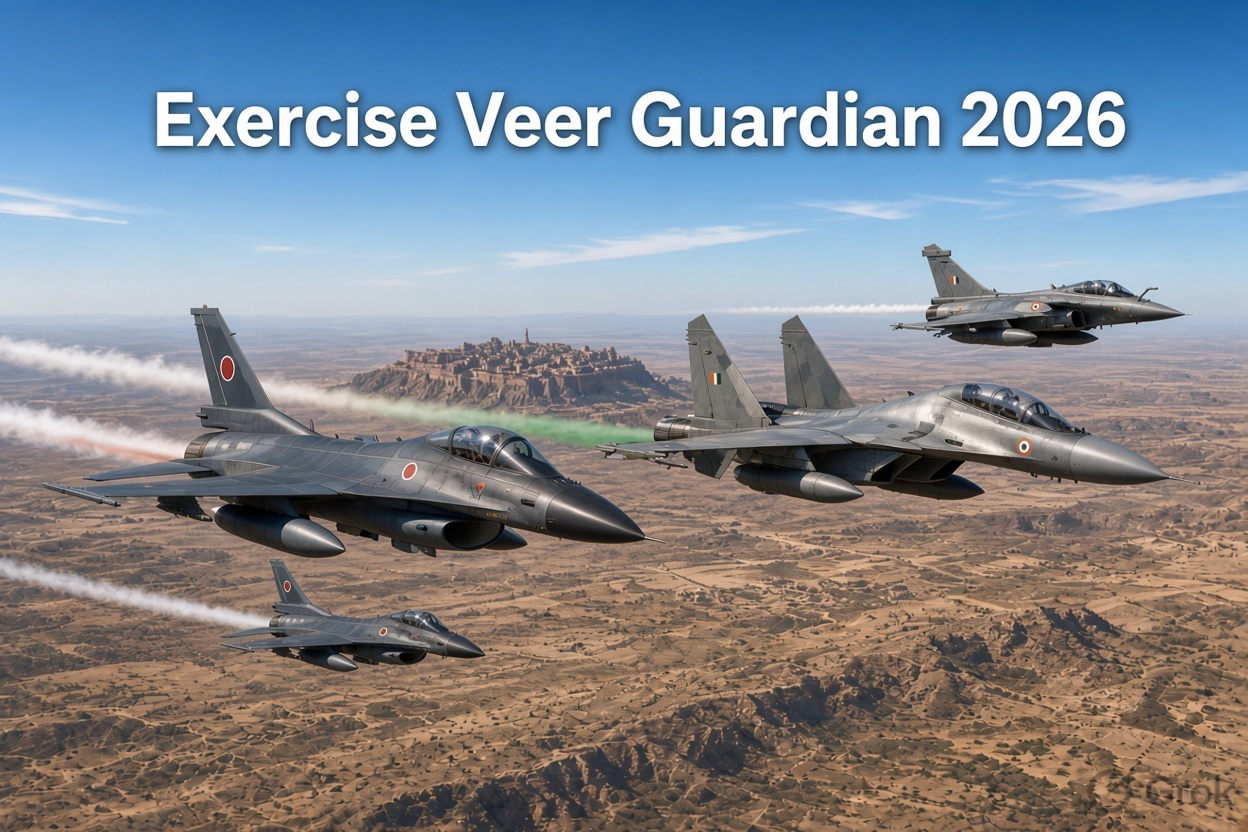
Inputs shared with journalists on the joint Indo-Japan air exercise “Veer Guardian 2026”
India and Japan’s air forces will conduct a joint training exercise, Veer Guardian 26, from September 9 to 21 in the Jodhpur area of Rajasthan, western India. As part of the joint training, Tokyo will deploy three F-2 fighter jets to India, as well as about 110 personnel from the Eighth Air Wing stationed at Tsuiki Airbase in southwestern Japan’s Fukuoka prefecture.
The first-time deployment of Japan’s fighter aircraft for Exercise Veer Guardian 26 is an important milestone in India–Japan air cooperation. High-end air combat training on each other’s soil signals a major increment in the partnership and defence cooperation.
Air Exercise
Veer Guardian introduces cooperation at the sharp end of air power: fighter operations, mission planning, air-combat training, communications, deconfliction and the practical problems of deploying and sustaining aircraft on a foreign airbase. The larger objective is therefore not platform-versus-platform competition, but gradually building a more interoperable air ecosystem.
The exercise provides both sides with an opportunity to understand different operating philosophies and equipment ecosystems. The JASDF operates predominantly US-origin or US-derived platforms, while the IAF fields a much more diverse inventory combining Russian, French, Israeli, indigenous and other technologies. Training across these differences matters because interoperability cannot be created through political agreements alone. It has to be built through repeated operational contact.
Strategic and Geopolitical Importance
For years, Indo-Japan bilateral security cooperation has been centred on diplomatic consultations, senior-level exchanges, logistics arrangements and broader Indo-Pacific initiatives. That relationship is now acquiring a more operational character.
The agreements reached during the India-Japan defence ministerial meeting (in August 2026) confirm this trend. The two countries agreed to conduct more complex exercises at short notice. They also agreed to expand cooperation in operational activities, intelligence, equipment, technology, and the defence industry.
That makes Veer Guardian 2026 less an isolated fighter exercise than one component of an increasingly institutionalised defence relationship under the India-Japan “Special Strategic and Global Partnership.”
The exercise aligns with other tracks of a more resilient partnership, namely defence industry cooperation, maritime domain awareness, and economic security.
For Japan, this is part of a broader shift from “defence only” postures to expeditionary, coalition-capable air operations, including long-range deployments and integration with non-US partners.
Indo-Pacific context
Exercise Veer Guardian 26 also fits well within the larger Indo-Pacific framework. It follows the India–Japan agreement on Maritime Security Cooperation, signed at the defence ministers’ meeting on 20 Aug 26. The agreement stresses interoperability, security of the sea lanes of communication, and a ‘stable Indo-Pacific order’.
It dovetails with other bilateral/multilateral drills: Malabar (navies), Dharma Guardian (armies), JAIMEX (special forces), and the expanding US–Japan–India–Australia web of exercises.
Strategically, this is a sort of minilateralism. Defence ties and cooperation without a formal alliance. It should be viewed as one component of a much larger India-Japan military relationship that is becoming increasingly operational.
Upset China
India maintains defence and strategic relationships with a wide range of countries (including the United States, Japan, France, Russia and Southeast Asian partners. Its objective is to expand strategic options rather than subordinate its security policy to any single bloc.
India conducts joint exercises with numerous nations to learn best practices and improve interoperability. These engagements do not mean that India is joining a military bloc. This is best understood as alignment without alliance. India’s participation should therefore not be interpreted as a decision to join an anti-China coalition. Veer Guardian fits that model, and not every event should be viewed through a China lens.
Japan and India confront different manifestations of the same broad strategic challenge. Japan is increasingly concerned about China’s military power and its activities in the East China Sea, around the Senkaku/Diaoyu Islands and across the western Pacific. India faces China along the Line of Actual Control and is increasingly attentive to China’s maritime presence in the Indian Ocean.
India and Japan are Special Strategic and Global Partners with converging interests in the Indo-Pacific. Both countries have disagreements and clash of interest with China. They view China’s military modernisation, grey-zone activities and territorial assertiveness as challenges. Such joint military events naturally make China wary and uncomfortable.
Future Trajectory
Veer Guardian 26 can be seen as an early building block of a much deeper India-Japan security relationship. Such frequent, routine deployments reduce political and logistical barriers. Future exercises could involve larger participation and scope. Deployments could include more fighter aircraft, support aircraft, unmanned systems, and electronic-warfare elements. They could expand to include more complex fighter training, stronger logistics cooperation, and increasingly rapid or short-notice deployments.
Concluding Thoughts
The scale of Japanese participation (with three fighters and about 110 personnel) is modest. Veer Guardian 26 is therefore best understood as a milestone rather than a military game-changer. Its immediate combat value may be limited, but its interoperability dividend is significant. Its political signalling value is even greater.
The exercise demonstrates that:
-
- Japan can deploy combat aircraft to India and sustain them there;
- the two air forces are willing to deepen tactical interoperability;
- Japan is gaining experience operating militarily farther from its immediate home environment;
- the bilateral relationship is becoming increasingly connected to the wider Indo-Pacific security architecture.
The future iterations are likely to grow in complexity if the political relationship and defence cooperation continue on their current trajectory.
Bottom Line
India and Japan are not creating an alliance. They are creating the interoperable capacity to act together.
Link to the quoted article on the subject:-
Please Add Value to the write-up with your views on the subject.
For regular updates, please register your email here:-
References and credits
To all the online sites and channels.
Pics Courtesy: Internet
Disclaimer:
Information and data included in the blog are for educational & non-commercial purposes only and have been carefully adapted, excerpted, or edited from reliable and accurate sources. All copyrighted material belongs to the respective owners and is provided only for wider dissemination.
References: –
- Japan Ministry of Defence, “Japan-India joint press statement”, Japan Ministry of Defence, 20 Aug 26.
- Japan Ministry of Defence, “Extraordinary press conference by Defence Minister Koizumi on Thursday, August 20, 2026, at 3:02 PM”, Japan Ministry of Defence, 20 Aug 26.
- Ministry of Defence, Government of India, “IAF & Japan Air Self Defence Force set to exercise jointly in Japan”, Press Information Bureau. 07 Jan 26.
- Ministry of Defence, Government of India, “IAF’s joint air defence exercise with Japan, ‘Veer Guardian 2023’ concludes”, Press Information Bureau. 27 Jan 26.
- Embassy of India, Tokyo, “Veer Guardian 2023”, Embassy of India, Tokyo, 2026.
- Embassy of India, Tokyo, “India-Japan defence cooperation”, Embassy of India, Tokyo, 2026.
- The Diplomat, “JASDF fighter jets to visit India for first time”, The Diplomat, Aug 26.