
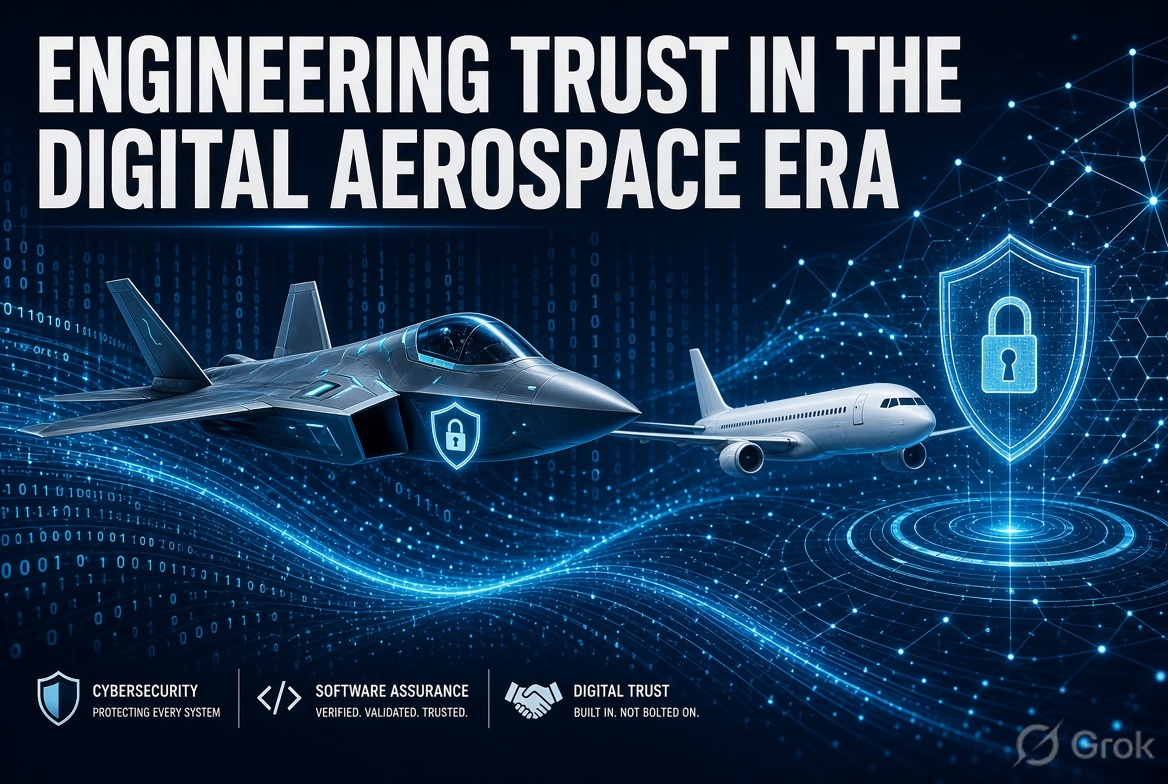
849: ENGINEERING TRUST IN THE DIGITAL AEROSPACE ERA


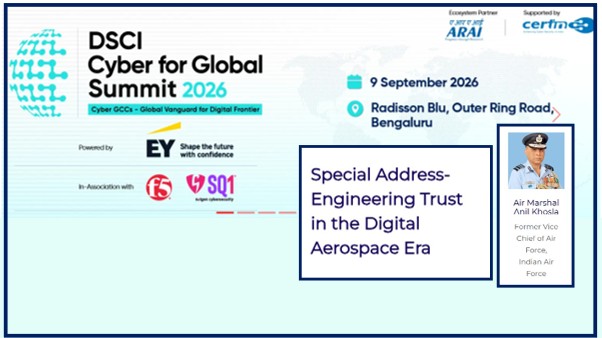
Shared my views on the subject at the DSCI Summit

on 09 Sep 26


Aerospace is undergoing the deepest transformation since the shift from piston to jet propulsion, except that this one is digital rather than mechanical. Aerospace systems are becoming software-defined, networked, and AI-enabled.

Flight control laws, mission systems, maintenance procedures, and command networks are increasingly mediated by software, sensors, and, increasingly, machine learning models.  These models can make decisions or influence them at a speed no human operator can independently verify in real time.

In an era where aerospace systems are defined as much by lines of code as by laws of aerodynamics. A compromise of software, data or communications can have consequences comparable to physical damage. In this environment, the “Engineering Trust” is taking on a new connotation.


Transformation of the Definition of “Engineering Trust”.

Engineering trust means designing, testing, and building systems so predictably safe and transparent that humans and regulators can rely on them without hesitation. The digital aerospace era has transformed the scope of “engineering trust”. Beyond the stated definition, it now also includes “having complete confidence that digital tools, data networks, and artificial intelligence (AI) systems are safe, secure, and fully verified”.

Trust must therefore extend from the physical platform to code, data, identity, networks, AI and the supply chain. It is no longer merely a peripheral technical concern. Engineering trust has become a central focus. Engineering digital trust requires validating each link, including hardware, flight software, network communications, and operational execution. It must be demonstrated, verified, and maintained throughout the system lifecycle.

The challenges relate to both the software code and the Data.

    • Code-related matters emphasise the importance of trust, Verification, authentic updates, and isolating compromised software to enhance resilience.
    • Data-related matters include data poisoning, Model manipulation, Adversarial inputs, AI Hallucination, unreliable outputs, and supply-chain digital compromises.


Core Pillars of Digital Aerospace Trust

Safety, Reliability, and Airworthiness. Safety, reliability, and airworthiness require that digital systems (such as flight controls, mission systems, avionics, MRO platforms, and autonomous functions) act predictably in normal, failed, and off-nominal situations without compromising platform or mission safety.

Cybersecurity and Cyber Resilience. The term cybersecurity, with an expanding scope, has been transformed into “digital mission assurance”. Aircraft, satellites, ground systems, and supporting infrastructure must be protected against cyber threats. Protective systems must prevent, detect, contain, withstand, and recover from attacks. This protection is required across the product lifecycle and supply chain.

Software Assurance and Verification. The development, verification, and certification of flight-critical software must be thorough and should follow the certification procedures adopted by aviation regulatory bodies such as the FAA and EASA. Formal methods and mathematical verification can complement testing and provide greater assurance of correctness, especially for functions that require a high level of assurance. Assurance must also extend to software updates, digital twins, and the growing number of adaptive systems.

Data Integrity and Sovereignty. Ensuring data integrity and sovereignty means that navigation, telemetry, sensor, maintenance, and operational data must be accurate, genuine, and readily available. It must also be protected against manipulation or spoofing.  Solid data pipelines, anti-spoofing methods, and sensor integration (for example, combining GNSS, INS, and optical tracking) can increase resilience. Regarding data sovereignty, it is also necessary to control where the data is stored, who can access it, and which legal or regulatory system applies, especially for multinational and classified programs.

AI Trustworthiness and Bounded Autonomy. AI/ML is used in predictive maintenance, decision support, pilot assistance, and autonomous systems. In these cases, evidence of robustness, transparency, accountability, and suitable human oversight is required. Autonomous features must operate within clearly defined and verifiable safety limits; deterministic safety mechanisms or “wrappers” (protective software boundaries or guardrails that surround an adaptive AI algorithm to restrict its behaviour and ensure safety) should keep adaptive algorithms within their certified operational envelopes.

Human–Machine Trust. The trust humans place in automation requires that pilots, engineers, and operators have enough insight into the system’s status, limitations, uncertainty, and decision-making logic to know when to rely on the automation and when to intervene or take over.

Supply-Chain and Firmware Integrity. Trust must extend throughout the entire manufacturing process, from component sourcing to software development, integration, deployment, and maintenance.

Continuous Lifecycle Assurance.  Trust cannot be established once and then assumed; it must be maintained through configuration control, monitoring, vulnerability management, software updates, supplier changes, operational data, and evidence provided throughout the entire system lifecycle.


Policy Framework for Engineering Trust in the Digital Era

Appropriate measures are required to ensure that India’s digital ecosystem for the aerospace and defence sector is secure, sovereign, traceable, certifiable and internationally trusted. The framework should contribute to national security, speed up the adoption of digital engineering and AI, improve supply chain resilience, support certification and exports, and, at the same time, increase confidence in India’s expanding indigenous aerospace and defence industrial base.

Make Digital Engineering Safe and Trustworthy. Set up a reliable digital engineering framework for the aerospace and defence sectors to guarantee the safety, reliability, security, and integrity of digital models, software, hardware, and digital twins. Adopt internationally recognised aerospace standards where appropriate and create end-to-end digital traceability covering the entire process from requirements, through design, implementation, verification, to certification. At the same time, maximise the automation of verification and testing and incorporate cybersecurity throughout the entire engineering lifecycle.

Protect Manufacturing and MRO from Cyber Attacks. Build robust and cyber-secure manufacturing, maintenance, repair and overhaul (MRO), testing, and operating environments using zero-trust principles. Ensure strong identity management, multi-factor authentication, least-privilege access, network segmentation, continuous monitoring, and strict third-party controls are in place. Cybersecurity requirements must cover the entire supply chain, including measures to ensure production and maintenance can continue during a cyber incident.

Make AI Safe and Trustworthy. We should establish a governance and assurance framework so that AI may be safely introduced into the aviation and defence sectors. Clear boundaries must be set regarding the level of autonomy of AI, and there must be adequate human supervision for any decisions which are of safety or mission importance. AI systems must be thoroughly tested under normal, abnormal, and failure conditions, monitored throughout their operational life, and supported by appropriate measures for accountability, data provenance, transparency, security, and auditability.

Create Digital Traceability for Parts and Products. Set up a complete digital traceability system for important aerospace and defence parts and components. Give each item a unique digital identity and keep reliable records relating to its origin, certification, configuration, inspections, repairs, modifications, and full lifecycle history. Apply tamper-evident technologies and digital product passports, as appropriate, in order to enhance authenticity, prevent the use of counterfeit components, and meet regulatory and customer assurance requirements.

Control Sensitive Data and use the Sovereign Cloud. Establish a national framework which covers the classification, protection, storage, processing, and controlled sharing of sensitive, classified, proprietary and export-controlled information. Sensitive aerospace and defence data should remain under the proper control of the nation and the organisation. For important programmes, use sovereign or controlled cloud environments, while allowing secure international cooperation without jeopardising sensitive data or intellectual property.

Develop Certifiable Digital Engineering Capability. Build national and industrial capabilities in the areas of model-based engineering, model-based systems engineering, and digital twins. Ensure digital engineering practices conform to international aerospace standards and automate verification where possible. Create definitive digital evidence to support airworthiness certification, obtain regulatory approval, and gain international customer acceptance.

Set up a Zero-Trust Defence Industrial Base. Introduce a zero-trust approach to cybersecurity in all defence organisations and within their industry ecosystem. Protect critical networks and systems by implementing robust identity management, using multi-factor authentication, applying segmentation, applying the principle of least privilege, and maintaining continuous monitoring. Make cybersecurity assurance a fundamental requirement of defence procurement and supplier management, backed by a common framework for managing cyber risk across the defence industrial base.

Develop sovereign AI and Cloud Capabilities. Create sovereign AI and cloud infrastructure for sensitive aerospace and defence applications, ensuring the nation maintains control over critical data, models, infrastructure, and intellectual property. Develop secure AI capabilities for areas including UAVs, predictive maintenance, mission support, simulation, and other defence applications, while allowing controlled collaboration with international partners.

Establish Governance for AI in Safety-Critical Systems. A governance protocol is required for using AI in safety-critical systems.  It should contain clearly defined sector-specific rules.  It should also include requirements for human supervision, intervention, testing, monitoring, accountability, and assurance throughout the system lifecycle. The governance framework must align with established principles of trustworthy AI, including safety, security, transparency, privacy, fairness, robustness, and accountability.


Concluding Thoughts

A digital platform, network, or system that you do not trust should not be considered a capability but rather a liability. The principle in question—that trust is essential—has not changed with digitalisation; in fact, digitalisation has made it harder and more urgent to engineer trust.

Trust in the digital aerospace era should not be treated as a secondary issue or as a compliance item to be dealt with after the project has been completed; instead, it must be built into the system from the very first line of code, the very first component, and the very first hour of operator training. It must be maintained throughout the system’s entire lifecycle.

Engineering trust in the digital era is therefore not merely about aerospace system reliability. It is about ensuring that their safety and security are continuously demonstrable, auditable, and verifiable.


Please Add Value to the write-up with your views on the subject.


2106
Default rating

Please give a thumbs up if you  like The Post?


For regular updates, please register your email here:-

Subscribe


References and credits

To all the online sites and channels.

Pics Courtesy: Internet

Disclaimer:

Information and data included in the blog are for educational & non-commercial purposes only and have been carefully adapted, excerpted, or edited from reliable and accurate sources. All copyrighted material belongs to the respective owners and is provided only for wider dissemination.


References: –

  1. SAE International. “Guidelines for development of civil aircraft and systems”, SAE Aerospace Recommended Practices ARP4754B, 2023.
  1. International Civil Aviation Organisation. “Cybersecurity action plan”, 2022.
  1. Rose, S., Borchert, O., Mitchell, S., & Connelly, S., “Zero trust architecture”. Special Publication 800-207, National Institute of Standards and Technology, 2020.
  1. Boyens, J., Smith, A., Bartol, N., Winkler, K., Holbrook, A., & Fallon, M. “Cybersecurity supply chain risk management practices for systems and organisations”. Special Publication 800-161 Rev. 1, Update 1, National Institute of Standards and Technology, 2024.
  1. National Institute of Standards and Technology. “Secure software development practices for generative AI and dual-use foundation models”, NIST AI 600-1, supplementary guidance, 2024.
  1. Tabassi, E., “Artificial intelligence risk management framework (AI RMF 1.0)” (NIST AI 100-1), National Institute of Standards and Technology, 2023.
  1. Autio, C., Schwartz, R., Dunietz, J., Jain, S., Stanley, M., Tabassi, E., Hall, P., & Roberts, K., “Artificial intelligence risk management framework: Generative artificial intelligence profile”, NIST AI 600-1, National Institute of Standards and Technology, 2024.
  1. Lee, J. D., & See, K. A. “Trust in automation: Designing for appropriate reliance”, Human Factors, 46 (1), 50–80, 2004.
  1. Indian Computer Emergency Response Team. “Blueprint for reducing exposure and defending against AI-assisted vulnerabilities exploitation in digital infrastructure”, 2026.
  1. Ministry of Defence, Government of India. *Security manual for licensed defence industries, 2025.

632: 5G RACE BETWEEN THE DRAGON AND THE EAGLE: POTENTIAL TO ENHANCE AERIAL WARFARE


My Article Published on the EurasianTimes Website on 30 Mar 25.


Beginning of Mar 25, at the Mobile World Congress (MWC) in Barcelona, Nokia revealed that US defence and aerospace manufacturer Lockheed has deployed Nokia’s 5G solutions into its Hybrid Base Station. According to its website, Lockheed’s HBS is a unified network solution that provides communications, Edge processing, and advanced network capabilities for interoperable, resilient, and secure connectivity and data flow across all domains. Nokia added that its military-grade 5G technology makes it possible to “integrate commercial 5G connections with military communications systems to provide decisive information for national defence,” highlighting the importance of interoperability.


Earlier this year, China claimed to have introduced what it describes as the world’s first mobile 5G base station for military purposes. According to a South China Morning Post report, it was developed in partnership with China Mobile Communications Group and the Chinese People’s Liberation Army (PLA). The reports highlighted that the 5G mobile base station delivers high-speed, low-latency, and secure data services, supporting up to 10,000 users within a 3km radius. The system maintains a consistent total throughput of 10 gigabits per second with latency under 15 milliseconds. The report also stated that this new 5G base station paves the way for the extensive deployment of intelligent war machines. China is currently constructing what it claims to be the world’s most significant unmanned military force, featuring advanced yet cost-effective drones, robotic dogs, and other autonomous combat platforms that could eventually outnumber human soldiers.


Effective communication is essential in military aviation, where split-second decisions can determine a mission’s success or a personnel’s safety. The advent of fifth-generation wireless technology (5G) and advanced communication networks promises to revolutionise this field. With unparalleled speed, low latency, and extensive connectivity, 5G has transformative potential for real-time data sharing among aircraft, command centres, and other platforms. It enhances real-time communications in military aviation, strengthens network-centric warfare for a more integrated air force, and introduces security risks that must be addressed to protect operations. By examining these factors, we can recognise the significant implications of advanced communication technologies for modern military aviation.


Understanding 5G Technology. 5G, the fifth generation of wireless communication technology, is characterised by its high speed, low latency, and capacity to connect many devices simultaneously. These attributes make it a game-changer for military aviation, where timely and reliable communication is critical. Unlike its predecessors, 5G operates on higher frequency bands, such as millimeter waves, providing wider bandwidths for faster data transmission. It also employs techniques like beam forming, directing signals to specific devices rather than broadcasting omnidirectionally, to optimise signal strength and reduce interference.


Military Aviation: Possibilities

In military aviation, real-time data sharing involves the seamless exchange of information between aircraft, command centers, unmanned aerial vehicles (UAVs), and other platforms. 5 G’s speed often exceeds 1 Gbps. Its latency, reduced to as low as 1 millisecond, enables near-instantaneous communication, a stark improvement over 4G’s 20-30 millisecond latency.

Types of Data.  Real-time data is crucial in military and defence applications, enhancing situational awareness and operational efficiency. Sensor data from radar, infrared, and other detection systems provide critical intelligence on enemy positions and movements. For instance, a fighter jet detecting a hostile target can instantly transmit its coordinates to allied forces, improving response time. Video feeds, including HD or 4K footage from UAVs or onboard cameras, offer live intelligence, with 5G ensuring seamless transmission to command centers. Telemetry data tracks aircraft speed, altitude, fuel levels, and system health, enabling proactive maintenance and reducing downtime. Communication data, including voice and text transmissions, ensures seamless coordination between pilots, ground crews, and commanders, facilitating synchronised operations. These data types support real-time decision-making, enhancing battlefield effectiveness, reducing risks, and optimising mission success rates. Integrating AI and advanced networks further strengthens these capabilities, making modern military operations more responsive and precise.

Enhancing Data Sharing Across Platforms. In combat scenarios, aircraft must exchange vast amounts of data, radar signatures, sensor readings, high-definition video feeds, and tactical updates with command centers and allied units. Consider a multi-aircraft operation targeting enemy defences: each fighter jet must instantly share its position, target data, and threat assessments. For instance, a reconnaissance plane detecting an enemy convoy could stream live video to a command center, relaying precise coordinates to strike aircraft within moments. This speed enhances decision-making, enabling commanders to adapt strategies dynamically. Moreover, 5G’s low latency is a game-changer for time-sensitive applications. Even a half-second delay could be fatal during air-to-air engagements, where pilots rely on real-time radar and missile lock data. By slashing latency to 1 ms, 5G ensures data arrives when needed, improving coordination and precision.

Integration with Unmanned Systems. Unmanned aerial vehicles (UAVs) and drones are increasingly vital to military operations and performing reconnaissance, strikes, and electronic warfare. These systems depend on robust communication links to receive commands and transmit data. 5G’s high capacity and responsiveness enhance this connectivity. For example, a drone swarm conducting surveillance over hostile territory could send high-resolution imagery back to a command center while receiving real-time updated flight instructions. This capability supports more autonomous and complex UAV missions, such as coordinated attacks or perimeter defence, by maintaining a constant, reliable link. Additionally, 5G’s massive device connectivity allows numerous sensors and platforms to be integrated. A single operation might involve dozens of drones, manned aircraft, and ground stations, all sharing data through a unified network. This scalability ensures the communication infrastructure can keep pace as unmanned systems proliferate, fostering a more versatile and responsive air force.

Network-Centric Joint Warfare. Network-centric warfare (NCW) redefines military operations by linking all elements, aircraft, ground forces, naval units, and command centers into a cohesive information-sharing network. The goal is to achieve a decisive advantage through enhanced situational awareness, coordination, and speed. In aviation, NCW transforms isolated aircraft into nodes within a broader system, amplifying their effectiveness through collective intelligence. With 5G, NCW reaches new heights. Its high-speed, low-latency network enables seamless data exchange across platforms, creating a more integrated air force. Imagine a scenario where a reconnaissance drone identifies a mobile missile launcher. Within seconds, 5G transmits this intelligence to a nearby fighter jet, which adjusts its flight path while informing ground-based air defences and a command center. The jet engages the target, and the updated status is shared network-wide, allowing other units to reposition accordingly. This rapid, synchronised response exemplifies how 5G enhances operational tempo and effectiveness.

Enhancing Situational Awareness.  Modern combat aircraft, including fifth- and sixth-generation fighters, rely heavily on seamless communication with command centers, reconnaissance drones, and other allied aircraft. The ability to transmit and receive data in real time enhances situational awareness, allowing pilots to react swiftly to evolving threats.

Optimising Command and Control. Military command centers depend on real-time data feeds to make strategic decisions. 5G networks enable instantaneous transmission of mission-critical information, including radar feeds, target tracking, and intelligence updates. This increased speed and reliability minimises decision-making delays, ensuring that commanders can deploy assets more efficiently and respond dynamically to threats.

AI and Big Data Integration. Advanced communication networks empower artificial intelligence (AI) systems to analyse vast battlefield data in real time. AI-driven analytics can provide predictive insights on enemy movements, optimise flight paths, and suggest strategic manoeuvres to pilots. Fusing AI with 5G networks creates a more innovative, adaptive military force capable of making split-second decisions based on real-time intelligence. This integration allows for the efficient processing of large volumes of data, enabling the military to make informed decisions and respond effectively to changing situations.


Security Risks

Integrating 5G into military aviation offers enhanced communication, real-time data sharing, and improved battlefield awareness. However, it also introduces significant security risks that could compromise mission success. As military systems increasingly rely on wireless, software-driven networks, the attack surface expands, creating new vulnerabilities.

One primary concern is jamming and interference, whereby adversaries employ electronic warfare techniques to disrupt 5G signals, which could sever critical communication links. Cyber attacks pose another serious threat; hackers might manipulate data transmissions, injecting false coordinates into navigation systems, potentially leading to disastrous consequences such as mission failure or friendly fire. Espionage is also a pressing issue, as adversaries could intercept sensitive transmissions, including radar data and flight plans, thereby exposing strategic operations. Furthermore, vulnerabilities in the supply chain emerge due to reliance on commercial 5G infrastructure.

Many private firms involved in 5G deployment may inadvertently introduce security loopholes, whether intentionally or not, granting hostile entities backdoor access. The sheer speed of 5G exacerbates these risks, allowing adversaries to launch large-scale cyber attacks more swiftly than traditional defence mechanisms can react. Additionally, the heavy dependence on virtualisation and software-defined networking introduces software-based vulnerabilities, which, if left unpatched, could be exploited by sophisticated attackers.

EW adds another layer of complexity. Adversaries might target 5G’s millimeter-wave frequencies, which, while offering high bandwidth, are susceptible to interference in contested environments. A successful jamming operation could isolate aircraft from command, crippling NCW’s effectiveness.

Threats to Military Aviation. These risks have dire implications in aviation. A compromised 5G network could disrupt UAV control, causing drones to crash or attack unintended targets. Interrupted communications might allow enemies to anticipate and counter manoeuvres during a coordinated strike. Moreover, reliance on commercial networks shared in 5G deployments raises concerns about espionage, especially if foreign entities dominate the supply chain. For instance, debates over certain manufacturers’ involvement in 5G infrastructure highlight fears of embedded vulnerabilities accessible to rival nations.


Mitigation Strategies.

To address the security risks associated with 5G in military aviation, robust defence mechanisms must be established. Encryption is vital, ensuring that intercepted communications remain indecipherable to adversaries—end-to-end encryption safeguards sensitive data, such as radar feeds and flight plans, from exploitation. Authentication protocols further bolster security by requiring multi-factor authentication to verify user and device identities, thereby preventing unauthorised access. Intrusion detection systems play a crucial role by continuously monitoring network traffic for anomalies, enabling rapid responses to cyber threats before they cause harm. Furthermore, redundancy is essential—backup communication channels, such as satellite links, provide fail-safes during 5G network disruption due to jamming or cyber attacks. Developing dedicated, military-specific 5G networks, distinct from commercial infrastructure, further enhances security by minimising exposure to supply chain risks and potential backdoors. Regular security audits and penetration testing assist in identifying vulnerabilities before adversaries can exploit them. Collaborating with the private sector can also strengthen the security of commercial components used in military applications. Lastly, training personnel to recognise cyber threats and respond effectively ensures that human factors do not become vulnerabilities in cyber security. The military can mitigate 5G-related risks while harnessing its advantages by adopting a comprehensive, multi-layered defence strategy.


Conclusion

The 5G race between China and the United States is more than just a contest for technological supremacy; it is a battle that could redefine the future of aerial warfare. As both nations invest heavily in next-generation networks, integrating 5G into military aviation will enable faster data transmission, enhanced artificial intelligence, and real-time battlefield awareness. This technology has the potential to revolutionise drone warfare, enable seamless coordination between manned and unmanned systems, and improve electronic warfare capabilities. However, the competition is not solely about innovation but security and strategic dominance. The United States remains wary of China’s 5G infrastructure, citing risks of espionage and cyber vulnerabilities, while China continues to push its indigenous advancements to reduce dependence on Western technology. The outcome of this race will not only shape military strategies but also influence global alliances, trade policies, and the future of digital warfare. As the dragon and the eagle vie for control, nations aligning with either power must carefully navigate the geopolitical implications of their technological choices. Ultimately, the side that harnesses 5G most effectively for aerial combat may gain a decisive edge in future conflicts, setting the stage for a new era of warfare.


Please Do Comment.


2106
Default rating

Please give a thumbs up if you  like The Post?


Link to the Article on the website:-

U.S.-China Aerial Warfare: How 5G Could Redefine The Future Of Battles Between The Dragon & The Eagle

For regular updates, please register your email here:-

Subscribe


References and credits

To all the online sites and channels.

Pics Courtesy: Internet

Disclaimer:

Information and data included in the blog are for educational & non-commercial purposes only and have been carefully adapted, excerpted, or edited from reliable and accurate sources. All copyrighted material belongs to respective owners and is provided only for wider dissemination.


References:-

  1. Bertók, P., Salah, K., & Zhuang, W. (2022). “Security Challenges and Countermeasures in 5G Networks for Military Use.” IEEE Access, 10, 49321–49337.
  1. O’Hanlon, M. (2021). “The Role of Advanced Communications in Future Military Conflicts.” Brookings Institution Report.
  1. He, Y., & Song, H. (2023). “5G-Enabled Cyber Defence in Military Aviation: Threats and Solutions.” Defence Technology, 19(4), 320-336.
  1. Weinbaum, C. (2022). “5G and the Battlefield of the Future.” Defence One. www.defenseone.com
  1. Strout, N. (2023). “How the Pentagon Plans to Secure 5G Networks for Military Use.” C4ISRNET. www.c4isrnet.com
  1. McLeary, P. (2023). “5G, AI, and the Future of Defense Communications.” Breaking Defence. Retrieved from www.breakingdefense.com
  1. U.S. Department of Defense. (2020). 5G Strategy Implementation Plan. www.defense.gov
  1. North Atlantic Treaty Organization (NATO). 5G Technologies in Future Air Combat Systems. NATO Communications and Information Agency (NCIA), 2022.
  1. Ericsson. (2021). The Role of 5G in Defense and Security Applications. Retrieved from www.ericsson.com
  1. RAND Corporation. (2023). The Future of 5G in U.S. Military Operations. www.rand.org
  1. International Air Transport Association (IATA). 5G and Military Aviation: Enabling Next-Generation Communications. IATA Aviation Technology Conference, 2022.
  1. Air Force Research Laboratory (AFRL). Next-Gen Combat Cloud: How 5G Will Enhance Aerial Combat Systems. AFRL Annual Symposium, 2023.
  1. European Defence Agency. The Role of 5G in Military Communication Networks. EDA Technical Report, 2021.
  1. Erwin, Sandra. “How 5G Could Revolutionize Air Combat Networks.” SpaceNews, 15 August 2021.
  1. Mehta, Aaron. “5G and the Future of Military Aviation: The Risks and Benefits.” Breaking Defense, 10 November 2022.
  1. Gao, Charlie. “The Air Force’s 5G Ambitions: A Faster, Smarter, and More Connected Force.” The National Interest, 5 January 2023.

English हिंदी