
836: MUM-T DEMONSTRATION: POSEIDON TASKING TRITON


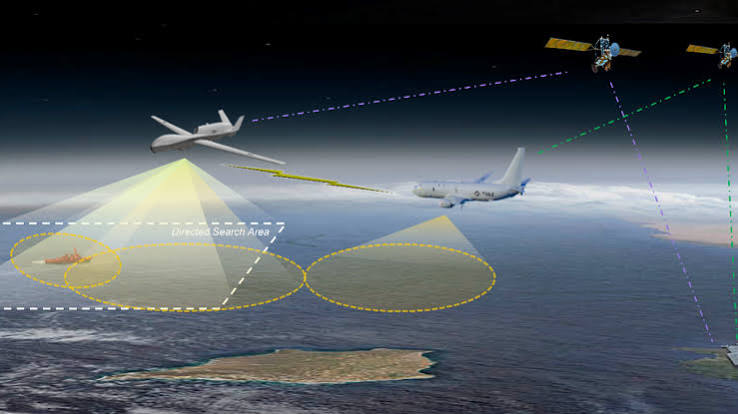
On 05 Aug 26, Boeing and Northrop conducted a lab demo test teaming the manned P-8A Poseidon maritime patrol aircraft and the unmanned MQ-4C Triton high-altitude long-endurance (HALE) ISR platform.

The P-8A operator sent machine-readable/machine-actionable mission tasking to a simulated Triton. The Triton then autonomously planned and executed the mission (e.g., transit to an area, collect intelligence with its sensors), processed data onboard via AI algorithms, and returned processed intelligence to the Poseidon.

The demo showed the first automated collaboration using an open systems architecture and the Universal Command and Control Interface. The announcement’s emphasis on universal standard interfaces is significant. Rather than using proprietary, platform-specific software, standard interfaces allow different systems to exchange information more easily.


Even though the P-8A and MQ-4C are both surveillance platforms, they have very different strengths.

P-8A Poseidon. Manned, multi-mission platform optimised for anti-submarine warfare (ASW), anti-surface warfare, response/agility (including lower-altitude operations), high-resolution imagery, weapons delivery, and rapid prosecution of contacts. Its crews operate in a dynamic tactical environment.

MQ-4C Triton. Unmanned HALE platform for persistent, wide-area maritime domain awareness. It has long endurance of more than 24 hours, and operates at high altitude (50,000+ feet). It has broad sensor coverage including multi-int radar, EO/IR, SIGINT.


Key Benefits for Operators

The key idea in teaming them up is about letting each do what it does best. Instead of both independently searching the same ocean, the Triton can automatically detect and cue the Poseidon. It reduces the workload on human operators.

It would reduce operator workload, speed up decision-making, enable more flexible and responsive manned-unmanned teaming, and leverage their complementary strengths for broader, more efficient maritime ISR and related missions. Key benefits would be: –

Reduced Workload and Cognitive Burden. The demonstration focuses on automating tasking, planning, execution, and the use of onboard AI. As a result, P-8 operators will no longer have to manually coordinate all the individual aspects or depend on ground stations when making routine intelligence requests or assigning tasks. Instead, they will be able to concentrate on higher-level mission management, tactical decisions, and using the fused picture, rather than closely monitoring the unmanned asset. This reduces the operator’s workload and speeds up the intelligence cycle.

Faster, More Responsive Decision-Making and Targeting. Direct machine-to-machine exchange delivers processed maritime intelligence much faster. This supports quicker cueing for follow-on actions. In contested or time-sensitive environments, this improves the overall kill chain decision speed.

Direct In-Flight Tasking and Greater Tactical Flexibility. Currently, Tritons are typically controlled from distant ground stations. The demo establishes a foundation for P-8 crews to issue tasking and receive results in flight (via realistic links such as satellite relay) without routing everything through the ground control station. This extends the Poseidon’s effective reach, allows dynamic retasking based on the manned aircraft’s real-time situational awareness, and improves the composite battlespace picture under the control of the airborne crew.

Better Use of Complementary Capabilities Without Redundancy. Triton handles the long-endurance, broad-area “look” mission persistently. Poseidon handles responsive, close-in, multi-mission work (including ASW that Triton does not perform). Automated teaming lets them operate more seamlessly as a unit rather than operating in relative isolation or with slower human-mediated coordination. Shared standards also ease training synergies (some operators cross-qualify) and common operating pictures.

Broader Interoperability and Future Scalability at Lower Cost/Risk. Use of universal/open standards rather than proprietary links allows collaboration with other platforms. This makes integration easier and more cost-effective, and also supports evolutionary upgrades on existing fleets.


Summary

By combining the two surveillance platforms, the team created a more closely integrated system. The operators gain in efficiency (because there is less manual coordination), in speed (since the intelligence and decisions can be made more quickly), in reach and flexibility (through direct control from the air) and in effectiveness (due to the continuous coverage and the ability to carry out a variety of missions in a responsive manner). This is especially valuable in the case of large areas of responsibility over seawater where both persistence and rapid response are essential. The demonstration carried out in the laboratory represents an initial stage in the way these capabilities can be put into operational use.


Please Add Value to the write-up with your views on the subject.

2033
Default rating

Please give a thumbs up if you  like The Post?


For regular updates, please register your email here:-

Subscribe


References and credits

To all the online sites and channels.

Pics Courtesy: Internet

Disclaimer:

Information and data included in the blog are for educational & non-commercial purposes only and have been carefully adapted, excerpted, or edited from reliable and accurate sources. All copyrighted material belongs to the respective owners and is provided only for wider dissemination.
 

433: EXPANDING BOEING IN INDIA


Prime Minister of India will inaugurate American aircraft manufacturer Boeing’s new state-of-the-art global engineering and technology innovation campus (Boeing India Engineering and Technology Center {BIETC}),  in Devanahalli on the outskirts of Bengaluru on 19 Jan 24.


The 43-acre campus, built with an investment of Rs 1,600 crore, is said to be the largest such Boeing facility outside the U.S. According to the Press Information Bureau (PIB), it will be a cornerstone for partnership with the startup, private, and government ecosystem in India and will help develop next-generation products and services for the global aerospace and defence industry.


Additionally, the PM will also launch the Boeing Sukanya programme, which aims to support the entry of more women from across India into the country’s growing aviation sector. The programme will provide opportunities for girls and women from across India to learn critical skills in the science, technology, engineering, and maths (STEM) fields and train for jobs in the aviation sector. For young girls, the program will create STEM Labs at 150 planned locations to help spark interest in STEM careers. The programme will also provide scholarships to women who are training to be pilots.


Boeing


Boeing is one of the largest global aerospace manufacturers, with its corporate headquarters in Chicago, Illinois, and it employs approximately 153,000 personnel. The company designs, manufactures and sells aeroplanes, aircraft, rockets, satellites, telecommunication equipment and missiles around the world. Besides military aircraft, it has over ten thousand commercial aircraft operating all over the world.


Boeing started 107 years ago when American businessman William E. Boeing started a company named Aero Products for the manufacture of aeroplanes. About a year later, its name was changed to Boeing Airplane Company. The first aircraft was designed in 1917 and the World War I was the biggest turning point for the company. After, WW I Boeing started making commercial aircraft and continued to expand.  The company has taken over 32 other companies so far.


Some of the military aircraft/helicopters manufactured by Boeing are:-

      • C-17 Globemaster III
      • CH/MH-47 Chinook
      • V-22 Osprey
      • AH-6 Light Attack Helicopter
      • AH-64D Apache
      • F/A-18E/F Super Hornet Navy fighter aircraft
      • F-15E Strike Eagle tactical fighter
      • Boeing Vertol CH-46 Sea Knight (Vertol Aircraft Corp.)
      • Boeing AH-6.
      • Boeing Vertol YUH-61.
      • Boeing Vertol XCH-62.
      • MH-139 Gray Wolf (with Leonardo S.p.A.)


India Engagement.


Boeing has been a partner of India’s aerospace sector for almost eight decades, both with the commercial and defence aviation sectors. Boeing’s relationship with India goes back to the 1940s when the Indian Air Force inducted the Harvard Advanced Trainer and DC-3 military transport aircraft.


Boeing’s India operations include headquarters in Delhi and field service offices in Mumbai, Hindan, and Arkonam.  


Military aircraft from Boeing inducted into the Indian Defence forces include:-

      • A fleet of 11 C-17 Globemaster IIIs (India is the biggest operator of these aircraft in the world, outside of the US).
      • 15 CH-47 Chinook heavy lift helicopter.
      • 22 AH-64E Apache attack helicopters.
      • Modified Boeing transport aircraft for VIP duties.
      • Poseidon P-8I aircraft for IN (designed for long-range anti-submarine warfare, anti-surface warfare and intelligence, surveillance and reconnaissance missions).


Besides Military aircraft, various versions of Boeing aircraft (737,747,757,777 and 787) are being used by Indian air carriers (Air India, Vistara, Blue Dart, and Akasa etc.).  Akaasa has recently placed an order for 150 aircraft.


Boeing has a joint venture with Tata Advanced Systems Limited (TASL) – The Tata Boeing Aerospace Limited (TBAL). This state-of-the-art manufacturing facility has been producing aero-structures for Boeing’s AH-64 Apache helicopter, including fuselages, secondary structures and vertical spar boxes for customers worldwide. Recently a new production line to manufacture complex vertical fin structures for the 737 family of airplanes has been added.


Follow On Support, Maintenance Repair Overhaul (MRO) And Logistics Supply Lines. Various follow-up support, logistics supply lines, training and other services for various platforms purchased by India are being offered by another division of The Boeing Company, viz. Boeing Global Services (BGS). In February 2021, Boeing has signed a strategic collaboration with aviation services provider Air Works for the maintenance, repair and overhaul (MRO) of its VIP transport aircraft fleet operated by the IAF. This partnership is a first under the newly launched Boeing India Repair Development and Sustainment (BIRDS) hub initiative.


114 Multi-Role Fighter Aircraft (MRFA). Boeing is one of the contenders for the Indian acquisition plan, fielding its F-15 and F-18 aircraft.


Advantages


Boeing Engineering and Technology campus in Bengaluru, Karnataka will conduct core engineering and research for Boeing’s iconic products as well as future platforms. It will have future avionics manufacturing and assembly capability.

      • It will provide impetus to the Indian Atmanirbhar Bharat scheme.
      • It will provide a boost to “Make in India”, “Skill India” and “Make for the World” initiatives through investments in manufacturing, co-production, skilling, engineering, and innovation.
      • It will help the foray of the Indian defence industry into the world market and by co-development of integrated systems in aerospace and defence not just for India, but for the world.
      • It will generate employment opportunities. Today, Boeing India has 4,000 employees, and more than 7,000 people who work on dedicated supply chain jobs with Indian suppliers across manufacturing, engineering and IT sectors.
      • It will provide much-needed technology infusion into the Indian defence manufacturing ecosystem.
      • It will reinforce India’s status as a leading foreign Original Equipment Manufacturer (OEM) engaged in making, engineering, and sourcing from India.
      • It will improve MRO, training and supply chain facilities.
      • It is a Win-Win situation for both.


Coming Up:- Boeing’s Current Woes.


Suggestions and value additions are most welcome


For regular updates, please register here:-

Subscribe


References and credits

To all the online sites and channels.

  1. https://www.boeing.co.in/boeing-in-india/about-boeing-in-india.page
  2. ` https://www.moneycontrol.com/news/india/pm-modi-to-inaugurate-boeings-largest-facility-outside-the-us-in-bengaluru-on-january-19-12071891.html
  1. https://www.financialexpress.com/business/defence-fe-exclusive-boeings-vision-for-india-a-partner-in-progress-across-sectors-3237450/
  1. https://www.sps-aviation.com/story/?id=3133&h=Boeing-Defense-A-Long-Standing-Journey-in-India


Disclaimer:

Information and data included in the blog are for educational & non-commercial purposes only and have been carefully adapted, excerpted, or edited from sources deemed reliable and accurate. All copyrighted material belongs to respective owners and is provided only for purposes of wider dissemination.

English हिंदी