
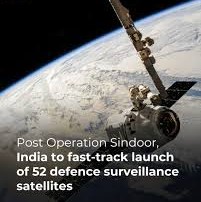
712: EYES IN THE SKY: OPERATION SINDOOR SPURS INDIA’S SPACE DEFENCE SURGE


My Article was published in the “Life of Soldier”  Journal, Aug 25.


In the wake of Operation Sindoor, conducted from May 7 to 10, 2025, India has launched an ambitious mission to enhance its space-based defence capabilities. The operation, a retaliatory strike against terror camps in Pakistan following the devastating Pahalgam attack on April 22, 2025, underscored the critical need for “deep” and “persistent” surveillance over adversarial territories. This necessity has prompted India to accelerate the deployment of 52 dedicated defence satellites under the Space-Based Surveillance (SBS) Phase-3 programme, which was approved in October 2024 with a budget of Rs 26,968 crore. Coupled with the finalisation of a comprehensive military space doctrine, India is poised to transform its strategic surveillance and defence framework, reducing reliance on foreign assets.


The Catalyst: Operation Sindoor

Operation Sindoor was a pivotal moment in India’s defence strategy, highlighting both the strengths and limitations of its current surveillance capabilities. The operation targeted terror infrastructure in Pakistan-occupied territories, relying on satellite imagery from foreign providers. While these assets provided critical intelligence, the operation exposed India’s dependence on external sources for real-time, high-resolution imagery. This dependency posed risks, including delayed access to data and potential vulnerabilities in data security, especially during high-stakes military engagements.

The Pahalgam attack, which killed 29 people, including civilians and security personnel, revealed gaps in India’s ability to monitor cross-border activities with the granularity and persistence required for pre-emptive or retaliatory actions. The subsequent success of Operation Sindoor, while a tactical victory, emphasised the need for an indigenous, robust, and self-reliant space-based surveillance system. The operation’s reliance on foreign satellites underscored the urgency to develop a dedicated constellation capable of providing continuous, high-resolution coverage of strategic areas, including Pakistan, China, and the Indian Ocean Region (IOR).


The Space-Based Surveillance (SBS) Phase-3 Programme

The Indian government had approved the SBS Phase-3 programme in October 2024, allocating Rs 26,968 crore to deploy 52 defence satellites. This ambitious initiative, led by the Indian Space Research Organisation (ISRO) in collaboration with private industry, aims to establish a comprehensive space-based intelligence, surveillance, and reconnaissance (ISR) network by 2029. The programme is structured to leverage both public and private sector expertise, with ISRO tasked with launching 21 satellites and three private companies deploying the remaining 31. Key Features of the Programme are as follows:-


Satellite Constellation. The 52 satellites will operate in a mix of low Earth orbit (LEO) and geostationary orbit (GEO). LEO satellites, positioned at altitudes between 500 and 900 km, will provide high-resolution imagery (up to 0.3 meters), ideal for detailed monitoring of military installations, troop movements, and infrastructure. GEO satellites, stationed at 36,000 km, will provide continuous wide-area coverage, which is critical for tracking maritime activities in the IOR and monitoring large-scale developments along India’s borders.


Technological Capabilities. The satellites will be equipped with advanced synthetic aperture radar (SAR) and electro-optical sensors, enabling all-weather, day-and-night imaging. SAR systems are exceptionally vital for penetrating cloud cover and monitoring during adverse weather conditions, a frequent challenge in regions like the Himalayas. The constellation will also incorporate secure communication links to ensure real-time data transmission to ground stations and military command centers.


Public-Private Partnership. The involvement of private companies marks a significant shift in India’s space strategy. Companies like Tata Advanced Systems, Larsen & Toubro, and startups such as Pixxel and Skyroot Aerospace are expected to contribute to satellite manufacturing and launch services. This collaboration aims to accelerate deployment, reduce costs, and foster innovation in India’s burgeoning private space sector.


Timeline and Deployment.  The first satellite launch is scheduled for April 2026, with the entire constellation expected to be operational by 2029. The phased rollout will prioritise coverage of high-threat areas, including the Line of Actual Control (LAC) with China and the Line of Control (LoC) with Pakistan, before expanding to broader regional surveillance.


Strategic Imperatives

The SBS Phase-3 programme is driven by India’s need to counter growing regional security challenges. China’s expansive space program, with over 1,000 satellites, including advanced ISR and anti-satellite (ASAT) capabilities, poses a significant threat. Beijing’s ability to disrupt or destroy satellites, demonstrated by its 2007 ASAT test, underscores the need for India to develop resilient and redundant space assets. The People’s Liberation Army (PLA) has integrated space-based ISR into its military doctrine, enabling precise targeting and real-time battlefield awareness, as seen in its activities along the LAC.

Pakistan, while less advanced in space technology, relies on Chinese support for its satellite capabilities, including the Pakistan Remote Sensing Satellite (PRSS-1). The growing China-Pakistan nexus necessitates enhanced surveillance to monitor joint military exercises, infrastructure development (e.g., the China-Pakistan Economic Corridor), and potential terror activities emanating from Pakistani territory.

The IOR, a critical maritime domain, is another focus area. With China’s increasing naval presence and the strategic importance of chokepoints like the Malacca Strait, India requires persistent surveillance to safeguard its maritime interests and counter piracy, smuggling, and hostile naval operations.


Complementary Initiatives: HAPS and Beyond

In addition to the satellite programme, the Indian Air Force (IAF) is pursuing three high-altitude platform systems (HAPS) aircraft to complement space-based ISR. These solar-powered, unmanned platforms, operating at altitudes of 18-20 km, can remain airborne for weeks, providing persistent surveillance over specific areas. HAPS aircraft are particularly suited for monitoring border regions and can serve as a cost-effective alternative to satellites for localised ISR missions.

The IAF is also exploring the integration of artificial intelligence (AI) and machine learning (ML) to process vast amounts of satellite data. AI-driven analytics can identify patterns, detect anomalies, and provide actionable intelligence in real time, enhancing India’s ability to respond to threats swiftly.


Challenges and Opportunities

While the SBS Phase-3 programme and the military space doctrine represent a significant leap forward, challenges remain. The ambitious timeline requires seamless coordination between ISRO, private companies, and the military, which could face delays due to technical complexities or funding constraints. The private sector’s relative inexperience in defence-grade satellite manufacturing may also pose risks to quality and reliability.

Moreover, the global space environment is increasingly contested, with space debris and ASAT threats complicating satellite operations. India must invest in space situational awareness (SSA) capabilities to monitor and mitigate these risks. International norms on space militarisation, which are still in their infancy, could also impact India’s plans, necessitating diplomatic efforts to safeguard its interests.

On the opportunity front, the programme positions India as a significant space power, fostering technological innovation and economic growth through the private space sector. The public-private partnership model could serve as a blueprint for future defence projects, reducing costs and enhancing efficiency. Additionally, the doctrine’s focus on international cooperation opens avenues for technology transfers and strategic alliances, strengthening India’s geopolitical standing.


Conclusion

Operation Sindoor served as a wake-up call for India, highlighting the indispensable role of space-based surveillance in modern warfare. The SBS Phase-3 programme, with its 52 dedicated defence satellites, and the forthcoming military space doctrine mark a transformative step toward self-reliance and strategic dominance in the space domain. By addressing regional threats, leveraging public-private partnerships, and integrating advanced technologies like HAPS and AI, India is poised to secure its borders, maritime interests, and national security.


Please Add Value to the write-up with your views on the subject.


1914
Default rating

Please give a thumbs up if you  like The Post?


For regular updates, please register your email here:-

Subscribe


References and credits

To all the online sites and channels.

Pics Courtesy: Internet

Disclaimer:

Information and data included in the blog are for educational & non-commercial purposes only and have been carefully adapted, excerpted, or edited from reliable and accurate sources. All copyrighted material belongs to respective owners and is provided only for wider dissemination.


References:-


  1. Times of India (ToI). (2025). “India to Fast-Track 52 Defence Satellites After Operation Sindoor.”
  2. Indian Space Research Organisation (ISRO). (2024). “Space-Based Surveillance Phase-3 Programme Overview
  3. Ministry of Defence, Government of India. (2024). “Approval of Rs 26,968 Crore for Defence Satellite Programme.” Press Release, October 2024.
  4. Defence Space Agency (DSA). (2019). “Mission Shakti and India’s Anti-Satellite Capabilities.” Government of India.
  5. Jane’s Defence Weekly. (2025). “India’s High-Altitude Platform System (HAPS) Acquisition for ISR Missions.”
  6. Stockholm International Peace Research Institute (SIPRI). (2024). “China’s Space Programme and Anti-Satellite Capabilities.” SIPRI Yearbook 2024.
  7. Observer Research Foundation (ORF). (2025). “India’s Military Space Doctrine: A Strategic Roadmap.”
  8. The Hindu. (2025). “Operation Sindoor: India’s Response to Pahalgam Attack.” May 12, 2025.
  9. SpaceNews. (2024). “India’s Private Space Sector: Emerging Players in Defence Satellite Manufacturing.”
  10. Center for Strategic and International Studies (CSIS). (2024). “Space Situational Awareness and the Contested Space Environment.”

547: Antariksha Abhyas 2024: A New Era for India’s Space Security


Pic courtesy Net


My Article published on the Chanakya Forum Website

on 04 Dec 24.


India conducted its first comprehensive space defence exercise, “Antariksha Abhyas 2024”, from November 11 to 13, 2024. It was spearheaded by the Defence Space Agency (DSA) and sought to simulate and tackle the evolving threats posed to space-based assets critical for national security.  The exercise strengthened coordination among India’s tri-services—Army, Navy, and Air Force—while integrating strategic assets within space operations. A primary objective was to assess vulnerabilities in space operations, enhance operational readiness, and develop strategies to withstand potential disruptions or denials of service. The exercise was a drill and a significant milestone in India’s defence strategy. The lessons learned from this exercise are expected to shape future military doctrines and enhance policy frameworks for space security.


Space Warfare. Space warfare refers to using space-based technologies and assets for military purposes, focusing on gaining strategic advantage through control of the space domain. It involves defending space infrastructure (like satellites and communication systems) and the potential to disable or destroy enemy satellites and other space-based assets during conflicts. The critical aspects of space warfare include anti-satellite weapons (ASAT), orbital warfare tactics, and strategies to control or interfere with satellite operations, such as space-based surveillance and reconnaissance and cyber-attacks. Many countries, including India, are establishing space forces and creating specialised units that handle operations in space. In recent years, nations like the U.S., China, Russia, and India have invested heavily in developing space defence capabilities, preparing for the possibility of conflict extending into space. Space warfare is seen as the next frontier in military strategy, where securing space assets will become crucial for the success of both conventional and unconventional military operations.


India and Space Warfare. India has made significant strides in developing its space warfare capabilities, primarily through its defence and space agencies like the Indian Space Research Organisation (ISRO) and the Indian Armed Forces. In recent years, India’s space capabilities have increasingly been integrated into its national defence strategy, and the country has made efforts to ensure the security of its space assets while also developing the capacity to counter space-based threats. India has recognised the importance of space security and is actively working towards setting up a specialised force to handle space-related defence operations. The Indian Air Force (IAF), currently tasked with most space defence-related activities, is being augmented with space warfare-focused units. India established the Integrated Space Cell (ISC) in 2010 to integrate space capabilities into its defence strategy. India’s Defence Space Agency (DSA) was established in 2019 under the Ministry of Defence (MoD) to enhance India’s capabilities in space for defence purposes. The agency coordinates with other agencies, including the Indian Space Research Organisation (ISRO), which handles civilian space exploration and satellite development. In future, the Indian Space Defence Command (ISDC) is expected to be formed to provide a more cohesive and focused defence approach for space assets. India demonstrated its anti-satellite (ASAT) capabilities in March 2019 when it successfully tested Mission Shakti, an ASAT weapon that destroyed one of its satellites in low Earth orbit (LEO). This test marked India as the fourth country after the United States, Russia, and China to develop and demonstrate such a capability. India has invested heavily in developing space-based surveillance and reconnaissance systems to monitor activities on Earth and space. India has been actively developing its space situational awareness (SSA) capabilities to track objects in space, detect potential threats, and predict collisions or other hazards to its satellites. This includes tracking space debris, monitoring the orbits of satellites, and identifying potential risks from enemy or hostile space activities. India is making significant advancements in its space warfare capabilities, focusing on both offensive and defensive measures to safeguard its space assets and ensure dominance in the space domain in future conflicts.


Exercise Antariksha Abhyas 2024


The Structure and Conduct of the Exercise. Antariksha Abhyas was a highly structured event involving a mix of simulation-based war games, technical briefings, and strategic discussions. The exercise spanned three days and engaged military personnel from the Defence Space Agency and its allied units, as well as representatives from ISRO and DRDO. Each participant played a specific role, ensuring that the exercise was comprehensive and reflective of the real-world challenges India faces in space. The exercise included both tabletop simulations and live operations, with wargame scenarios designed to test the capabilities of India’s space assets in various conflict situations. These simulations included situations where space assets were compromised, such as jamming, cyber-attacks, or physical destruction through anti-satellite missiles. The exercises were not limited to offensive strategies; defensive measures such as securing satellites, countering space-based threats, and recovering lost capabilities were also explored.​


Aim and Objectives. Antariksha Abhyas 2024, India’s first-ever dedicated military space exercise, marks a pivotal moment in its defence strategy.  It was conceived as a ground-breaking exercise to simulate the defence of India’s space assets against emerging threats.  The exercise aimed to test and enhance the operational readiness of India’s space assets, assess vulnerabilities, and improve integration between the various branches of the armed forces and civilian space organisations like ISRO (Indian Space Research Organisation). The key objectives of Antariksha Abhyas 2024 were multi-faceted, focusing on operational readiness and strategic foresight in space defence.


Assessing Vulnerabilities in Space Operations. One of the primary objectives was to evaluate the vulnerabilities of India’s space-based assets. Space is becoming increasingly congested, contested, and competitive, with potential adversaries looking to disrupt or deny access to space-based services. The exercise focused on identifying the weaknesses in operational capacity that might arise if these assets were targeted or disrupted, allowing for a more robust and agile defence strategy.​


Enhancing Inter-Agency Coordination. The exercise aimed to strengthen the integration of space capabilities with the Indian military’s overall defence strategy. This involved collaboration among the Army, Navy, and Air Force and several specialised agencies such as the Defence Cyber Agency, the Defence Intelligence Agency, and the Strategic Forces Command. These agencies and civilian bodies like ISRO and DRDO (Defence Research & Development Organisation) participated to ensure a holistic approach to space defence.​


Testing Operational Dependencies. Another critical aspect of the exercise was understanding how different military operations depend on space-based assets. Many military activities, from satellite communications to surveys, rely heavily on space infrastructure. The exercise sought to simulate how various military sectors could function with or without these vital services, identifying gaps in operational dependency.​


Fostering Innovation in Space Technologies. Given the fast-paced advancements in space technology, the exercise encouraged innovation and collaboration between the military and civilian sectors. This was particularly crucial in addressing emerging challenges such as anti-satellite warfare, space debris management, and the protection of critical satellites.​


Implications for India’s Space Security.


Antariksha Abhyas is significant not only for its technical achievements but also for its broader geopolitical implications. India has long maintained a robust space exploration program, with notable milestones such as the Mars Orbiter Mission (Mangalyaan) and the Chandrayaan missions to the Moon. However, with the growing militarisation of space by other countries, such as the U.S., China, and Russia, India has recognised the need to integrate space into its national security framework.


The exercise reflects India’s growing ambition to become a significant space security player. While the U.S. and China have already developed sophisticated space defence capabilities, India has traditionally lagged in this domain. However, initiatives like Antariksha Abhyas indicate that India is catching up, with a clear focus on developing both offensive and defensive space operations.


Furthermore, the exercise highlights the critical role of civilian-military collaboration. ISRO, with its cutting-edge satellite capabilities, plays a central role in supporting India’s military operations in space. By engaging ISRO in defence exercises, India ensures its military can leverage the latest technologies and research to enhance its space capabilities. This collaboration is crucial in ensuring that India’s space assets are efficient and secure against potential threats.


As India expands its space capabilities, exercises like Antariksha Abhyas will be critical in shaping its future defence strategies. The exercise is a significant milestone in India’s defence and space policy. It signals India’s recognition of space as a vital component of its national security infrastructure. It reflects the growing urgency to protect space assets from conventional and non-conventional threats. The exercise has helped bolster India’s defence capabilities by providing valuable insights into space vulnerabilities, fostering inter-agency collaboration, and enhancing the nation’s readiness for potential space conflicts. Antariksha Abhyas 2024 is more than just a military exercise; it is a symbol of India’s growing space capabilities and its determination to secure its interests in space for the future.


Your valuable comments are most welcome.


Link to the article:

https://chanakyaforum.com/antariksha-abhyas-2024-a-new-era-for-indias-space-security/


1914
Default rating

Please give a thumbs up if you  like The Post?


For regular updates, please register your email here:-

Subscribe


References and credits

To all the online sites and channels.

References:

  1. “Antariksha Abhyas: India’s New Space Security Initiative”, Indian Space Research Organisation (ISRO), 2024.
  1. “India’s Space Security Strategy”, Ministry of Defence, Government of India, 2024.
  1. Nair, S. “Antariksha Abhyas: India’s New Space Security Doctrine.” The Economic Times,
  2. Pandit, R. “India’s Space Defense Strategy: Antariksha Abhyas and Beyond.” The Times of India,
  1. Krishna, A. & Sharma, “The Future of Space Warfare: India’s Response to Emerging Threats”. New Delhi: Oxford University Press.
  1. “India’s Space Diplomacy: Strengthening Security in Outer Space”, Indian Ministry of External Affairs;
  1. Chandran, A, “How Antariksha Abhyas Elevates India’s Strategic Position in Space.” Global Times, 2024.
  1. Raghuvanshi, S, “Space as the New Frontier in India’s Defense Strategy.” Indian Defence Review, 2024
  1. Gulati, V, “China, Pakistan, and the Strategic Implications of India’s Space Security Programs.” The Diplomat, 2024.
  1. “The Evolution of India’s Space Security Strategy”, Space and Defence Research Center, 2024.
  1. “Space Security: Trends and Future Prospects”, UN Office for Disarmament Affairs, 2024.
  1. Sarma, N, “Antariksha Abhyas and Its Role in Strengthening India’s Space Command.” Journal of Strategic Studies, 2024.

Disclaimer:

Information and data included in the blog are for educational & non-commercial purposes only and have been carefully adapted, excerpted, or edited from reliable and accurate sources. All copyrighted material belongs to respective owners and is provided only for wider dissemination.


English हिंदी