
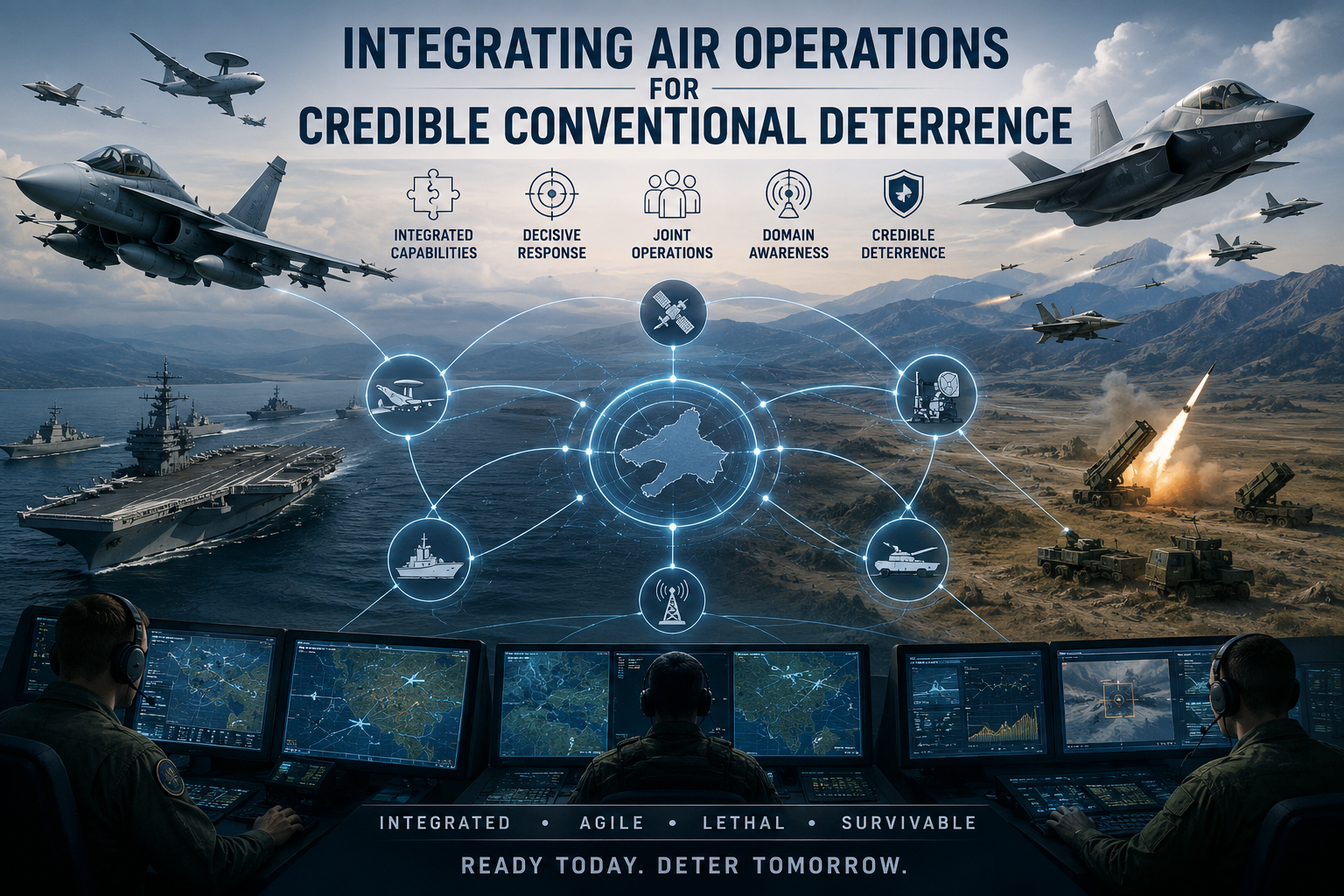
834: INTEGRATING AIR OPERATIONS FOR CREDIBLE CONVENTIONAL DETERRENCE


Article published in the inaugural issue of 

ADITI NATIONAL STRATEGY MAGAZINE


Credible conventional deterrence is not a function of numerical superiority alone. It is the demonstrated capacity to impose unacceptable costs on an adversary. The cost is imposed at short notice, with sufficient speed, precision, and integration across all domains, with a message that aggression will not be rewarded but punished. In this sense, deterrence is as much a matter of perception as of capability. The adversary must believe that the costs of military action will outweigh any conceivable gain. That belief must rest on something more substantial than a declaratory posture. It must rest on observable, tested, and credible military power.

For India, the architecture of conventional deterrence has been evolving gradually. At its heart is the transformation in how the three services fight, plan, and operate together. Jointness, once an aspirational buzzword, is now the necessary operative principle behind India’s warfighting doctrine. The nation’s security establishment has recognised that the conventional deterrent value of its armed forces is only as strong as the degree to which those forces can act in concert, with speed, precision, and lethality, across all domains simultaneously.

A Collusive Threat Environment. Understanding why joint operations matter to conventional deterrence requires first understanding the threat environment in which India operates. India faces a collusive threat and the possibility of concurrent or coordinated military pressure from both China and Pakistan. This is not merely a theoretical construct. The deepening military-to-military ties between Beijing and Islamabad, evidenced by technology transfer, co-developed weapons systems, and coordinated diplomatic positions, mean that India cannot plan its conventional responses in a sequential or siloed manner. It must be prepared to fight on multiple fronts and in multiple domains simultaneously.

Doctrine of Punitive Deterrence. Pakistan’s long-standing strategy has been of sponsoring cross-border terrorism while sheltering behind its nuclear umbrella (bleed India through a thousand cuts).  It has compelled India to rethink and change its conventional response. For decades, India’s posture was one of strategic restraint (absorbing provocations diplomatically and avoiding military action). That calculus has fundamentally changed as India has shifted toward a doctrine of punitive deterrence. Air strikes on terror camps have been carried out (Balakot in 2019 and Op Sindoor in 2025) as an instrument of punitive action.


Airpower Contribution to Conventional Deterrence. Deterrence refers to the ability to prevent an adversary from undertaking hostile action. It is achieved by convincing the enemy that the costs of aggression will outweigh any potential gains. Air power is an important part of military deterrence. It provides rapid military response options and creates strategic uncertainty for adversaries. The ability to strike with speed, precision, and unpredictability produces disproportionate strategic effects relative to the scale of force employed.


Misunderstood Roles. The Indian Air Force has repeatedly demonstrated that it can conduct joint operations while independently shaping strategic outcomes. Yet scepticism persists among some observers. Some view air power as an auxiliary arm supporting surface operations. This perspective is flawed as it ignores the inherent flexibility and reach of air power. Viewing air power through the narrow lens of close air support ignores its role in shaping the entire battlefield before the surface engagement begins.  To relegate the IAF to a support arm is to ignore the vertical dimension that prevents conflict from degenerating into attritional, terrain-bound warfare.


Air Superiority as an Enabler of Joint Operations. No element of joint warfighting is more foundational to conventional deterrence than air superiority. Control of the air domain enables all other joint force activities: it shields ground and maritime forces from enemy air attack, provides real-time intelligence that improves situational awareness across the force, and enables deep strike against adversary command nodes, logistics centres, and critical infrastructure. Conversely, the absence of air superiority exposes every other component of the joint force to attrition and denial. The objective is not to achieve a permanent air superiority across an entire area of operations. A window to enable uninterrupted operations would suffice.

SEAD/DEAD as the Gateway. The Suppression and Destruction of Enemy Air Defences mission is neither a secondary nor a preliminary task. It is the gateway through which the joint force enters the contested battlespace. An adversary’s integrated air defence network is its primary tool for denying the air superiority required for joint operations. The systematic suppression and destruction of that network (radars, fire-control systems, surface-to-air missile batteries, and command nodes) is therefore among the most operationally significant tasks the IAF performs and among the most strategically visible. An adversary that knows its air defence architecture can be comprehensively degraded in the opening hours of a conflict must factor that vulnerability into its pre-conflict calculations. That factoring is deterrence.


Demonstrated Capability and the IAF’s Evolution. The IAF has transformed from a tactical air force to a broad-spectrum aerospace power. The induction of airborne early warning and control systems gave the IAF the ability to manage the air battle across a vast area in real time. Aerial refuelling tankers extended strike ranges to operational depths. These capabilities fundamentally altered the adversary’s assessment of which assets were at risk. Stand-off precision capability enabled the IAF to engage hardened targets deep inside adversary territory without entering the engagement envelopes of the most capable surface-to-air missile systems.

Jointness as a Force Multiplier. While air power possesses independent strategic utility, its effectiveness increases when integrated into a joint operational framework. For India, the importance of this integration is amplified by the need for two-front planning. No single service has sufficient capacity to address the full scope of requirements on both fronts simultaneously. Joint planning that optimises the employment of air power across combat zones, that allocates strike, surveillance, airlift, and air defence assets according to operational priority rather than service entitlement, and that fuses the intelligence from all domains into a single coherent picture for commanders at every level, is the only organisational response adequate to the problem India faces.

The Maritime Dimension. Conventional deterrence is not a purely continental affair for India. The Indian Ocean Region is India’s strategic backyard and the artery of its economic prosperity. More than 80 per cent of India’s energy imports transit these waters. Any adversarial interdiction of these sea lanes, or a hostile maritime presence in the IOR, represents a direct threat to national interest. The Distributed Maritime Operations (DMO) concept being employed by the maritime forces aligns with India’s broader strategy to control key chokepoints and sustain an uninterrupted supply chain in the IOR. Airpower (integral with IN and AF), operating within a networked joint framework, makes the maritime deterrent credible against both state and grey-zone threats.

The Emerging Domain Space and Intelligence. The exploitation of space has become indispensable to joint conventional operations. Space assets provide the persistent surveillance, early warning, precision navigation, and communications infrastructure upon which joint warfighting depends. The key challenge that India’s joint space and intelligence architecture must address is fusing multi-source intelligence into a single, coherent operational picture that field commanders can act upon with confidence. Space-based surveillance, airborne radar, electronic intelligence, and human intelligence currently flow through separate chains before being reconciled at higher levels of command. An intelligence fusion center, is required to create a Common Operational Picture.
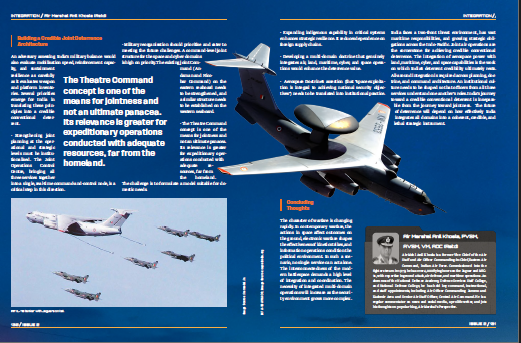


Building a Credible Joint Deterrence Architecture. An adversary assessing India’s military balance would also evaluate mobilisation speed, reinforcement capacity, and sustainment resilience as carefully as it evaluates weapon and platform inventories. Several priorities emerge for India in translating these principles into a credible conventional deterrent.

    • Strengthening joint planning at the operational and strategic levels must be institutionalised. The Joint Operations Control Centre, bringing all three services together into a single, real-time command-and-control node, is a critical step in this direction.
    • Military reorganisation should prioritise meeting future challenges. A command-level joint structure for the space and cyber domains is a high priority. The existing joint Command (Andaman and Nicobar Command) on the eastern seaboard needs to be strengthened, and a similar structure needs to be established on the western seaboard.
    • The theatre command concept is one means of achieving jointness, not an ultimate panacea. Its relevance is greater for expeditionary operations conducted with adequate resources, far from the homeland. The challenge is to formulate a model suitable for domestic needs.
    • Expanding indigenous capability in critical systems enhances strategic resilience. It reduces dependence on foreign supply chains.
    • Developing a multi-domain doctrine that genuinely integrates air, land, maritime, cyber, and space operations would enhance the deterrence value.
    • Aerospace Doctrine’s assertion (that “space exploitation is integral to achieving national security objectives”) needs to be translated into institutional practice.


Concluding Thoughts

The character of warfare is changing rapidly. In contemporary warfare, the actions in space affect outcomes on the ground, electronic warfare shapes the effectiveness of kinetic strikes, and information operations condition the political environment. In such a scenario, no single service can act alone.  The interconnectedness of the modern battlespace demands a high level of integration and coordination. The necessity of integrated multi-domain operations will increase as the security environment grows more complex.

India faces a two-front threat environment, has vast maritime responsibilities, and growing strategic obligations across the Indo-Pacific.

Joint air operations are the cornerstone for achieving credible conventional deterrence. The integration of aerospace power with land, maritime, cyber, and space capabilities is the work on which India’s deterrent credibility ultimately rests. All-around integration is required across planning, doctrine, and command architecture. An institutional culture needs to be shaped so that officers from all three services understand one another’s roles. India’s journey toward a credible conventional deterrent is inseparable from the journey toward jointness.  The future of deterrence will depend on how effectively India integrates all domains into a coherent, credible, and lethal strategic instrument.


Please Add Value to the write-up with your views on the subject.


2023
Default rating

Please give a thumbs up if you  like The Post?


For regular updates, please register your email here:-

Subscribe


References and credits

To all the online sites and channels.

Pics Courtesy: Internet

Disclaimer:

Information and data included in the blog are for educational & non-commercial purposes only and have been carefully adapted, excerpted, or edited from reliable and accurate sources. All copyrighted material belongs to the respective owners and is provided only for wider dissemination.


References: –

Cohen SP and Dasgupta S. “Arming without aiming: India’s military modernisation”, Brookings Institution Press (BIP). 2010.

Crowell  L.  “Multi-domain operations and the future of joint warfare”. Naval Institute Press (NIP). 2023.

Deptula, D. A. “Effects-based operations: Change like warfare”. Aerospace Education Foundation,  2001.

Government of India, Ministry of Defence. “Joint Doctrine of the Indian Armed Forces”. Headquarters, Integrated Defence Staff. 2023.

Gupta, A., “Building an arsenal: The evolution of regional power force structures”. Praeger. 2019.

Kapila, S., India’s defence modernisation: Structural constraints and strategic imperatives”. Journal of Defence Studies. 2021.

Air Mshl Anil Khosla. “Punitive deterrence: India’s evolving conventional response”. Blog “Air Marshal’s Perspective”, 2023. https://55nda.com/blogs/anil-khosla  

Air Mshl Anil Khosla. “Air superiority and joint operations: The SEAD/DEAD imperative”. Blog “Air Marshal’s Perspective”, 2024. https://55nda.com/blogs/anil-khosla

Ladwig, W. C. Indian military modernisation and conventional deterrence in South Asia. “Journal of Strategic Studies”, https://doi.org/10.1080/01402390.2014.942937, 2020.

Singh, S. “India’s military transformation: Challenges and imperatives”. Strategic Analysis 2020.

731: AIR SUPERIORITY AND SEAD/DEAD OPERATIONS: EVOLUTION, TECHNOLOGIES, AND STRATEGIC IMPORTANCE


Presented my views on the subject (corelating it to you context) at a seminar in Leh on 26 Aug 25.


Air superiority, the ability to control the airspace over a battlefield, is essential to modern military strategy. It allows for unrestricted air operations, supports joint force manoeuvres, facilitates deep strike campaigns, and strengthens deterrence against opponents. Achieving and maintaining air superiority relies heavily on Suppression of Enemy Air Defences (SEAD) and Destruction of Enemy Air Defences (DEAD). These crucial techniques have evolved from basic tactics during the World Wars to complex, multi-domain operations in modern conflicts. This article discusses the strategic importance of air superiority, outlines the historical development of SEAD and DEAD, examines key concepts and technologies, and looks at their role in contemporary air campaign planning and joint force doctrine.


Air Superiority: A Strategic Importance 

Air superiority allows friendly forces the freedom to conduct air operations while denying that capability to the enemy. Its strategic value lies in its enabling role in multiple areas of warfare: 

Unrestricted Aerial Operations. Control of the air lets aircraft carry out reconnaissance, close air support, intelligence, surveillance, reconnaissance, and precision strikes with little risk from enemy air defences or fighters. This freedom is vital for maintaining operational pace and reaching mission objectives. 

Joint Force Operations. Air superiority protects ground and naval forces from enemy air attacks, allowing freedom of movement. It also provides real-time intelligence, improving awareness across the joint force. 

Deep Strike Campaigns. Dominating the air enables strikes against key targets deep within enemy territory, such as command and control nodes, logistics centers, or infrastructure. These operations disrupt the enemy’s ability to conduct combat operations. 

  1. Ensuring Deterrence. Having credible air superiority helps deter adversaries by showcasing the ability to neutralise their air defences and project power effectively. This can prevent conflicts by signalling a strong military presence.

Historical examples highlight the significance of air superiority. During World War II, the Allies’ air control over Normandy contributed to the success of D-Day. In the 1991 Gulf War, coalition forces quickly achieved air superiority, effectively crippling Iraq’s capacity to resist. In current conflicts, such as those in Iraq, Syria, and Ukraine, air superiority has been crucial for enabling precision strikes, protecting ground forces, and maintaining supply lines. Without air superiority, joint operations are at greater risk, and deep strikes or deterrent efforts become less effective.


The Origin and Evolution of SEAD: Concepts and Technologies 

The roots of SEAD can be traced back to the World Wars, when early air defences, mainly anti-aircraft artillery, posed serious threats to air operations. SEAD has since developed into a complex, multi-domain discipline in response to more sophisticated integrated air defence systems. 

World Wars I and II (1914–1945). In World War I, air defences were limited to anti-aircraft artillery and small arms. Efforts to suppress enemy defences involved strafing gun placements or avoiding known threats. Air superiority was mostly achieved through air-to-air combat. By World War II, the introduction of radar-guided anti-aircraft artillery necessitated focused SEAD tactics. Allied forces undertook “Flak Neutralisation Missions,” using bombers or fighters to suppress anti-aircraft guns with bombs, rockets, or machine guns. These missions depended on visual targeting and massive formations, using electronic countermeasures like chaff to disrupt radar. They carried high risks due to limited precision and awareness, depending heavily on pilot skill and overwhelming force.  The development of radar jamming technology was another significant step. The British, for instance, deployed the “Window” system, which involved dropping strips of aluminium foil to confuse enemy radar systems. These early efforts laid the foundation for the sophisticated SEAD tactics employed in later conflicts.

Cold War and Vietnam War (1950s–1970s). The Korean War introduced jet aircraft, but did not see significant advancements in SEAD due to less sophisticated air defences. However, the Vietnam War marked a turning point. North Vietnam deployed a vast network of radar-guided surface-to-air missiles, particularly the Soviet SA-2, which posed a new threat to U.S. air operations. This spurred the development of the “Wild Weasel” program, where aircraft like the F-100F, F-105G, and later F-4G featured radar warning receivers and electronic warfare systems to locate and destroy missile sites. These high-risk missions involved luring missile radars to emit signals, then attacking with bombs or early anti-radiation missiles. The F-4G and later F-16CJ integrated advanced electronic warfare systems and anti-radiation missiles, raising effectiveness. This “find-fix-finish” method greatly reduced missile threats and improved survival for strike missions. 

Post-Vietnam to Gulf War (1980s–1991). SEAD doctrine progressed during the Cold War as enemy integrated air defence systems grew more advanced. Anti-Radiation Missiles became vital to SEAD, evolving from the basic AGM-45 Shrike to the AGM-88 HARM, which offered better speed, range, and targeting. The AGM-88E Advanced Anti-Radiation Guided Missile features improved seekers and network-enabled targeting, allowing it to hit radars even if they shut down. 

SEAD / DEAD Campaign. During Operation Desert Storm, coalition forces launched a thorough SEAD-DEAD campaign, using stealth aircraft, stand-off weapons, electronic jamming platforms, and anti-radiation missiles to dismantle Iraq’s integrated air defence systems in a matter of hours, establishing a model for future operations.


Modern Conflicts (2000s–Present). Today, SEAD counters advanced integrated air defence systems, such as Russia’s S-400 or China’s HQ-9, which feature layered defences. Actions in Iraq, Syria, and Ukraine show how stealth aircraft, drones, and loitering munitions are used to disrupt enemy defences. SEAD is now a multi-domain effort, leveraging air, space, cyber, and ground capabilities to tackle mobile and electronic warfare-resistant air defence systems.

    • Stealth. Stealth aircraft like the F-117 Nighthawk, F-22 Raptor, and F-35 Lightning II minimise radar visibility, enabling them to penetrate heavily defended airspace.
    • EW. Modern SEAD (suppression of Enemy Air Defences) also fundamentally depends on electronic warfare (EW) techniques. Jamming and spoofing adversary radar systems have evolved to become more sophisticated, employing advanced electronic countermeasures to effectively disrupt and deceive enemy defences. Advanced electronic warfare systems are capable of jamming or confusing enemy radars. Dedicated electronic warfare aircraft provide jamming support, effectively blinding enemy radars and communication systems.
    • Drones and Loitering Munitions. Unmanned Aerial Vehicles have transformed SEAD. Drones like the MQ-9 Reaper provide intelligence gathering and strike capabilities, while loitering munitions offer low-cost, ongoing threats. These systems can saturate air defences, overwhelm operators, or strike urgent targets, improving safety for human pilots.
    • Cyber and Electronic Attack Cooperation. Cyber warfare is becoming central to SEAD, disrupting or damaging air defence networks, making it harder for adversaries to coordinate, and misleading sensors. When combined with electronic warfare and kinetic strikes, these methods create a layered suppression strategy that prevents opponents from effectively contesting airspace.


Integration into Air Campaign Planning and Joint Force Doctrine

SEAD has evolved from a specialised air force task to a key part of joint operations across various domains. Its incorporation into air campaign planning and joint doctrine shows its strategic value: 

Air Campaign Planning. SEAD is prioritised during the initial stages of air campaigns to neutralise integrated air defence systems, creating a safe environment for subsequent strikes. In Operation Desert Storm, SEAD operations dismantled Iraq’s radar network, yielding air dominance for coalition forces. Modern campaigns combine SEAD with offensive counter-air and defensive counter-air efforts to gain air superiority, coordinating fixed-wing fighters, electronic warfare aircraft, drones, and ground-based assets. 

Joint Force Doctrine. SEAD has to be embedded in doctrines. It requires coordination across air, land, sea, space, and cyber domains. Aspects related to Joint tactics standardise collaborative efforts, enabling centralised planning and decentralised execution for greater agility have to be highlighted.

Network-Centric SEAD. The shift to network-centric warfare has changed SEAD into a multi-platform and multi-domain effort. Real-time data sharing enables quick target detection, identification, and engagement. For instance, an F-35 can find a radar, share its location with an F-16CJ or EA-18G Growler, and guide a missile to the target. Space-based intelligence gathering and cyber operations enhance targeting precision, while new technologies like hypersonic missiles and directed-energy weapons are being tested to counter advanced air defences.

Multi-Platform Coordination. Modern SEAD combines stealth fighters, electronic warfare aircraft, drones, and ground systems. The new doctrine of Manned-Unmanned Teaming boosts SEAD effectiveness by pairing human pilots’ flexibility with drones’ endurance and expendability. Platforms like the F-35 act as “quarterbacks,” working with legacy fighters, drones, and cyber assets to suppress enemy defences.


SEAD as a Strategic Deterrence Tool 

Beyond its tactical and operational functions, SEAD is key to strategic deterrence. The ability to suppress and destroy enemy air defences imposes significant psychological and operational costs on adversaries, undermining their anti-access strategies. By showcasing the ability to breach defended airspace and threaten vital targets, SEAD strengthens deterrent postures, especially in regions with sophisticated air defence systems like the Indo-Pacific and Eastern Europe. This capability ensures freedom of movement in high-stakes conflicts, contributing to strategic stability.


Future Trends in SEAD Operations 

The ongoing evolution of SEAD will rely more on autonomy, artificial intelligence, and multi-domain operations. Autonomous platforms with advanced sensors and decision-making abilities will support manned systems, lowering risks and boosting endurance over contested areas. AI-enhanced loitering munitions will improve target identification and strikes, speeding up responses to mobile threats. 

Integration with space-based intelligence gathering and cyber warfare will further weaken enemy air defences. Hypersonic weapons, directed-energy systems, and advanced electronic warfare capabilities will tackle next-generation integrated air defence systems, ensuring low visibility and network functionality. SEAD will increasingly be a comprehensive warfare effort, coordinated in real time across global defence networks.


Conclusion 

Air superiority remains a critical requirement, enabling unrestricted operations, joint force collaboration, deep strikes, and deterrence. SEAD and DEAD have evolved from basic flak suppression in World War II to complex, network-based practices driven by innovations like the Wild Weasel program, anti-radiation missiles, stealth aircraft, drones, and cyber warfare. Their incorporation into air campaign planning and joint doctrine highlights their role as force multipliers. As enemy air defences become more complex, SEAD will continue to adapt, using multi-domain capabilities to secure air dominance in future conflicts. The success of future operations depends on advancing SEAD capabilities to ensure the freedom, flexibility, and strength that characterise modern military power projection.


Please Add Value to the write-up with your views on the subject.


2023
Default rating

Please give a thumbs up if you  like The Post?


For regular updates, please register your email here:-

Subscribe


References and credits

To all the online sites and channels.

Pics Courtesy: Internet

Disclaimer:

Information and data included in the blog are for educational & non-commercial purposes only and have been carefully adapted, excerpted, or edited from reliable and accurate sources. All copyrighted material belongs to respective owners and is provided only for wider dissemination.


References:-


  1. Air superiority: What the wars in the Middle East and Ukraine can teach Europeans about NATO readiness. (2025). European Council on Foreign Relations.


  1. Doctrine of the Indian Air Force. (2023). Indian Air Force.


  1. Finding, fixing, and finishing the guideline: The development of SEAD. (n.d.). Defense Technical Information Center.


  1. Hewitt, T. (2017). Planting the seeds of SEAD: The Wild Weasel in Vietnam. Air University.


  1. Johnson, D. E. (2014). The challenges of the “Anti-Access/Area Denial” (A2/AD) environment. RAND Corporation.


  1. Joint Publication 3-01.4: Joint tactics, techniques, and procedures for joint suppression of enemy air defences (J-SEAD). (n.d.). Defense Technical Information Center.


  1. Peck, G. (2023, March 15). The rise of loitering munitions in modern SEAD operations. Defence News.


  1. Price, A. (2017). The history of U.S. Wild Weasels: Suppression of enemy air defences (SEAD) from Vietnam to the Gulf War. Air Power Review, 20(3), 22–35.


  1. Putting the “J” in J-SEAD. (n.d.). Defense Technical Information Center.

Rethinking strategic advantages of air supremacy in modern warfare. (n.d.). SciELO.


  1. SEAD operations of the future. (n.d.). Joint Air Power Competence Centre.


  1. Sweetman, B. (2015). SEAD operations in the 21st century: An integrated approach to air defence suppression. Jane’s Defence Weekly, 52(4), 42–49.


  1. The evolution of SEAD: From World War II to modern warfare. (n.d.). SchoolTube.


  1. U.S. Air Force. (1990). The Wild Weasel mission: A history of SEAD operations. Air Force Historical Research Agency.


  1. U.S. Marine Corps. (n.d.). MCWP 3-22.2: Suppression of enemy air defences. U.S. Marine Corps.


422: DOMINATING THE SKIES


“Air control can be established by superiority in numbers, by better employment, by better equipment, or by a combination of these factors.”

– Carl Andrew Spaatz


Air control is essential and a fundamental principle for the effective employment of air power.


Air dominance is a generic term meaning dominating the domain of the air.  It is like saying that Nadal or Djokovic are dominating the tennis circuit or Tiger Woods is dominating the golf world. In the context of air warfare, the genesis of this term started with the United States when they started their F22 program and the fifth generation F-35 aircraft, calling it air domination fighter, claiming that the aircraft has technology so superior that it’ll dominate the skies. USA has named its next sixth generation program as the New Generation Air Dominance (NGAD) program. USA has been dominating the skies for years with superior technology, which is now being challenged by China with its fifth and sixth-generation aircraft and systems.


“To have command of the air means to cut an enemy’s army and navy from their bases of operation and nullify their chances of winning the war.”

– Giulio Douhet


Command of the air and Control of the air, are terms indicating the prevailing state in the air war i.e. which side is getting the better off the other one. Both terms are loosely used interchangeably, but there is a subtle difference regarding the level. It is not the fighter aircraft alone, that contributes toward commanding or controlling the skies, it is the entire gambit of air power. These terms indicate the freedom to use the medium of air to own advantage and denial of the same to the enemy.


Air Supremacy, Air Superiority, and Favourable air situation are three terms that indicate the degree of command and control. They are indicative of three factors i.e. volume of airspace, duration, and extent of possible enemy interference.


Air Supremacy is when the entire airspace (own and enemy) is under its control for the entire duration of hostilities and the enemy is not able to interfere in any way with operations. Most of the US air wars have been against enemies that are weak in air war capability and the US forces have been able to achieve and maintain air superiority.


Air Supremacy is achieved when the entire enemy air power is neutralised, and the entire enemy air power is not able to use the medium of the air. Achieving air supremacy is a sort of strategic objective that needs a dedicated counter-air campaign.


Air superiority exists when the area is somewhat limited geographically and does not cover the entire air space,  time-wise it may be restricted to a few hours or days and the enemy may be able to interfere to some extent  (not to a prohibitively high extent).


Favourable Air Situation is the lowest level of control, influencing much smaller areas, for a limited duration and with a higher (not high enough to jeopardise the success of own missions) degree of enemy interference. It is like a tactical umbrella.


The degree to which the control of air can be achieved largely depends upon the differential in air power of the two opposing sides.


It needs to be decided and specified clearly in the objectives.


Suggestions and value additions are most welcome


For regular updates, please register here:-

Subscribe


References and credits

To all the online sites and channels.


Disclaimer:

Information and data included in the blog are for educational & non-commercial purposes only and have been carefully adapted, excerpted, or edited from sources deemed reliable and accurate. All copyrighted material belongs to respective owners and is provided only for purposes of wider dissemination.


English हिंदी