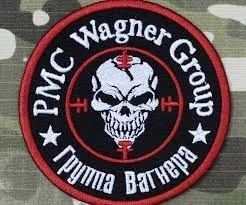
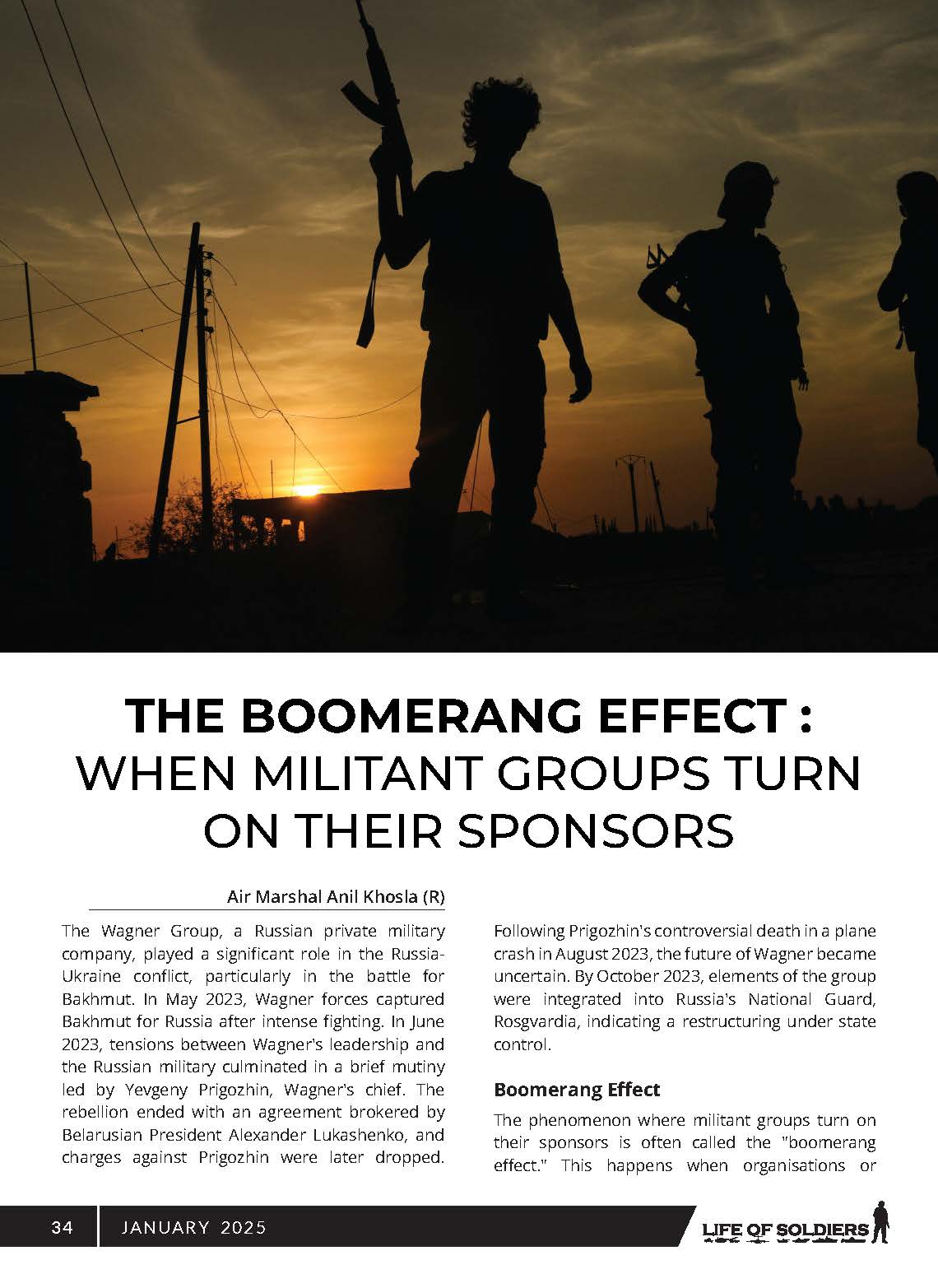
Pic Courtesy Net
My Article Published in the Life of Soldiers (a premier monthly defence magazine) on 30 Dec 24.
The Wagner Group, a Russian private military company, played a significant role in the Russia-Ukraine conflict, particularly in the battle for Bakhmut. In May 2023, Wagner forces captured Bakhmut for Russia after intense fighting. In June 2023, tensions between Wagner’s leadership and the Russian military culminated in a brief mutiny led by Yevgeny Prigozhin, Wagner’s chief. The rebellion ended with an agreement brokered by Belarusian President Alexander Lukashenko, and charges against Prigozhin were later dropped. Following Prigozhin’s controversial death in a plane crash in August 2023, the future of Wagner became uncertain. By October 2023, elements of the group were integrated into Russia’s National Guard, Rosgvardia, indicating a restructuring under state control.
Boomerang Effect.
The phenomenon where militant groups turn on their sponsors is often called the “boomerang effect.” This happens when organisations or groups created, funded, or supported by a state or another actor shift their allegiances or use their skills and resources against their former backers. The reasons for this shift can be complex and multifaceted, involving ideological differences, changing power dynamics, or disillusionment with their sponsors’ objectives. Contributing factors are as follows:-
Ideological Divergence. Initially, militant groups are often created with shared goals and objectives aligned with their sponsors. However, as they gain strength and experience, they may develop their agendas. Differences in ideology can lead to clashes, especially if the militants feel their sponsors are manipulating them for geopolitical gain.
Loss of Control. Sponsors often lose control over the militants they support. As these groups gain legitimacy and power, they may increasingly act independently, pursuing their objectives, which might not align with those of their sponsors. This can lead to a strategic shift where militants view their sponsors as obstacles rather than allies.
Disillusionment and Frustration. Sometimes, militants feel let down by their sponsors. They may believe that their resources or support are inadequate or misdirected. This frustration can lead to losing loyalty, with groups turning against their sponsors.
Changing Power Dynamics. As the geopolitical landscape changes, so too can militants’ strategic interests. They may switch sides in pursuit of more favourable conditions, especially when they see greater opportunities to achieve their goals with a different sponsor or on their own.
The Wagner Group Story
Wagner Group, a Russian private military contractor (PMC), provides a recent example of a sponsored organisation turning against its sponsor. Initially backed by the Russian government, Wagner became a powerful, semi-autonomous entity with ambitions and interests, ultimately leading to a public confrontation with the Russian state.
Background. The Wagner Group was founded around 2014 by Dmitry Utkin, a former Russian military officer, and Yevgeny Prigozhin, a businessman with close ties to the Kremlin. It served as a proxy force for Russian interests in global hotspots, allowing Russia to exert influence without direct military involvement or the political risk of deploying official troops. Wagner operated in Syria, Libya, the Central African Republic, and other countries, carrying out missions aligned with Russian geopolitical interests and reportedly receiving support and resources from the Russian state, including training facilities and equipment.
Tensions Leading to Conflict. As Wagner’s activities grew, so did its autonomy and influence. Wagner played a significant role in the 2022 invasion of Ukraine, taking on critical combat roles. However, Prigozhin became increasingly outspoken about the Russian military’s failings, explicitly criticising the Ministry of Defence’s handling of the war. Wagner’s leadership grew resentful, accusing Russian military officials of incompetence, neglecting logistical support, and underestimating Wagner’s sacrifices on the front lines.
The Wagner Rebellion of 2023. This tension culminated in a dramatic turn in June 2023, when Wagner launched an armed rebellion against the Russian military leadership. Prigozhin led his forces into the Russian city of Rostov-on-Don, seizing an army headquarters, and then began an advance toward Moscow. Prigozhin demanded changes in the Russian military leadership, mainly targeting Defence Minister Sergei Shoigu and General Valery Gerasimov. Although it was ultimately short-lived, this direct challenge to the Kremlin marked a sharp break with their previous sponsor, the Russian state. The rebellion ended after negotiations, reportedly brokered by Belarusian President Alexander Lukashenko. Prigozhin agreed to stand down in exchange for a safe passage to Belarus, and Wagner’s forces withdrew. However, the incident exposed significant rifts between Wagner and the Russian government, highlighting how sponsorship of militant or paramilitary organisations can backfire when these groups gain enough power to pursue their agendas.
Aftermath and Fallout. The fallout from the rebellion was significant. Prigozhin’s death in a plane crash in August 2023 was widely speculated to have been orchestrated by elements within the Russian state. Wagner’s operations were subsequently restructured, with many members reportedly re-assigned or integrated into other units more directly controlled by the Russian government.
Lessons and Analysis. The Wagner Group’s rebellion is a cautionary tale about the risks of using paramilitary organisations for state purposes. Once such groups gain power, resources, and a sense of autonomy, they can become difficult to control, and their interests may diverge from those of their original sponsor. In Wagner’s case, the group’s loyalty to Prigozhin and its operational independence contributed to a volatile situation where, ultimately, Wagner’s ambitions turned against the very state that enabled its rise.
Boomerang Effect: Notable Instances
Several historical examples exist of militant organisations that initially received sponsorship from governments or other entities but later turned against their sponsors. This phenomenon often results from shifting political dynamics, ideological conflicts, or changes. in militant groups’ objectives.
Al-Qaeda and the United States. During the 1980s, the United States, along with Pakistan and Saudi Arabia, provided financial and military support to Afghan mujahideen fighters to combat the Soviet Union’s invasion of Afghanistan. Many of these fighters, including Osama bin Laden, received resources and training indirectly through the CIA’s Operation Cyclone. After the Soviet withdrawal, some of these fighters, including bin Laden, formed Al-Qaeda. Al-Qaeda grew increasingly antagonistic toward the United States, particularly due to its military presence in the Middle East and its support for governments seen as oppressive or contrary to Islamic principles. This hostility culminated in the September 11, 2001 attacks, marking a complete break from their former indirect sponsor.
The Taliban and Pakistan. Pakistan’s Inter-Services Intelligence (ISI) supported the formation of the Taliban in the 1990s, seeing them as a potential ally to ensure a friendly government in Afghanistan, which would provide Pakistan with strategic depth against India. While the Taliban still maintains some ties with Pakistan, there have been periods of tension. Taliban-linked groups, such as the Tehrik-i-Taliban Pakistan (TTP), have turned against the Pakistani state, conducting attacks within Pakistan. The TTP aims to overthrow the Pakistani government and establish a stricter interpretation of Islamic law, which has led to significant violence and conflict within Pakistan itself.
Hamas and Israel. During the early years of the Palestinian resistance, Israel indirectly supported groups that would later form Hamas, aiming to create a counterbalance to the secular Palestinian Liberation Organization (PLO) led by Yasser Arafat. This was based on the notion that Islamist movements could divide the Palestinian resistance, making it easier to manage. Hamas eventually became a formidable opponent to Israel, adopting a hardline stance and engaging in numerous conflicts with the Israeli state. Today, Hamas is a prominent political and militant force in Gaza and has carried out attacks against Israeli targets, becoming one of Israel’s most persistent adversaries.
The Islamic State (ISIS) and the Gulf States. During the Syrian Civil War, several Gulf States, including Qatar and Saudi Arabia, provided funding and weapons to Sunni rebel groups to oppose the Assad regime in Syria. Some of these groups either merged with or evolved into extremist groups like ISIS. Although Gulf States may not have directly funded ISIS, their support for anti-Assad rebels indirectly bolstered ISIS’s power. Once ISIS gained control of territory and declared a caliphate, it posed a threat to all governments in the region, including those in the Gulf. ISIS targeted these governments rhetorically and sometimes directly, seeing them as illegitimate and corrupt.
M23 Rebels and Rwanda. The M23 rebel group in the Democratic Republic of the Congo (DRC) was reportedly supported by neighbouring Rwanda, which viewed them as a means to secure influence in the DRC and counter the presence of anti-Rwandan Hutu militias. Over time, M23 developed its political ambitions, creating sporadic tensions with Rwanda. Although the relationship between Rwanda and M23 is complex and fluctuates, there have been instances where M23 acted independently, with a leadership not fully aligned with Rwanda’s objectives.
Fatah al-Islam and Syria. Syria was alleged to have supported Fatah al-Islam, a militant group in Lebanon, to destabilise the Lebanese government, particularly during times of political tension between Syria and Lebanon. Fatah al-Islam later became a problem for Syria and the broader region. The group’s activities and increasing autonomy led to clashes with the Lebanese government and other regional actors, pushing them further away from Syrian influence.
Conclusion
These examples illustrate how sponsorship of militant groups is fraught with inherent risks and unintended consequences. Such alliances with unpredictable partners often backfire as these organisations evolve ideologically, gain independence, or shift their focus based on changing political landscapes. The short-term gains can lead to long-term instability, undermining the sponsor’s original goals and threatening regional and global security. They are stark reminders of the dangers of using militancy as a proxy for power, underscoring the need for more sustainable and ethical approaches to conflict resolution and statecraft.
Your valuable comments are most welcome.
Link to the Article on the website:-
The Boomerang Effect: When Militant Groups Turn On Their Sponsors
For regular updates, please register your email here:-
References and credits
To all the online sites and channels.
References:–
- Byman, Daniel. “Friends Like These: Counterinsurgency and the War on Terrorism.” International Security, vol. 31, no. 2, 2006, pp. 79–115.
- Crenshaw, Martha. “The Causes of Terrorism.” Comparative Politics, vol. 13, no. 4, 1981, pp. 379–399.
- Weinberg, Leonard, and William L. Eubank. “State-Sponsored Terrorism: A Reassessment.” Terrorism and Political Violence, vol. 2, no. 1, 1990, pp. 287–302.
- Piazza, James A. “Incubators of Terror: Do Failed and Failing States Promote Transnational Terrorism?” International Studies Quarterly, vol. 52, no. 3, 2008, pp. 469–488.
- Coll, Steve. Ghost Wars: The Secret History of the CIA, Afghanistan, and Bin Laden, from the Soviet Invasion to September 10, 2001. New York: Penguin Press, 2004.
- Mamdani, Mahmood. Good Muslim, Bad Muslim: America, the Cold War, and the Roots of Terror. New York: Pantheon Books, 2004.
- Gerges, Fawaz A. The Far Enemy: Why Jihad Went Global. Cambridge: Cambridge University Press, 2005.
- Kepel, Gilles. Jihad: The Trail of Political Islam. Cambridge, MA: Harvard University Press, 2002.
- Rashid, Ahmed. Taliban: Militant Islam, Oil, and Fundamentalism in Central Asia. New Haven, CT: Yale University Press, 2000.
- Gunaratna, Rohan. Inside Al Qaeda: Global Network of Terror. New York: Columbia University Press, 2002.
- Katzman, Kenneth. Afghanistan: Post-Taliban Governance, Security, and U.S. Policy. Congressional Research Service Report, 2021.
- Jones, Seth G. In the Graveyard of Empires: America’s War in Afghanistan. New York: W.W. Norton & Company, 2009.
- Norton, Augustus R. Hezbollah: A Short History. Princeton: Princeton University Press, 2007.
- Fair, C. Christine. In Their Own Words: Understanding Lashkar-e-Taiba. New York: Oxford University Press, 2018.
- Galeotti, Mark. Putin’s Wars: From Chechnya to Ukraine. London: Bloomsbury Publishing, 2022.
- Nixey, James. The Weaponisation of Everything: Russia’s Hybrid Warfare in the 21st Century. London: Royal Institute of International Affairs, 2021.
- Marten, Kimberly. Warlords and Coalition Politics in Post-Soviet States. Ithaca, NY: Cornell University Press, 2012.
- Marten, Kimberly. “The Puzzle of Russian Behavior in Deir Al-Zour.” War on the Rocks, 2018.
- Galeotti, Mark. “Russia’s Private Military Companies: The Example of Wagner.” RUSI Journal, vol. 164, no. 1, 2019, pp. 20–28.
- MacFarquhar, Neil, and Eric Schmitt. “Inside the Wagner Group’s Mutiny Against the Kremlin.” The New York Times, June 2023.
- Seddon, Max. “The Wagner Group Mutiny: What It Tells Us About Putin’s Russia.” Financial Times, July 2023.
- Galeotti, Mark. “The Russian Way of War: From Chechnya to Ukraine.” Foreign Affairs, 2022.
Disclaimer:
Information and data included in the blog are for educational & non-commercial purposes only and have been carefully adapted, excerpted, or edited from reliable and accurate sources. All copyrighted material belongs to respective owners and is provided only for wider dissemination.