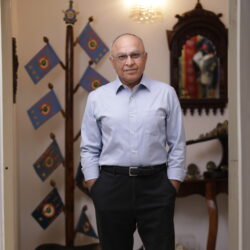

354: Indian Sudoku Championship 2023


Indian Sudoku Championship is conducted by Logic Masters India

This year it was held on 28 May 23.


Took part in it  for the 12th year consecutively.

 

Stood third in the A-50 category.

 

Secured an all India rank of 22 in the open category.


It was a four round gruelling competition, with about 30 odd variants of Sudoku being played.


Instructions booklet for

Sudoku Mahabharat 2023 Finals

&

Indian Sudoku Championship 2023


28th May 2023


Finals: Round 1 – The Classics 40 minutes: 400 points
Starts at 9:00 AM

Total Solving Time:

270 minutes Total Points: 2600 + Bonus + Base points

Round 2 – The Seen 70 minutes: 700 points
Round 3 – And the Unseen 90 minutes: 900 points
Round 4 – Two Way Relay 70 minutes: 600 points

 Round 1 

It had 10 Classic Sudokus.


Sudoku Points
Classic Sudoku 1 20 points
Classic Sudoku 2 20 points
Classic Sudoku 3 30 points
Classic Sudoku 4 25 points
Classic Sudoku 5 30 points
Classic Sudoku 6 30 points
Classic Sudoku 7 40 points
Classic Sudoku 8 55 points
Classic Sudoku 9 50 points
Classic Sudoku 10 100 points

(1-10). Classic Sudoku (20+20+30+25+30+30+40+55+50+100 points)

Place a digit from 1 to 9 in each empty cell so that each digit appears exactly once in each row, column and 3×3 box.

 Round 2

It had ten sudoku variants representing some of the online rounds of Sudoku Mahabharat 2023.


Variant Points
Outside Sudoku 45 points
Pointing Evens Sudoku 50 points
Killer Sudoku 55 points
Thermo Sudoku 55 points
Position Sums Sudoku 100 points
No Three in a Row Sudoku 80 points
Skyscrapers Sudoku 75 points
Hex Sudoku 75 points
XV Sudoku 120 points
Pencil marks Sudoku 40 points


1. Outside Sudoku (45 points)

 Apply classic Sudoku rules. Additionally, the digits outside the grid must appear in one of the cells in the first box (till the next bold line) seen from that edge of the grid

2. Pointing Evens Sudoku (50 points)

Apply classic Sudoku rules. Digits outside the grid indicate the number of evendigits in the direction of the arrow.

3. Killer Sudoku (55 points)

Apply classic Sudoku rules. Additionally, the sum of digits in cells inside everycage must equal the total given for the cage at the upper left cell. Digits do not repeat inside a cage.


4. Thermo Sudoku (55 points)

Apply classic Sudoku rules. Digits along each thermometer are strictly increasing from its bulb to each of its ends.


5. Position Sums (100 points)

Apply classic Sudoku rules. Digits in the first and second cell from the top and from the left are A and B for that column/row. There are two sets of clues outside the grid: The ones closest to the grid give the sum of A and B. The ones further out give the sum of the digits in the Ath and Bth positions in that direction.

6. No Three in a Row Sudoku (80 points)

Apply classic Sudoku rules. Digits in any three consecutive cells in any row or column must not be of the same parity.

7. Skyscrapers Sudoku (75 points)

Apply classic Sudoku rules. Each digit inside the grid represents the height of a skyscraper in that cell. Each number outside the grid represents the number of skyscrapers that can be seen in that row or column. Taller skyscrapers hide shorter ones.

8. Hex Sudoku (75 points)

Apply classic Sudoku rules. Digits do not repeat along any of the three directions in which the hexagonalcells share edges of a line.

9. XV Sudoku (125 points)

Apply classic Sudoku rules. Adjacent cells with digits summing to 5 are marked by V. Adjacent cellswith digits summing to 10 are markedby X. All possible V and X are marked.

 10. Pencilmarks Sudoku (40 points)

Apply classic Sudoku rules. Additionally, in some cells you find all allowed candidates for the specific cell.

 Round 3

It had ten sudoku variants which are seen less frequently in competitions.


Variant Points
Confetti Sums Sudoku 55 points
First Seen Odd/Even Sudoku 55 points
Position Sudoku 50 points
Slanted Killer Cages Sudoku 115 points
Nine Pins Sudoku 95 points
Mathrax Sudoku 70 points
Max Ascending Sudoku 100 points
Quad Sums Sudoku 80 points
Rossini Sudoku 110 points
Arrow or Thermo Sudoku 170 points

1. Confetti Sums Sudoku (55 points)

Apply classic Sudoku rules. All pairs of digits having sums of A, B and C are marked with circles of white, grey, and black colors respectively. A, B and C have different values and need to be determined as part of solving.

2. First Seen Odd/Even Sudoku (55 points)

Apply classic Sudoku rules. Clues adjacent to a row or column give the first odd (if the clue is odd) or first even(if the clue is even) digit in that row or column from the direction of the clue.

3.Position Sudoku (50 points)

Apply classic Sudoku rules. Numbers outside the grid indicate the position of the largest digit in the first three cells.

4. Slanted Killer Cages Sudoku (115 points)

Apply classic Sudoku rules. Digits in cages must sum to the given total and must not repeat. Digits in cells containing diagonal lines contribute half their value to the total of the cage and may belong to more than one cage.

5. Nine Pins Sudoku (95 points)

Apply classic Sudoku rules. Each digit from 1 to 9 must form a diagonal triplet (three of same digit along a diagonal line) at least once.

6. Mathrax Sudoku (70 points)

Apply classic Sudoku rules. Some intersections of the grid lines are marked by a number and an operator (+, -, X, /) in a circle. The number is the result of the operation, applied to both pairs of diagonally opposite cells. An “E” in the circle indicates that all four adjacent digits are even; an “O” indicates that all four adjacent digits are odd.

7. Max Ascending Sudoku (100 points)

Apply classic Sudoku rules. Each clue adjacent to a row or column gives the exact length of the longest contiguous run of increasing digits within that row or that column, counting from the direction of the clue.

8. Quad Sums Sudoku (80 points)

Apply classic Sudoku rules. A dot at a corner implies that one digit is the sum of the remaining three digits at that corner. Not all dots are given.

9. Rossini Sudoku (110 points)


Apply classic Sudoku rules. Each arrow outside the grid indicates that the digits within the first box (till the next bold line) in the corresponding direction are in ascending order in the direction of the arrow. All such arrows are marked.

10.  Arrow or Thermo Sudoku (170 points)

Apply classic Sudoku rules. Each line is either a Thermo from the given bulb, or an Arrow with the given head. Exactly half of the lines are Thermos and half are Arrows.

Arrow Sudoku: Digits in the circled cells must be the sum of the digits along the arrow pointing out of it. Digits can repeat on the arrow.

Thermo Sudoku: Digits along each thermometer are strictly increasing from its bulb to each of its ends.


Round 4

General rules:

·        This round consists of 9 puzzles, 3 Classic Sudokus and 6 Sudoku Variants. The first and last puzzle are solvable by themselves.

·        In other puzzles, there are some arrows.

·        The digit from the same cell from the previous sudoku should be transferred to the downward- pointing arrow.

·        The digit from the same cell from the next sudoku should be transferred to the upward-pointing arrow.

·        Some sudokus may have multiple solutions but the complete round can be solved in only one way.

·        Partial points will be givenonly for every correct grid which is part of the complete solution.

·        Points will be awarded based on the number of sudokus solved correctly as part of the overall solution.


Variant Points
1 Sudoku 30 points
2 Sudokus 90 points
3 Sudokus 150 points
4 Sudokus 220 points
5 Sudokus 290 points
6 Sudokus 360 points
7 Sudokus 440 points
8 Sudokus 520 points
9 Sudokus 600 points


1,4,7. Classic Sudoku

Refer to rules and example in round 1.

2. Irregular Sudoku

Place a digit from 1 to 9 in each empty cell so that each digit appears exactly once in each row, column and each outlined region.


3. Product Frame Sudoku

Apply classic Sudoku rules. Numbers outside the grid equal the product of the first three numbers in the corresponding row or column in the given direction.

5. Palindrome

Apply classic Sudoku rules. The digits in the cells with the line form palindromes, i.e. they read the same from both the directions.


6. Sandwich

Apply classic Sudoku rules. Numbers outside the grid indicate the sum of digits between 1 and 9 in the corresponding row or column.

8. Slot Machine

Apply classic Sudoku rules. The three shaded columns are like a slot machine. The 9 numbers they contain will be in the same sequence. (The strips wrap around the grid for the ordering)

9.  Clone Sudoku

Apply classic Sudoku rules. Digits in each corresponding cell in the shaded figures are identical.

Suggestions and value additions are most welcome


For regular updates, please register here

Subscribe


References and credits

To all the online sites and channels.


Disclaimer:

Information and data included in the blog are for educational & non-commercial purposes only and have been carefully adapted, excerpted, or edited from sources deemed reliable and accurate. All copyrighted material belongs to respective owners and is provided only for purposes of wider dissemination.

 

353: ECONOMIC SANCTIONS: TWO-EDGED SWORD


Sanctions as more than verbal condemnation and less than the use of armed forces.

 – UN general secretary Kofi Annan


The USA has been using economic sanctions as a foreign policy tool. It has imposed economic sanctions against Russia, China, North Korea, Iran, Afghanistan, Venezuela, etc.


Besides other countries, the sanctions are also used against members of commercial entities and private individuals, as well as non-state actors such as terror groups, etc. affecting their participation in global trade.


Nonviolent Coercive Diplomacy. The sanctions in the conflict continuum fall somewhere midway between censure and armed hostilities. Sanctions are frequently used as part of nonviolent coercive diplomacy to coerce targets away from unacceptable behaviour and restrain them from behaving in those ways in the future as well.  This nonviolent nature of sanctions has made them so appealing in international relations and since the end of the cold war, they have grown very popular.


Continue reading “353: ECONOMIC SANCTIONS: TWO-EDGED SWORD”

352: Arms Trade (Part I): Trends and Concerns


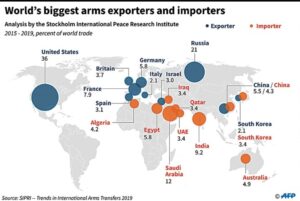
Stockholm International Peace Research Institute (SIPRI) based in Stockholm, is an independent international institute dedicated to research into conflict, armaments, arms control and disarmament. Established in 1966, SIPRI provides data, analysis and recommendations, based on open sources, to policymakers, researchers, media and the interested public.


Recently it published its annual research report on Trends in International Arms Transfer, 2022. The report essentially compares two five years periods i.e. 2013-17 and 2018-22.


Relevant extracts related to trends and concerns are as follows:-


Overview: Exporters


There are 63 states as exporters of major arms. The top 25 arms exporters accounted for 98 per cent of the world’s arms exports in 2018–22.


The five largest exporters of arms during the period 2018–22 are the USA, Russia, France, China and Germany. These five account for over three-quarters (76 per cent) of all arms exports.


States in North America and Europe together accounted for 87 per cent of all arms exports in the period. The five largest exporters in Western Europe (France, Germany, Italy, the United Kingdom and Spain) supplied around one-quarter (24 per cent) of total global arms exports in 2018–22.


USA. US arms exports accounted for 40 per cent of the global total in 2018–22 and were 14 per cent higher than in 2013–17. The USA delivered major arms to 103 states in 2018–22, almost as many as the next two biggest exporters combined. The USA’s arms exports grew by 14 per cent between 2013–17 and 2018–22 and its share of total global arms exports rose from 33 per cent to 40 per cent. Its total arms exports in 2018–22 were 148 per cent higher than those of Russia—the second largest exporter—compared with 50 per cent higher in 2013–17.


Russia. In 2018–22 Russia delivered major arms to 47 states and accounted for 16 per cent of total global arms exports. Russian arms exports remained stable between 2008–12 and 2013–17 but fell by 31 per cent between 2013–17 and 2018–22. The annual volumes of arms exports in 2018 and 2019 were at similar levels to or higher than those in each of the previous 20 years but were at significantly lower levels in 2020, 2021 and 2022.


Others. French arms exports increased by 44 per cent between 2013–17 and 2018–22, while Russian (–31 per cent), Chinese (–23 per cent) and German (–35 per cent) arms exports decreased.


Comments:


  • Four major exporters of arms are the USA, European Union, Russia and China.


  • Well established defence industry (Eco System) is essential to be a world power.


  • Defence export is necessary for the growth of the domestic defence industry.


  • While the export trend is upward for the USA, it is downward for Russia and China.


  • Are the US-led wars in the world, for the benefit of and encouraged by its arms industry?


Overview: Importers


SIPRI has identified 167 states as importers of major arms in 2018–22. The five largest arms importers in 2018–22, India, Saudi Arabia, Qatar, Australia and China, together received 36 per cent of the world’s arms imports.


The main recipient region in 2018–22 was Asia and Oceania (accounting for 41 per cent of global arms imports), followed by the Middle East (31 per cent), Europe (16 per cent), the Americas (5.8 per cent) and Africa (5.0 per cent).


Six of the world’s 10 largest arms importers in 2018–22 were in Asia and Oceania: India, Australia, China, South Korea, Pakistan and Japan. The USA (31 per cent) accounted for the largest share of arms imports to states in the region, followed by Russia (26 per cent) and France (12 per cent).


Comments:


  • Arms are being pumped into Asia and Oceania, making them the biggest hot spots.


  • Hot spots in the Middle East are being kept alive to cash in on the prevailing arms market of oil-rich countries.


  • After a long period, a hot spot has appeared on the doorstep of Europe.


  • China is adding to its military power by every possible means.


Ukraine War


Ukraine imported very few major arms in the period from its independence in 1991 until the end of 2021. This changed after the Russian invasion of Ukraine in February 2022, as the United States and many European states began to send large quantities of military aid to Ukraine. As a result, it became the 3rd largest importer of major arms in 2022, after Qatar and India, and the 14th largest for the five-year period 2018–22, accounting for 2.0 per cent of total global arms imports.


Of the 29 states that supplied major arms to Ukraine in 2022, the main suppliers were the USA, which accounted for 35 per cent of total Ukrainian arms imports during the year, Poland (17 per cent), Germany (11 per cent), the United Kingdom (10 per cent) and Czechia (4.4 per cent).


Ukraine did not receive all the types of arms it asked its supporters to provide and, at different stages, there was a divergence between states about what they were willing to supply. In many cases, the supply of arms by one state was financed by other states or by the European Union (EU) through the European Peace Facility.


Russia, in contrast, relied almost exclusively on domestically produced arms—although it did import unmanned aerial vehicles (UAVs) and flying bombs from Iran in 2022.


Effect: Ukraine War The war in Ukraine had only a limited impact on the total volume of arms transfers in 2018–22, but Ukraine did become a major importer of arms in 2022. In addition, most European states substantially increased their arms import orders and the war will have significant ramifications for future supplier–recipient arms trade relations globally.


Comments:


  • USA-led NATO has pushed Russia into the Ukraine conflict, with the benefit of weakening Russia and boost to its arms industry.


  • Many of the arms supplied were second-hand items from existing stocks. (Including artillery pieces, guided artillery rockets, old tanks, and anti-tank missiles).


  • Some newly produced arms, such as air defence systems were also supplied.


  • Most of the arms supplied were vital for Ukraine to halt the Russian offensive and provided limited offensive capability. They essentially boosted the defensive capability, with “urban jungle warfare” and “shoot and scoot” employment philosophy.


  • The Suppliers were not prepared to deliver arms with a long-range strike capability, such as combat aircraft and long-range land-attack missiles, presumably because of affordability and more importantly to keep the conflict below a certain threshold.


  • The Ukraine conflict will further reduce the Russian arms export in future.


Relevant Aspects: Closer to Home


China. China accounted for 5.2 per cent of total global arms exports in 2018–22. Its arms exports decreased by 23 per cent between 2013–17 and 2018–22. The vast majority of Chinese arms exports (80 per cent) went to states in Asia and Oceania. China delivered major arms to 46 states in 2018–22, but over half of its arms exports (54 per cent) went to just one state—Pakistan.


China’s arms imports grew by 4.1 per cent and accounted for 4.6 per cent of the global total in 2018–22. The vast majority of Chinese arms imports (83 per cent) came from Russia. Russian deliveries in the last three years of the period (2020–22) consisted almost entirely of helicopters and engines for aircraft, which are the last few types of major arms that China has had difficulties in developing.


Comments


  • China is increasing its logistic bases in Oceania and IOR, for future expeditionary operations capability.


  • China is pumping Chinese arms and equipment into countries of its interest to increase interoperability with them and also make them reliant on China in the long run.


Pakistan. Arms imports by Pakistan increased by 14 per cent between 2013–17 and 2018–22 and accounted for 3.7 per cent of the global total. China supplied over three-quarters (77 per cent) of Pakistan’s arms imports in 2018–22.


Comments


  • Pakistan keeps spending money on its military in spite of the economic crisis at home.


  • China has boosted Pakistan’s military capability (Army, Navy and Air Force), defence industry, nuclear capability, and long-range missile capability.


India. India’s tensions with Pakistan and China largely drive its demand for arms imports. With an 11 per cent share of total global arms imports, India was the world’s biggest importer of major arms in 2018–22, a position it has held for the period 1993–2022. It retained this position even though its arms imports dropped by 11 per cent between 2013–17 and 2018–22.


Russia was the largest supplier of arms to India in both 2013–17 and 2018–22, but its share of total Indian arms imports fell from 64 per cent to 45 per cent. Russia’s position as India’s main arms supplier is under pressure due to strong competition from other supplier states, increased Indian arms production and, since 2022, the above-mentioned constraints on Russia’s arms exports related to its invasion of Ukraine.


India’s arms imports from France,  increased by 489 per cent between 2013–17 and 2018–22. France, therefore, displaced the USA to become the second largest supplier to India in 2018–22.


Comments


  • India Continues to retain the dubious record of being the biggest defence importer.


  • The import content is showing a downward trend due to the attempts to replace imports with major arms that are designed and produced domestically (self-reliance).


  • Russian content in the Indian military is reducing and being replaced by the USA and other Western exporters.


  • The Indian military has a very diverse defence inventory resulting in a logistic nightmare. But it is also a blessing in disguise, as far as reliance on one particular supplier is concerned.


  • Indian procurement follows the principle of “Maximum bang for the buck”, buying the best available equipment in the market.


Bottom Line

Wheels within wheels in the Arms industry and trade.

Humans are in Self Protect or Self-destruct mode?


Coming Up

Arms TradePart II: Flows vis-à-vis Hot Spots


Suggestions and value additions are most welcome


For regular updates, please register here

Subscribe

References and credits

To all the online sites and channels.

Disclaimer:

Information and data included in the blog are for educational & non-commercial purposes only and have been carefully adapted, excerpted, or edited from sources deemed reliable and accurate. All copyrighted material belongs to respective owners and is provided only for purposes of wider dissemination.

English हिंदी