820: ARTEMIS II AND THE SECOND SPACE RACE FOR THE LUNAR RESOURCES


Article published in the jun 26 edition of the News Analytics Magazine


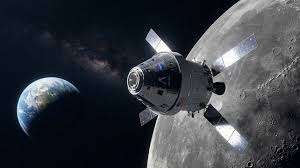
On April 1, 2026, the Space Launch System ignited at Launch Pad 39B at Kennedy Space Centre and punched the Orion spacecraft into a clear Florida sky. Onboard were Commander Reid Wiseman, Pilot Victor Glover, Mission Specialist Christina Koch, and Canadian Space Agency astronaut Jeremy Hansen. Ten days and 1.4 million kilometres later, having looped around the far side of the Moon on a free-return trajectory and broken the distance record set by Apollo 13, they splashed down in the Pacific off San Diego. Artemis II was complete.

It is humanity’s first crewed journey to the vicinity of the Moon in more than fifty years. It was also the first test of Orion’s life-support systems with humans aboard in deep space. The Orion capsule’s computers ran 20,000 times faster than those used during Apollo, while the European Service Module, built by ESA, provided propulsion, power, water, and oxygen throughout. The Space Launch System, generating roughly 15 per cent more thrust than the Saturn V, performed without issue. Technicians were already beginning work on the hardware for Artemis III before the recovery ships reached the crew.

But the mission’s significance goes far beyond the engineering feat. Artemis II is a move in a geopolitical contest. The stakes are much higher than Apollo’s. The second space race has started, and this time the prize is not prestige alone.

From Apollo to Artemis. The first space race was about ideology. The United States claimed a symbolic victory over the Soviet Union when Neil Armstrong stepped onto the Moon in July 1969. Then the urgency collapsed for several reasons. These included budget constraints, a shift toward the Space Shuttle and low-Earth orbit, and the thawing of the Cold War. The pace became a domain of cautious cooperation, culminating in the International Space Station. Even that era is over now. The Artemis programme, announced in 2017, has revived lunar ambition on entirely different terms.  The Artemis Program is built around a sustained presence and a plan to use the Moon as a proving ground for Mars.

Racing Blocs. The geopolitical architecture of the second space race is hardening into two distinct coalitions.


    • The American-led bloc is around the Artemis Accords. It has now been signed by 61 nations, establishing principles for transparency, interoperability, and the legality of resource extraction under existing international law. The partners include Canada, ESA member states, Japan, the UK, Australia, and the UAE.


    • China’s answer is the International Lunar Research Station, co-founded with Russia in 2021. Russia has become a junior partner in a China-led programme. China has recruited 13 countries to the ILRS framework, including Pakistan, Belarus, South Africa, and Venezuela, and is aggressively expanding that list through a “5-5-5” initiative. The initiative aims to enrol 50 nations, 500 institutions, and 5,000 researchers in lunar science by the early 2030s. Beijing is offering low-interest loans for ground stations, technology transfer guarantees and payload slots on Chinese missions.
    • India occupies the middle ground. India has signed the Artemis Accords while simultaneously building indigenous capability. While joining the Accord, India is not a direct participant in the NASA-led Artemis Programme’s mission-driven hardware development, but rather a partner in its guiding principles. By joining, India aligns with international principles for space exploration. These include transparency, interoperability, and the peaceful use of space resources. The agreement fosters strengthening space cooperation between the Indian Space Research Organisation (ISRO) and NASA.

South Pole: Ground Zero for the Next Space Race. Every major programme (Artemis, the Chinese Lunar Exploration Program, and Chandrayaan) targets the same narrow strip of terrain. The reason is water ice, preserved for billions of years in permanently shadowed craters at temperatures around -173°C. Through electrolysis, that ice can be split into hydrogen and oxygen (which are useful for rocket propulsion). A reliable South Pole water supply could turn the Moon into what planners call a gas station in the sky. There is also helium-3 stock, deposited by solar wind over billions of years. It is estimated at around one million tonnes across the lunar surface. Helium-3 holds promise as a fuel for aneutronic fusion reactions that produce far less radioactive waste than conventional fission. The South Pole’s value is as much strategic as it is geological. Both Artemis and the ILRS are fixated on the same area.

US Increasing the Pace. The Artemis programme, announced in 2017, is built around a sustained presence around the moon. Artemis II was the crewed proof of concept for that ecosystem. Artemis III will test lunar landing equipment in Earth orbit in 2027. Artemis IV, carrying the first crew actually to land at the South Pole, is targeted for 2028. Each member of the accord is contributing hardware or expertise (Canada’s Canadarm3 for the Gateway, ESA’s service modules, and Japan’s logistics). The programme also integrates the private industry. SpaceX holds the Artemis IV lander contract, and Blue Origin holds the Artemis V contract. Intuitive Machines and Firefly Aerospace are conducting robotic precursor missions under NASA’s Commercial Lunar Payload Services programme.

China Maintaining the Momentum. In roughly two decades, the China National Space Administration has gone from launching its first taikonaut in 2003 to landing a rover on the lunar far side, returning samples from the surface, operating its own space station, and sending a rover to Mars. The Chang’e programme has been methodical: Chang’e-4 became the first mission to soft-land on the far side in 2019; Chang’e-5 returned near-side samples in 2020; Chang’e-6 brought back far-side samples in 2024,  the first time that had been done. Chang’e-7, scheduled for late 2026, will survey the south pole for water ice. Chang’e-8, in 2028, will test in situ source utilisation. China is targeting a crewed landing by 2030. The crewed mission will adopt a dual-launch architecture. The Long March 10 rocket will carry the Mengzhou spacecraft, which will carry three taikonauts. Another one will deliver the Lanyue lander. The two vehicles will rendezvous in lunar orbit. Two crew members will descend to the surface while a third remains above. The ILRS envisions a permanent facility near the Lunar South Pole being built and operationalised in three phases—reconnaissance through 2025, construction from 2026 to 2035, and full utilisation from 2036.

Indian Effort. India’s space programme has, in a short span, moved from ambition to achievement. In August 2023, Chandrayaan-3’s soft landing near the lunar south pole was a landmark moment. No nation had touched down on that terrain before. The feat placed the Indian Space Research Organisation in a category, until then occupied only by the United States, the Soviet Union, and China, in terms of demonstrated lunar landing capability. The follow-up mission, Chandrayaan-4, targets the MM-4 site on Mons Mouton at nearly 84 degrees south latitude. The return mission planned for 2028  will push India’s indigenous capability further still.

The Stakes. The Apollo contest was primarily a demonstration of ideological and technological superiority. The Artemis contest is about infrastructure and norms. Leadership in space is not symbolic. It shapes standards, partnerships and long-term strategic influence. Whoever builds the first permanent presence at the South Pole gains the standing to set the terms for everyone who follows.  These include docking interfaces, communication protocols, and resource-extraction norms. The United States set them for the internet. China is making a methodical bid for the lunar space. The stakes are much higher than in the 1960s race. The logic is simple. Resources are needed to sustain presence, but presence is needed to access resources. What matters is who reaches first.


What Next. The Artemis programme is moving, but so is China’s IRLS. The ILRS coalition continues to add members. Artemis II proved the hardware works with people inside. The Orion heat shield held, the SLS performed, and the European Service Module delivered. Work on Artemis III and IV is already underway. On the other hand, China’s Chang’e-7 is planned for launch later in 2026 to map resources at the South Pole. The Long March 10 crewed vehicle is approaching its maiden flight. The window to set multilateral governance frameworks before the first permanent infrastructure goes into the ground is closing.


The Moon that humanity walked away from after Apollo 17 in December 1972 is returning to the centre of global attention. This time, not as a destination for brief visits but as a domain to be occupied, developed, and contested. The second space race is not a metaphor or a rhetorical convenience. It is a structural feature of twenty-first-century great-power competition. The race, playing out at a quarter-million miles, is just warming up.


Please Add Value to the write-up with your views on the subject.

1942
Default rating

Please give a thumbs up if you  like The Post?


For regular updates, please register your email here:-

Subscribe


References and credits

To all the online sites and channels.

Pics Courtesy: Internet

Disclaimer:

Information and data included in the blog are for educational & non-commercial purposes only and have been carefully adapted, excerpted, or edited from reliable and accurate sources. All copyrighted material belongs to the respective owners and is provided only for wider dissemination.


References: –

  1. NASA, “Artemis II: First crewed Orion & SLS flight test”, 2026. https://www.nasa.gov/mission/artemis-ii
  1. NASA, “NASA’s plan for sustained lunar exploration and development”, 2017. https://www.nasa.gov/artemis
  1. NASA, “The Artemis Accords”, 2020. https://www.nasa.gov/artemis-accords
  1. China National Space Administration, “China and Russia sign a MoU to construct the International Lunar Research Station”, CNSA, 2021. http://www.cnsa.gov.cn
  1. China Manned Space Agency, “Long March 10 and crewed lunar mission architecture”, 2026. http://www.cmse.gov.cn
  1. Jones A, “Chang’e-6 returns first samples from the Moon’s far side”, Space News, 25 Jun 2024. https://spacenews.com
  1. Indian Space Research Organisation, “Chandrayaan-3 mission: Successful soft landing on lunar south pole”, 2023. https://www.isro.gov.in/Chandrayaan3
  1. Indian Space Research Organisation, “Chandrayaan-4: Site selection for sample return at Mons Mouton”, Apr 2026.  https://www.isro.gov.in
  1. Ministry of External Affairs, GOI, “Joint statement from the United States and India: A partnership for the 21st century”, 2023. https://www.mea.gov.in
  1. Lowy Institute, “Artemis II and the geopolitics of the second space race”, Apr 2026. https://www.lowyinstitute.org
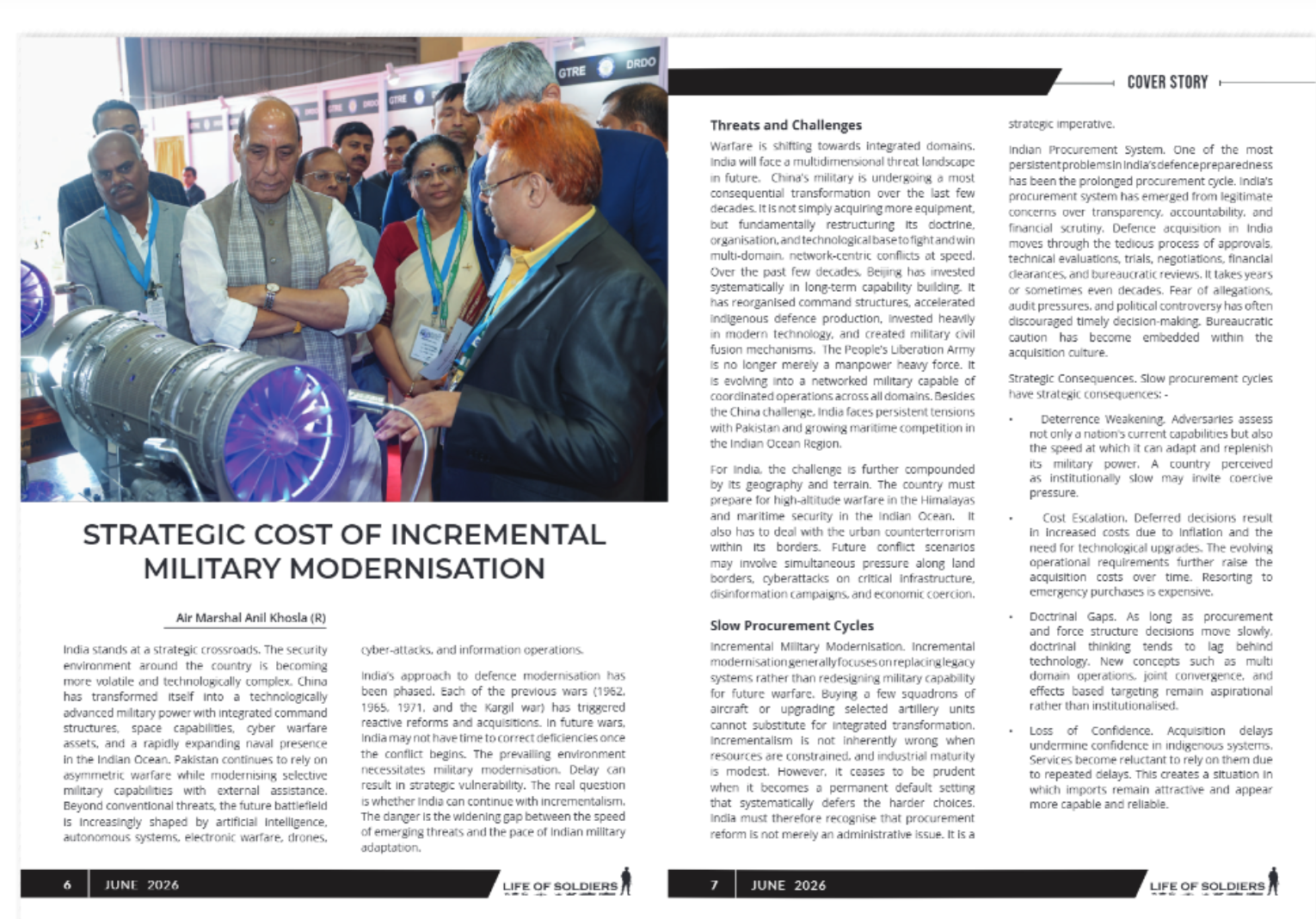
819: STRATEGIC COST OF INCREMENTAL MILITARY MODERNISATION


Article published in the June 26 edition of the “Life of Soldier” Journal.


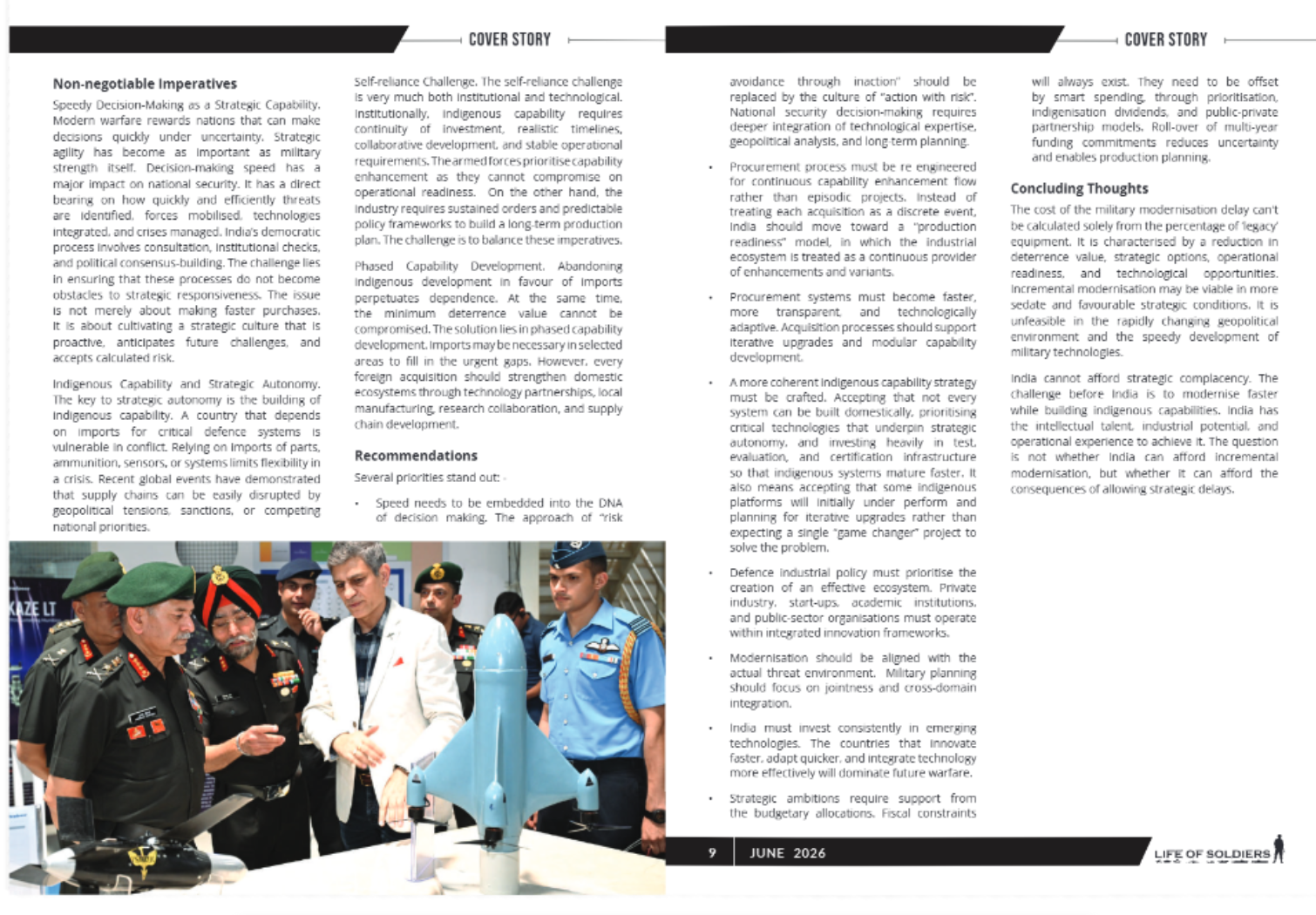
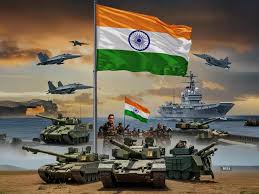
India stands at a strategic crossroads. The security environment around the country is becoming more volatile and technologically complex. China has transformed itself into a technologically advanced military power with integrated command structures, space capabilities, cyber warfare assets, and a rapidly expanding naval presence in the Indian Ocean. Pakistan continues to rely on asymmetric warfare while modernising selective military capabilities with external assistance. Beyond conventional threats, the future battlefield is increasingly shaped by artificial intelligence, autonomous systems, electronic warfare, drones, cyber-attacks, and information operations.

India’s approach to defence modernisation has been phased. Each of the previous wars (1962, 1965, 1971, and the Kargil war) has triggered reactive reforms and acquisitions. In future wars, India may not have time to correct deficiencies once the conflict begins. The prevailing environment necessitates military modernisation. Delay can result in strategic vulnerability. The real question is whether India can continue with incrementalism. The danger is the widening gap between the speed of emerging threats and the pace of Indian military adaptation.


Threats and Challenges

Warfare is shifting towards integrated domains. India will face a multidimensional threat landscape in future.  China’s military is undergoing a most consequential transformation over the last few decades. It is not simply acquiring more equipment, but fundamentally restructuring its doctrine, organisation, and technological base to fight and win multi-domain, network-centric conflicts at speed. Over the past few decades, Beijing has invested systematically in long-term capability building. It has reorganised command structures, accelerated indigenous defence production, invested heavily in modern technology, and created military civil fusion mechanisms.  The People’s Liberation Army is no longer merely a manpower heavy force. It is evolving into a networked military capable of coordinated operations across all domains. Besides the China challenge, India faces persistent tensions with Pakistan and growing maritime competition in the Indian Ocean Region.

For India, the challenge is further compounded by its geography and terrain. The country must prepare for high-altitude warfare in the Himalayas and maritime security in the Indian Ocean.  It also has to deal with the urban counterterrorism within its borders. Future conflict scenarios may involve simultaneous pressure along land borders, cyberattacks on critical infrastructure, disinformation campaigns, and economic coercion.


Slow Procurement Cycles

Incremental Military Modernisation. Incremental modernisation generally focuses on replacing legacy systems rather than redesigning military capability for future warfare. Buying a few squadrons of aircraft or upgrading selected artillery units cannot substitute for integrated transformation.  Incrementalism is not inherently wrong when resources are constrained, and industrial maturity is modest. However, it ceases to be prudent when it becomes a permanent default setting that systematically defers the harder choices. India must therefore recognise that procurement reform is not merely an administrative issue. It is a strategic imperative.

Indian Procurement System. One of the most persistent problems in India’s defence preparedness has been the prolonged procurement cycle. India’s procurement system has emerged from legitimate concerns over transparency, accountability, and financial scrutiny. Defence acquisition in India moves through the tedious process of approvals, technical evaluations, trials, negotiations, financial clearances, and bureaucratic reviews. It takes years or sometimes even decades. Fear of allegations, audit pressures, and political controversy has often discouraged timely decision-making. Bureaucratic caution has become embedded within the acquisition culture.

Strategic Consequences. Slow procurement cycles have strategic consequences: –

    •  Deterrence Weakening. Adversaries assess not only a nation’s current capabilities but also the speed at which it can adapt and replenish its military power. A country perceived as institutionally slow may invite coercive pressure.
    •  Cost Escalation. Deferred decisions result in increased costs due to Inflation and the need for technological upgrades. The evolving operational requirements further raise the acquisition costs over time. Resorting to emergency purchases is expensive.
    • Doctrinal Gaps. As long as procurement and force‑structure decisions move slowly, doctrinal thinking tends to lag behind technology. New concepts such as multi‑domain operations, joint convergence, and effects‑based targeting remain aspirational rather than institutionalised.
    • Loss of Confidence. Acquisition delays undermine confidence in indigenous systems. Services become reluctant to rely on them due to repeated delays. This creates a situation in which imports remain attractive and appear more capable and reliable.


Non-negotiable Imperatives.

Speedy Decision-Making as a Strategic Capability. Modern warfare rewards nations that can make decisions quickly under uncertainty. Strategic agility has become as important as military strength itself. Decision-making speed has a major impact on national security. It has a direct bearing on how quickly and efficiently threats are identified, forces mobilised, technologies integrated, and crises managed. India’s democratic process involves consultation, institutional checks, and political consensus-building. The challenge lies in ensuring that these processes do not become obstacles to strategic responsiveness. The issue is not merely about making faster purchases. It is about cultivating a strategic culture that is proactive, anticipates future challenges, and accepts calculated risk.

Indigenous Capability and Strategic Autonomy. The key to strategic autonomy is the building of indigenous capability. A country that depends on imports for critical defence systems is vulnerable in conflict. Relying on imports of parts, ammunition, sensors, or systems limits flexibility in a crisis. Recent global events have demonstrated that supply chains can be easily disrupted by geopolitical tensions, sanctions, or competing national priorities.

Self-reliance Challenge. The self-reliance challenge is very much both institutional and technological.  Institutionally, indigenous capability requires continuity of investment, realistic timelines, collaborative development, and stable operational requirements. The armed forces prioritise capability enhancement as they cannot compromise on operational readiness.  On the other hand, the industry requires sustained orders and predictable policy frameworks to build a long-term production plan. The challenge is to balance these imperatives.

Phased Capability Development. Abandoning indigenous development in favour of imports perpetuates dependence. At the same time, the minimum deterrence value cannot be compromised. The solution lies in phased capability development. Imports may be necessary in selected areas to fill in the urgent gaps. However, every foreign acquisition should strengthen domestic ecosystems through technology partnerships, local manufacturing, research collaboration, and supply chain development.


Recommendations.

Several priorities stand out: –

    • Speed needs to be embedded into the DNA of decision‑making. The approach of “risk‑avoidance‑through‑inaction” should be replaced by the culture of “action‑with‑risk”. National security decision-making requires deeper integration of technological expertise, geopolitical analysis, and long-term planning.
    • Procurement process must be re‑engineered for continuous capability enhancement flow rather than episodic projects. Instead of treating each acquisition as a discrete event, India should move toward a “production‑readiness” model, in which the industrial ecosystem is treated as a continuous provider of enhancements and variants.
    • Procurement systems must become faster, more transparent, and technologically adaptive. Acquisition processes should support iterative upgrades and modular capability development.
    • A more coherent indigenous‑capability strategy must be crafted. Accepting that not every system can be built domestically, prioritising critical technologies that underpin strategic autonomy, and investing heavily in test, evaluation, and certification infrastructure so that indigenous systems mature faster. It also means accepting that some indigenous platforms will initially under‑perform and planning for iterative upgrades rather than expecting a single “game‑changer” project to solve the problem.
    • Defence industrial policy must prioritise the creation of an effective ecosystem. Private industry, start-ups, academic institutions, and public-sector organisations must operate within integrated innovation frameworks.
    • Modernisation should be aligned with the actual threat environment. Military planning should focus on jointness and cross-domain integration.
    • India must invest consistently in emerging technologies. The countries that innovate faster, adapt quicker, and integrate technology more effectively will dominate future warfare.
    • Strategic ambitions require support from the budgetary allocations. Fiscal constraints will always exist. They need to be offset by smart spending, through prioritisation, indigenisation dividends, and public-private partnership models. Roll-over of multi-year funding commitments reduces uncertainty and enables production planning.


Concluding Thoughts

The cost of the military modernisation delay can’t be calculated solely from the percentage of ‘legacy’ equipment. It is characterised by a reduction in deterrence value, strategic options, operational readiness, and technological opportunities. Incremental modernisation may be viable in more sedate and favourable strategic conditions. It is unfeasible in the rapidly changing geopolitical environment and the speedy development of military technologies.

India cannot afford strategic complacency. The challenge before India is to modernise faster while building indigenous capabilities. India has the intellectual talent, industrial potential, and operational experience to achieve it. The question is not whether India can afford incremental modernisation, but whether it can afford the consequences of allowing strategic delays.


Please Add Value to the write-up with your views on the subject.


1942
Default rating

Please give a thumbs up if you  like The Post?


For regular updates, please register your email here:-

Subscribe


References and credits

To all the online sites and channels.

Pics Courtesy: Internet

Disclaimer:

Information and data included in the blog are for educational & non-commercial purposes only and have been carefully adapted, excerpted, or edited from reliable and accurate sources. All copyrighted material belongs to the respective owners and is provided only for wider dissemination.


References

Bajwa, P. S., “India’s defence procurement: Challenges and the way forward”. United Service Institution of India. 2023.

Bitzinger, R. A. (2021). “Modernising China’s military: Problems, progress, and prospects”. RAND Corporation.

Cohen, S. P., & Dasgupta, S. (2010). “Arming without aiming: India’s military modernisation”. Brookings Institution Press.

Dahiya, R., & Behuria, A. K. (Eds.). (2012). “India’s neighbourhood: Challenges in the next two decades”. Institute for Defence Studies and Analyses.

Government of India, Ministry of Defence. (2023). “Defence acquisition procedure 2020 (amended)”. Department of Military Affairs.

Gupta, A. (2019). “Building an arsenal: The evolution of regional power force structures”. Praeger.

Kapila, S. (2021). India’s defence modernisation: Structural constraints and strategic imperatives. Journal of Defence Studies.

Khosla, A. (2024, November). “India’s aerospace modernisation: Challenges and imperatives”. Air Marshal’s Perspective. https://55nda.com/blogs/anil-khosla

Ladwig, W. C. (2020). “Indian military modernisation and conventional deterrence in South Asia”. Journal of Strategic Studies.

Sawhney, P., & Wahab, G. (2014). “Dragon on our doorstep: Managing China through military power”. Aleph Book Company.

Tatsumi, Y., & Weston, J. (2019). “Conventional deterrence in the second nuclear age”. Stimson Center.

818: REVISITING DOKLAM: FROM STANDOFF TO STRATEGIC CONTEST


In 2017, India and China had the most dangerous bilateral confrontation since 1962 at the Doklam Plateau. Disengagement took place after a 73-day standoff. The face-off ended without a formal agreement or any resolution of the underlying territorial contest. Both sides claimed a measure of satisfaction. India had stopped the road. China had not been forced to concede anything publicly. Seven years later, the situation has taken an entirely different direction.  From a temporary military standoff, it has become a permanent grey-zone contest in which the instruments of Chinese pressure are increasingly civilian, infrastructural, and juridical rather than uniformed and kinetic. Understanding what has happened at Doklam since 2017, what China is now doing in the Amo Chu Valley, and what India must do in response is not an exercise in historical analysis. It is the most pressing operational and strategic question facing India’s eastern defence architecture in 2026.


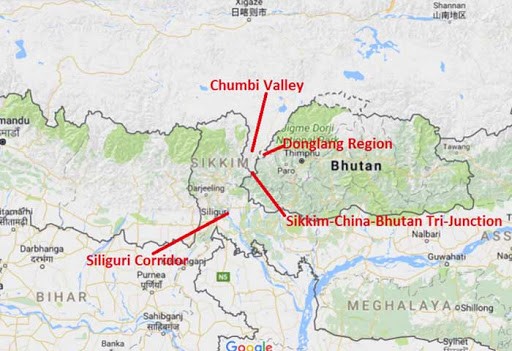
Indian Redline. A specific act at a specific location triggered the 2017 standoff.  Chinese road construction at a point on the Doklam plateau where the road, if completed, would have given the People’s Liberation Army direct vehicular access to the Jampheri Ridge. That ridge is the dominant high ground overlooking the Siliguri Corridor. The corridor is a narrow strip of Indian territory, barely 22 kilometres wide at its narrowest, that constitutes the sole land link between the northeastern states and the Indian mainland. Control of the Jampheri Ridge does not merely threaten the Siliguri Corridor; it commands it. Artillery or missiles positioned there can interdict the Corridor without crossing into Indian territory.


Post 2017 Changes.

Alternate Road. What India stopped in 2017 was a road to a specific point via a specific route. What China has since done is build a different road to the same strategic destination. Satellite imagery analysed by multiple independent research organisations confirms that China has completed a road approximately 5 kilometres long through the Amo Chu Valley. The route has been redesigned to circumvent the specific location of India’s red line rather than to challenge it directly.  This road allows PLA forces and vehicles to approach the Jampheri Ridge area without crossing the precise point where Indian troops halted Chinese construction in 2017. The strategic objective of access to the high ground above the Siliguri Corridor remains unchanged. 

Demographic Alteration. The Amo Chu road is the kinetic component of a broader strategy, the most significant element of which is the construction of permanent settlements. China’s Xiaokang village programme has placed villages in strategically selected locations (previously uninhabited or seasonally used by Tibetan herders) across the Himalayan frontier. They have been created to establish a permanent Chinese presence. Continuous occupation supports territorial claims under international norms. These villages are not primarily civilian in purpose, irrespective of their formal designation. These settlements house border defence forces alongside civilian residents. They are connected by road infrastructure that provides the PLA with access and logistics. And they are designed to make any Indian military response to Chinese encroachment diplomatically and legally costly, because attacking or displacing a civilian settlement carries international consequences that interdicting a military road column does not. In the Doklam area, the village of Pangda, situated in the Amo Chu Valley, is the most significant of these.


Indian Options

The appropriate Indian response to the situation at Doklam is not a military operation. It is the construction of a comprehensive active deterrence architecture that operates across the same grey-zone spectrum that China is exploiting, while reinforcing the conventional deterrent that limits China’s escalatory options. This architecture has several components.

Military Bases to Hardening the Chicken’s Neck. The Siliguri Corridor’s strategic vulnerability is a serious problem. Still, it can be substantially mitigated through layered defensive depth. The completion of the Lachit Borphukan Military Station at Dhubri, combined with new military stations at Chopra and Kishanganj, would provide overlapping defensive coverage across the approaches to the Corridor from multiple directions simultaneously. These stations would create a defence-in-depth.  The stations would also provide forward basing for the UAV, electronic warfare, and air defence assets that active deterrence in this theatre requires.

Military Technology Utilisation. China’s principal tactical advantage in the Chumbi Valley is logistical.  The road network and infrastructure investment that gives the PLA the ability to position and sustain significant forces in terrain where India’s own logistics are comparatively constrained. The answer is making that logistics infrastructure a liability rather than an asset. The deployment of advanced surface-to-air missile systems (S-400), supplemented by the Rafale’s organic electronic warfare capability and the Su-30MKI’s air-to-air performance, would provide an asymmetric advantage.   The A2AD architecture is not merely about shooting down aircraft; it is about denying China the confident expectation of air superiority that any escalation to conventional conflict would require.

Demographic Counter. The most direct counter to China’s Xiaokang village strategy is India’s own Vibrant Villages Programme. Chinese villages in border areas serve military functions precisely because they are permanently inhabited. India’s border hamlets in Sikkim and Arunachal Pradesh, many of which have experienced significant depopulation as residents migrate to urban centres for economic opportunity, present the opposite picture. The Vibrant Villages Programme aims to reverse the trend. A Combination of 5G connectivity, all-weather roads, economic incentives, and livelihood support is designed to reverse this depopulation. Permanently inhabited Indian villages along the Sikkim and Arunachal borders would assert Indian sovereignty and serve as a HUMINT asset.  The pace of the programme’s implementation must be accelerated.

Tourism as Sovereignty. The relationship between civilian presence and territorial claim is well established in international practice, and India has underutilised the tourism instrument as a form of continuous sovereign assertion. Tourism is not merely an economic activity. Active promotion of border tourism (facilitated by improved road connectivity, accommodation infrastructure, and streamlined permit processes) would create a continuous civilian presence that directly challenges any claims of vacant territory. Tourism is also a form of territorial assertion that is simultaneously visible, documentable, and internationally legitimate.

Deepening the Bhutanese Engagement. The India-Bhutan relationship is crucial. In 2021, China proposed resolving the broader Bhutan boundary dispute through a “three-step roadmap”.  It was Beijing’s strategy of using Bhutan-China bilateral negotiations to achieve favourable outcomes while circumventing Indian involvement. India’s response must go beyond security assurances and treaty obligations. A Bhutan that is economically prosperous and strategically confident is a far more resilient partner in resisting Chinese pressure than a Bhutan that perceives its security relationship with India as its only alternative to accommodation with Beijing.

AI-Driven ISR to Counter Grey-Zone Activities.  The central operational weakness that grey-zone salami-slicing exploits is the gap between periodic observation and continuous surveillance. Patrolling schedules, satellite revisit intervals, and human intelligence collection cycles all create windows of unobserved time during which incremental changes can be made and completed before India’s intelligence system registers them. By the time the change is observed, it is a fact on the ground. Contesting it requires either the military action that grey-zone methodology is designed to deter or acceptance of the new reality. The answer lies in eliminating the observational gaps through AI-driven continuous monitoring. AI-assisted change-detection processing applied to the continuous imagery feed identifies variations in the physical landscape within hours of their occurrence, rather than days or weeks. This is the single most important capability investment India can make in this theatre.

Digital Border Ledger. China’s grey-zone methodology depends on narrative ambiguity.  The counter to narrative ambiguity is documented transparency. The answer lies in a publicly accessible Digital Border Ledger. A regularly updated database of satellite evidence showing Chinese construction activity, vegetation clearance, road extension, and settlement development along the LAC and the Bhutan-China boundary, with time-stamped imagery and geographic coordinates, would transform the information environment in which Chinese grey-zone operations proceed. A systematic publication of such documents would counter Beijing’s deniability.


Concluding Thoughts

The Doklam plateau is a strategic red line for India, as it overlooks the Siliguri Corridor. Chinese activities in the Chumbi Valley, such as the making of Amo Chu Road and the establishment of Pangda Village, are not isolated actions. They are part of a deliberate strategy to incrementally improve China’s position on the high ground. India’s answer must be equally patient, persistent, and multi-dimensional.

The prevention that worked at Doklam in 2017 was the product of decisions made years before the standoff. Forward basing decisions, ISR investments, force posturing, and treaty relationships that were in place when the crisis arrived. The deterrence required at Doklam in the years ahead must be built now, before the next crisis defines the terms of the contest.


Please Add Value to the write-up with your views on the subject.


1942
Default rating

Please give a thumbs up if you  like The Post?


For regular updates, please register your email here:-

Subscribe


References and credits

To all the online sites and channels.

Pics Courtesy: Internet

Disclaimer:

Information and data included in the blog are for educational & non-commercial purposes only and have been carefully adapted, excerpted, or edited from reliable and accurate sources. All copyrighted material belongs to the respective owners and is provided only for wider dissemination.


English हिंदी