
Published by Book review literary Trust
BOOK REVIEW
1946 LAST WAR OF INDEPENDENCE
ROYAL INDIAN NAVY MUTINY
By Pramod Kapoor
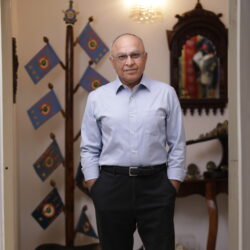
Review by: Air Marshal Anil Khosla (Retd) PVSM, AVSM, VM
Former Vice Chief of Air Staff, Indian Air Force.
In 1946, 20,000 non-commissioned sailors of the Royal Indian Navy mutinied. They were inspired by the heroism of the Azad Hind Fauj. But their anger was sparked by terrible service conditions, racism, and broken recruitment promises. In less than 48 hours, 20,000 men took over 78 ships and 21 shore establishments and replaced British flags with the entwined flags of the Congress, the Muslim League, and the Communists. The British panicked because the mutiny sparked revolts in other branches of the armed forces. As news of the uprising became known, there were widespread agitations in different parts of the country although the worst affected was Mumbai itself. People thronged the streets in support, and hartals were followed by street fights between civilians and British soldiers resulting in over 400 deaths and 1,500 injured. The British realised that they could no longer hold India by force. The event had a profound impact on the colonial authorities and undoubtedly contributed to hastening the processes that led to the departure of the British and the freedom of India in 1947.
Unlike other major events of the Indian freedom struggle like the Salt March and Jallianwala Bagh, etc., the naval mutiny of 1946 got somewhat ignored and did not receive the attention it deserved. In his book “1946 Last War of Independence, Royal Indian Navy Mutiny”, the well-known publisher Pramod Kapoor, with great flair unearths this partly-forgotten and ignored part of the Indian freedom struggle. He presents a gripping account of the events and personalities involved, shedding new light on the event besides its reconstruction.
Pramod Kapoor, the founder and publisher of Roli Books (established in 1978), is one of the leading names in the Indian publishing industry. He is an awardee of the Mahatma Award 2021 for lifetime achievement in literature in Indian publishing and honoured with the prestigious Chevalier de la Legion d’Honneur (Knight of the Legion of Honour) for his enormous contribution to publishing path-breaking books. He has over the course of his illustrious career, conceived and produced award-winning books that have proven to be game-changers in the world of publishing world, with his 2016 book “Gandhi: An Illustrated Biography” receiving international acclaim.
Pramod states that he stumbled upon and got interested in this forgotten story while researching for his book on Gandhi. His research discovered hundreds of reports by British admirals, commanding officers of ships and shore establishments, cables and letters exchanged between London and Delhi, proceedings in the British parliament and debates in the Legislative Council in India. He thoroughly researched hundreds of reports by both British-owned and nationalist newspapers and documents at libraries. He gained first-hand experience by meeting and interviewing people with knowledge of the revolt and the kin of mutineers. The author’s visits to HMIS Talwar, the signal school of the Navy at Colaba, the dockyard and areas of Navy Nagar in Mumbai, helped him understand the “history and geography of the area where the uprising took place.” His book is full of vignettes which reveal the mutiny in stark relief and meticulous detail.
The 16-chapter, 350-page book published by Roli Books, sheds light on the uprising by young sailors of the RIN. The book delves deep into the episode, providing all aspects of the rebellion in detail. The book begins by revisiting Calcutta in March 1965 — when Utpal Dutt staged his play, Kallol, at the Minerva Theatre, dramatising the Naval Mutiny of 1946. The author narrates the genesis and warnings of the brewing revolt in the chapter titled ‘The Gathering Storm’. He elaborates on the unjust manner in which the British had treated the INA officers stirring anger and resentment, particularly at the signal school of HMIS Talwar, where the sailors were from a better educational background, and aware of the “rebellious activity taking place beyond the high walls of their barracks.” According to the author, one of the villains was surely Commander Arthur Frederick King whose rude behaviour and “foul, racist language” sparked the protest at HMIS Talwar.
The chapter, ‘Planning the Mutiny: The Secret Heroes’, is the most thrilling part of the book. Besides the planning process, it also elucidates the profiles of the “heroes of the mutiny” in great detail. His sketches of the main characters in itself make the book worth reading. He has also written about the places where it was all planned and happened. To anyone familiar with Bombay, it’s striking that most of them lived in very posh areas. Kapoor describes the events with passion, straight from the heart and the book offers a riveting, day-by-day account and hour-by-hour recreation of the events of the Mutiny, i.e. declaration of the general strike to the surrender on February 23.
The extensive Epilogue provides a glimpse of the life of the key protagonists post-uprising as also notes on some of the ships and shore establishments. The book also analyses the routine Commission of Enquiry formed to inquire into the whole matter. The author feels that the enquiry served more as a political tool than a judicial purpose.
Kapoor feels that the politicians helped the British put an end to the uprising, despite widespread sympathy for the sailors across the nation. He also points out that the promises made to the sailors at the time of surrender by the Indian leaders were not kept. The author concludes that the rebellious event made the British realise that it was time to quit India. He also strongly believes that partition would have been less bloody if the political leaders had tried to build upon the communal unity created by the events of February 1946 instead of ignoring it.
The book traces the reasons, episodic details, and consequences of this untold saga of Indian history. The well-researched book fills a vital gap in our history and gives much-deserved recognition to the long-ignored heroes of the freedom struggle. It is a compellingly good book and a must-read for specialists of South Asian history in general and anyone interested in the freedom struggle and the history of twentieth-century India.
Suggestions and value additions are most welcome
For regular updates, please register here
References and credits
To all the online sites and channels.
Disclaimer:
Information and data included in the blog are for educational & non-commercial purposes only and have been carefully adapted, excerpted, or edited from sources deemed reliable and accurate. All copyrighted material belongs to respective owners and is provided only for purposes of wider dissemination.