688: INNOVATION: THE NEW AGE WEAPON IN MODERN WARS


My Article was published on “The Eurasian Times” website on 22 Jun 25.


In the rapidly evolving landscape of 21st-century conflict, innovation has emerged as the cornerstone of modern warfare. Nations and non-state actors leverage cutting-edge technology and unconventional tactics to achieve strategic objectives with unprecedented precision, stealth, and impact. Three recent examples, Israel’s drone attack in Iran, Ukraine’s drone assault on Russian military targets, and Israel’s explosive pager attack on Hezbollah, illustrate how innovation is reshaping the battlefield. Executed with remarkable ingenuity, these operations highlight the shift toward asymmetric, hybrid warfare that combines advanced technology, covert intelligence, and psychological operations. The innovative aspects of these cases must be explored to understand their strategic implications and the broader challenges they present for global security.


Israel’s Drone Attack in Iran: A Master Class in Covert Precision

In June 2025, Israel executed a series of drone strikes targeting Iran’s nuclear facilities, missile launchers, and military infrastructure, showcasing a new paradigm in covert warfare. Unlike traditional airstrikes, Israel reportedly activated a network of “kamikaze” drones pre-positioned inside Iran, bypassing the country’s sophisticated air defence systems. This operation, attributed to the Mossad and Israeli Air Force, underscores several innovative aspects of modern warfare.

Strategic Innovation. The attack’s success hinged on long-term infiltration. Over the years, Israel allegedly smuggled drone components into Iran, assembling a clandestine arsenal that could be remotely activated. This approach required meticulous planning, blending human intelligence with technological expertise. By launching drones from within Iran, Israel avoided detection by radar systems designed to counter external threats, such as ballistic missiles or fighter jets. The strikes targeted high-value sites, including the Natanz nuclear enrichment facility and mobile missile launchers, disrupting Iran’s nuclear ambitions and retaliatory capabilities with surgical precision.

Technological Edge. The drones were compact, stealthy, and equipped with advanced navigation systems, enabling them to evade Iran’s multi-layered defences. Reports suggest that using AI-guided drones capable of autonomous target selection represents a leap forward in unmanned warfare. This technology allowed Israel to strike multiple targets simultaneously, maximising impact while minimising exposure.

Implications and Risks. While innovative, the operation carried significant risks. Iran retaliated with missile barrages, escalating tensions and raising fears of a broader regional conflict. The covert nature of the attack also sets a precedent for deniable operations, complicating attribution and accountability.


Ukraine’s Drone Attack in Russia: Asymmetric Warfare Redefined

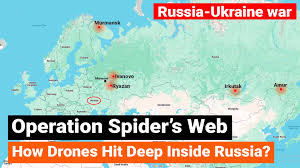
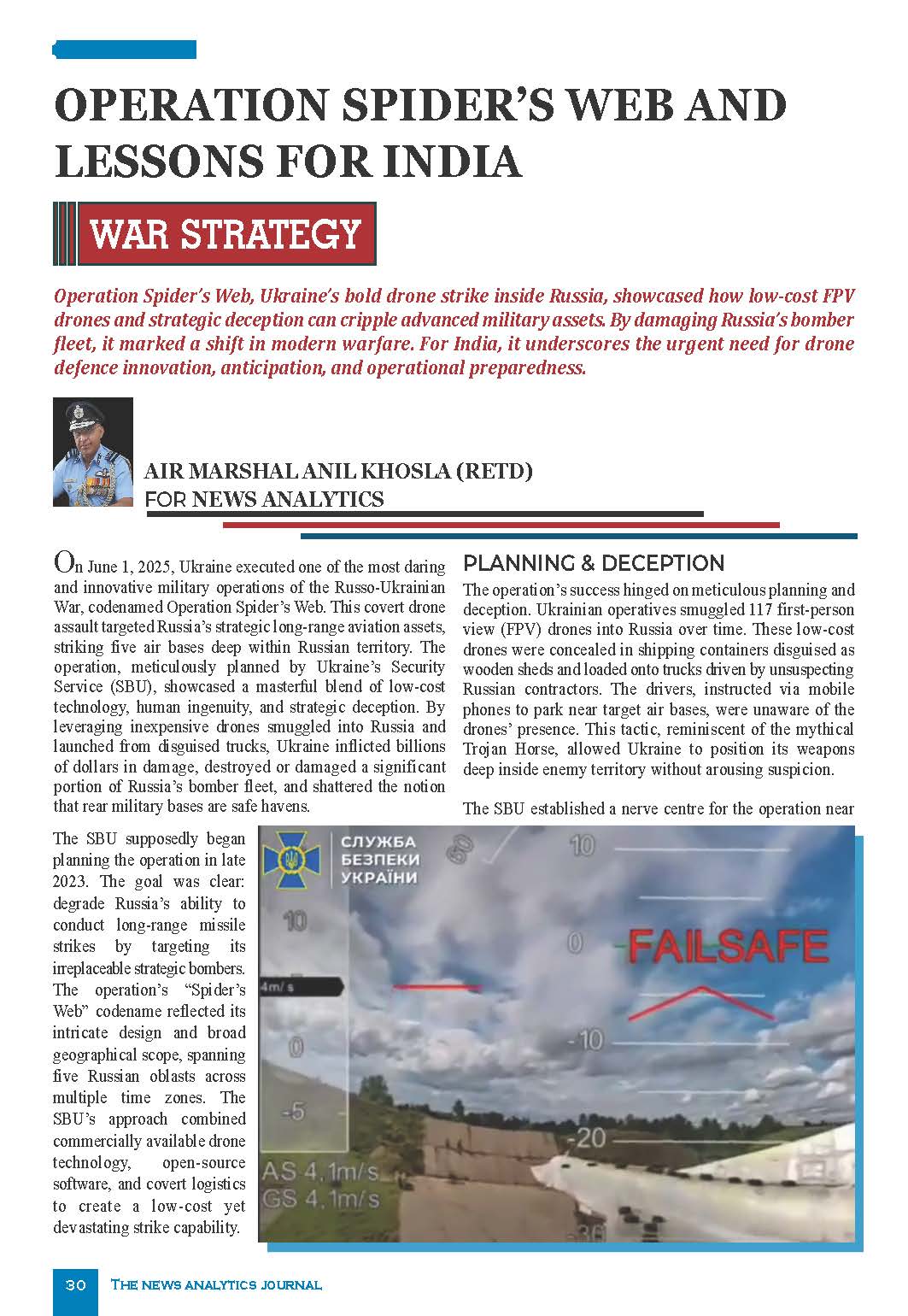
Ukraine’s June 2025 drone attack on Russian military bases, dubbed “Operation Spiderweb,” destroyed over 40 warplanes, demonstrating how resource-constrained nations can challenge superpowers through innovation. By smuggling 117 drones near Russian targets and launching them from within enemy territory, Ukraine showcased the power of asymmetric warfare.

Logistical Creativity. The operation’s success relied on covert logistics. Ukraine transported disassembled drones thousands of miles into Russia, likely using local networks or operatives to assemble and deploy them. This approach bypassed Russia’s border defences and air surveillance, catching military commanders off guard. The drones, described as low-cost and modular, were designed for scalability, allowing Ukraine to mount a large-scale attack with limited resources.

Tactical Impact. The drones targeted airbases, fuel depots, and ammunition stores, inflicting significant damage. By striking deep inside Russia, Ukraine forced Moscow to divert resources to internal defence, creating a new front in the ongoing war. The psychological impact was equally profound, as Russian citizens grappled with the vulnerability of their homeland. This operation highlighted drones as a cost-effective alternative to traditional air forces, levelling the playing field for smaller nations. While a tactical triumph, Ukraine’s strategy risks escalation. Russia may intensify its punitive strikes, targeting Ukrainian cities or infrastructure.


Israel’s Pager Attack on Hezbollah: Cyber-Physical Warfare

In September 2024, Israel executed an unprecedented attack on Hezbollah, using explosive-laden pagers and walkie-talkies to target operatives across Lebanon. This operation crippled Hezbollah’s command structure and marked a new frontier in cyber-physical warfare.

Supply Chain Infiltration. The attack’s brilliance lay in its exploitation of the supply chain. Israel reportedly compromised the manufacturing and distribution of communication devices, embedding micro-explosives in pagers and radios used by Hezbollah. This required years of planning, from infiltrating tech companies to ensuring the devices reached their targets. The operation’s complexity underscores the fusion of intelligence, engineering, and deception in modern warfare.

Precision and Psychological Impact. By detonating thousands of devices simultaneously, Israel disrupted Hezbollah’s operational cohesion with minimal collateral damage compared to airstrikes. The attack killed or injured key commanders, weakening Iran’s proxy network. Beyond physical damage, it sowed distrust among Hezbollah operatives, as everyday devices became potential threats. Retired Mossad agents hailed the operation as a turning point, demonstrating how consumer technology can be weaponised with devastating effect.


The Broader Trend: “Amazon Prime Warfare”

These cases reflect a broader trend toward what can be called “Amazon Prime Warfare,” where small, modular components are delivered covertly, assembled on-site, and used for high-impact strikes. This paradigm shift is driven by AI, robotics, and supply chain manipulation advancements, enabling actors to achieve strategic goals with minimal conventional engagement. However, it also democratises warfare, allowing non-state actors and rogue regimes to adopt similar tactics.

Innovative Elements. This approach combines several innovative elements:-

  • Cost-Effectiveness. Drones and modified consumer devices are far cheaper than traditional weapons, enabling smaller actors like Ukraine to compete with larger powers.
  • Deniability and Stealth. Covert operations, like Israel’s drone and pager attacks, allow states to strike without immediate attribution, delaying retaliation and complicating diplomacy.
  • Hybrid Tactics. Integrating cyber, physical, and intelligence operations creates unpredictable threats, forcing adversaries to rethink defence strategies.

Risks and Challenges. The rise of innovative warfare poses significant challenges for global security. Each attack prompts retaliation, as seen in Iran’s missile strikes following Israel’s drone operation. This tit-for-tat dynamic risks spiralling into broader conflicts. Traditional defence systems, designed for missiles and jets, are ill-equipped to counter combined drone-supply chain attacks. To keep pace, nations must invest in new technologies, such as anti-drone systems and supply chain auditing.


Conclusion

Innovation is undeniably the key to modern warfare, as demonstrated by Israel’s and Ukraine’s ground-breaking operations. Drones, compromised devices, and covert logistics enable precision, stealth, and impact, redefining how conflicts are fought. These tactics empower smaller actors to challenge superpowers, disrupt adversaries, and achieve strategic goals with minimal resources. However, they also destabilise traditional deterrence models, inviting retaliation, proliferation, and ethical controversies.

As warfare evolves, the challenge lies in balancing innovation with restraint. Nations must develop explicit norms for emerging technologies, such as drones and cyber-physical weapons, to prevent escalation and protect civilians. International cooperation is essential to curb proliferation and ensure accountability, particularly when private companies are involved. While innovation drives progress on the battlefield, its unchecked spread risks a future where conflict is ubiquitous, unpredictable, and uncontainable. The lesson is clear for policymakers, military strategists, and global citizens: innovation in warfare is a double-edged sword.


Please Add Value to the write-up with your views on the subject.


Link to the article on the website:-

Stunning Innovative Attacks! Everything & Anything Could Be A Weapon Now; Israel & Ukraine Show The Way

1943
Default rating

Please give a thumbs up if you  like The Post?


For regular updates, please register your email here:-

Subscribe


References and credits

To all the online sites and channels.

Pics Courtesy: Internet

Disclaimer:

Information and data included in the blog are for educational & non-commercial purposes only and have been carefully adapted, excerpted, or edited from reliable and accurate sources. All copyrighted material belongs to respective owners and is provided only for wider dissemination.


References:-

  1. Bergen, Peter, and Alyssa Sims. “How Drones Are Changing Warfare.” Council on Foreign Relations, 29 September 2023.
  1. Binnie, Jeremy. “Israel’s Covert Drone Operations in Iran: A New Era of Warfare.” Jane’s Intelligence Review, 15 June 2025.
  1. Borger, Julian. “Israel’s Pager Attack on Hezbollah: A Cyber-Physical Triumph.” The Guardian, 18 September 2024.
  1. Defence News, “Ukraine’s ‘Operation Spiderweb’ destroys 40+ Russian warplanes using smuggled drones. A game-changer for asymmetric warfare”, 10 June 2025.
  1. Hambling, David. “The Rise of ‘Amazon Prime Warfare’: How Drones and Supply Chains Are Reshaping Conflict.” Forbes, 5 October 2024,
  1. Human Rights Watch. “Civilian Casualties in Israel-Iran Drone Strikes: Legal and Ethical Concerns.” HRW Reports, 20 June 2025,
  1. International Institute for Strategic Studies (IISS). “The Proliferation of Drone Warfare: Implications for Global Security.” IISS Strategic Comments, Vol. 31, No. 4, April 2025.
  1. Sanger, David E., and Ronen Bergman. “How Israel Weaponised Consumer Electronics Against Hezbollah.” The New York Times, 20 September 2024.
  1. Stratcom Analyst. “Iran’s missile retaliation after Israel’s drone strikes shows the escalation risks of covert ops”, 16 June 2025.
  1. United Nations Office for Disarmament Affairs (UNODA). “Emerging Technologies in Warfare: Drones and Cyber-Physical Weapons.” UNODA Occasional Papers, No. 42, March 2025,

687: SIPRI YEARBOOK 2025: HIGHLIGHTS OF KEY FINDINGS


Stockholm International Peace Research Institute (SIPRI) is an independent international institute researching conflict, armaments, arms control, and disarmament. Established in 1966, SIPRI provides data, analysis and recommendations, based on open sources, to policymakers, researchers, media and the interested public. Based in Stockholm, SIPRI is regularly ranked among the most respected think tanks worldwide.

SIPRI publishes a yearbook recognised as an authoritative source for policymakers, researchers, and the public. The 56th edition of the SIPRI Yearbook 2025, published recently, provides a comprehensive overview of global developments in armaments, disarmament, and international security for 2024.


Key Findings

Global Security. Global security continued to decline in 2024, marked by major armed conflicts in regions such as Gaza, Myanmar, Sudan, and Ukraine. These conflicts contributed to heightened geopolitical tensions and increased military activities worldwide.

Military Expenditure. Global military spending reached an all-time high in 2024, marking the ninth consecutive year of increases. Ongoing conflicts like the Russia-Ukraine war and geopolitical tensions drove this rise.

Armed Conflicts and Conflict Management. The Yearbook covers global and regional developments in armed conflicts, peace processes, and peace operations. Specific focus areas include the role of Russian private military and security companies, food insecurity, and climate-related peace and security risks in Yemen. Tensions between India and Pakistan escalated into a brief armed conflict in early 2025, highlighting ongoing regional instability.

Arms Production and Trade. International arms transfers and production saw significant developments, influenced by the Russia-Ukraine war and geopolitical rivalries. The Yearbook notes the continued dominance of major arms suppliers like the United States, Russia, France, Germany, and China.

Emerging Technologies and Security The Yearbook examines the international governance of artificial intelligence, cyberspace, and space security, with a focus on autonomous weapon systems. Developments in dual-use and arms trade controls were noted, including updates to the Arms Trade Treaty and multilateral arms embargoes.

Environmental and Humanitarian Concerns. The report highlights the impact of ecological imbalances and climate-related risks, noting that 2023 was the hottest year in 174 years. These factors exacerbate security challenges, particularly in conflict-affected regions like Yemen.


Nuclear Weapons and Risks

All nine nuclear-armed states (the United States, Russia, the United Kingdom, France, China, India, Pakistan, North Korea, and Israel) continued modernising their nuclear arsenals, with some expanding their stockpiles.

The global inventory of nuclear warheads is estimated at approximately 12,121, with 9,585 in military stockpiles for potential use. Around 3,904 warheads are deployed on missiles and aircraft, a slight increase from 2023.

China’s nuclear arsenal grew significantly, from 410 warheads in January 2023 to 500 in January 2024, the fastest expansion among nuclear-armed states. For the first time, China is believed to have some warheads on high operational alert during peacetime.

India expanded its nuclear arsenal to 172 warheads in 2024, surpassing Pakistan (170 warheads) for the first time. Both countries continued developing new delivery systems, with India focusing on longer-range weapons to target China.

North Korea is estimated to have around 50 assembled warheads, with the potential to produce up to 90, and conducted tests of nuclear-capable missiles in 2023.

The decline in global nuclear warhead numbers has slowed, with operational warheads increasing due to modernisation and expansion programs, signalling a potential new arms race.


Arms Control and Non-Proliferation.

Nuclear arms control efforts faced challenges, with limited progress in dialogues involving China, Russia, and the United States. Concerns were raised about Iran’s nuclear program and attacks on Ukrainian nuclear power plants.

Conventional arms control weakened, with the collapse of the Treaty on Conventional Armed Forces in Europe and the proliferation of explosive weapons in conflicts like Russia-Ukraine and Israel-Hamas.

Chemical and biological security threats were addressed, including investigations into alleged weapon use and updates to international legal frameworks.


Please Add Value to the write-up with your views on the subject.


1943
Default rating

Please give a thumbs up if you  like The Post?


For regular updates, please register your email here:-

Subscribe


References and credits

To all the online sites and channels.

Pics Courtesy: Internet

Disclaimer:

Information and data included in the blog are for educational & non-commercial purposes only and have been carefully adapted, excerpted, or edited from reliable and accurate sources. All copyrighted material belongs to respective owners and is provided only for wider dissemination.


678: PROJECT KUSHA: INDIA’S INDIGENOUS SKY SHIELD


My Article published on “The EurasianTimes” website on 10 Jun 25.


On June 8, 2025, the Defence Research and Development Organisation (DRDO) chief announced that Project Kusha is equivalent to Russia’s S-500 and surpasses the S-400 in capabilities. This positions it as a “game-changer” for India’s air defence. It is designed to counter stealth jets, drones, aircraft, and Mach 7 anti-ship ballistic missiles with an 80–90% interception success rate.

Project Kusha is an ambitious Indigenous long-range air defence system being developed by the DRDO. It is also known as the Extended Range Air Defence System (ERADS) or Precision-Guided Long-Range Surface-to-Air Missile (PGLRSAM). Project Kusha bridges the gap between the 80 km MR-SAM and 400 km S-400, integrating with systems like Akash and Barak-8.

It is a critical part of India’s self-reliance initiative, “Atmanirbhar Bharat”.  The home-grown solution aims to safeguard India’s airspace from aerial threats by strengthening defences against regional threats, particularly from Pakistan and China. The project has gained attention after the May 2025 India-Pakistan conflict, where air defence systems proved vital against drones and missiles, underscoring the need for indigenous capabilities like Kusha. With a projected deployment timeline of 2028–2029, this system is poised to enhance the operational readiness of the Indian Air Force (IAF) and Indian Navy.


System Specifications

Interceptor Missiles. Project Kusha’s core strength lies in its three-tiered interceptor missile system, designed to neutralise various aerial threats at varying ranges. The M1 Interceptor (150 km) missile would target threats like fighter jets, drones, and cruise missiles at shorter ranges. Its compact 250 mm diameter kill vehicle, equipped with a dual-pulse solid rocket motor and thrust vector control, ensures high manoeuvrability and precision, making it ideal for tactical engagements. The M2 Interceptor (250 km) missile with an extended range can engage advanced targets, including airborne early warning and control systems (AEW&CS) and anti-ship ballistic missiles (ASBMs). It shares the M1’s 250 mm kill vehicle, optimised for agility and accuracy against mid-range threats. The M3 Interceptor (350–400 km), the longest-range missile in the system, is designed to counter larger aircraft and potentially short- and medium-range ballistic missiles (SRBMs and IRBMs). It may feature a larger 450 mm diameter kill vehicle to achieve its extended range and enhanced lethality.

Capabilities. These interceptors boast an impressive single-shot kill probability of 85%, which rises to 98.5% when two missiles are launched in salvo mode, five seconds apart. The missiles likely employ hit-to-kill (HTK) technology, relying on kinetic energy rather than explosive warheads, similar to advanced systems like the US THAAD or SM-3. Dual-seeker technology, combining radar and infrared guidance, enhances their ability to track and destroy low-radar-signature targets, such as stealth aircraft and cruise missiles.

Advanced Radar Systems. The effectiveness of Project Kusha hinges on its state-of-the-art radar systems, particularly the Long Range Battle Management Radar (LRBMR), an S-band radar with a detection range exceeding 500 km. This radar can scan 500–600 km into enemy territory, providing early warning against stealth aircraft, drones, precision-guided munitions, and ballistic missiles. The system integrates seamlessly with India’s Integrated Air Command and Control System (IACCS), enabling real-time coordination with other air defence systems, including Akash, MRSAM, and the S-400. For naval applications, the Indian Navy is developing a 6×6-meter radar for its Next Generation Destroyer, four times larger than the radar on the Visakhapatnam-class destroyer, to detect sea-skimming missiles and ASBMs with ranges up to 1,000 km.

Multi-Layered Defence Architecture. Project Kusha is designed as a multi-layered air defence system. It provides strategic and tactical cover for critical infrastructure, military bases, and urban centers. The system’s versatility allows it to counter various threats, from low-flying cruise missiles to high-altitude aircraft and limited ballistic missile threats. By integrating with India’s Ballistic Missile Defence (BMD) program, including the AD-1 and AD-2 interceptors, Project Kusha forms a robust shield against both conventional and strategic threats.

Technological Innovations. Project Kusha incorporates cutting-edge technologies to ensure operational superiority:-

    • AI-Enabled Decision Support. The system may leverage artificial intelligence to coordinate intercepts, process real-time data from satellites, radars, AWACS, and UAVs, and optimise target engagement.
    • Dual-Seeker Technology. Combining radar and infrared seekers enhances the system’s ability to track and destroy stealthy or low-observable targets.
    • Compact Design. The M1 and M2 interceptors’ 250 mm diameter kill vehicles are notably smaller than comparable systems like the US SM-2 or SM-6, showcasing DRDO’s innovative approach to missile design.


Comparison with Global Systems


S-400 Triumf (Russia). The S-400 can engage 36 targets simultaneously at a range of 400 km. Project Kusha aims to match this range with its M3 interceptor and offers better integration with India’s defence architecture, reducing reliance on foreign maintenance and support.

Patriot (USA). While the Patriot is a proven system, Kusha’s lower cost and indigenous design provide a tailored alternative for India’s needs, with potential for greater scalability.

David’s Sling and Iron Dome (Israel). Although similar in some aspects, such as dual-seeker technology, Kusha’s M2 and M3 missiles offer longer ranges and limited BMD capabilities, unlike David’s Sling’s focus on shorter-range threats. The Iron Dome is optimised for short-range rocket interception, while Kusha targets long-range strategic threats, making it more comparable to the S-400 or Patriot.


Project Details & Development Journey

Approval and Funding. In May 2022, the Cabinet Committee on Security (CCS) approved the development of Project Kusha. In September 2023, the Ministry of Defence granted the Acceptance of Necessity (AoN) for procuring five IAF squadrons at an estimated cost of ₹21,700 crore (approximately US$2.6 billion). This investment reflects India’s commitment to building a self-reliant defence ecosystem that addresses modern threats.

Key Partners. The DRDO is leading the Project Kusha, with Bharat Electronics Limited (BEL) playing a pivotal role in developing critical subsystems like radars and battle management systems. The Defence Research and Development Laboratory (DRDL) is responsible for designing the interceptor missiles, while the Research Centre Imarat (RCI) focuses on advanced seeker technology. Collaboration with private industry partners is expected to accelerate development and production, aligning with India’s push for public-private partnerships in defence.

Timeline. As of May 2025, the DRDO has reportedly completed the design phase, with development of critical components underway. BEL aims to complete a prototype within 12–18 months (by November 2026–May 2027). The user trials are expected to last 12–36 months, paving the way for operational deployment by 2028–2029.


Strategic Significance

Self-Reliance and Cost-Effectiveness. Project Kusha is a cornerstone of India’s Atmanirbhar Bharat initiative, reducing dependence on foreign systems like the S-400, which faced delivery delays due to the Russia-Ukraine conflict. At ₹21,700 crore for five IAF squadrons, it is significantly more cost-effective than the $5.25 billion deal for five S-400 units, offering comparable capabilities tailored to India’s operational needs. This cost advantage enhances India’s ability to scale its air defence infrastructure without straining its defence budget.

Regional Deterrence.  With China and Pakistan modernising their air forces and missile arsenals, Project Kusha strengthens India’s deterrence posture. Its ability to counter stealth aircraft, cruise missiles, and ASBMs addresses emerging threats in the Indo-Pacific, particularly China’s growing naval and missile capabilities. The system’s integration with the IACCS ensures a cohesive defence network, enabling rapid response to multi-domain threats and enhancing India’s strategic autonomy.

Export Potential. Project Kusha’s advanced technology and competitive pricing position India as a potential global air defence market player. Countries seeking alternatives to Western and Russian systems may find Kusha attractive, boosting India’s defence exports and geopolitical influence. Success in this arena could elevate India’s status as a defence technology provider, complementing its exports like the BrahMos missile.


Challenges and Considerations

Technical Challenges. Achieving the claimed ranges with compact interceptors, particularly the 150 km M1, has raised scepticism due to its small size compared to US SM-2 or SM-6 systems. Ensuring reliability and accuracy against stealthy and hypersonic threats will require rigorous testing and validation.

Development Timeline. The 2028–2029 deployment target is ambitious, given the complexity of integrating advanced radars, AI systems, and interceptors. Delays in prototype development or user trials could push back operational readiness, as seen in past DRDO projects.

System Integration. Seamless integration with existing systems (Akash, MRSAM, S-400) and future systems (AD-1, AD-2) is essential for a cohesive air defence network. Any interoperability issues could undermine the system’s effectiveness and delay deployment.

International Competition. India will face stiff competition from established players like the US, Russia, and Israel in the global air defence market. Demonstrating technological superiority and reliability will be critical for export success and domestic adoption.


Future Phases

Naval Integration. The Indian Navy plans to deploy the M1 and M2 interceptors on next-generation surface combatants, such as destroyers, to counter ASBMs and other maritime threats. The enhanced naval radar system will provide 360-degree coverage, enabling early detection and interception of sea-skimming missiles. This integration underscores Project Kusha’s role in strengthening India’s maritime security, particularly in the Indo-Pacific region, where threats like China’s DF-21D “carrier-killer” missiles pose significant challenges.

Future Enhancement. Project Kusha is the first phase of a multi-phase program. Phase II aims to develop interceptors with ranges exceeding 400 km and anti-hypersonic capabilities, potentially rivalling Russia’s S-500 system. This long-term vision underscores India’s ambition to remain at the forefront of air defence technology, addressing future threats like hypersonic missiles and advanced stealth platforms.


Conclusion

Project Kusha represents a monumental leap in India’s quest for self-reliance in defence technology. It promises to deliver a versatile, multi-layered air defence shield capable of countering diverse threats by combining advanced interceptors, long-range radars, and AI-driven systems. A cost-effective price tag and a focus on indigenous innovation strengthen India’s strategic autonomy and position the country as a potential leader in the global defence market. However, overcoming technical challenges and meeting the ambitious 2028–2029 timeline will be critical to realising its full potential. As India advances toward operational deployment, Project Kusha is a testament to its growing technological prowess and commitment to safeguarding its skies.


Please Add Value to the write-up with your views on the subject.


1943
Default rating

Please give a thumbs up if you  like The Post?


Link to the article on the website:-

India’s Own S-500 & THAAD! DRDO Announces Project Kusha Sky Shield Program That Could Revolutionize Indian Defenses

For regular updates, please register your email here:-

Subscribe


References and credits

To all the online sites and channels.

Pics Courtesy: Internet

Disclaimer:

Information and data included in the blog are for educational & non-commercial purposes only and have been carefully adapted, excerpted, or edited from reliable and accurate sources. All copyrighted material belongs to respective owners and is provided only for wider dissemination.

References:-

  1. Press Information Bureau (PIB), Government of India, “DRDO Chief Briefs on Indigenous Long-Range Air Defence System ‘Project Kusha’.” PIB Release, June 8, 2025.
  2. Bedi, R. (2023, September 10). India approves indigenous long-range air defence system under Project Kusha—Jane’s Defence Weekly.
  3. Bharat Electronics Limited. (2025, May 15). Annual report 2024–2025: Progress on Project Kusha.
  4. Defence Research and Development Organisation. (2024). DRDO newsletter: Advances in air defence systems.
  5. Gupta, S. (2024, December 12). Project Kusha: India’s answer to the S-400. The Times of India.
  6. Indian Ministry of Defence. (2023, September 15). Acceptance of Necessity (AoN) for Project Kusha. Press Information Bureau.
  7. Sagar, P. (2024, November 20). Project Kusha and India’s multi-layered air defence strategy. The Diplomat.
  8. Singh, R. (2025, March 15). How Project Kusha could transform India’s defence exports. India Today.
  9. The Hindu, “Project Kusha Will Be India’s Answer to S-500, Says DRDO Chief.” The Hindu Defence Correspondent, June 8, 2025.
  10. Hindustan Times, “Explained: What Is Project Kusha and Why It Is a Game-Changer for India’s Air Defence?” Hindustan Times Defence Desk, June 9, 2025.
  11. Economic Times (ET Defence), “DRDO’s Project Kusha: India’s Indigenous Answer to S-400 and THAAD.” ET Defence, May 2025.
  12. Livefist Defence, Shukla, Shiv Aroor. “India’s Kusha Air Defence System: Details, Development and Deployment Plans.” Livefist, June 2025.
  13. Business Standard, “DRDO’s Project Kusha: DRDL, BEL, RCI Key Partners in Long-Range SAM System.” Business Standard Defence, September 2023.
  14. Jane’s Defence Weekly, “India Advances Work on Multi-Layered Air Defence with Project Kusha.” Janes.com, February 2025.
  15. ORF (Observer Research Foundation), Das, Abhijit Iyer-Mitra. “Strategic Implications of India’s Long-Range Air Defence Ambitions.” ORF Occasional Paper, March 2025.
  16. Vayu Aerospace and Defence Review, “Kusha, Akash-NG, and the Future of Indian Air Defence.” Vayu Defence Review, Issue Q2 2025.
  17. South Asia Monitor, “India’s Air Defence Evolution: From Akash to Kusha.” South Asia Monitor, April 2025.

English हिंदी