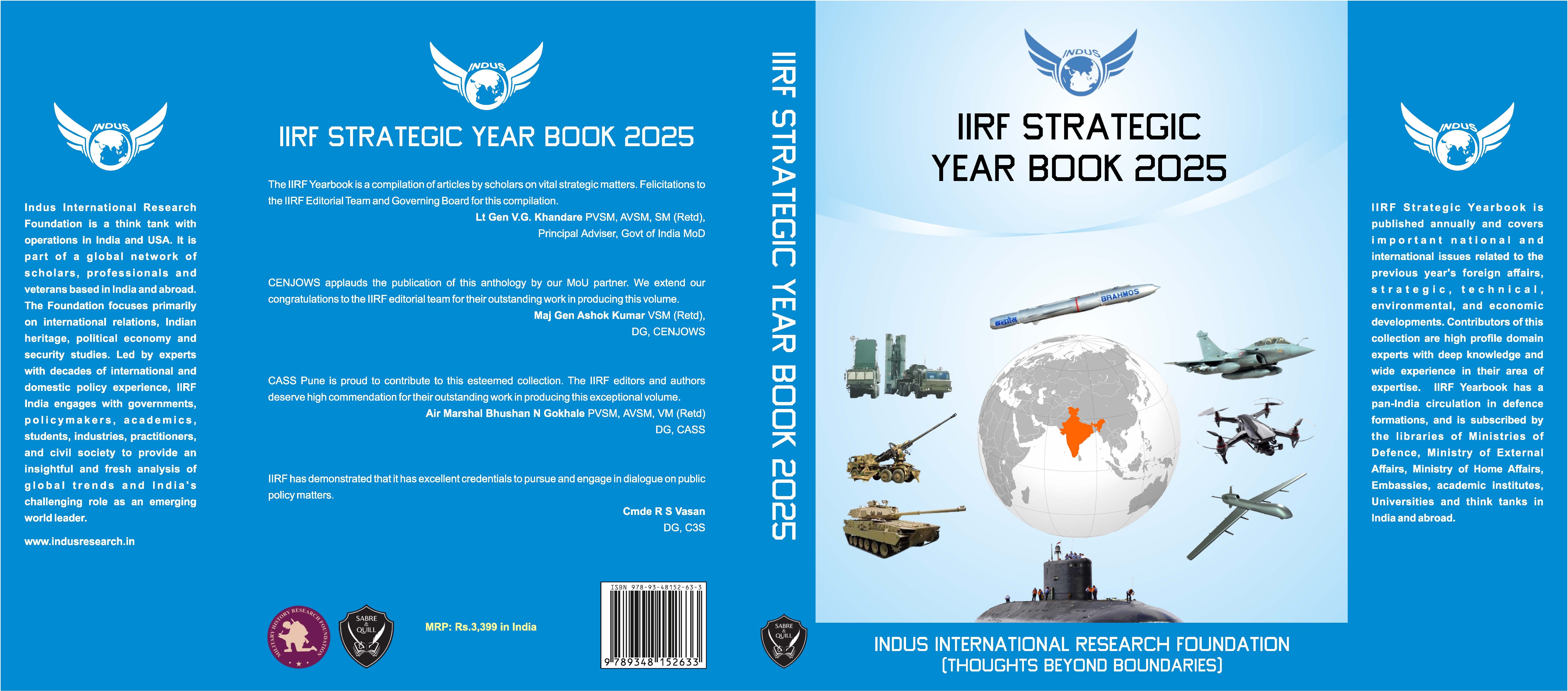
My Article was published in the Indus International Research Foundation Yearbook 2025
The Israeli Air Force (IAF) is one of the world’s most advanced and capable air forces. It is known for its high operational effectiveness, state-of-the-art technology, and strategic importance to Israel’s defence. The IAF is a crucial branch of the Israel Defence Forces (IDF) and is critical in maintaining Israel’s security and deterrence posture in a volatile region. It symbolises the country’s resolve to defend itself in an often hostile regional environment. The IAF has built a global reputation for excellence in air combat and defence through innovation, highly trained personnel, and cutting-edge technology.
Israeli Air Force1
Genesis. The IAF was officially established on May 28, 1948, shortly after the creation of the State of Israel. It initially consisted of a small fleet of mainly outdated World War II-era foreign aircraft. Over time, the IAF evolved into a sophisticated, modern air force focused on air superiority, precision strikes, intelligence gathering, and air defence.
Mission and Roles. The IAF is responsible for maintaining control of Israeli airspace and ensuring that no enemy aircraft can operate above Israeli territory. It conducts targeted airstrikes against enemy military installations, terrorist bases, and high-value targets that threaten Israel’s security. These operations are designed to neutralise threats quickly and with minimal collateral damage. It also conducts continuous surveillance using advanced unmanned aerial vehicles (UAVs) and reconnaissance aircraft to gather intelligence on hostile forces and threats. In its Air Defence role, it operates missile defence systems like the Iron Dome, David’s Sling, and Arrow to protect Israeli cities and strategic sites from rocket and missile attacks. The transport and helicopter fleet of the IAF provides airlift and logistical support to Israeli military operations and humanitarian missions, both domestically and abroad. It also conducts search and rescue missions.
Aircraft. The IAF operates a wide range of cutting-edge aircraft, many of which are sourced from the United States, while others are modified with Israeli-made technology. The IAF’s backbone consists of fighter jets like the F-16 Fighting Falcon and the F-15 Eagle, with Israel being one of the largest aircraft operators outside the U.S. In recent years, the IAF has also acquired the F-35 Lightning II (Adir), a fifth-generation stealth fighter, enhancing its ability to strike undetected in hostile airspace. The IAF operates AH-64 Apache attack helicopters, providing air support for ground forces and precision strikes against armoured and terrorist targets. Israel is a world leader in drone development. The IAF operates a range of UAVs for intelligence gathering, surveillance, and reconnaissance (ISR) missions, including the Heron and Eitan drones. The IAF uses C-130 Hercules and C-130J Super Hercules for transport missions, along with Boeing 707 and KC-135 aircraft for aerial refuelling.
Technological Edge. The IAF is known for its ability to integrate cutting-edge technologies into its operations. Israel’s aerospace and defence industries, such as Israel Aerospace Industries (IAI) and Rafael Advanced Defence Systems, develop advanced avionics, electronic warfare systems, and weaponry that significantly enhance the IAF’s capabilities.
Missile Defence. The IAF also plays a significant role in missile defence. The Iron Dome system is a short-range missile defence system designed to intercept and destroy rockets and artillery shells fired at Israeli civilian areas. David’s Sling is designed to intercept medium-to-long-range missiles and rockets. The Arrow system is a long-range missile defence capable of intercepting ballistic missiles at high altitudes.
Pilot Training and Recruitment. IAF pilots undergo one of the world’s most rigorous and prestigious training programs, which only a small percentage of recruits complete. The training emphasises flying skills, leadership, teamwork, and operational flexibility. Israel also recruits highly skilled operators for its drone and intelligence units, who play a crucial role in modern warfare and intelligence-gathering operations.
Strategic Importance. The IAF is vital for Israel’s deterrence strategy in the Middle East, as it projects Israeli power and provides a rapid response to emerging threats. Its capabilities allow Israel to conduct long-range operations, often with minimal outside support, and provide a strong defence against regional adversaries like Iran, Hezbollah, and Hamas.
Notable Operations by Israeli Air Force.
The Israel Air Force has conducted numerous military operations since its establishment in 1948. Given Israel’s complex security environment, these operations combine defensive actions, counterterrorism efforts, and strategic pre-emptive strikes to maintain security. These operations are primarily driven by the need to protect Israel from external threats, insurgent groups, and regional conflicts.
Operation Focus2
Operation Focus (Hebrew: Mivtza Moked) was the opening airstrike of the Six-Day War between Israel and its neighbouring Arab states, including Egypt, Syria, and Jordan. The operation commenced on June 5, 1967, and is considered one of the most successful pre-emptive air strikes in military history. The operation aimed to neutralise the Arab air forces, especially Egypt’s, by destroying their air capabilities before they could be fully deployed against Israel. Israel believed that the Arab nations were preparing to invade, and striking first would give them a decisive advantage. Israel’s Air Force (IAF) launched the operation after meticulous planning.
The IAF sent almost all of its aircraft (around 200 planes) in waves, targeting air bases and runways in Egypt, followed by air forces in Jordan, Syria, and Iraq. Israel’s airstrikes were coordinated with exceptional precision, utilising tactics like low-altitude flying to avoid radar detection. The timing of the strike (early morning) and the decision to launch simultaneous attacks on multiple fronts were pivotal in overwhelming the enemy’s defences. The first wave destroyed around 204 Egyptian aircraft on the ground in the first few hours, essentially destroying Egypt’s air force. By the end of the day, the Israeli Air Force had destroyed about 450 aircraft from Egypt, Jordan, Syria, and Iraq, mainly while they were still on the ground. The mission also targeted runways to prevent planes from taking off again. Within the first few hours, Israel had established air superiority over the region, which allowed them to conduct successful ground operations with minimal resistance from the air. Operation Focus set the tone for the Six-Day War, giving Israel a significant early advantage and leading to their eventual victory.
Yom Kippur War (1973)3
The Yom Kippur War, also known as the October War or the 1973 Arab-Israeli War, was a conflict that took place from October 6 to October 25, 1973, primarily between Israel and a coalition of Arab states led by Egypt and Syria. The war was a direct result of longstanding tensions between Israel and its neighbouring Arab states following Israel’s victory in the Six-Day War of 1967, during which it captured significant territories, including the Sinai Peninsula from Egypt, the Golan Heights from Syria, and the West Bank and East Jerusalem from Jordan. The Arab states, particularly Egypt and Syria, sought to regain these lost territories and restore national pride. Egyptian President Anwar Sadat and Syrian President Hafez al-Assad coordinated a surprise attack on Israel to reclaim the Sinai Peninsula and Golan Heights, respectively. They aimed to catch Israel off guard, hoping to shift the political and military balance in the region.
On October 6, 1973, Egypt and Syria launched a coordinated surprise attack on Israeli positions in the Sinai Peninsula and the Golan Heights. Egyptian forces successfully crossed the Suez Canal and overwhelmed Israeli defences. Syrian forces launched an assault on the Golan Heights, initially pushing Israeli forces back. After the initial shock, Israel mobilised its reserves and launched a counteroffensive. The Israeli Defence Forces (IDF) managed to halt the Syrian advance in the north and eventually pushed Syrian forces back. In the Sinai, after initial Egyptian successes, the IDF counterattacked, crossing the Suez Canal and encircling the Egyptian Third Army. A ceasefire was agreed upon on October 22, 1973, following intense diplomatic efforts led by the United States.
Despite the initial setbacks, Israel emerged militarily stronger. It regained the Golan Heights and crossed the Suez Canal into Egypt. The war marked a shift in the Arab world’s approach to Israel, paving the way for future peace agreements. The Yom Kippur War was pivotal in Middle Eastern history, reshaping regional dynamics and global geopolitics.
Operation Entebbe4
Operation Entebbe, also known as Operation Thunderbolt (later renamed Operation Jonathan in honour of the raid’s fallen commander, Jonathan “Yoni” Netanyahu), was a daring hostage rescue mission carried out by Israeli commandos on July 4, 1976. The operation took place at Entebbe Airport in Uganda, where Palestinian and German terrorists, supported by the Ugandan government, had hijacked an Air France flight. Operation Entebbe remains one of the most audacious and successful hostage rescue missions in modern history. It significantly boosted Israeli morale and demonstrated the strength of the country’s military forces on the world stage.
On June 27, 1976, Air France Flight 139, an Airbus A300 travelling from Tel Aviv to Paris, was hijacked by two members of the Popular Front for the Liberation of Palestine – External Operations (PFLP-EO) and two members of the Revolutionary Cells, a German militant group. The flight had stopped in Athens, Greece, to pick up additional passengers, and it was there that the hijackers boarded the plane. The plane, with 248 passengers and crew members, was diverted to Benghazi, Libya, and then flown to Entebbe Airport in Uganda, where the passengers were held hostage in an airport terminal. The hijackers demanded the release of 40 Palestinians imprisoned in Israel and 13 other prisoners held in Kenya, France, Switzerland, and Germany. They threatened to kill the hostages if their demands were not met. Upon arrival in Entebbe, the terrorists received the support of Uganda’s dictator, Idi Amin, who provided them with protection and allowed them to use the airport as their base. Over the next few days, the hostages were separated. Non-Israeli hostages were released, while 94 passengers, primarily Israeli citizens or Jews, along with the 12-member French crew, were held at the airport under heavy guard by Ugandan soldiers.
In Israel, the government, led by Prime Minister Yitzhak Rabin, and the Israeli Defence Forces (IDF) began planning a rescue mission after negotiations seemed to stall. Intelligence was gathered from various sources, including satellite images, accounts from released hostages, and Israeli nationals with prior knowledge of Entebbe Airport. Essential intelligence came from Mossad, Israel’s intelligence agency, which built a replica of the terminal using information from builders involved in its construction.
The rescue force, led by Lieutenant Colonel Jonathan Netanyahu, consisted of around 100 elite commandos from the Israeli Sayeret Matkal (General Staff Reconnaissance Unit). The Israeli commandos flew to Entebbe in four Hercules C-130 transport planes, refuelling along the way. They used the element of surprise, landing at night and rapidly deploying forces to the terminal where the hostages were being held. The commandos approached the terminal in black Mercedes and Land Rovers, similar to those Idi Amin’s entourage used. They initially deceived the Ugandan soldiers. In a 90-minute raid, Israeli forces stormed the terminal, killed all the hijackers, and neutralised the Ugandan soldiers who were assisting them. 102 hostages were rescued and flown back to Israel. Jonathan Netanyahu, the raid’s commander and brother of future Israeli Prime Minister Benjamin Netanyahu, was the only Israeli commando killed during the raid. Approximately 45 Ugandan soldiers were killed, and 11 MiG-17 fighter jets (part of Uganda’s air force) were destroyed to prevent them from pursuing the Israeli planes.
Operation Entebbe’s success was seen as a stunning military and intelligence victory for Israel, which demonstrated its willingness and capability to protect its citizens from terrorism anywhere in the world. It became an iconic rescue mission and is widely studied as an example of successful military planning and execution, using speed, precision, and surprise to achieve an overwhelming victory.
Operation Opera5
Operation Opera (also known as Operation Babylon) was an Israeli airstrike carried out on June 7, 1981, which targeted and destroyed an Iraqi nuclear reactor located at Osirak, about 17 kilometers southeast of Baghdad. The operation was designed to prevent Iraq from acquiring nuclear weapons capability. The reactor, known as Osirak, was a French-built nuclear reactor in Iraq. The Israeli government believed that Saddam Hussein’s regime intended to use the reactor to develop nuclear weapons, posing a significant threat to Israel. Iraq had repeatedly claimed that the reactor was meant for peaceful purposes, but Israel’s intelligence services, as well as international suspicions, pointed to the possibility of nuclear weapons development. Israeli officials feared that if Iraq completed the reactor, they would develop nuclear weapons that could be used against Israel. They also believed that once the reactor went operational, any attack could cause widespread radioactive fallout, so time was of the essence.
Operation Opera was meticulously planned by the Israeli Air Force (IAF) under the orders of then-Prime Minister Menachem Begin. Israeli intelligence had been monitoring the progress of the Iraqi nuclear program for years. The operation was given a green light when Israel learned that the reactor would soon be loaded with nuclear fuel. On June 7, 1981, eight F-16 fighter jets and six F-15 fighter jets were used in the raid. The Israeli jets flew a 1,600-kilometer (1,000-mile) round trip from Israel to Iraq, evading detection by flying at very low altitudes over Jordanian and Saudi Arabian airspace. The aircraft arrived over the reactor and delivered precision strikes that destroyed the Osirak reactor with a direct hit. The bombing raid lasted approximately 90 seconds, and the reactor was destroyed before it could go operational. The operation was considered a resounding success, with all Israeli aircraft returning safely.
Operation Opera has since become a significant case study in pre-emptive military action and the “Begin Doctrine,” which asserted that Israel would not allow hostile neighbours to develop weapons of mass destruction that could threaten its existence. The raid is often cited as an example of successful counter-proliferation efforts, although its legality under international law remains debated. The operation also influenced later international discussions on nuclear proliferation, and some view it as a precursor to future debates on preventing nuclear capabilities in other countries, such as Iran. It remains one of the most famous pre-emptive airstrikes in modern history.
Operation Mole Cricket 19 (1982) during the Lebanon War 6
Operation Mole Cricket 19 was a significant Israeli air operation that took place during the 1982 Lebanon War, specifically on June 9, 1982. It marked a turning point in modern air warfare due to the effective use of electronic warfare, air superiority, and precision strikes. Israel initiated the 1982 Lebanon War primarily to eliminate the threat posed by the Palestine Liberation Organization (PLO), which had been launching attacks from southern Lebanon. The PLO had established strongholds in Lebanon, and Israel saw an opportunity to neutralise the threat. However, Syrian forces were also involved in Lebanon, maintaining a solid presence in the Bekaa Valley. Operation Mole Cricket 19’s main goal was to destroy Syrian surface-to-air missile (SAM) batteries stationed in the Bekaa Valley. Syria had deployed a dense network of Soviet-supplied SAMs (including SA-6, SA-2, and SA-3 systems), which posed a significant threat to Israeli Air Force (IAF) operations. Israel sought to establish air superiority by neutralising these SAM sites.
The Israeli Air Force planned and executed a complex and highly coordinated attack involving several vital elements. The IAF used advanced electronic warfare measures to jam Syrian radar and communication systems. This included the deployment of drones to simulate aircraft and trick Syrian radars into locking onto them, exposing the locations of the SAM batteries. Air Superiority Fighters: F-15 and F-16 fighter jets were deployed to engage Syrian MiGs, providing air cover for the strike packages and ensuring Israeli dominance in the air. They were using a combination of precision-guided munitions and traditional bombs, and Israeli aircraft targeted and destroyed the Syrian SAM sites. The operation involved a combination of aircraft types, including F-4 Phantoms, A-4 Skyhawks, and F-16s, all coordinating their strikes.
Operation Mole Cricket 19 was a resounding success for Israel. In just a few hours, the Israeli Air Force destroyed 19 of the 30 Syrian SAM batteries stationed in the Bekaa Valley without losing a single aircraft. Additionally, the operation resulted in the downing of 29 Syrian MiGs, with no Israeli aircraft losses. The success of this operation effectively neutralised the Syrian air defence system in the region and gave Israel uncontested air superiority over Lebanon for the rest of the war.
Operation Mole Cricket 19 is regarded as one of the most successful air operations in modern military history. It demonstrated the effectiveness of electronic warfare, drone technology, and precision-guided munitions in neutralising sophisticated air defence systems. The lessons from this operation influenced air combat tactics and military doctrines worldwide, particularly regarding electronic warfare and the integration of air and ground operations.
Operation Mole Cricket 19 is often cited as a precursor to later air campaigns, such as the 1991 Gulf War, where coalition forces used similar tactics to neutralise Iraqi air defences during Operation Desert Storm. The operation underscored the importance of maintaining a technological edge in air warfare and the value of integrating various elements of modern warfare, such as electronic jamming, drones, and precision-guided munitions.
Operation Orchard7
Operation Orchard was a covert Israeli airstrike that took place on September 6, 2007, targeting a secret nuclear reactor in the Deir ez-Zor region of north-eastern Syria. The operation was aimed at preventing the Syrian regime from developing nuclear weapons. The reactor, known as Al-Kibar, was being constructed with North Korean assistance and was believed to be capable of producing plutonium for nuclear weapons. Israeli intelligence, with the help of Mossad, gathered information about the reactor’s existence and its potential threat to Israel. Intelligence indicated that Syria, under President Bashar al-Assad, was developing nuclear capabilities in secret, in violation of international norms. The Israeli government, led by Prime Minister Ehud Olmert, believed that a nuclear-armed Syria would pose an existential threat to Israel and decided that military action was necessary to eliminate the threat before the reactor became operational.
The operation was carefully planned and conducted by the Israeli Air Force (IAF), which had a history of successful pre-emptive strikes, most notably Operation Opera (1981), when Israel destroyed Iraq’s Osirak nuclear reactor. The IAF identified the precise location of the Al-Kibar reactor and developed a strategy to destroy it with minimal diplomatic fallout and civilian casualties. On the night of September 6, 2007, the IAF launched a covert airstrike. A squadron of F-15I Ra’am and F-16I Sufa fighter jets, accompanied by electronic warfare aircraft, flew a low-altitude route to avoid Syrian radar detection. The Israeli jets crossed into Syrian airspace without being detected, as Israeli electronic warfare units jammed Syrian radar systems. Once they reached the target, the IAF pilots released precision-guided bombs that destroyed the reactor in a matter of minutes. The attack was swift, and the facility was utterly obliterated before being activated.
Operation Orchard was seen as a major intelligence and military success for Israel, reinforcing the country’s deterrence posture in the Middle East. By destroying the reactor, Israel eliminated the immediate nuclear threat posed by Syria, which was later engulfed in a civil war starting in 2011. Had the reactor survived and gone online, it might have added a dangerous dimension to the conflict. The operation also highlighted Israel’s capabilities in long-range strikes and electronic warfare, as the Israeli jets successfully infiltrated Syrian airspace undetected. Operation Orchard remains one of the most significant preemptive strikes in modern military history, demonstrating Israel’s resolve and capability to confront nuclear threats.
Joint Operations against Hamas in Gaza.
Operation Cast Lead8. Operation Cast Lead was a military operation launched by the Israel Defense Forces (IDF) in the Gaza Strip from December 27, 2008, to January 18, 2009. The primary objectives of Operation Cast Lead were to deter Hamas from firing rockets into Israel, destroy Hamas’ military capabilities (including weapons stockpiles, launch sites, and command and control infrastructure) and target tunnels used for smuggling weapons from Egypt to Gaza. The operation began with a massive aerial bombardment on December 27, 2008, which included hundreds of airstrikes aimed at Hamas’ military infrastructure. The operation lasted for 22 days and ended on January 18, 2009. Operation Cast Lead showcased Israel’s military capabilities and its willingness to conduct extensive military operations to secure its borders and deter attacks.
Operation Protective Edge9. Operation Protective Edge was a military operation launched by the Israel Defence Forces (IDF) in the Gaza Strip from July 8 to August 26, 2014. The operation aimed to stop rocket fire from Gaza into Israel and to target Hamas and other militant groups’ infrastructure. The operation began with a series of airstrikes on July 8, 2014, targeting rocket launchers, command centers, and other Hamas military infrastructure. The operation lasted 50 days. Operation Protective Edge highlighted the complexity of urban warfare, as the IDF faced challenges in minimising civilian casualties while targeting a well-entrenched enemy in a densely populated area.
Operation Guardian of the Walls10. Operation Guardian of the Walls (Hebrew: Mivtza Shomer HaChomot) was a military operation conducted by the Israel Defence Forces (IDF) from May 10 to May 21, 2021. The main objectives of Operation Guardian of the Walls were to stop the rocket fire from Gaza into Israeli territory, to target Hamas military infrastructure (including rocket launch sites, command centres, and tunnel networks) and to restore security and deter further aggression from Hamas and other militant groups in Gaza. The operation began with a significant air campaign involving hundreds of airstrikes targeting Hamas’ military capabilities, including rocket launchers and command centers. The IDF utilised advanced technology, including precision-guided munitions, and focused on minimising civilian casualties despite the challenges of operating in a densely populated area like Gaza. Operation Guardian of the Walls lasted 11 days. Initial airstrikes aimed at degrading Hamas’ rocket capabilities and command structures were followed by continued bombardment and targeted operations against high-value Hamas leaders and military assets. Operation Guardian of the Walls demonstrated the IDF’s capabilities and the effectiveness of Israel’s Iron Dome missile defence system, which intercepted a significant percentage of rockets fired from Gaza. Operation Guardian of the Walls was a substantial chapter in the ongoing Israeli-Palestinian conflict, reflecting the complexities and challenges of achieving lasting peace in a region marked by deep-seated grievances and tensions.
Ongoing Operations11. The IDF is involved in ongoing security operations, particularly in Gaza, West Bank, Lebanon and Iran. These include counterterrorism missions, targeted airstrikes, and border defence. The Iron Dome missile defence system plays a crucial role in intercepting rockets fired from Gaza and other hostile entities.
Lessons Learnt From Air Operations Undertaken by Israel’s Air Force.
The Israeli Air Force (IAF) has been involved in various air operations, from conventional wars to counterinsurgency operations and precision strikes12. Over the decades, the operations conducted by the IAF have provided crucial lessons for Israel and militaries worldwide. These lessons span strategic, tactical, and operational insights (13-17).
Importance of Air Superiority. Gaining air superiority early is critical in modern warfare to provide freedom of movement for ground forces and deny the enemy similar capabilities. In the 1967 Six-Day War, the IAF achieved air superiority within hours by launching pre-emptive strikes on Arab air forces, particularly targeting Egyptian runways and aircraft. This set the stage for Israel’s overwhelming ground victories.
Pre-emptive and Preventive Strikes. Air power can neutralise threats before they materialise, particularly in asymmetrical conflicts where non-state actors or hostile states might acquire dangerous capabilities. The Osirak Raid (Operation Opera, 1981), where Israeli jets destroyed an Iraqi nuclear reactor, demonstrated the value of pre-emptive strikes to prevent potential existential threats.
Precision and Intelligence Integration. Integrating real-time intelligence, surveillance, and reconnaissance (ISR) with air operations is essential for precision strikes and minimising collateral damage. In operations such as Operation Entebbe (1976) and Operation Orchard (2007), intelligence gathering played a crucial role in determining the exact locations of enemy assets, leading to highly successful strikes.
Technological Innovation and Adaptation. Investing in and rapidly adopting cutting-edge technology, such as drones and electronic warfare systems, can give a significant edge in air operations. The IAF has pioneered the use of drones and UAVs (unmanned aerial vehicles), such as in Operation Mole Cricket 19 (1982) during the Lebanon War, where UAVs were used to identify Syrian SAM (surface-to-air missile) systems, allowing Israeli jets to take them out.
Flexibility and Multi-Role Capabilities. Developing aircraft with multi-role capabilities enables greater flexibility, allowing air forces to quickly adapt to changing battlefield conditions. The IAF’s use of multi-role fighter jets, such as the F-15 and F-16, which can perform air-to-air combat, ground attack, and reconnaissance missions, allows for greater operational flexibility.
Dealing with Asymmetrical Threats. Air operations against non-state actors and in urban warfare require precision-guided munitions, superior ISR, and the development of doctrines that minimise civilian casualties while maintaining military effectiveness. During conflicts with Hezbollah in Lebanon and Hamas in Gaza, the IAF has to deal with asymmetrical threats such as rockets fired from densely populated areas.
Operational Preparedness and Rapid Deployment. Preparedness and rapid response capabilities are critical for sudden escalations, particularly in a volatile regional environment. Israel’s air force is designed to be highly responsive, with pilots on constant standby and highly trained for rapid deployment.
Minimising Collateral Damage. Modern air forces must balance military objectives with the necessity of minimising civilian casualties, especially when operating in densely populated areas, for ethical reasons and to maintain international support. In recent operations, the IAF has faced significant international scrutiny for civilian casualties. In response, they have developed and use more precise weapons and warning systems (e.g., “roof-knocking”) to alert civilians before strikes.
Electronic Warfare and Cyber Capabilities. Integrating electronic warfare and cyber capabilities into air operations is crucial for neutralising enemy defences and gaining an operational advantage. During Operation Orchard (2007), when Israel destroyed a Syrian nuclear reactor, electronic warfare systems disabled Syria’s radar systems, effectively “blinding” them during the raid.
Psychological and Deterrence Impact. Air operations can have a significant psychological and strategic deterrence effect, signalling to adversaries that specific actions will lead to swift and devastating consequences. The IAF has often been used as a tool for strategic deterrence, demonstrating Israel’s ability to strike distant and high-value targets (e.g., the strikes on Iraq and Syria’s nuclear facilities).
Coordination with Other Forces. Close coordination and communication between air and surface forces are essential for effective combined arms operations, particularly in defensive and counteroffensive actions. During the Yom Kippur War (1973), initial Israeli air operations faced setbacks due to poorly coordinated attacks with ground forces. However, later improvements in coordination significantly boosted the effectiveness of close air support.
Adaptability in a Changing Battlefield. A key lesson is the ability to adjust tactics in response to unconventional warfare, where the enemy uses non-traditional strategies to counteract conventional air superiority. The Lebanon War of 2006 highlighted the need for the IAF to adapt its tactics when fighting against an enemy using guerrilla tactics and mobile rocket launchers.
Israel’s air force has learned to excel through pre-emptive action, technological superiority, intelligence integration, and a strong focus on operational preparedness. These lessons continue to shape not only Israel’s approach to air warfare but also influence air power doctrines globally. The IAF’s experiences have influenced modern military strategies worldwide, especially in counterterrorism, urban combat, and technological warfare.
Your valuable comments are most welcome.
For regular updates, please register your email here:-
References and credits
To all the online sites and channels.
Disclaimer:
Information and data included in the blog are for educational & non-commercial purposes only and have been carefully adapted, excerpted, or edited from reliable and accurate sources. All copyrighted material belongs to respective owners and is provided only for wider dissemination.
References:-
- Israeli Air Force website, https://www.idf.il/en/mini-sites/israeli-air-force/
- Eric Hammel, “The Sinai Air Strike: June 5, 1967”, Warfare history network website, October 2002
- Nicole Hassenstab, “ 50 Years On Explaining the Yom Kippur War”, American University Washington DC website, October 6, 2023
- Business Standard Web Team, “All you need to know about famous hostage rescue mission Operation Entebbe”, Business Standard, Jul 04 2023.
- Debanish Achom, “Operation Opera: Israel Bombed Nuclear Reactor In Iraq”, World news, NDTV World, 11 Oct 23.
- Constantine Atlamazoglou, “How the Israeli Air Force once destroyed over 60 enemy jets and dozens of Soviet missile systems in battle without losing a single fighter”, Business Insider India, 11 May 2024.
- Andrew Garwood-Gowers, “Israel’s Airstrike on Syria’s Al-Kibar Facility: A Test Case for the Doctrine of Pre-emptive Self-Defence?”, Journal of Conflict & Security Law, Vol. 16, No. 2 (Summer 2011).
- Jeffrey White, “Operation Cast Lead: Israel’s Assault on Hamas”, The Washington Institute, Policy Analysis 29 Dec 2008.
- Eitan Shamir, “Rethinking Operation Protective Edge”, Middle East Forum, Middle East Quarterly, Spring 2015.
- Anna Ahronheim, “Operation Guardian of the Walls: Targeting Hamas terror, behind the scenes”, The Jerusalem Post, 03 Jun 2021.
- By the Center for Preventive Action, “Israeli-Palestinian Conflict”, Global Conflict Tracker, 06 Oct 2024.
- Editors of Encyclopedia Britannica, “Arab-Israeli wars”, Britannica, 09 Sep 2024.
- Dr Jack Watling and Nick Reynolds, “Occasional Papers – Tactical Lessons from Israel Defense Forces Operations in Gaza”, RUSI, 11 Jul 2024.
- Brief, “Lessons from Israel’s war in Gaza”, Rand Corporation.
- Daniel Byman, “Lessons from Israel’s Last War in Lebanon”, CSIS Brief, Center for Strategic and International Studies, 02 Oct 2024.
- Report, “Lessons from Israel’s Forever Wars”, Reports and Papers Belfer Center for Science and International Affairs, Harvard Kennedy School.
- Raphael S. Cohen, David E. Johnson, David E. Thaler, Brenna Allen, Elizabeth M. Bartels, James Cahill, Shira Efron, “Lessons from Israel’s Wars in Gaza”, RAND Research Summary, 18 Oct 2017.