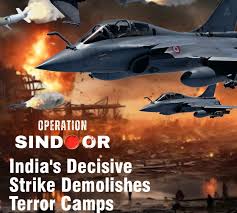
662:OP SINDOOR – INDIA’S WATER CANNON AGAINST PAKISTAN-SPONSORED TERRORISM: INDUS WATER TREATY


My article was published on the “Life of Soldier” website

on 29 Apr 25.


“Blood and water cannot flow together”

– Indian Prime Minister Narendra Modi


The Indus Waters Treaty is a water-sharing agreement between India and Pakistan, signed on September 19, 1960, in Karachi by Indian Prime Minister Jawaharlal Nehru and Pakistani President Ayub Khan. The World Bank brokered it and governs the use of the Indus River system, which includes six rivers: Indus, Jhelum, Chenab, Ravi, Beas, and Sutlej. The Indus River system is critical for both countries’ irrigation, hydropower, and drinking water.

India held the Indus Waters Treaty in abeyance on April 23, 2025, following the Pahalgam terrorist attack that killed 26 civilians. India’s decision, citing national security concerns, grants it greater control over the western rivers, potentially impacting Pakistan’s agriculture and water supply. Pakistan condemned the move as an “act of war,” suspending the Simla Agreement and closing the Wagah border. The World Bank, a treaty signatory, has urged dialogue but lacks enforcement power. This development heightens regional instability and raises concerns about future conflicts and diplomatic relations.


Key Provisions

Division of Rivers. Western Rivers (Indus, Jhelum, Chenab) are allocated to Pakistan for unrestricted use, except for limited Indian uses (e.g., domestic, non-consumptive, and specified agricultural purposes). Eastern Rivers (Ravi, Beas, Sutlej) are allocated to India for unrestricted use.

Water Sharing. Pakistan receives about 80% of the Indus system’s water (around 135 million acre-feet annually), while India gets 20%.

Infrastructure. India can build run-of-the-river dams on Western Rivers for hydropower, but cannot store water beyond specified limits. Pakistan can object to designs that violate the treaty.

Permanent Indus Commission. A bilateral body with representatives from both countries meets regularly to monitor implementation, share data, and resolve disputes.


Context and Significance.

The treaty was necessitated by the 1947 partition, which split the Indus basin, leaving canal headworks in India and irrigated lands in Pakistan. A 1948 standoff, when India briefly cut off water to Pakistan, underscored the need for a formal agreement. It is considered one of the most successful water-sharing treaties globally, surviving three wars.

The Indus system originates in the Himalayas, with major tributaries flowing through Indian-administered Jammu, Kashmir, and Pakistani-occupied Gilgit-Baltistan, making it geopolitically sensitive. In 2016, after a terrorist attack in Uri, India reviewed the treaty. In 2022 and 2023, India issued notices to Pakistan for treaty modification, citing “fundamental changes” like cross-border terrorism and environmental challenges, but no formal revocation has occurred. In 2023, Pakistan sought arbitration over Kishanganga and Ratle, while India challenged the arbitration process, preferring Neutral Expert resolution.

Pakistan, heavily dependent on the Indus for 90% of its water needs, fears reduced flows due to Indian projects or climate change. Delays in its storage infrastructure (e.g., Diamer-Bhasha Dam) exacerbate vulnerabilities. Glacial melt, erratic monsoons, and floods (e.g., 2010, 2022) strain the treaty’s framework, which lacks provisions for climate adaptation.


Recent Development

India has officially held the IWT with Pakistan in abeyance, marking a significant shift in bilateral relations. This decision was announced on April 23, 2025, following a terrorist attack in Pahalgam, Jammu and Kashmir. India invoked Article XII(3) of the IWT and sent a formal notice to Pakistan. The Ministry of Jal Shakti cited Pakistan’s alleged support for cross-border terrorism, shifting demographics, and energy demands as reasons the agreement could no longer continue “in good faith.”​

With the treaty placed in abeyance, India is no longer obligated to share information regarding water storage levels or flow in the rivers of the Indus River System with Pakistan.​ India has ceased sharing hydrological data (e.g., water flow, snowmelt, flood updates) with Pakistan, halted technical meetings, and stopped allowing Pakistani inspections of Indian projects. India is no longer bound by treaty restrictions on building storage or hydropower projects on the western rivers (Indus, Jhelum, Chenab).


Adverse Impact on Pakistan

India’s suspension of the Indus Waters Treaty (IWT) poses significant adverse impacts on Pakistan, particularly in agriculture, water supply, energy, and economic stability.

Agriculture. Pakistan relies on the Indus River system for 80% of its irrigated agriculture, supporting 16 million hectares of farmland. The western rivers (Indus, Jhelum, Chenab) allocated to Pakistan under the IWT provide 93% of its irrigation water. A 10-20% reduction in water availability could lead to significant declines in agricultural output, threatening food security and rural livelihoods. Pakistan’s agriculture sector, which employs 40% of the workforce and contributes 24% to GDP, faces severe risks. While India’s current infrastructure limits immediate large-scale water diversion, future dams or storage projects could reduce water availability, especially during critical sowing seasons (e.g., Rabi and Kharif), reduced flows could lower crop yields for wheat, rice, and cotton—key staples and export crops.

Water Scarcity in Urban Centres. Major cities like Karachi, Lahore, Multan, and Faisalabad depend on the Indus and its tributaries for drinking water and industrial use. Any reduction in river flows, even temporary, could exacerbate existing water scarcity. Pakistan already faces a per capita water availability of ~1,000 cubic meters, close to the “water scarce” threshold. Water rationing, public health crises, and industrial slowdowns could occur, particularly in Punjab and Sindh provinces, which rely heavily on the Indus.

Energy Sector. Pakistan generates significant electricity from hydropower plants like Tarbela (3,478 MW) and Mangla (1,000 MW), which rely on consistent river flows from the Indus and Jhelum. Reduced or irregular water flows could lower power generation, worsening Pakistan’s energy crisis. For example, a 10% reduction in Tarbela’s water inflow could cut its output by hundreds of megawatts, affecting millions of households.

Economic. Energy shortages could disrupt industrial production and increase reliance on costly imported fuels, straining Pakistan’s foreign exchange reserves. A decline in crop production would reduce export revenues (e.g., rice and cotton) and increase food import costs, exacerbating Pakistan’s trade deficit. Reduced agricultural output could lead to job losses in rural areas, driving migration to urban centers and rising social unrest. Higher food and energy prices and potential infrastructure damage from flooding (if India releases water abruptly) could fuel inflation. Pakistan’s external debt (~$130 billion in 2025) limits its ability to fund mitigation measures. A 2023 World Bank study estimated that a 20% reduction in Indus water flows could shave 5-7% off Pakistan’s GDP over a decade.

Social and Political Fallout. Water shortages could spark protests, particularly in Sindh and Punjab, where water allocation disputes between provinces are already contentious. Provinces like Sindh, which rely on downstream flows, may accuse Punjab of hoarding water, exacerbating internal political divides.


India’s Justification and Legitimacy.

India’s justification and Legitimacy for holding in abeyance the Indus Waters Treaty (IWT) hinges on the principle of a “fundamental change of circumstances,” as outlined in Article 62 of the Vienna Convention on the Law of Treaties. New Delhi argues that Pakistan’s continued support for cross-border terrorism, especially following incidents like the April 2025 Pahalgam attack, violates the underlying premise of peaceful bilateral relations that formed the basis of the IWT in 1960. India contends that a country facilitating terrorist activity cannot expect continued cooperation on vital issues like water sharing. While the IWT lacks a unilateral withdrawal clause, India maintains that suspension, not withdrawal, can be a legitimate, proportionate response to persistent security threats.


Diplomatic and Legal Aspects

Pakistan’s Prime Minister Shehbaz Sharif called the suspension an “act of war” and announced retaliatory measures, including suspending the 1972 Simla Agreement and closing the Wagah border.

Pakistan may seek World Bank mediation or international arbitration. The IWT lacks a unilateral exit clause, and India’s suspension may not be easily challenged under international law if framed as a response to terrorism (per Article 62, Vienna Convention). Experts argue India’s suspension is permissible under Article 62 of the Vienna Convention on the Law of Treaties, citing a “fundamental change of circumstances” due to Pakistan’s alleged terrorism support for terrorism. The World Bank, a treaty signatory, has urged dialogue but cannot enforce compliance.

Pakistan may seek neutral expert mediation or arbitration, but India’s refusal to cooperate could render these mechanisms ineffective. Escalating the issue to the UN or other forums may gain Pakistan sympathy but will unlikely force India to reverse the suspension.


The Only Way out for Pakistan.

The only viable way for Pakistan to restore the Indus Waters Treaty is through diplomatic engagement coupled with tangible actions to address India’s core security concerns, particularly those related to cross-border terrorism. India’s decision, justified under the “fundamental change of circumstances” clause in international law, is rooted in accusations of Pakistan’s support for militant activities. Therefore, Pakistan would need to:-

  • Stop escalatory rhetoric (including regular and brash nuclear sabre rattling) and retaliatory actions, as these would only harden India’s stance.
  • Demonstrate a verifiable crackdown on terror infrastructure operating from its territory, especially groups targeting India.
  • Offer security guarantees and confidence-building measures that acknowledge India’s national security concerns to rebuild trust and initiate fresh dialogue.

Ultimately, Pakistan’s path to treaty restoration lies not just in legal appeals but in restructuring the political and security context in which the treaty was suspended. Only by addressing the root causes—especially terrorism—can the IWT be revived in a stable, sustainable way.


Please Add Value to the write-up with your views on the subject.


1879
Default rating

Please give a thumbs up if you  like The Post?


Link to the article on the website:-

https://www.lifeofsoldiers.com/2025/04/29/indias-water-cannon-against-pakistan-sponsored-terrorism-indus-water-treaty/


For regular updates, please register your email here:-

Subscribe


References and credits

To all the online sites and channels.

Pics Courtesy: Internet

Disclaimer:

Information and data included in the blog are for educational & non-commercial purposes only and have been carefully adapted, excerpted, or edited from reliable and accurate sources. All copyrighted material belongs to respective owners and is provided only for wider dissemination.


References:-

  1. Financial Times. “Undermining the Indus Waters Treaty imperils Indian security.” April 26, 2025.
  1. Reuters. “India suspends Indus Waters Treaty after Pahalgam terror attack.” April 23, 2025.
  1. Al Jazeera. “Pakistan calls Indus Treaty suspension ‘an act of war’.” April 24, 2025.
  1. The Hindu. “India halts hydrological data sharing with Pakistan under Indus Treaty.” April 25, 2025.
  1. BBC. “Water Wars? India wields Indus Treaty amid rising tensions with Pakistan.” April 27, 2025.
  1. Dawn. “Pakistan to seek World Bank mediation on Indus Treaty row with India.” April 28, 2025.
  1. Institute for Defence Studies and Analyses (IDSA). Indus Treaty as a Strategic Lever: Implications for India’s National Security. Issue Brief, 2023.
  1. Rajagopalan, Rajeswari Pillai. India’s Water Diplomacy: Reclaiming the Strategic Narrative. Observer Research Foundation, 2023.
  1. Observer Research Foundation (ORF). India’s Options under the Indus Waters Treaty: A Strategic Overview. 2022.
  1. United States Institute of Peace (USIP). Resolving India-Pakistan Water Disputes: A Legal and Strategic Perspective. 2020.
  1. International Crisis Group. Water Pressure: Climate Risk and Security in Pakistan. ICG Asia Report No. 297, 2018.
  1. World Bank. Indus Waters Treaty and Current Status of Disputes. [World Bank Briefing Note, 2023].
  1. Wirsing, Robert G. The Indus Waters Treaty: Political Stability and Water Security in South Asia. Asia-Pacific Center for Security Studies, 2013.
  1. Salman, Salman M.A. The Indus Waters Treaty: A History of a Treaty that has Survived Wars and Disputes. Water International, Vol. 36, No. 4, 2011.

656: FROM ESTRANGEMENT TO ENGAGEMENT: PAKISTAN AND BANGLADESH RECALIBRATING TIES


My Article published on The EurasianTimes website on 20 Apr 25


On April 17, 2025, Bangladesh and Pakistan held their first foreign secretary-level talks in 15 years in Dhaka, marking a significant step toward resetting bilateral ties: Bangladesh’s Foreign Secretary, Md. Jashim Uddin and Pakistan’s Foreign Secretary Amna Baloch led the Foreign Office Consultations. The discussions covered various issues, including trade, economic cooperation, regional matters, and historically unresolved disputes.

Bangladesh demanded a public apology from Pakistan for alleged atrocities committed during the 1971 Liberation War and sought $4.52 billion as its share of pre-1971 assets from undivided Pakistan. Other issues included the repatriation of stranded Pakistanis and the transfer of foreign aid funds related to the 1970 cyclone. Jashim Uddin emphasised resolving these issues to build a “solid foundation” for relations, while Baloch described the talks as “constructive” and focused on harnessing bilateral potential.

Pakistan acknowledged “outstanding issues” but did not confirm commitments to Bangladesh’s demands in public statements. The talks also explored boosting trade, with Bangladesh highlighting investment opportunities in jute and textiles. Both sides noted a January 2025 MoU for rice procurement from Pakistan. Bangladesh has eased visa restrictions for Pakistani nationals and launched direct shipping links, while Pakistan approved Fly Jinnah, a low-cost airline, to operate between the two countries. Baloch met Yunus and the Foreign Affairs Adviser, Md. Touhid Hossain, discussing the revival of SAARC and regional cooperation. Pakistan’s Deputy Prime Minister and Foreign Minister, Ishaq Dar, is scheduled to visit Dhaka on April 27-28, 2025, the first such visit since 2012, with expectations of signing agreements to strengthen ties further.

For over five decades, the relationship between Pakistan and Bangladesh has been defined by estrangement, rooted in the traumatic 1971 Liberation War, when East Pakistan seceded to form Bangladesh with India’s military backing. The war left deep scars, with Bangladesh accusing Pakistani forces of committing genocide, resulting in an estimated 3 million deaths and widespread atrocities. Under Bangladesh’s former Prime Minister Sheikh Hasina (2009–2024), ties remained frosty due to her government’s focus on war crime tribunals and alignment with India. However, the ouster of Hasina in August 2024, following a student-led uprising, marked a turning point. Under the interim government led by Muhammad Yunus, Bangladesh and Pakistan have embarked on a path of pragmatic engagement, driven by diplomatic, economic, and military cooperation. Unanswered questions include the drivers of this thaw, the challenges ahead, and the implications for South Asian geopolitics, particularly India.


Historical Context: A Legacy of Estrangement

The 1971 war remains the defining fault line in Pakistan-Bangladesh relations. Bangladesh’s narrative emphasises Pakistani military atrocities, including mass killings and the rapes, claims Pakistan disputes. Post-independence, Bangladesh’s early leaders, such as Sheikh Mujibur Rahman, sought to balance ties with Pakistan, attending the 1974 Organisation of Islamic Conference summit in Lahore. However, relations deteriorated after Mujib’s assassination in 1975, as subsequent Bangladeshi governments oscillated between secularism and Islamic identity, complicating reconciliation. During Hasina’s tenure, Bangladesh pursued war crimes trials, executing figures like Jamaat-e-Islami leader Motiur Rahman Nizami in 2016, prompting Pakistan’s condemnation and further straining ties. Visa restrictions, lack of direct flights, and minimal trade underscored the diplomatic freeze, with Pakistani goods often rerouted through third-party ports.


Catalysts for Change: The Post-Hasina Era

The political upheaval in Bangladesh in August 2024, which forced Hasina to flee to India, created a strategic opening for reconciliation. The interim government under Yunus adopted a “friendship to all” foreign policy, distancing itself from Hasina’s India-centric approach and opening doors to Pakistan. This significant shift in Bangladesh’s foreign policy can potentially reshape the region’s geopolitical dynamics.

    • Political Realignment. Hasina’s ouster reduced anti-Pakistan rhetoric, as her Awami League had leveraged 1971 grievances for political legitimacy. Yunus’s neutral stance prioritises economic and diplomatic diversification.
    • Strained India-Bangladesh Ties. Hasina’s exile in India and Bangladesh’s demand for her extradition have fueled anti-India sentiment, amplified by the “India Out” campaign in 2024. This has pushed Bangladesh to seek alternative partners like Pakistan to counterbalance India’s influence.
    • Economic Pressures. Both nations face economic challenges, including high inflation and global trade uncertainties. Bangladesh’s 6% GDP growth since 2021 and Pakistan’s “Uraan Pakistan” plan for 6% growth by 2028 incentivise trade expansion.
    • China’s Role. China’s strategic partnerships with both countries, including Bangladesh’s participation in the Belt and Road Initiative and Pakistan’s China-Pakistan Economic Corridor, encourage a trilateral alignment, raising concerns in India about the potential shift in power dynamics in the region.


Recent Engagements

Diplomatic Engagement. Diplomatic interactions have surged since August 2024. Yunus and Pakistan’s Prime Minister Shehbaz Sharif met twice—on the sidelines of the UN General Assembly in September 2024 and the D-8 Summit in Cairo in December 2024—discussing trade, cultural exchanges, and regional cooperation, including reviving the South Asian Association for Regional Cooperation (SAARC). A symbolic Eid al-Fitr phone call in March 2025 between the leaders underscored goodwill.

Economic and Trade Cooperation. Bilateral trade grew by 27% between August and December 2024, with both nations targeting a $3 billion trade volume within a year, over four times the current level. In November 2024, direct sea trade resumed after 53 years, with two Pakistani cargo ships docking at Chittagong Port carrying sugar and potatoes. Bangladesh also permitted Pakistani vessels at Mongla Port. Bangladesh scrapped mandatory 100% physical inspections of Pakistani goods in September 2024, reducing logistical costs. A memorandum of understanding signed on January 13, 2025, established a joint business council to boost private-sector ties. Bangladesh eased strict security clearances for Pakistani travellers, while Pakistan waived visa fees for Bangladeshis. Plans for direct flights, which have been absent since 2018, are underway.

Military Cooperation. Military ties have seen unprecedented growth, signalling a strategic shift. In January 2025, a Bangladeshi delegation led by Lt. General S.M. Kamrul-Hassan visited Pakistan, meeting Army Chief General Asim Munir to discuss joint exercises, training, and arms trade. Pakistan described the nations as “brotherly,” aiming to reshape South Asia’s security landscape. Bangladesh’s BNS Samudra Joy participated in Pakistan’s “Aman 2025” naval exercise in February 2025. This was the first major Bangladeshi warship deployment to Pakistan in over a decade, and the exercise focused on countering piracy and illegal fishing. Between September and December 2024, Bangladesh ordered 40,000 rounds of artillery ammunition, 2,000 rounds of tank ammunition, and 40 tonnes of RDX from Pakistan, tripling the previous year’s volume. Reports suggest interest in acquiring JF-17 Thunder fighter jets, co-developed by Pakistan and China, to support Bangladesh’s “Forces Goal 2030” modernisation. Pakistan will begin training Bangladesh’s army in February 2025, with a Pakistani Major General overseeing programs at Momenshahi Cantonment.

Cultural and People-to-People Ties. Shared cultural heritage has facilitated reconciliation, including Urdu-Bengali linguistic ties and a Muslim-majority identity. The 2024 visit of a Pakistani artist to Dhaka and the Bangladesh cricket team’s tour to Pakistan were celebrated as soft diplomacy successes. The “Bay of Bengal Conversation” seminar in November 2024, attended by Pakistani scholars, emphasised Track II diplomacy to rebuild trust.


Challenges to Sustained Engagement

Despite progress, several challenges persist. Bangladesh’s demand for a formal Pakistani apology and $4.2 billion in compensation for 1971 remains unmet, fuelling public opposition in Bangladesh, especially during Victory Day commemorations. While some Bangladeshis welcome renewed ties, others, particularly 1971 war survivors, oppose reconciliation without accountability. Further, Bangladesh’s economic reliance on India and shared counterterrorism goals may constrain its pivot toward Pakistan. Reports of a foiled coup in Bangladesh with alleged ISI backing raise concerns about Pakistan’s intentions, complicating military cooperation.


Implications for India

The Bangladesh-Pakistan thaw could reshape South Asian geopolitics. Given its ties with both nations, it may strengthen China’s regional influence, potentially forming a “trifecta” that concerns India.   Unresolved 1971 issues and India’s security concerns may limit the depth of this alignment. India, a key player in Bangladesh’s 1971 independence and a close ally under Hasina, views this rapprochement with alarm. The warming ties threaten India’s influence in South Asia, particularly given concerns over the Siliguri Corridor, the narrow 20-22 km strip connecting India’s northeast.

Prime Minister Narendra Modi met Yunus at the BIMSTEC Summit in Bangkok in April 2025, raising concerns about the safety of the Hindu minority and Hasina’s extradition. India’s High Commissioner Pranay Verma emphasised a “people-centric” approach, advocating for a “democratic, stable” Bangladesh. India has provided Bangladesh $7.862 billion in Lines of Credit to support infrastructure projects. However, it recently terminated transhipment facilities for Bangladesh’s cargo, signalling displeasure.

India has to bolster its 4,096-km border with Bangladesh, deploying technology and increasing Border Security Force inspections to counter infiltration and smuggling. Fears persist that Pakistan’s ISI could transfer weapons to insurgent groups via Bangladesh, threatening India’s northeastern states.


Conclusion

The recalibration of Pakistan-Bangladesh ties since August 2024 marks a significant shift from estrangement to engagement, driven by political changes, economic imperatives, and strategic realignments. Diplomatic, economic, and military cooperation, underpinned by cultural ties, reflects an approach to overcoming historical animosities. However, unresolved grievances, public sentiment, and India’s wary response pose challenges to sustained progress. For India, the thaw necessitates a recalibrated strategy to maintain influence in Bangladesh while addressing regional security concerns. As South Asia navigates this evolving dynamic, the Bangladesh-Pakistan rapprochement underscores the region’s complex interplay of history, geopolitics, and pragmatism. The coming years will test whether this engagement can transcend tactical gains to foster lasting reconciliation.


Please Add Value to the write-up with your views on the subject.


1879
Default rating

Please give a thumbs up if you  like The Post?


For regular updates, please register your email here:-

Subscribe


Link to the article on the website:-

Lost In 1971 War, Pakistan Attempts To Rebuild Ties With Bangladesh With China’s Help; Concern For India?

References and credits

To all the online sites and channels.

Pics Courtesy: Internet

Disclaimer:

Information and data included in the blog are for educational & non-commercial purposes only and have been carefully adapted, excerpted, or edited from reliable and accurate sources. All copyrighted material belongs to respective owners and is provided only for wider dissemination.


References:-

  1. AP News. “Bangladesh and Pakistan resume talks after 15 years, seek to mend strained ties.” April 18, 2025.
  1. DW. “How Bangladesh-Pakistan reconciliation impacts India.” December 31, 2024.
  1. India Today. “Pakistan moves to reset ties with Bangladesh as China factor grows.” April 9, 2025.
  1. Lowy Institute. “The revival of Bangladesh-Pakistan ties.” February 2, 2025.
  1. Modern Diplomacy. “Bangladesh-Pakistan Thaw and a Regional Realignment.” February 23, 2025.
  1. Moneycontrol. “With China in the wings, Pakistan-Bangladesh talks resume after 15 years.” April 17, 2025.
  1. NewKerala.com. “Bangladesh-Pakistan Ties: Implications for India’s Diplomacy.” February 2, 2025.
  1. South Asian Voices. “Bangladesh in 2024: Protests, Political Shifts, and a New Path Ahead.” December 19, 2024.
  1. South Asian Voices. “How Naval Diplomacy Could Rewrite Pakistan-Bangladesh Ties.” April 9, 2025.
  1. Takshashila Institution. “India-Bangladesh relations – Challenges and Opportunities.” October 22, 2024.
  1. The Diplomat. “Moonis Ahmar on the Future of Bangladesh-Pakistan Relations.” September 30, 2024.
  1. TRT Global. “Pakistan and Bangladesh: A thaw begins after decades of frosty relations.” April 16, 2025.
  1. World Economic Forum. “Pakistan’s path towards sustainable and inclusive growth.” January 21, 2025.

619: PAKISTAN TRAIN HIJACK: START OF A LARGER CRISIS?


My Article was published on the Eurasian Times Website

on 12 Mar 25.


On March 11, 2025, separatist militants attacked the Jaffar Express passenger train in Balochistan’s Bolan district, Pakistan. The train, carrying approximately 500 passengers, was en route from Quetta to Peshawar when it was ambushed in a tunnel. The assailants detonated explosives on the railroad track and engaged in gunfire with onboard security personnel. The Baloch Liberation Army (BLA), designated as a terrorist organisation by both Pakistan and the United States, claimed responsibility for the assault. They asserted that they had taken security forces and civilians hostage, using women and children as human shields. Authorities face challenges accessing the remote, mountainous area to conduct rescue operations. ​

Reports on the number of hostages vary, with some sources estimating 182 while others suggest the initial number could exceed 400. The BLA later claimed to have released civilian passengers—including women, children, and Baloch citizens—but retained active-duty military and security personnel. Conflicting accounts also exist regarding casualties, with the BLA alleging deaths among security forces, though exact figures remain unconfirmed.

The crisis remains ongoing, with tensions high between the BLA and Pakistani authorities. The government and military face the challenge of resolving the standoff without further loss of life, while the BLA’s threats add urgency to the situation. The incident underscores the persistent unrest in Balochistan and the complexities of addressing the region’s separatist movements.


BLA Origin and Background. The Balochistan Liberation Army (BLA) is an ethno-nationalist militant group that seeks an independent Balochistan, citing political marginalisation, economic exploitation, and human rights abuses by the Pakistani state. Its origins are deeply rooted in the broader Baloch nationalist movement, which began when Pakistan annexed the princely state of Kalat in 1948 despite resistance from its ruler, Mir Ahmad Yar Khan. This led to the first Baloch insurgency, followed by successive uprisings in 1958-59, 1973-77, and post-2000, each met with Pakistani military crackdowns. The modern BLA is believed to have formed in the late 1990s or early 2000s, allegedly led by Baloch separatist leaders such as Hyrbyair Marri and Balach Marri. The growing militarisation of Balochistan fueled its emergence, enforced disappearances, and the assassination of nationalist leaders, notably Nawab Akbar Bugti, in 2006. Initially, the BLA targeted Pakistani security forces, gas pipelines, and government installations, but in the 2010s, it expanded its focus to attacking Chinese interests, particularly the China-Pakistan Economic Corridor (CPEC). High-profile attacks include the 2018 Karachi consulate bombing, the 2019 Gwadar Pearl Continental attack, and the 2022 Karachi University suicide bombing targeting Chinese nationals. Pakistan has banned the BLA and designated it as a terrorist organisation, accusing India’s RAW and Afghan intelligence of supporting it, though India denies involvement. The BLA has since fragmented into factions like the Majeed Brigade, known for its suicide attacks and high-profile operations.


Pakistan’s Strategy to Deal with the Baloch Problem. Pakistan has adopted a military-centric approach to address the Baloch insurgency, using a combination of force, intelligence operations, and economic incentives. The Pakistan Army and intelligence agencies (ISI and MI) have led counterinsurgency campaigns, conducting large-scale military operations, airstrikes, and search-and-kill missions against Baloch militant groups like the Balochistan Liberation Army (BLA). Reports suggest enforced disappearances, extrajudicial killings, and torture of suspected militants and activists, which have further fuelled resentment. To counter separatist narratives, Pakistan has also sought to integrate Balochistan into national development programs. Projects under the China-Pakistan Economic Corridor (CPEC), including Gwadar Port, are promoted as economic solutions, but many Baloch nationalists argue they benefit outsiders while displacing locals. The government has also offered amnesty programs, urging militants to surrender in exchange for reintegration and financial incentives. Diplomatically, Pakistan has labelled Baloch insurgents as foreign-backed terrorists. Security forces have intensified border controls and cracked down on pro-Baloch political groups and media outlets. However, these actions have failed to neutralise the insurgency, as groups like the BLA’s Majeed Brigade continue attacks, mainly targeting Pakistani forces and Chinese interests in the region.


Past Incidents Worldwide. Throughout history, militant groups have targeted trains for hijackings or attacks as part of their insurgencies. During the Nicaraguan Contra War (1980s), the leftist Sandinista rebels hijacked and ambushed trains carrying military supplies, disrupting government forces. In Russia, Chechen militants and North Caucasus insurgents targeted trains, including the 2009 Nevsky Express bombing, which killed dozens and highlighted vulnerabilities in railway security. Closer at home, in 1982, Naxalite rebels in India hijacked a train in Bhusaval, Maharashtra, using it as a platform to protest government policies. Naxalites have also derailed and bombed trains, particularly in Chhattisgarh, Jharkhand, and Odisha, as part of their guerrilla warfare.  These historical cases show how trains remain a strategic target for militants aiming to spread terror and weaken state control.


Likely Future Consequences.

This incident underscores the ongoing security challenges in Balochistan and reflects the BLA’s capacity to orchestrate significant attacks. It marks a serious escalation in the Baloch insurgency and could have far-reaching consequences for Pakistan’s security, economy, and regional stability. The incident demonstrates the BLA’s growing operational capability, suggesting that future attacks could target critical infrastructure, transport networks, and Chinese-backed projects like CPEC. In response, Pakistan is likely to intensify military operations, search-and-destroy missions, and intelligence-based crackdowns in Balochistan. However, such actions may exacerbate local grievances, leading to further radicalisation and recruitment into militant ranks. The potential future consequences of this incident are grave, emphasizing the need for immediate action and the audience’s understanding of the gravity of the situation.

Politically, the hijacking may prompt increased state suppression of Baloch political movements, fuelling more unrest. It could also heighten diplomatic tensions, as Pakistan is likely to accuse India (RAW) of supporting Baloch insurgents, increasing hostilities between the two nations. Additionally, the attack raises serious security concerns for Chinese investments, potentially discouraging future economic cooperation and funding for CPEC projects. Foreign investors may reconsider their commitments if such incidents continue, further straining Pakistan’s fragile economy. The incident could have significant economic implications, potentially discouraging foreign investment and economic cooperation and undermining the potential benefits of CPEC for regional development.

In the long term, the train hijacking could push the Baloch insurgency towards more sophisticated urban warfare tactics, creating sustained instability that Pakistan’s current military approach may struggle to contain.


Please Do Comment.


1879
Default rating

Please give a thumbs up if you  like The Post?


Link to the article on the website:-

https://www.eurasiantimes.com/train-attack-pakistan-sends-200-coffins-to-bolan/


For regular updates, please register your email here:-

Subscribe


References and credits

To all the online sites and channels.

Pics Courtesy: Internet

Disclaimer:

Information and data included in the blog are for educational & non-commercial purposes only and have been carefully adapted, excerpted, or edited from reliable and accurate sources. All copyrighted material belongs to respective owners and is provided only for wider dissemination.


English हिंदी