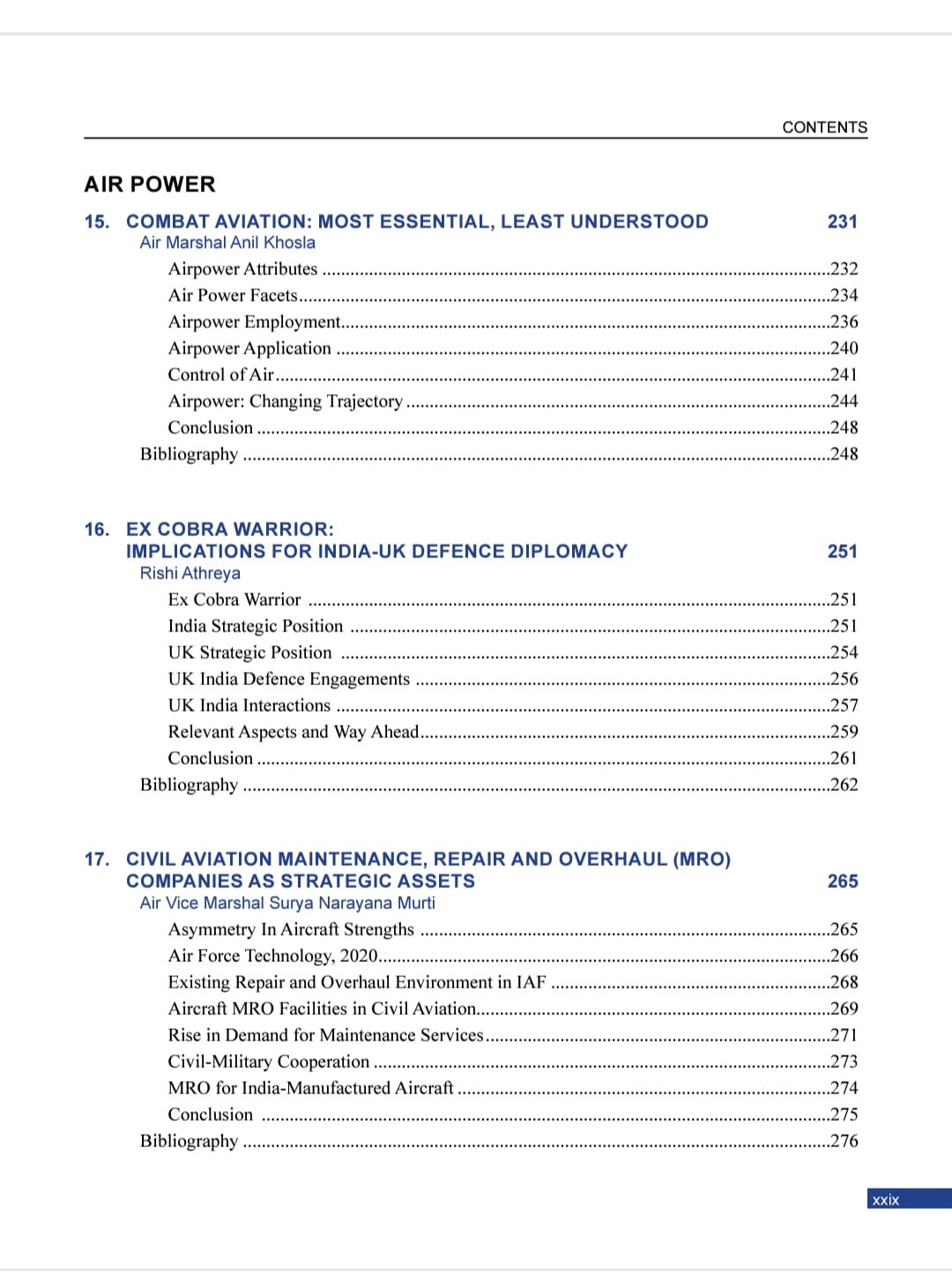
My Article published in the Indus International Research Foundation Year Book 2024.
“Air power is not only a fascinating subject, but its theory and practice also constitute a very demanding profession, and even a lifetime’s study and devotion is inadequate to unravel its mystique or fully understand its imperatives.”
– Air Cmde Jasjit Singh
Air power is a revolutionary force that transformed the fundamental nature of war in less than a century. The concept of air power is often considered one of the most essential elements in modern military operations, but it can also be the least understood aspect for various reasons. Aviation technology advances open up many new possibilities for air power applications. Developing, maintaining, and operating a modern air force is resource-intensive. Balancing budget constraints with the need for cutting-edge technology and capabilities is a complex task. The effective integration of air power with surface forces can be challenging. Joint operations require seamless communication, coordination, and a shared understanding of each other’s roles, tasks, and core competencies. These complexities make it challenging to understand the potential of air power and the nuances of its application for both the practitioners of air power and those affected directly or indirectly by it. Douhet, Mitchell, and Trenchard, the three airpower prophets from military aviation’s earliest years, articulated their airpower theories that shaped military aviation for decades. While it is good always to remember the basics, it is worthwhile to revisit and review them, especially with the ongoing and urgent debate about proposed organisational changes.
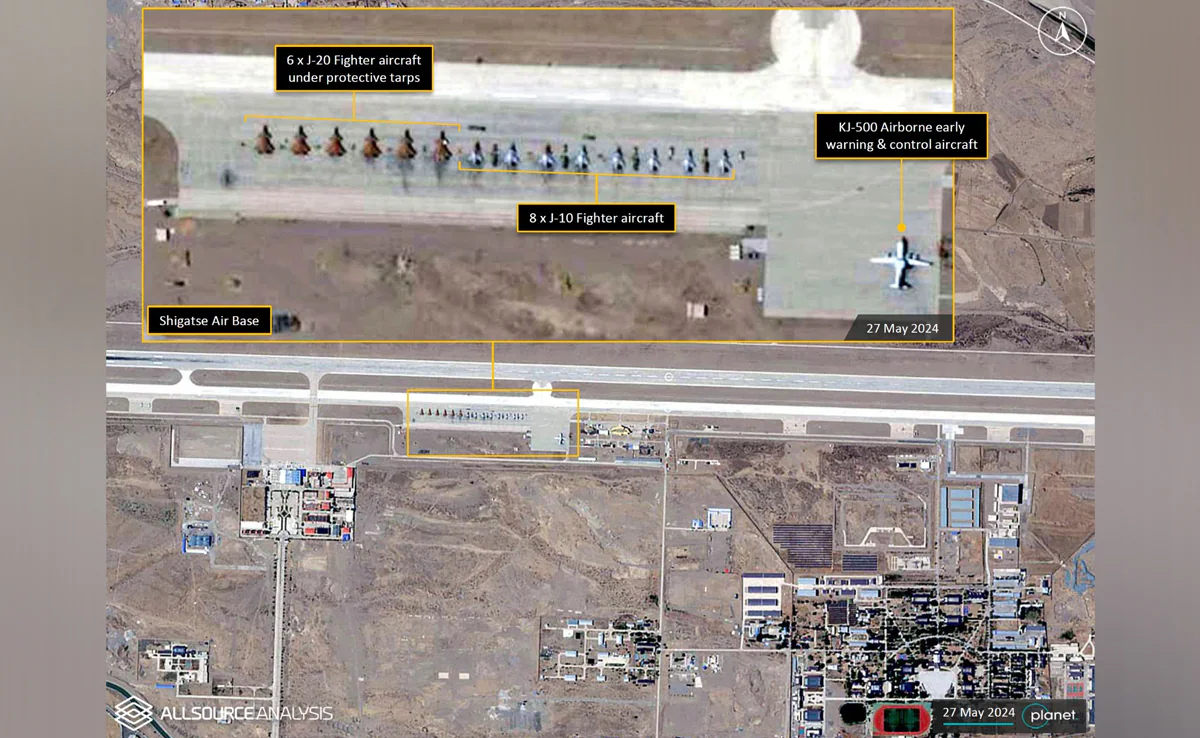
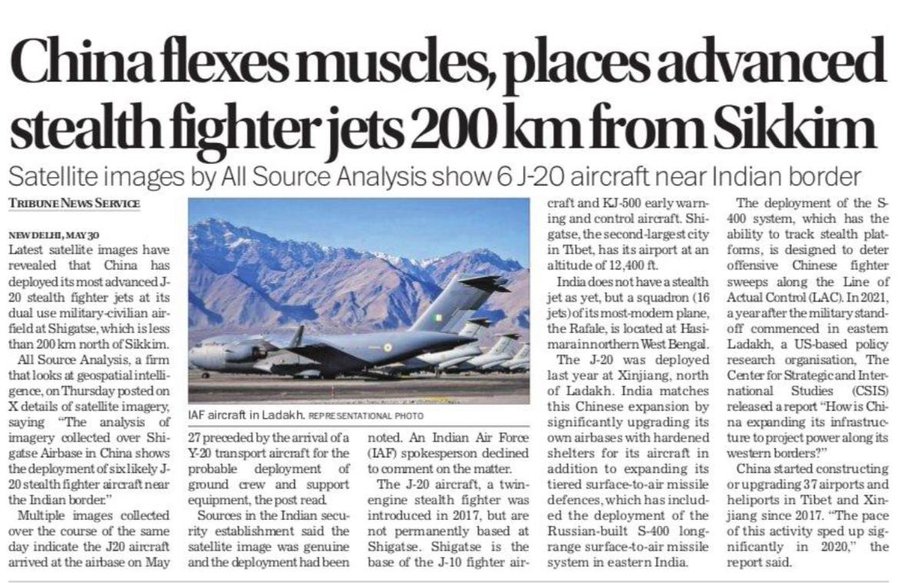
On 27 May, a satellite picture revealed that China had deployed its J-20 aircraft at Shigatse airbase in Tibet. The imagery shows six J-20 aircraft, eight J-10 aircraft, and one KJ-500 airborne Early Warning aircraft on the tarmac.
These deployments are regularly monitored and recorded.Purpose of these deployments are generally for:-
1. During Peace Time- Operate aircraft from a new base to ascertain and address the short comings / problem areas (including aircraft operations from high altitude area).
2. During Peace/No war No Peace conditions – For Political Signalling.
3. During Pre War Hostile situation – For Strategic Coercion.
4. During Hostilities – For war fighting ( In this case the air assets are dispersed, camouflaged and protected.
In this case the aircraft are positioned on the tarmac in a line, not dispersed, camouflaged, or under protected shelters. This deployment seems to be mainly under number 1 category, and to some extend the second one.
Pic Coutesy: Internet
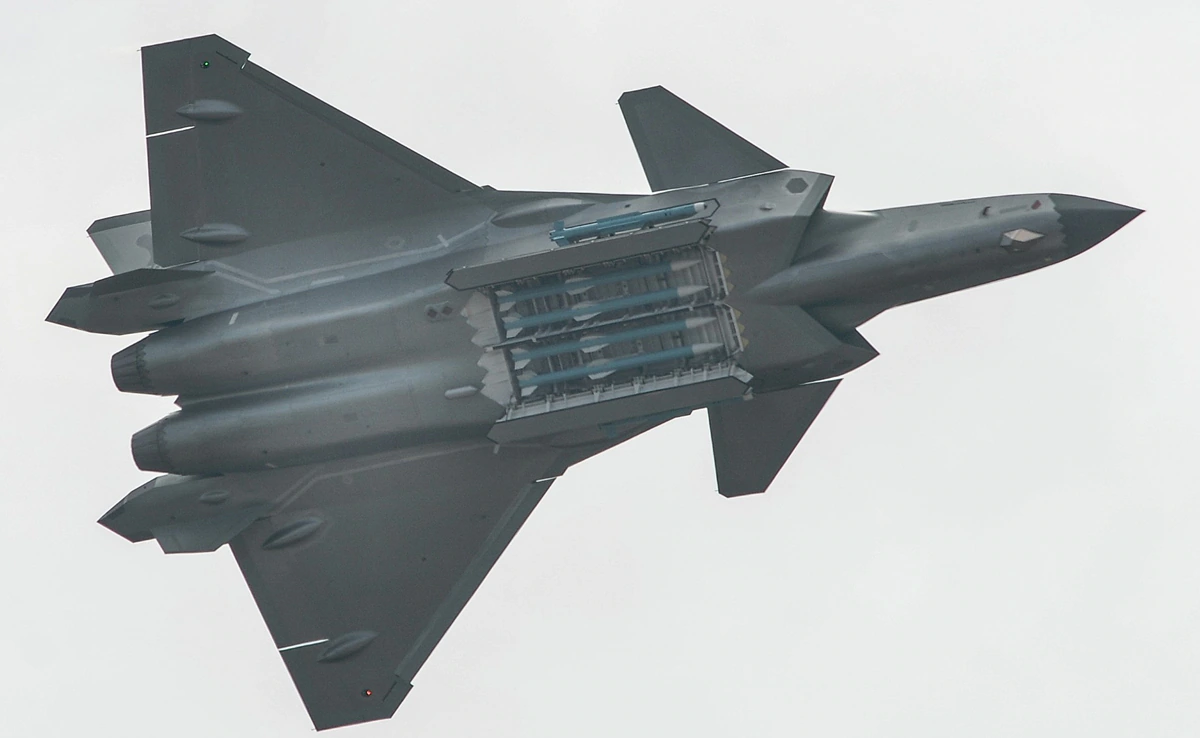
China claims J-20 to be 5th generation aircraft with superior performance, stealth features, advanced avionics and potent weapon suit. It claims it to be at par with or better than F-22 and F-35 of USA. It carries PL-15 Air to air missile with claimed range of 300 km.
These claims have not been demonstrated or proven anywhere during the air shows or air combat exercises. Notwithstanding, credit needs to be given to the adversary and one should prepare for the worst case scenario.
Pic Courtesy: Internet
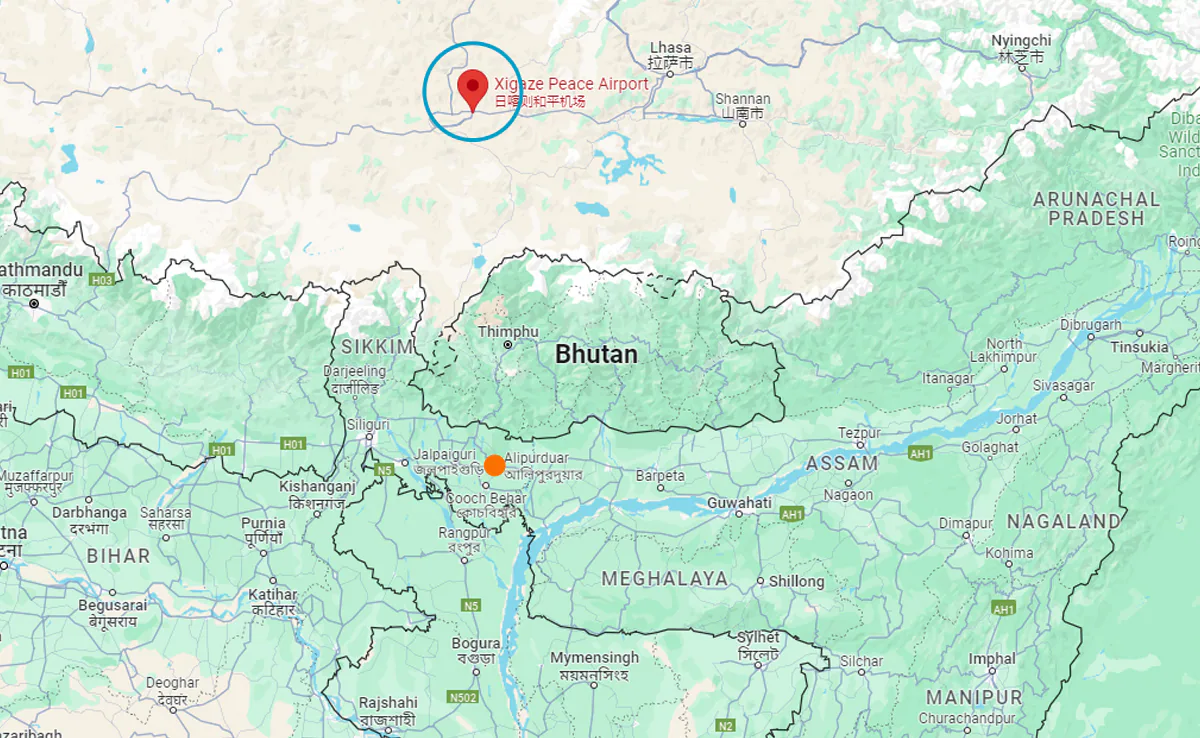
Shigatse is a dual purpose airfield in Tibet, located at a height of 12,408 ft. It is located approximately 150 km from the Sikkim LoC and 300 km from Hashimara base.
China has been upgrading its air war fighting infrastructure Including 37 airports and heliports) in the Tibet area.
Pic Courtesy: Internet
The deployment is a significant occurrence considering the prevailing Situation.
China’s military power and capability is growing rapidly.
It is displaying a belligerent and aggressive attitude.
It has expansionist aspirations.
Having annexed Tibet, it is looking at Taiwan next.
It has also expressed claims on Arunachal Pradesh.
With India, China has been following the policy of “keep the pot boiling”, besides salami slicing and String of pearls”. In the last decade, major Conflicts (skirmishes / Clashes / Encounters / Scuffles) have taken place at regular interval. In 2017, There was a standoff at Doklam in the Sikkim area. Post Galwan incident three years back, the situation is still not normal with both sides forward deploying their forces.
Possibility of Chinese action in the Eastern sector cannot be ruled out. This could be as a diversionary tactics for annexation of Taiwan or post Taiwan for annexation of Indian territory.
India has taken cognisance of the challenge and adopted a multi-prongrd approach to deal with it.
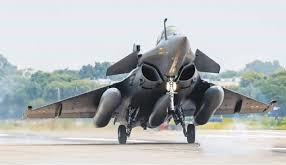
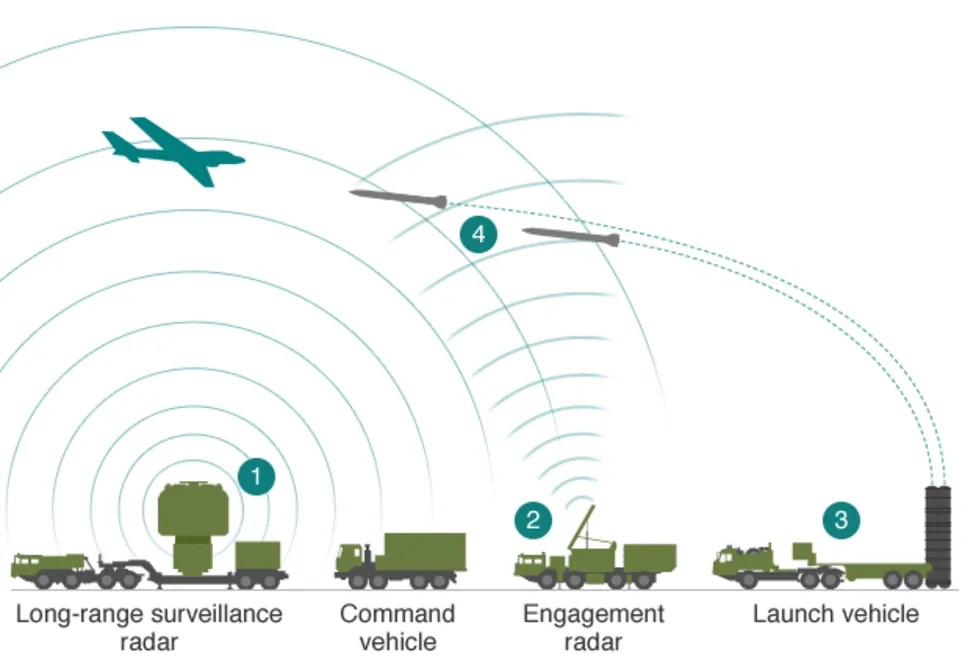
Air power capability is being increased in the eastern sector with stationing and operationalisation of Rafael fighter aircraft, S-400 Air defence system, Combat support aircraft (fixed wing, helicopters, and UAVs). The combat enhancing infrastructure is being developed on a fast track.
Question
Are we doing enough and at the required pace?
Bottom Line
We have woken up late and gone into 3rd/4th gear. We need to get into even higher gear.
Information and data included in the blog are for educational & non-commercial purposes only and have been carefully adapted, excerpted, or edited from reliable and accurate sources. All copyrighted material belongs to respective owners and is provided only for wider dissemination.
Ritu Sharma is a journalist, with a Master’s Degree in Conflict Studies and Management of Peace from the University of Erfurt, Germany. Her areas of interest include Asia-Pacific, the South China Sea, and Aviation history. She has been writing on subjects related to defence, foreign affairs, and nuclear technology for the last 15 years. She has written for PTI, IANS and The New Indian Express. Presently she is writing for the EurAsian Times.
Her article on Kargil Operations (Op Safed Sagar) was published on 01 Jun 2024 on “The EurAsian Times”.
(Besides the two quotes, the views of the author are her own)
When Eagles Kept Falcons At Bay – How IAF’s MiG-29 Fighters Triumphed Pakistan’s F-16s At 18,000 Feet
By Ritu Sharma – 01 Jun 2024
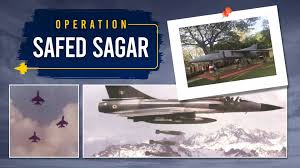
On May 26, the Indian Air Force (IAF) launched Operation Safed Sagar, which saw the deployment of air power at 18,000 feet. As the intruders, backed by the Pakistan Army, entrenched themselves on the treacherous heights of the Kargil sector, the IAF deployed its entire fleet, and the pounding continued for the next 60 days.
On May 21, the IAF launched a Canberra PR57 to conduct a reconnaissance of the Kargil area to assess the extent of intrusion. The aircraft descended to 22,000 feet, just two miles from the LoC, and was just 4,000 feet above the highest Himalayan points. The Canberra sustained a hit on its right engine by what was later determined to have been a Chinese-made Anza infrared surface-to-air missile. This called for a change in tactics by the IAF.
The Indian government had given the green light for the use of air power, albeit with one caveat – the Indian fighter jets were not allowed to cross the border with Pakistan. India began the air bombing on May 26 with MiG-21, MiG-23, and MiG-27 fighters carrying out six attacks against intruder camps, materiel dumps, and supply routes.
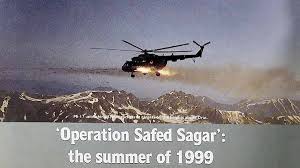
On the second day, the force lost two fighter jets—a MiG-27 and a MiG-21. The Pakistan-backed insurgents were using Stinger, a Man-Portable Air Defence System (MANPADS) that operates as an infrared-homing surface-to-air missile (SAM). The IAF MiG-21 piloted by Squadron Leader Ajay Ahuja, tasked with photo reconnaissance during the Kargil conflict, was shot down by ground-fired missiles over Batalik along the Line of Control in Ladakh. He ejected in time but parachuted down into Pakistan-occupied Kashmir and was later executed by the Pakistan forces in contravention of the Geneva Convention. On the third day of air operations, an IAF Mi-17 helicopter was downed again by an enemy shoulder-fired Stinger surface-to-air missile while conducting a low-level attack. After this, the IAF stopped using all slow-moving air assets in the conflict.
India had pressed its fleet of MiG-21s, MiG-23s, MiG-25s, MiG-27s, MiG-29 Fulcrums, Jaguars, and Mirage-2000s into the attack of the enemy positions within a small target area of just 5-12 km from the Line of Control (LoC). These fighters flew at 30,000 feet to avoid Pakistan missiles. The Pakistan and Indian Air Forces did not have dogfights. But, the Indian MiG-29s called ‘Baaz’ (or Eagle) did have whoever blinks first games with Pakistan’s F-16 ‘Falcons.’
“While PAF fighters did fly Combat Air Patrols (CAP) during the conflict, they stayed well within Pakistani air space. On occasions, IAF MiG-29s armed with the deadly R-77 BVR Air-to-Air missiles could lock on to PAF F-16s, forcing the latter to disengage. In the absence of a PAF threat, the IAF was able to deliver numerous devastating strikes on intruder positions and supply dumps,” a Strategy Page report said in the aftermath of the conflict. During the Kargil War, the PAF’s director of operations later reported isolated instances of IAF and PAF fighters locking on to each other with their onboard fire control radars.
The IAF pilots carried out 6,500 sorties, including strikes, reconnaissance, evacuation, transportation, and logistic support. In a 2012 report by Benjamin Lambeth of the Carnegie Endowment for International Peace titled “Airpower at 18,000 feet: The Indian Air Force in the Kargil War” explained how the IAF pummelled the Pakistan Army and the PAF: “Throughout the campaign, whenever IAF reconnaissance or ground attack operations were underway in the immediate combat zone, Western Air Command ensured that MiG-29s or other air-to-air fighters were also airborne on combat air patrol stations over the ground fighting on India’s side of the LoC to provide top cover against any attempt by the PAF to enter the fray in a ground attack role.”
The result was that PAF F-16s maintained a safe distance of 10 to 20 miles on the Pakistani side of the border. The report quotes Air Marshal (retired) Vinod Patney, the then head of Western Air Command: “I think my insistence on mounting CAPs across the (command’s entire area of responsibility) at different heights and times to give the message that we were ready and angling for an enlarged conflict helped. It was akin to throwing a glove, but it was not picked up.” Then IAF Chief AY Tipnis later recalled that he had “authorised the escorting fighter pilots to chase away Pakistani aircraft further back across the LoC.”
Talking to the EurAsian Times, Air Marshal Anil Khosla (retired) said: “Mig-29 and Mig-21 aircraft played an important role in local area air dominance by preventing enemy aircraft from interfering with our air and ground operations.” “The effort these aircraft put into air defence escorts and Combat Air Patrolling by day and night proved an effective deterrent, ensuring local air superiority. At times, PAF F-16s, orbiting on their side of the LOC, were kept at bay by our air defence fighters flying a protective pattern above the strike,” Khosla added.
MiG-23 and MiG-27 fighter jets had to manually dive to bomb the targets as they lacked modern equipment to locate them. However, this tactic did not work well in the rarefied atmosphere of the Himalayas. Hence, the IAF introduced the French Mirage 2000H equipped with day—and night laser-guided bomb delivery pods. On June 24, the IAF’s two Mirage 2000Hs dropped the first-ever laser-guided bombs of the force in a combat mission and destroyed the Northern Light Infantry’s command and control bunkers. The IAF reported at the end of 1999 that it resulted in as many as 300 enemy casualties within just minutes.
Air Marshal Khosla said: “Interdiction proved effective (Attack on NLI’s (Northern Light Infantry of Pakistan) command headquarters at Tiger Hill and supply dumps at Muntho Dhalo).” However, he adds, “helicopters and fixed-wing combat support aircraft are vulnerable in confined and contested air space”. This holds even in today’s battleground. Air Marshal Khosla underscores that airpower needs to be applied innovatively with ingenuity. The challenges during the Kargil conflict were manifold, including the high-altitude terrain (10,000 to 18,000 ft), low air density, strong winds, small camouflaged targets, and self-imposed restrictions like not crossing the border.
The IAF’s MiG-21s operated without modern navigation equipment, and pilots navigated with handheld GPS gadgets. The Indian Air Force integrated the 1000-kg bombs with laser-guided weapon pods. The IAF selected weapon impact points that would snowball into landslides or avalanches.
The IAF also deployed its ‘Super Spy’ MiG-25 Foxbat for reconnaissance missions. With an operational flight of over 70,000 feet and a speed of Mach 2.5, the fighter jet had regularly flown reconnaissance missions. Such was the clarity of the camera fitted in the belly of the aircraft, which allowed it to click photos of humans on a Pakistani tarmac. The Foxbat would create a sonic boom and escape before PAF could scramble its interceptors. In 1999, however, its mission parameters were different—it was to fly low and slow to map the targets on the Pakistani side for the Mirage-2000s bombing. The aircraft flew at a lower height, which was never envisaged, and there were no Standard Operating Procedures (SOPs) laid down. Also, it needed to maintain a velocity and height ratio for the camera to click clear photographs. At the given height, the aircraft was well beyond the range of the surface-to-air missiles, but the only threat was from aerial interception. To overcome that, the aircraft was escorted by Mirage-2000s during the mission.
Information and data included in the blog are for educational & non-commercial purposes only and have been carefully adapted, excerpted, or edited from reliable and accurate sources. All copyrighted material belongs to respective owners and is provided only for wider dissemination.