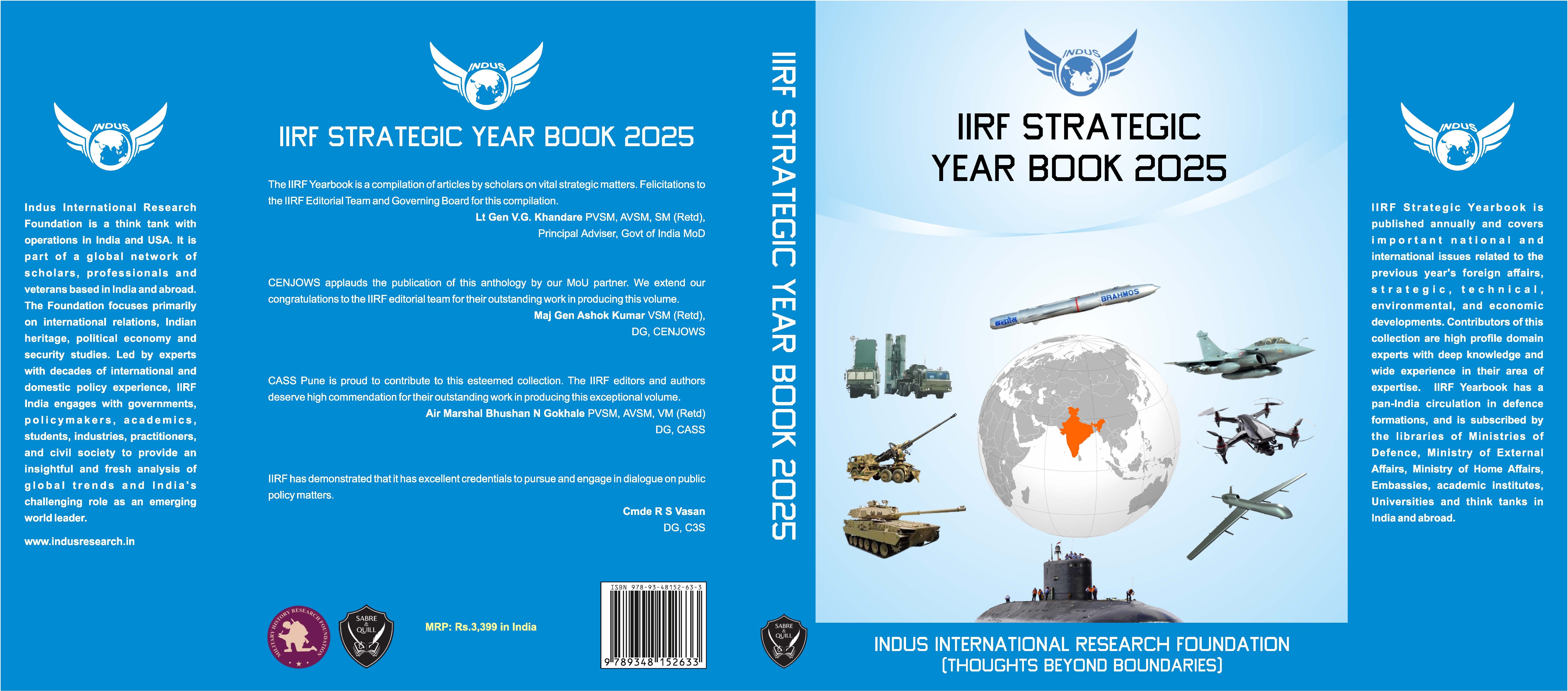

My Article published in the IIRF Yearbook 2025.
The “Loyal Wingman” concept refers to an innovative approach in military aviation where autonomous or semi-autonomous drones or unmanned combat aerial vehicles (UCAVs) work with piloted aircraft to perform various support and combat missions. These drones act as “wingmen” to human pilots, providing increased situational awareness, expanding mission capabilities, and reducing the risk to human pilots by taking on more dangerous or complex tasks1.
Loyal Wingman: Roles, Tasks and Missions. Loyal wingmen can perform numerous roles, tasks and missions2.
-
- Intelligence, Surveillance, and Reconnaissance. They can conduct ISR (Intelligence, Surveillance, and Reconnaissance) missions, gathering real-time data and feeding it to the manned aircraft and ground control. They can also scout ahead of the main force to identify threats or provide battlefield intelligence.
-
- Electronic Warfare. They can carry out electronic jamming, disrupting enemy communications, radar, or defence systems, creating opportunities for manned aircraft to penetrate defended airspace. They can also protect manned aircraft by providing electronic countermeasures (ECM) to confuse or disable enemy sensors and weapons.
-
- Combat Support and Strike. They can carry out precision strikes against enemy targets, such as radar stations, missile launchers, or vehicles, reducing risk to human pilots. They also support manned aircraft by attacking high-value targets while coordinating with the pilot.
-
- Decoy Missions. They can act as decoys to draw enemy fire, helping protect manned aircraft. It can simulate a manned jet’s radar or thermal signature to confuse enemy targeting systems.
-
- Defensive Operations. They can provide additional defensive cover to the human pilot, using on board sensors to detect incoming threats such as missiles or hostile aircraft. They can intercept or engage threats before they risk the manned aircraft.
Advantages Loyal Wing Man.
The Loyal Wingman concept offers numerous advantages across various aspects of military operations.3
Force Multiplication. Loyal wingmen enhance the operational reach of a single manned aircraft by acting as additional force elements. Multiple drones working in tandem with a manned platform allow one pilot to manage more assets, effectively increasing the overall combat power without needing additional manned aircraft.
Risk Reduction for Human Pilots. Loyal Wingman drones can be sent into dangerous or heavily contested airspace where human pilots would be at significant risk. These drones can engage enemy air defences, scout enemy positions, or launch strikes, minimising the exposure of manned aircraft to enemy fire. Many Loyal Wingman drones are designed to be attritable, meaning they are relatively low-cost and expendable. This allows commanders to act more aggressively without fear of losing expensive manned aircraft or risking human lives.
Enhanced Situational Awareness. Loyal wingmen are often equipped with advanced sensors and communication systems, allowing them to gather and share real-time intelligence with the manned aircraft. This increases the pilot’s situational awareness by providing additional eyes on the battlefield, detecting threats, and providing early warning of incoming dangers. The drones can fly ahead or to the sides of the manned aircraft, extending the range of surveillance and reconnaissance.
Increased Mission Flexibility. Loyal Wingman drones can be equipped for various missions, including intelligence, surveillance, and reconnaissance (ISR), electronic warfare (EW), air-to-air and air-to-ground combat, and decoy operations. Their modular design allows for rapid reconfiguration based on mission requirements.
Cost-Effectiveness. Loyal Wingman drones are generally less expensive to produce and operate than manned aircraft. This cost-effectiveness enables air forces to build larger fleets of drones, enhancing force projection without the prohibitive costs associated with maintaining and deploying traditional fighter jets. Since Loyal Wingman drones are unmanned, there is no need for extensive pilot training, which is typically required for manned aircraft.
Decoy and Distraction Capabilities. Loyal Wingman drones can act as decoys, drawing enemy radar and missile fire away from more valuable manned aircraft. By saturating enemy defences with multiple targets, these drones can help overwhelm adversary systems, creating safer conditions for manned platforms.
Scalability and Swarm Tactics. Loyal Wingman systems can operate in swarms to overwhelm enemy defences. A swarm of drones can overload enemy radar, making it difficult for adversaries to focus on any single target. Commanders can scale the number of drones deployed based on mission needs.
Complementing Advanced Manned Platforms. Loyal wingmen are particularly valuable in complementing advanced, expensive platforms like the F-35 Lightning II, F-22 Raptor, or HAL Tejas. They can perform secondary tasks, allowing the manned aircraft to focus on strategic objectives such as air superiority or critical strikes.
Electronic Warfare and Cyber Operations. Loyal Wingman drones can use electronic warfare to jam enemy communications, radars, or missile guidance systems. This capability enables them to suppress enemy defences, creating opportunities for manned aircraft to operate more freely.
Autonomous Decision-Making Loyal wingman drones are equipped with AI to autonomously make real-time decisions, reducing the need for constant human oversight. This autonomy allows them to react quickly to changes in the battlefield, engaging threats or adjusting tactics as needed.
Loyal Wingman: Technology Enablers.
The Loyal Wingman concept relies on various advanced cutting-edge technologies to enable autonomous drones to work alongside manned aircraft in combat operations. These systems work together to ensure that unmanned platforms can operate effectively alongside manned aircraft in high-threat environments4.
Artificial Intelligence (AI) and Machine Learning. AI enables Loyal Wingman drones to operate independently or semi-autonomously, making real-time decisions without constant human input. These systems use AI algorithms to analyse sensor data, assess threats, and adjust tactics dynamically. AI also allows for coordination between multiple drones and manned aircraft.
Sensor and Surveillance Systems. Loyal Wingman drones have advanced sensors that gather data across multiple spectrums, such as infrared (IR), electro-optical (EO), and radar. These sensors provide drones with situational awareness, target detection, and tracking capabilities, which they can share with manned aircraft.
Data Links and Communication Systems. Loyal Wingman drones rely on secure, encrypted communication links to coordinate with manned aircraft. These systems ensure continuous data flow between the drone and the human pilot, allowing real-time updates on mission status, threats, and tactical changes. Communication systems in Loyal Wingman drones are designed to minimise latency, ensuring that drones can react quickly to commands and adapt to dynamic changes in combat environments.
Autonomous Flight and Navigation Systems. Loyal Wingman drones have advanced navigation systems that allow them to operate in environments where GPS signals may be jammed or unavailable. In such scenarios, the drones rely on inertial navigation systems (INS), terrain mapping, and image-based navigation to maintain course and execute missions. Autonomous drones must be capable of avoiding obstacles and other aircraft in complex airspaces. Sense-and-avoid systems use a combination of sensors (radar, LIDAR, EO/IR) to detect nearby objects and adjust flight paths to prevent collisions, ensuring safe operation alongside manned aircraft. Drones flying in formation with manned aircraft or other drones must maintain precise spatial relationships, even during rapid manoeuvres. Autonomous flight control systems manage this formation flying, allowing drones to adjust their positions dynamically in response to changes in the environment or mission requirements.
Stealth and Survivability Technologies. Many Loyal Wingman drones are designed with low radar cross-sections (RCS), infrared suppression, and other stealth features to reduce their visibility to enemy radar and sensors. This allows them to operate in contested airspace with a reduced risk of detection and engagement. Loyal Wingman drones have electronic countermeasures to enhance survivability that can jam enemy radars, disrupt missile guidance systems, or confuse tracking systems. These ECM systems protect both the drone and the manned aircraft it supports.
Modular Payload Systems. Loyal Wingman drones often feature modular payload bays, allowing them to be reconfigured for various roles, such as intelligence, surveillance, and reconnaissance (ISR), electronic warfare (EW), or strike missions. Payloads can include sensors, weapons, jammers, or decoys.
Swarming Technology. In some Loyal Wingman applications, multiple drones can operate as part of a swarm, coordinating their actions through AI algorithms. These swarming systems allow drones to autonomously divide tasks, share sensor data, and execute coordinated attacks on enemy defences or assets.
Human-Machine Interface (HMI). Developing an intuitive interface for pilots to manage Loyal Wingman drones is crucial for operational success. This includes voice commands, graphical interfaces, or augmented reality (AR) systems that allow pilots to monitor and control multiple drones without becoming overwhelmed by excessive data.
Collaborative Targeting and Data Fusion. Loyal Wingman drones often act as part of a network of platforms, sharing data with manned aircraft and other assets. Advanced data fusion systems combine sensor inputs from multiple platforms into a cohesive battlefield picture, allowing for more informed decision-making and quicker reactions to emerging threats.
Loyal Wingman Development Projects
Several nations and defence organisations worldwide are actively developing the Loyal Wingman concept.
Boeing Airpower Teaming System (ATS).5&6 The Boeing Airpower Teaming System (ATS) is a ground-breaking unmanned combat aircraft developed by Boeing in collaboration with the Royal Australian Air Force (RAAF). It is designed with advanced artificial intelligence (AI) and autonomy. This allows the ATS to coordinate with manned aircraft such as the F/A-18 Super Hornet, F-35 Lightning II, or other fighter jets. The ATS conducted its first successful flight in March 2021, marking a significant milestone in developing unmanned teaming technology.
Skyborg.7&8 Skyborg is an ambitious program developed by the United States Air Force (USAF) to create a family of autonomous, unmanned combat aerial vehicles (UCAVs) that can operate alongside manned aircraft, functioning as “loyal wingmen” and perform a wide range of missions. The Skyborg initiative is part of the broader USAF vision of developing low-cost, expendable unmanned systems to complement manned aircraft like the F-35 Lightning II, F-22 Raptor, and other next-generation platforms. The core of the Skyborg program is the development of a robust autonomy core system (ACS)—a sophisticated AI platform that allows UAVs to fly and fight with little to no human input. The AI system is designed to continuously learn and adapt based on real-time data from the environment, improving its performance with each mission. The Skyborg program involves partnerships with several aerospace and defence companies, including Boeing, Kratos Defense, General Atomics, and Northrop Grumman, developing different UAV platforms to test Skyborg’s AI capabilities. These companies provide the hardware and airframes, while the USAF focuses on integrating the AI systems. One of the most notable platforms associated with Skyborg is the Kratos XQ-58A Valkyrie, an unmanned aerial vehicle considered a key candidate for Skyborg operations. Other platforms, like the General Atomics MQ-20 Avenger and Boeing ATS (Airpower Teaming System), are also being tested for Skyborg’s AI-driven operations. The first successful flight of a Skyborg-equipped drone took place in April 2021, when the autonomy core system was tested on a Kratos Valkyrie UAV. This marked a significant milestone in demonstrating the AI’s ability to operate autonomously, navigate, and perform essential mission functions without human intervention.
Kratos XQ-58A Valkyrie.9&10 The Kratos XQ-58A Valkyrie is an experimental unmanned combat aerial vehicle (UCAV) developed by Kratos Defense & Security Solutions for the United States Air Force (USAF) as part of its Low-Cost Attritable Aircraft Technology (LCAAT) initiative. The XQ-58A is designed to function as a loyal wingman. It aims to offer a low-cost, expendable option for future combat scenarios. The XQ-58A Valkyrie is designed to operate in various roles alongside manned aircraft, such as the F-35 or F-22. It has been tested with weapon payloads, including the potential to carry small precision-guided munitions (such as JDAMs or SDBs). The XQ-58A is designed for long-range missions with significant endurance. It can travel over 3,200 km, which makes it ideal for deep penetration missions. The XQ-58A features a stealthy, low-observable design intended to reduce its radar cross-section, making it harder for adversaries to detect. While it doesn’t have the same stealth capabilities as fifth-generation fighter jets like the F-35, it still offers reduced visibility on enemy radar systems. The Valkyrie flew in March 2019 at Yuma Proving Ground in Arizona. Since then, it has undergone several test flights, demonstrating its ability to fly autonomously, deploy weapons, and work in tandem with manned aircraft. The ongoing development is focused on further integrating the aircraft into USAF operations and exploring its full range of mission capabilities. The project aligns with the Skyborg program.
Future Combat Air System (FCAS) Loyal Wing Man Project of Europe. 11&12 The Future Combat Air System (FCAS) is a major European defence initiative to develop a next-generation air combat capability. It involves several countries, primarily France, Germany, and Spain. It focuses on integrating advanced technologies into a new family of systems that will replace the ageing fleets of fighter aircraft, such as the Eurofighter Typhoon and Dassault Rafale. A vital aspect of the FCAS is the development of loyal wingman drones designed to work alongside manned fighter jets. The FCAS project was officially launched in 2017. It aims to create a comprehensive system that includes next-generation fighter aircraft, unmanned aerial vehicles (UAVs), and various supporting technologies. The program envisions a network of systems, often called the “system of systems,” that can communicate and operate together in a complex battlefield environment. The FCAS program is structured in phases. The goal is to have a prototype of the next-generation fighter by the mid-2030s. According to recent updates, the FCAS program continues to evolve, with ongoing discussions about integrating technologies and the roles of various nations in the project.
Loyal Wing Man Project Flygplan 2020 of Sweden. 13 The Loyal Wingman Project in Sweden, known as Flygplan 2020 (or Airplane 2020), is an initiative to develop an advanced unmanned aerial vehicle (UAV) that will operate alongside Sweden’s manned fighter jets, mainly the Saab JAS 39 Gripen. The Flygplan 2020 project is being developed with various partners, including defence industry stakeholders, research institutions, and the Swedish Armed Forces. Saab, a leading aerospace and defence company, plays a crucial role in the project, leveraging its aircraft design and development expertise. While specific timelines for the Flygplan 2020 project may vary, the development of loyal wingman capabilities is expected to progress in line with advancements in drone technology and changing defence needs.
Russia’s Loyal Wing Man. 14 Like other nations, Russia is also pursuing the development of the Loyal Wingman system. The Okhotnik-B is a stealthy unmanned combat aerial vehicle (UCAV) developed by Sukhoi. It is designed for various roles, including reconnaissance and precision strikes. The Okhotnik-B features a flying wing design for reduced radar signature and is intended to operate in conjunction with manned aircraft, such as the Su-57 fighter jet. The Orion drone is designed for reconnaissance and strike missions. While not a traditional Loyal Wingman platform, its capabilities align with the concept by enabling it to operate alongside manned fighters and support them in various roles.
China’s Loyal Wingman. 15 China has significantly advanced in developing its own Loyal Wingman systems. The CH-7 is an unmanned combat aerial vehicle (UCAV) developed by the Aviation Industry Corporation of China (AVIC). The CH-7 features stealthy design elements, advanced avionics, and a modular payload system, making it capable of operating alongside manned aircraft in combat scenarios. While primarily recognised as a reconnaissance and strike drone, the Wing Loong series (e.g., Wing Loong II) showcases capabilities that align with the Loyal Wingman concept. Another notable UCAV, the GJ-11, is designed with stealth features and advanced avionics. These drones are designed to coordinate with manned platforms. China is heavily investing in AI technologies to enhance the autonomy of its Loyal Wingman systems. China actively seeks to export its UAV technologies.
Indian HAL’s CATS.
HAL CATS (Combat Air Teaming System)16,17&18 is an advanced unmanned combat aerial vehicle (UCAV) program being developed by Hindustan Aeronautics Limited (HAL) in collaboration with other Indian defence agencies. The program is part of India’s effort to develop indigenous drone technologies capable of operating alongside manned aircraft. HAL CATS aligns with the growing global trend of integrating unmanned systems with traditional fighter jets through Manned-Unmanned Teaming (MUM-T). The CATS program includes multiple drone systems and components that work synergistically with manned aircraft, particularly with India’s HAL Tejas Light Combat Aircraft (LCA) and other future platforms. CATS’ key elements include the following:-
-
- CATS Warrior. The CATS Warrior is a loyal wingman UAV designed to fly alongside manned fighter jets, like the HAL Tejas. It can operate autonomously or under the direction of the manned aircraft, performing tasks such as reconnaissance, surveillance, and strike missions. The CATS Warrior will be armed with precision-guided munitions and can take on enemy targets independently or in support of manned aircraft. Its design focuses on being stealthy, agile, and capable of engaging in high-risk environments where manned platforms might face significant threats.
-
- CATS Hunter. CATS Hunter is a high-speed drone designed to act as a cruise missile capable of long-range precision strikes. It can be deployed from manned aircraft or larger UAVs and is intended for missions that require attacking heavily defended or high-value targets. It will carry advanced payloads such as precision-guided bombs and can strike enemy radar installations, command centers, and other critical infrastructure.
-
- CATS Alpha. CATS Alpha is a smaller, swarming drone working in groups to overwhelm enemy defences. These drones can be deployed in large numbers from manned or unmanned platforms to perform a variety of missions, including reconnaissance, electronic warfare, and decoy operations. The idea is for CATS Alpha to create confusion and disrupt enemy systems, allowing manned and larger unmanned platforms to penetrate deeper into contested areas.
-
- CATS Infinity. CATS Infinity is a long-range, high-altitude drone designed for intelligence, surveillance, and reconnaissance (ISR) missions. It will operate at high altitudes for extended periods, providing continuous data to ground commanders and manned aircraft. CATS Infinity will likely monitor large areas, gather intelligence on enemy movements, and support strike planning by providing real-time data.
The HAL CATS program represents a significant step for India in developing indigenous unmanned combat systems. With increasing threats from neighbouring adversaries and a push to modernise India’s air force, CATS is crucial in bolstering the country’s aerial defence and combat capabilities. As autonomous systems become more sophisticated, HAL CATS could form the backbone of India’s future air warfare strategy. Complementing manned platforms like the Tejas and future fighters would provide a flexible, powerful, and resilient air force capable of handling modern combat challenges.
Development Challenges.
While the Loyal Wingman concept offers many advantages in modern military operations, several challenges and limitations must be addressed to reach its full potential. These technical, operational, and strategic challenges reflect the complexities of integrating autonomous drones with manned aircraft in combat scenarios. 19&20
Autonomy and AI Development. The autonomy of Loyal Wingman drones relies on advanced AI systems capable of making real-time decisions in complex and dynamic combat environments. A significant technical challenge is developing AI that correctly identifies targets, avoids friendly fire, and reacts to unforeseen threats without human intervention. Errors in decision-making could lead to mission failure or unintended consequences such as friendly fire incidents.
Secure and Reliable Communication. Loyal Wingman systems depend on constant communication with manned aircraft to coordinate actions, receive instructions, and share battlefield data. In contested environments, adversaries may use electronic warfare (EW) tactics to jam or disrupt these communication links, potentially causing drones to lose connection with the pilot or the control station. Communication systems must operate with minimal latency to ensure real-time coordination between manned and unmanned platforms. Any delays in data transmission could hinder the drones’ ability to execute missions efficiently or respond to dynamic threats. Ensuring secure, encrypted, and tamper-proof communication is critical to prevent cyber-attacks on these autonomous systems.
Interoperability and Integration. Seamless Integration with Manned Platforms: One of the core challenges of Loyal Wingman systems is their ability to operate seamlessly with manned aircraft, particularly across different platforms (e.g., fighter jets and bombers). Ensuring that drones can integrate with various aircraft models and follow a wide range of mission commands requires advanced software and hardware compatibility. Integrating drones with older aircraft and advanced fifth-generation fighters poses a challenge.
Technical Reliability and Safety. As with any complex system, technical failures can occur in Loyal Wingman drones. If a drone malfunctions or loses its connection to a manned aircraft, it may need to execute fail-safe manoeuvres to avoid collisions or causing damage. It is essential to ensure that drones can safely return to base or neutralise themselves in the event of failure. Avoiding mid-air collisions, especially during high-speed manoeuvres in combat, requires advanced sense-and-avoid technology. Failure in this aspect could endanger both drones and human pilots.
Adversarial Countermeasures. Adversaries will likely develop countermeasures to neutralise Loyal Wingman drones, including jamming their communication systems, hacking their control software, or disrupting their navigation through GPS spoofing. A significant challenge is ensuring that drones can operate effectively in environments where these countermeasures are in play. As Loyal Wingman drones become more integrated into combat operations, adversaries will likely invest in anti-drone systems such as directed energy weapons (DEWs), missile systems, and radar that can detect and neutralise drones before they complete their missions. Ensuring the survivability of drones against these countermeasures requires continuous advancements in stealth technology, speed, and electronic protection.
Cost and Resource Allocation. Although Loyal Wingman drones are often described as cost-effective compared to manned aircraft, the development of autonomous technologies, AI, and advanced communication systems is still costly. Nations may need help balancing investment in new drone systems with maintaining and upgrading existing fleets of manned aircraft.
Future Prospects.
The future of the Loyal Wingman concept holds significant potential to revolutionise air combat by further advancing the integration of manned and unmanned systems. As technology evolves, Loyal Wingman drones will become more autonomous, intelligent, versatile, and capable of executing a wider range of missions alongside manned aircraft. 21&22
Increased Autonomy and AI Evolution. While current Loyal Wingman systems typically operate semi-autonomously, drones capable of completing missions without direct human oversight will likely be used. AI-driven swarms of Loyal Wingman drones will become more sophisticated, capable of self-organising, adapting to changes in the battlefield, and autonomously executing complex coordinated manoeuvres. Swarming drones may dynamically allocate roles—such as decoys, sensors, or attackers—based on real-time needs without direct human input. Future Loyal Wingman systems will feature more advanced AI that can interact intuitively with human pilots.
Integration of Multi-Domain Operations. In the future, Loyal Wingman drones will increasingly be integrated into multi-domain operations, coordinating with space, cyber, and maritime platforms. Future Loyal Wingman drones may possess enhanced cyber capabilities, allowing them to engage in cyber warfare by disrupting enemy networks, jamming communications, or even conducting offensive cyber operations against critical enemy infrastructure.
Enhanced Combat Roles and Mission Versatility. As technology advances, Loyal Wingman drones will become more versatile, taking on roles beyond traditional combat support. These may include electronic warfare (EW), suppression of enemy air defences (SEAD), psychological operations (PsyOps), and even humanitarian missions such as search and rescue or disaster relief. Future Loyal Wingman platforms will have modular, customisable payload bays that allow them to switch rapidly between roles.
Advanced Networking and Communication. Future Loyal Wingman systems will be connected through highly advanced, AI-driven battle networks that enable real-time data sharing across air, sea, and land assets. Quantum communication and encryption in the future will provide near-invulnerable communication links that are resistant to jamming or interception by adversaries.
Greater Survivability and Stealth. Future Loyal Wingman drones will likely feature cutting-edge stealth designs like next-generation low-observability materials, active camouflage systems, and heat suppression technologies. These advances will make it increasingly difficult for adversaries to detect, track, or engage Loyal Wingman platforms. Drones will also have advanced defensive systems that enable them to evade enemy missiles autonomously, counter radar lock-on, and jam incoming threats. These self-defence capabilities will make future Loyal Wingman systems more survivable in high-threat environments.
Interoperability with Next-Generation Aircraft. The next generation of manned fighter aircraft will be designed to operate with autonomous Loyal Wingman drones. These drones will enhance the capabilities of sixth-generation fighters and extend their range, sensor reach, and mission flexibility. Future manned-unmanned teaming (MUM-T) will become even more integrated.
Integration with Space-Based Assets. Future Loyal Wingman systems could coordinate with space-based assets, such as surveillance satellites and high-altitude unmanned aerial vehicles (UAVs), to provide a comprehensive battlefield view. This integration would enable real-time, global intelligence gathering and strike capabilities, extending the operational reach of both manned and unmanned systems. In the future, Loyal Wingman drones could also defend space-based assets or coordinate with space forces to counter threats in orbit. Integrating air and space combat capabilities will become critical as space becomes increasingly contested.
Conclusion
The Loyal Wingman concept represents a significant advancement in air combat but comes with various technical, operational, ethical, and legal challenges. As militaries and defence industries continue to develop these autonomous systems, addressing these challenges will ensure the effective and responsible integration of Loyal Wingman drones into future combat scenarios. Advancements in AI, autonomy, multi-domain integration, communications, stealth, and human-machine teaming will shape the future of the Loyal Wingman concept. As these technologies evolve, Loyal Wingman drones will become more intelligent, versatile, and capable, playing a crucial role in next-generation air combat. Their ability to enhance manned platforms, operate in swarms, and execute autonomous missions will make them indispensable assets in future warfare, revolutionising how air forces approach combat operations.
Please Add Value to the write-up with your views on the subject.
For regular updates, please register your email here:-
References and credits
To all the online sites and channels.
Pics Courtesy: Internet
Disclaimer:
Information and data included in the blog are for educational & non-commercial purposes only and have been carefully adapted, excerpted, or edited from reliable and accurate sources. All copyrighted material belongs to respective owners and is provided only for wider dissemination.
References:-
- RAND Corporation, “The Future of Autonomous Air Combat: Manned-Unmanned Teaming and the Role of the Loyal Wingman”, RAND, 2021.
- Royal United Services Institute (RUSI). The Future of Air Combat: Manned-Unmanned Teaming (MUM-T), 2021. Focuses on the operational tasks and missions of loyal wingman systems.
- Hoyle, Craig. “Unmanned Systems in Combat: Enhancing Airpower Effectiveness.” Aerospace International, Vol. 22, No. 4, 2021. Details the operational advantages of loyal wingman systems.
- Wilson, Clay. Emerging Military Technologies. Covers various advanced military technologies, including AI and robotics. Highlights loyal wingman concepts as a disruptive force in modern air combat.
- Boeing Defense. “Boeing Airpower Teaming System: Redefining Airpower,” 2021. Technical whitepaper on the Boeing ATS loyal wingman platform.
- Defense News. “Boeing ATS: The First Flight of the Loyal Wingman.” March 2021. Covers milestones in the development of the Boeing ATS.
- Center for a New American Security (CNAS). Skyborg and Beyond: Unmanned Systems in the U.S. Air Force, 2020. Discusses the Skyborg program in detail, including its development challenges and strategic objectives.
- Popular Mechanics. “The Skyborg Program and the Future of Unmanned Combat Aircraft.” August 2022. Analyses the U.S. Air Force’s Skyborg program and its strategic significance.
- Kratos Defense. “Kratos XQ-58A Valkyrie: A Tactical UAS for MUM-T Applications.” AIAA SciTech Forum, 2020. Details the technical specifications and envisioned roles of the Valkyrie.
- Flight Global. “Kratos XQ-58A Valkyrie: A Game Changer for Manned-Unmanned Teaming.” June 2020. Highlights the operational role of the Valkyrie in MUM-T scenarios.
- European Defence Agency (EDA). Future Combat Air System (FCAS): Towards the Next Generation of Air Combat, 2021. Examines Europe’s FCAS program, highlighting the loyal wingman component.
- Jane’s Defence Weekly. “Future Combat Air System (FCAS): Europe’s Next-Gen Airpower.” October 2021. Covers the loyal wingman concept in the FCAS program.
- Swedish Defence Research Agency (FOI). Flygplan 2020: Sweden’s Loyal Wingman Initiative, 2021. Technical report on Sweden’s Flygplan 2020 project. Examines Sweden’s Flygplan 2020 program, focusing on autonomy, stealth, and collaboration with Gripen fighters.
- Russian Aviation Insider. “Russia’s Loyal Wingman: The Okhotnik UAV.” April 2022. Focuses on Russia’s Su-57 Okhotnik UAV as a loyal wingman prototype.
- The Drive – Warzone. “China’s Loyal Wingman: Insights into the GJ-11 and FH-97 Programs.” January 2023. Examines China’s loyal wingman platforms and their integration into the PLAAF.
- Hindustan Aeronautics Limited (HAL). “Combat Air Teaming System (CATS).” Insights into India’s indigenous loyal wingman program. Development Challenges and Future Prospects
- Indian Institute for Defence Studies and Analyses (IDSA). India’s UAV Ecosystem and HAL’s Combat Air Teaming System (CATS), 2022. Covers India’s HAL CATS program, focusing on its vision and development hurdles.
- Economic Times. “HAL’s CATS: India’s Leap into Manned-Unmanned Teaming.” July 2022. Explores HAL’s vision for its Combat Air Teaming System.
- Galliott, Jai. Military Robots: Mapping the Moral Landscape. Routledge, 2020. Explores ethical and operational challenges of deploying loyal wingman systems.
- Defence Advanced Research Projects Agency (DARPA). Challenges in Autonomous Air Combat Systems, 2021. Focuses on key technological hurdles in loyal wingman development.
- Laird, Robbin. “Future Prospects of Manned-Unmanned Teaming in Air Combat.” Discusses the strategic implications of loyal wingman systems for air force modernisation.
- SIPRI. The Role of AI in Future Air Combat: Risks and Opportunities, 2022. Explores AI’s role in enhancing loyal wingman capabilities while addressing challenges.