254: India’s Ukraine Policy

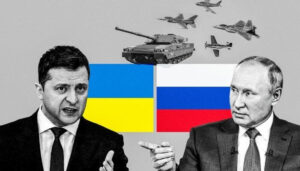
Fair Observer and USI had organized an interesting discussion on India’s stand on the Ukraine crisis.

Information about the think tank and the panelists is placed at the end of the post.

The link to the video is below:-

https://youtu.be/W743K5ZT2bY


For issue-based viewing please click on the links below:-

  1. Introduction by Christopher (00.00 – 01.58).
  2. Question about defence supplies from Ukraine and Russia to Anil Khosla.  Overall perspective, factors, compulsions, mitigating actions. (01.58 – 08.27).
  3. Question about the greater opportunity for the western defence industry to Anil Khosla. (08/27 – 11.27).
  4. Question about why is the western pressure not working for Manu Sharma. (11.27 – 17.12).
  5. Question about why relations with Russia are important for India, to Atul Singh. (17.15 – 28.25).
  6. Question about strategic lessons for India, to Anil Khosla. (28.50 – 34.10).
  7. Question about repercussions of the collapse of the Russian defence industry, to Gen BK Sharma. (34.5 – 41.10).
  8. Question about alternate sources of military equipment and supplies, to Gen BK Sharma. (41.10 – 43.57).
  9. Q & A Session. Questions about does Russia needs India, India’s reverse leverage with Russia, and sharing of technology between western and Indian Defence companies. (43.57 onwards).


Fair Observer

 Fair Observer is a US-based, independent, non-profit media organization that engages in citizen journalism and civic education.  Its digital media platform has 2,500 contributors from 90 countries, cutting across borders, backgrounds, and beliefs.


Mr Atul Singh

Atul Singh is the founder, CEO, and editor-in-chief of Fair Observer. He has taught political economy at the University of California, Berkeley, and been a visiting professor of humanities and social sciences at the Indian Institute of Technology, Gandhinagar. Atul studied philosophy, politics, and economics at the University of Oxford on the Radhakrishnan Scholarship and did an MBA with a triple major in finance, strategy, and entrepreneurship at the Wharton School of the University of Pennsylvania. He worked as a corporate lawyer in London and served as an officer in India’s volatile border areas where he had a few near-death experiences. Atul has also been a poet, playwright, sportsman, mountaineer, and founder of many organizations.


Mr Manu Sharma

Manu Sharma is a contributing editor at Fair Observer. He is a political analyst with an international footprint. A dynamic, young thought leader in the field of global political research, communications strategy, public policy, and political economy, Manu has served in financial institutions, international organizations, and media bodies across four continents. He brings a formidable mix of technical skills, multicultural experience, and the ability to deliver across several time zones. Manu’s areas of professional expertise include political risk research, psephology surveys, and quantitative research papers on economic issues. He has experience in econometric research, has made media appearances, and serves as an advisory aide to top decision-makers in politics.


Major General BK Sharma, AVSM, SM and Bar (Retd)

Maj Gen BK Sharma was commissioned in the SIKHLIGHT Infantry Regiment in 1976 and superannuated in 2012. He is the Director of the United Service Institution of India (USI), India’s oldest think tank established by the British in 1870. He was conferred three military awards by the President of India for rendering exceptional distinguished national service and for displaying courage. Besides, he was conferred the national award for nation-building by the Confederation of Educational Excellence of India in 2017. He has tenanted prestigious assignments in India, including command of a mountain division on the China border and Senior Faculty Member at the National Defence College. He has represented his country at the UN as Military Observer in Central America and has been India’s Defence Attaché in Central Asia. He specializes in Strategic Net Assessment methodology, Scenario Building, and Strategic Gaming. He has visited about 35 countries as a member of international delegations and on educational tours. He has participated in 29 international conferences abroad and several such conferences in India. He has edited about 08 books, contributed more than 60 seminal papers to the Indian / foreign journals and Newspapers, and presented 30 research papers at international conferences. He edits the prestigious USI Strategic Year Book. He has lectured at the prestigious military establishment, policy think tanks, and universities, literature festivals in India and abroad.


Christopher Roper Schell

Christopher Roper Schell is a contributing editor at Fair Observer. He is currently a book editor and policy advisor. He studied British literature at Southern Methodist University and law at George Washington University. With over a decade of Capitol Hill experience working for three Members of Congress, Christopher has handled policy issues varying from the financial crisis to healthcare. After a year spent at the Pentagon as a Congressional liaison, he ran for Congress in a 2020 special election.


Suggestions and value additions are most welcome


For regular updates, please register here

Subscribe

251: Pakistan in Turmoil: Once Again

Pic Courtesy: Net (Dawn)

Khan a popular cricket star, was elected prime minister in 2018 on a reform and anti-corruption platform.

Khan followed an antagonistic brand of politics, at times unwilling to build political consensus.

Some parties and the opposition formed an alliance in 2020 and have tried to oust Khan from power.

The opposition says Imran Khan has failed to deliver, citing inflation, and economic pressures.

Now he faces a vote of no-confidence in the National Assembly.


Dynamics


Political Pattern.

  • Pakistan displays a political cycle indicating built-in political instability.
  • No Pakistani prime minister has completed their full five-year term in office.
  • The opposition parties do not wait for elections to occur, for the previous party to be voted out.


Military

  • Khan’s relationship with the military has changed.
  • The military had stood behind Khan since 2018.
  • Lately, faultlines have emerged in Khan’s relationship with the military.
  • The military is not happy with the way he runs domestic politics.
  • The military also does not like his antagonistic brand of politics.
  • One of the triggers is the appointment of the ISI chief. The military had presented the candidate for the next chief of the ISI and Khan dragged his feet over that, leading to an impasse. This was an embarrassment for the military.


Foreign Policy

  • Khan wants Pakistan to have an independent foreign policy, i.e. good relationship with all powers (Russia, China, and the US).
  • But the reality is that under Khan’s term, Pakistan has drifted away from the US.
  • Whereas, Pakistan is getting closer to China and Russia.
  • The Pak military wants a closer relationship with the US.


Afghanistan Factor.

  • US withdrawal from Afghanistan is another factor for the coldness of the relationship with the US.
  • The US has no need for Pakistan for its fight in Afghanistan.
  • Pakistan’s engagement with the Taliban is another factor having both external and internal repercussions.


Imran’s Last Ditch Efforts.

  • Khan is relying on popular political tactics, basically blaming the political turmoil on a foreign conspiracy theory, blaming the West.
  • He claims that the opposition is acting at the behest of western foreign powers and the CIA.
  • He is portraying himself as the one to stand up against the west.


Likely Outcomes.


One thing is sure, whatever happens, would be with the support of the Pakistan Military.

The military has said that it is neutral in the vote of no confidence situation. What it means is it is ditching Imran Khan.


Imran Stays.

  • This is possible only if he cuts a deal with the military.
  • In this case, he would be weakened and would have to tow the military line.


Imran Goes.

  • Political instability would prevail.
  • This could result in early elections.
  • The elections would be highly charged and the possibility of political violence is very high.


Imran takes political asylum.

  • This is another possibility as has happened before with Nawaz Sharif and Pervez Musharraf.
  • He is already stating a threat to his life. This could be making grounds for seeking political asylum in the future.


Repercussions


Pakistani people are losing faith in the electoral process.

Whatsoever be the outcome, either way, Pakistan’s democracy will suffer.

Prevailing political instability and violence may create further economic crisis in the country.

The military may step in and take control as has happened before, till they install another puppet government.


Bottom Line

Time for India to keep its guard up.

Going by past experience anti-Indian activities and sentiments go up during these times.


Question

Who are the contenders for the post of PM in Pakistan?


Random Thought 1.

The oft-repeated political cycle in Pakistan sounds familiar.

The military installs a puppet government.

Things keep getting worse.

Military cuts the cord.

The military takes over or installs another government.

Military is seen as a saviour and retains control.


Random Thought 2.

The oft-repeated cycle of political asylum also sounds familiar.

The political leaders in Pakistan stay in power till the military wants.

Once deposed, they take political asylum.

Live happily ever after.


Suggestions and value additions are most welcome


For regular updates, please register here

Subscribe

References and credits

To all the online news channels.

249: UKRAINE WAR: MAYBE THE BIRTH OF A NEW GLOBAL MONETARY ORDER

Pic courtesy: The Borgen Project (Internet)


Western Sanctions on Russia


  • The United States and European Union have frozen nearly half the Russian central bank’s $640-billion foreign exchange reserves held in banks outside Russia.


  • Russian companies have been debarred from doing transactions in dollars and euros.


  • 400 odd western firms have closed operations in Russia.


  • A majority of the Russian banks have been cut off from the SWIFT (Society for Worldwide Interbank Financial Telecommunication), which executes financial transactions and payments among banks worldwide.


Expected results


  • The sanctions and curbs were expected to result in a big sell-off of the rouble.


  • It was expected to create insolvency risks for the Russian economy.


Rouble Performance

  • The rouble was trading at around 76 before the invasion.


  • It went down to a record low of 139 on March 7.


  • The rouble appreciated to 83 to the dollar intraday on 29 Mar.


  • The rouble has recouped most of its losses.


Sanction Effect (So Far)


Considering the severity of European and American sanctions on Russia, the effect on the rouble is modest. The recovery in the rouble suggests that the impact of the West’s economic sanctions is much lower than anticipated.


Likely reasons


  • European countries continue to buy oil and gas from Russia. The European Union gets 40 percent of its natural gas from Russia.


  • Major emerging markets (including China) continue to trade with Russia.


  • The biggest jump in the rouble occurred when the Russian president announced that unfriendly countries (EU, USA, Canada, Australia, New Zealand, Japan, South Korea, and Taiwan) would have to pay in roubles. This increased the demand for the rouble.


Implications


  • Energy Crisis. The sanctions on Russia might lead to a global energy crisis.


  • This could be the beginning of the de-dollarisation of global trade, especially in oil and gas.


  • This could be the beginning of a new global monetary order.


  • The new monetary order could be based on commodity-based currencies.


  • This would weaken the Eurodollar system.


It is wait and watch for long term repercussions.


Bottom Line

It is all about Money.


Question

Is this the end of the Petro-Dollar?


Suggestions and value additions are most welcome


Links to previous posts on Ukraine war:

USE OR NON USE OF AIRPOWER IN UKRAINE WAR

UKRAINE CRISIS & INDIA (02 FEB 22)

RUSSIA – UKRAINE CRISIS BLOWS UP: 24 FEB 22

UKRAINE CRISIS: A GAME OF DOG AND THE BONE

RUSSIA – UKRAINE CRISIS ESCALATES (24 FEB 22)

For regular updates, please register here

Subscribe

References and Credits

To all the online news channels.

English हिंदी