Article published on Chanakya Forum

“While the IAF has plans to steadily induct locally made fighter jets like Tejas Mk1, Mk2, and AMCA, the need for 114 jets under Multi-Role Fighter Aircraft (MRFA) will remain due to the planned retirement of fighter fleet types like Jaguar, Mirage-2000, and MiG-29 in the next few years.
IAF Chief Air Chief Marshal V R Chaudhari,
(while speaking at Agenda Aajak)
Introduction
The Parliamentary Standing Committee on Defence (SCOD) is a department-related standing committee (DRSC) of selected members of Parliament, constituted by the Parliament of India to provide legislative oversight of the defence policies and decision-making of the Ministry of Defence (MOD). The Committee recently carried out its yearly review and made public its thirty-sixth report. The issue of the dwindling Fighter squadron strength of the Indian Air Force finds a place in the report yet again, triggering a debate on social media and amongst the defence analysts’ community.
The drawdown did not happen overnight, and the issue has not been addressed earlier. The Indian Air Force always has two plans: one to carry out allotted tasks with existing resources, and another for future capability enhancement and development. Slippages in executing capability development mid-term/long-term plans have reduced fighter aircraft strength to around 30 squadrons, down from the authorised strength of about 42 squadrons. Several factors explain the current situation; however, prudence demands that the main focus be regaining the required strength as soon as possible rather than dwelling on past slip-ups.
Aspects Related to Drawdown Mitigation
Authorised Fighter Squadron Strength. It is a truism that an Air Force needs fighter aircraft in adequate numbers to be combat-ready. It is a concern that the Indian Air Force (IAF), the world’s fourth-largest, is deficient in fighter aircraft. Various calculations have been done in the past, and suggestions have been made about the number of fighter aircraft squadrons the IAF requires. Most of the analysts conclude that while the authorised strength is 42 squadrons, the minimum required is 45 squadrons. These figures may rise to 60 in the future as both adversaries continue to grow in operational capability.
Present Status & Future Outlook. Fighter Aircraft have a specified Total Technical Life (TTL) of about 25 years, extendable to perhaps 40 years with judicious mid-life upgrades. Since the acquisition process takes many years, replacements for each fleet must be initiated well before the anticipated phase-out. The IAF is down to about 30 fighter squadrons, and several frontline aircraft in the inventory (including the Jaguars, Mirage-2000, and MIG-29s) will begin phasing out by the end of the decade. A drawdown mitigation plan exists and is reviewed periodically; however, inductions are slower than phase-outs, reducing overall strength. Two major factors are responsible for the IAF’s plight today: delays in procurement of the Medium Multi-Role Combat Aircraft (MMRCA) and delays in the development and operationalisation of the indigenous fighter aircraft Tejas.
Procurement Dilemma. Almost three decades ago, the proposal was put up for licensed production of Mirage 2000 aircraft by Hindustan Aeronautics Limited (HAL). In 2003, the Defence Acquisition Council (DAC) ruled in favour of a global tendering process. The process to procure 126 MMRCA, with 4.5-generation capabilities, was initiated with the stated intent of inducting the first aircraft by 2010. After inordinate delays, the Rafale aircraft was finally shortlisted in 2012, and in March 2014, HAL and Dassault signed an agreement for licensed production of the Rafale in India. However, protracted contract negotiations and wrangling over timelines and warranty liabilities dragged on interminably. In April 2015, the government decided to acquire 36 Rafale jets from France in a fly-away condition. This decision sounded the death knell of the 126 MMRCA deal. Two squadrons of Rafale aircraft have been inducted; however, the number is far short of the 126 aircraft shortfall perceived more than two decades ago, with the shortfall growing even more in the intervening years. The MoD released an RFI in April 2018 to acquire 114 Multi-Role Fighter Aircraft (MRFA). The procurement process is still in progress.
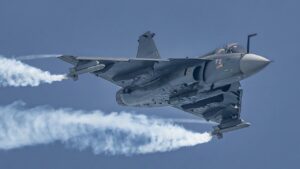
Indigenous Effort. The LCA program originated in 1983 with the goal of developing a new light combat aircraft to replace the ageing IAF MiG-21 fighter variants. After much delay, and more than three decades later, the IAF inducted the first squadron in 2016. Of the 40 LCA Mk I aircraft initially ordered by the IAF, 20 are in Initial Operational Clearance (IOC) and 20 in Final Operational Clearance (FOC) status. IAF has also placed an order for 83 LCA Mk 1A aircraft. Work is in progress on the development of the LCA Mk2 and the 5th-generation Advanced Medium Combat Aircraft (AMCA).
Prevailing Challenges. A nation’s military aspirations must align with its socio-economic condition and likely threats. India is a major regional player, and due to its unique geographical location and geo-political environment, India faces a collusive threat (from its two nuclear-powered inimical neighbours) with significant chances of military conflict. Therefore, her national interest dictates that the country be able to deter both her inimical neighbours from any military misadventure, either singly or collusively. Although land borders would remain the main source of the dispute, the security of the IOR region would be a major necessity. The IAF would need to offer options to meet India’s domestic and regional security requirements.
The Air Threat. For a considerable time, the IAF enjoyed an edge in modern combat aircraft over its rivals – the Chinese People’s Liberation Army Air Force (PLAAF) and the Pakistan Air Force (PAF). That no longer holds true. The PLAAF is transforming rapidly, and China is investing heavily in aerospace Research and Development and aircraft manufacture. They have two home-grown stealth fighters (J-20 and J-31). They are also developing the H-20 stealth bomber, along with a host of attack helicopters and Unmanned Aerial Vehicles (UAVs). Pakistan continues to be in collusion with China. The PAF has inducted Chinese J-10 and JF-17 aircraft, and its strength is rising. In such a scenario, it is imperative that the IAF’s fighter squadron strength be quickly rebuilt to the authorised level.
Deterrence Value. The primary aim of defence forces is to provide the necessary deterrence. The minimum deterrence value depends on three major factors: the number of enemies, the enemy’s capabilities, and their attitude. Deterrence includes both military capability and the capacity to wage war. A demonstrated will to use the military as a tool of statecraft is another important factor. In our case, air capability has steadily increased over the years; however, we urgently need to enhance its deterrent value.
Balanced Force. Air Force is a technology-intensive service and requires a continuous infusion of modern cutting-edge equipment and technology. New state-of-the-art equipment is costly, and affordability is an important factor for consideration. IAF generally maintains a reasonable mix of new state-of-the-art, refurbished/upgraded, and old legacy platforms and equipment. IAF also needs to balance quality and quantity.
Multiple Inventories. IAF maintains a very diverse inventory of fighter aircraft and equipment, including Russian Su-30 MKI, MiG-21, and MiG-29; French Rafale and Mirage 2000; British Jaguar; and indigenous LCA. The sources increase further if you include fixed-wing combat support aircraft, helicopters, and unmanned platforms. So many fighter types create a training, logistics, and maintenance nightmare; however, they also offer advantages.
Self-Reliance. The recent Ukraine conflict has reinforced the lesson that self-reliance is an absolute necessity when it comes to military power. The Indian Air Force firmly believes that indigenisation reduces dependence on foreign sources, supports the nation’s economic growth, and has long encouraged and supported it. The IAF has operated indigenously built aircraft and aircraft built in India under license production, giving impetus to the indigenous industry. It includes the Induction of Ajeet and HF-24 Marut aircraft in the past, and support for and induction of indigenous LCA (Tejas) and its variants.
Mitigation Plan. The drawdown mitigation plan essentially includes indigenous aircraft induction and speedy procurement of MRFA aircraft. It includes 4 squadrons of Tejas Mk1A already on order (likely to be built by 2025-27), 6 squadrons of Tejas Mark 2 aircraft (likely to be built by 2032), 6 squadrons of AMCA (likely to be built by 2035-36), and 6 squadrons (114 aircraft) of MRCA.
Timelines. The draw-down, arrest, and reversal of the trend depend essentially on the indigenous development and production timelines and urgency displayed in the procurement of MRFA. Based on past experience, the stipulated timelines seem highly optimistic unless various components of the ecosystem can coordinate and step up deliveries.
Way Ahead
The question being debated is when the IAF would reach its authorised fighter aircraft strength. Several estimates have been made, but one thing is certain: it won’t be possible by 2030, and at best there could be a reversal of the trend and a marginal increase in numbers. Later, around 2035, new inductions will start to be offset by the phase-out of older aircraft. Recommendations for the way ahead are as follows:-
- The time for “Gun vs Butter” is over, and prevailing circumstances demand some hard decisions about military spending.
- A wholehearted and all-around effort is required to meet the challenge.
- While efforts are underway to meet the target of authorised strength, a detailed study is needed to determine actual, realistic requirements, taking present and future circumstances and challenges into account.
- Self-reliance is an absolute necessity and needs to be supported and achieved.
- The minimum deterrence value needs to be stipulated and maintained while supporting indigenisation (including procurement from abroad, if required).
- A balance needs to be maintained between technology levels (a reasonable mix of new, upgraded, and old vintage) and the quality and quantity of platforms.
- The development process of indigenous Tejas Mk2 and AMCA needs to be sped up.
- HAL and DPSUs need to step up production capability.
- The procurement of 114 MFRA needs to be hastened up.
References:–
- https://loksabhadocs.nic.in/lsscommittee/Defence/17_Defence_36.pdf.
Suggestions and value additions are most welcome
For regular updates, please register here
References and credits
To all the online sites and channels.
Disclaimer:
Information and data included in the blog are for educational & non-commercial purposes only and have been carefully adapted, excerpted, or edited from sources deemed reliable and accurate. All copyrighted material belongs to respective owners and is provided only for purposes of wider dissemination.