C-295 is a new generation, twin-turboprop, tactical transport transport aircraft. The manufacturers claim it to be the world’s most robust, reliable, versatile, and efficient multi-role tactical airlift aircraft.
Manufacturers. CASA C-295 (now Airbus C295) aircraft was designed and initially manufactured by the Spanish aerospace company CASA (Construccionnes Aeronáuticas SA), a founder member of the EADS Company based in Madrid.
Vintage. The prototype of the aircraft flew on 28 Nov 97 and the production commenced shortly thereafter. In April 1999, the Spanish Air Force became its launch customer with an order for nine military-configured C-295s, and two years later (Nov 2001), it was declared operational with the service.
International Operators. Reports indicate that slightly less than 300 C-295 aircraft have been ordered by customers worldwide. The operators include the Polish Air Force, UAE Navy, Brazilian Air Force, Royal Jordanian Air Force, Algerian Air Force, Finnish Air Force, Egyptian Air Force, Ghana, Ivory Coast, Mali Air Force, Bangladesh, Indonesia, Philippines Air Force, Thailand, Vietnam, Kazakhstan Air Defence Force, Uzbekistan, Czech Republic, Portugal, Spain, Oman, Saudi Arabia, Canada, Chile, Colombia, Ecuador, and Mexico.
Combat Proven. The aircraft is reported to be combat-proven, having been successfully used during long deployments (up to two years, flying as many as 100 hours per aircraft per month) in remote areas such as Chad, Iraq, and Afghanistan. It routinely operates in the hot and humid conditions of the Brazilian jungle and Colombian mountains, in the dusty and very hot deserts of Egypt and Algeria, and in the extremely cold and icy winters of Poland, Finland, and Kazakhstan.
Roles and Tasks. The aircraft is designed for the movement of personnel and cargo within military conditions. It has also been designed to facilitate multi-role operations and has been produced in a wide range of configurations, as desired by the customers. Beyond its use as a tactical transporter, the C-295 is capable of performing a wide variety of missions effectively, which include:-
-
- Parachute and cargo dropping.
-
- Electronic signals intelligence (ELINT).
-
- Medical evacuation (MEDEVAC).
-
- Intelligence surveillance and reconnaissance (ISR) operations.
-
- As a gunship to provide air support to ground forces.
-
- Can be outfitted for use as a VIP transport, aerial refueling tanker, and water bomber for fire fighting.
Some of the equipment for adapting the aircraft to perform various roles is mounted onto pallets, allowing for its rapid installation and removal.
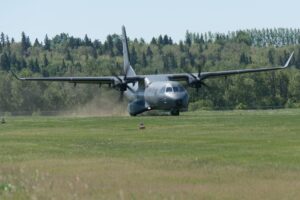
Capabilities. The aircraft is highly suitable for special operations with a characteristic high-wing, rear-loader design.
The aircraft is capable of carrying up to nine tonnes (9,250kg) of payload or as many as 71 troops or 45 paratroopers at a maximum cruise speed of 260 knots.
The aircraft has a rear ramp door for quick reaction and para dropping of troops and cargo.
The aircraft can be operated from austere (short or unprepared) airstrips with minimal reliance on ground support infrastructures. It can reportedly be operated on soft ground without major issues even when heavily loaded.
It has an auto-reverse capability, being able to turn 180º on runways as narrow as 12 meters wide.
It has a remarkable short take-off & and landing (STOL) performance (The landing and take-off run of just 320m and 670m) from unpaved, soft, and sandy/grass airstrips.
According to Airbus, the C-295 is powered by two Pratt & Whitney Canada PW127G turboprop engines that provide excellent manoeuvrability, and outstanding hot-and-high performance, with fuel consumption for long endurance (of up to 11 – 13 hours) and range.
Features & Performance Characteristics. A detailed list of features is placed at the end of the article. Relevant performance characteristics are as follows:-
-
- The aircraft has a flight endurance of up to 11 -13 hours and a maximum range of 5,630km.
-
- Its short take-off and landing capability allows operations from approximately 670m (2,200ft) of soft and rough unprepared airstrips.
-
- It is capable of low-level flight for tactical missions, at speeds down to 110kt.
-
- It has a maximum speed of 480 kmph.
-
- The C-295 can cruise at altitudes up to 30,000 ft.
Indian Contract.
India signed a contract (₹21,935-crore project) with Airbus Defence and Space to formalise an order of 56 C 295s in September 2021. The first 16 aircraft will be delivered in fly-away condition over four years from the date of implementation of the contract. The aircraft will be assembled at the Airbus facility in Seville, Spain. The remaining 40 aircraft will be manufactured and assembled by Tata Advanced Systems in India under an industrial partnership with Airbus.
Delivery Schedule. The first aircraft is being delivered today (13 Sep 23). The second aircraft is in final assembly at Airbus’s Seville facility and will be delivered in May 2024. The last of the 16 flyaway aircraft will be delivered to IAF by August 2025, while the first “made in India” C-295 will roll out of the Vadodara facility in September 2026 and the remaining 39 by August 2031.
Maintainability. The C-295 contract covers performance-based logistics support for five years ensuring a fleet availability rate of 85%. Also, the contract for the supply of spares is for 10 years covering 10 operating bases. It also includes ground support equipment, test equipment, tech publications, training devices, and training.
Manufacture in India.
The C-295 will be the first military aircraft to be manufactured in India by a private consortium. In terms of man hours, the aircraft will be built entirely in India from the 30th aircraft onwards, which means that there will be no work done by Airbus on the rest of the order outside the country.
The aircraft manufacture will take place at the Main Constituent Assembly (MCA) at Hyderabad and the Final Assembly Line (FAL) at Vadodara.
The MCA in Hyderabad is already functional with domestic production of the parts, including the rear-end fuselage, followed by the rear fuselage, center fuselage, and so on. These parts that go into building the full aircraft will be transported to Vadodara from MCA.
The final assembly of the C-295 at FAL will involve a raft of key processes and works in a predefined sequence before the aircraft rolls out of the facility. The final assembly in Vadodara will involve the integration of the power plant, propellers, flight controls, beam structure, and cargo launching system; work related to electrical harnesses, antennas, fairings, rigging, doors, windows, and air conditioning; impermeability tests; several functional tests; and painting of the aircraft. A comprehensive final inspection and several flight tests will be carried out before the delivery.
The final assembly line in Vadodara (the first one outside Spain) is being built on the lines of the Seville facility and will be operational in November 2024. It will have a capacity for 12 aircraft per year.
As part of the C-295 India project, the manufacturing of about 14,000 parts, 4,600 subassemblies, and all major component assemblies will be carried out in the country. These parts are already being indigenised by the TATA Group at a rate of about 4,000 every year. Non-airbus parts like engines (two Pratt & Whitney PW127G turboprop engines), landing gear, and avionics will be provided by Airbus, and integrated into the aircraft.
All 56 aircraft will be fitted with an indigenous electronic warfare suite developed by Bharat Electronics Ltd and Bharat Dynamics Limited. While BEL is supplying the radar warning receiver and the missile approach warning system, BDL is providing the countermeasure dispensing system. These have already been certified and installed on the first aircraft.
Advantages of the Contract.
The Indian Ministry of Defence and Airbus have signed a ‘Make-in-India’ and offset contract (the deal involves 30% offset obligations) under which the latter is obligated to purchase eligible products and services from local partners in India. The deal between Airbus and TATA will see nearly 90 percent of the technology transfer.
The project will create 15,000 direct jobs and 10,000 indirect jobs over the coming 10 years. Airbus currently employs over 2,750 full-time employees in India and its exports from the supply chain are $750 million per year in terms of components and services.
The program will provide a major boost to the ‘Atmanirbhar Bharat Abhiyan’ of the Government as it offers a unique opportunity for the Indian Private Sector to enter into a technology-intensive and highly competitive aviation Industry. The project will give a boost to the aerospace ecosystem in India wherein several MSMEs spread over the country will be involved in the manufacturing of parts of the aircraft. It will augment the domestic aviation manufacturing resulting in reduced import dependence and an expected increase in exports.
Training
Six IAF pilots and 20 technicians have thus far been trained at the Seville facility. Another 18 pilots and 60 technicians will be trained at Seville next. The first plane will be flown to India by a four-man IAF crew, including the two pilots, and supported by an Airbus pilot and a flight engineer.
A training center for the C-295 pilots along with a warehouse is coming up in Agra, including a full motion simulator (to be delivered by the end of 2024).
Boost to IAF Capability. IAF will be the world’s largest operator of the C-295. The aircraft is a replacement for the IAF’s fleet of aging Avro-748 planes that entered service in the early 1960s. The induction will enhance the IAF capability in the following ways:-
-
- Fill the medium-lift capability gap.
-
- Further boost to the special operation capability.
-
- Enhance high-altitude operation capability.
-
- Improve much-needed military aerial connectivity to ANC.
-
- Improve capability to sustain ground forces.
-
- Improve flexibility of air operations by providing a choice of palletised payloads.
Future Prospects
The Defence Research and Development Organisation is considering procurement of 15 more C-295s to be converted into a maritime role for the Navy and Coast Guard.
India is also in talks with Airbus to set up a maintenance, repair, and overhaul (MRO) hub for this aircraft, which is operated by several countries in the region, including the UAE, the Philippines, Thailand, Uzbekistan, and Indonesia.
In the future, the aircraft may replace the aging AN-32 aircraft.
Features. Some of the reported features of the aircraft are as follows:-
Avionics. It is equipped with the Highly Integrated Avionics System (HIAS), based on the digital Topdeck suite produced by the French avionics firm Thales. The avionics have been designed so that the aircraft can also be operated according to civil standards as well as military ones, including the stringent FAR-25 requirements. A Honeywell RDR-1400C weather radar is also typically installed to facilitate instrument flight rules (IFR) operations. It has search, beacon, and vertical navigation ground mapping modes.
Engines. Typically, the C-295 is powered by a pair of Pratt & Whitney Canada PW127G turboprop engines, each capable of providing up to 2,645 SHP (1,972 kW). These feature a modular design that facilitates easy access and reduced maintenance requirements, reportedly enabling up to 10,000 flight hours of uninterrupted operation before requiring servicing. It also features an Integrated Engine Data and Warning System that manages the engine and fuel systems and alerts pilots to detect faults along with other key information. The propellers used are six-bladed scimitar-shaped units, having a diameter of 3.89 meters, and built from composite materials by Hamilton Standard.
Undercarriage. The C-295 is equipped with a retractable undercarriage in a tricycle configuration, designed by Messier-Dowty. Two side fairings on the lower part of the fuselage accommodate the retracted main landing gear, while an alcove almost directly beneath the cockpit houses the forward landing gear. The undercarriage is durable enough to enable operations from semi-prepared runways. It is equipped with oleo-pneumatic shock absorbers, disc brakes capable of differential braking, and an anti-skid system.
Cockpit. C-295M features a glass cockpit with four large 152mm x 203mm (6in x 8in) Thales colour liquid crystal displays compatible with Night Vision Goggles (NVG). The flight deck is fitted with dual controls for the pilot and co-pilot. Two head-up displays can also be fitted as an option.
Communications. The communications suite includes two or three UHF/VHF radios, a single or dual HF radio, and an audio control system. The C-295 is also fitted with a cockpit voice recorder (CVR), an identification friend or foe (IFF) system, a flight data recorder (FDR), and an emergency locator transponder (ELT).
Controls. A dual Thales flight management system is fitted in the aircraft, which is controlled using two multifunction controller display units (MCDU), dual air data units type ADU 3000, dual attitude heading and reference systems (AHRS), two radar altimeters (radalt) and an optional Honeywell ground proximity warning system.
Navigation. Other navigation equipment includes two multimode receivers (MMR), two automatic direction finders (ADF), one direction finder (DF), and two distance measuring equipment (DME) units. There are also three possible configurations for long-range and autonomous navigation, two integrated inertial navigation and global positioning systems (INS/GPS), two GPS or two GPS plus one INS/GPS.
Cabin. The aircraft features the longest unobstructed cabin with a length of 12.7m, accommodating up to 71 seats. The main cabin can be fitted with two or three rows of foldable seats to accommodate 48 fully equipped paratroops or up to 75 troops. There are two paratroop doors, one on each side of the rear part of the cabin. The cabin is fully air-conditioned and pressurised.
Cabin Configurations. It can be fitted for mixed cargo and passenger transport, or for all cargo operations. A roller loading system is installed and a wide ventral door and cargo ramp in the upswept rear fuselage provide easy cargo access. The cabin holds up to 57m³ of cargo and can accommodate up to three light vehicles, Land Rovers or equivalent, or five 2.24m × 2.74m (standard 88in × 108in) pallets. The cabin can be configured for medical evacuation missions for 27 litters (stretcher patients) and four medical staff. An alternative configuration accommodates an intensive care unit for 12 stretcher patients.
C-295M Engines. The aircraft is powered by two Pratt & Whitney Canada PW127G turboprop engines, each rated at 1,972kW and 2,177kW with auto power reserve. The engines drive six-bladed composite propellers, type HS-568F-5 developed by Hamilton Sundstrand. The blades, of 3.89m diameter, have auto feathering and synchrophasing.
Countermeasures. C-295M can be fitted with the Indra ALR-300V2B radar warner and BAE Systems ANALE-47 chaff/flares dispenser.
Design Feature. The C295’s baseline now includes winglets that provide even better performance in all phases of flight, delivering improved takeoff characteristics at hot and high airfields, enabling higher cruise altitudes (especially at higher weights), increasing endurance, and reducing overall fuel consumption by three to six percent.
Feature Options.
The aircraft can be fitted with alternative communications and navigational systems to suit the customer country’s operational requirements. Optional equipment includes an enhanced terrain collision avoidance system (TCAS), tactical air navigation (TACAN), a category II instrument landing system, a microwave landing system, and satellite communications.
The maritime patrol variant (MP Persuader) can be fitted with the EADS CASA Fully Integrated Tactical System (FITS) mission system. Aircraft for the UAE Navy are fitted with FITS, which consists of four multi-function consoles and integrates data from sensors including search radar, forward-looking infrared (FLIR), TV cameras, or other sensors.
Comments, Suggestions, and Value Additions are most welcome
For regular updates, please register here
Subscribe
References and credits
To all the online sites and channels.
- https://en.wikipedia.org/wiki/EADS_CASA_C-295
- https://www.airbus.com/en/products-services/defence/military-aircraft/c295
- https://www.thehindu.com/news/national/c-295-manufacturing-ecosystem-takes-shape-in-india-as-first-aircraft-set-to-be-delivered-in-september/article67097785.ece
- https://economictimes.indiatimes.com/news/defence/iaf-chief-visiting-spain-to-receive-first-c-295-transport-plane-for-india/articleshow/103558129.cms?from=mdr
- https://theprint.in/defence/india-to-get-its-first-c-295-transport-aircraft-in-spain-this-wednesday/1757003/
- https://www.airforce-technology.com/projects/c295/
- https://www.hindustantimes.com/india-news/indian-air-force-to-receive-first-c-295-aircraft-from-airbus-in-september-in-21-935-crore-project-101692297140204.html
Disclaimer:
Information and data included in the blog are for educational & non-commercial purposes only and have been carefully adapted, excerpted, or edited from sources deemed reliable and accurate. All copyrighted material belongs to respective owners and is provided only for purposes of wider dissemination.