Information and data included in the blog are for educational & non-commercial purposes only and have been carefully adapted, excerpted, or edited from reliable and accurate sources. All copyrighted material belongs to respective owners and is provided only for wider dissemination.
My article was published on “The EurasianTimes” website
on 06 Jul 25.
The Indian Air Force (IAF) is set to significantly enhance its surveillance and precision strike capabilities with the procurement of three Intelligence, Surveillance, Target Acquisition, and Reconnaissance (ISTAR) aircraft under a project worth Rs 10,000 crore. The Defence Acquisition Council (DAC), chaired by Defence Minister Rajnath Singh, granted the “Acceptance of Necessity” (AoN) for this initiative on July 3, 2025, as part of a broader Rs 1.05 lakh crore defence modernisation package.
These advanced platforms integrate cutting-edge sensors, communication systems, and artificial intelligence to deliver real-time intelligence, enabling precise battlefield surveillance and strike coordination. The IAF aims to induct three state-of-the-art ISTAR aircraft, blending global aviation platforms with indigenous sensor technology developed by the Defence Research and Development Organisation (DRDO). The induction would position India among a select group of nations with elite air-to-ground surveillance capabilities.
Understanding ISTAR: A New Class of Airborne Intelligence. ISTAR is not a single system, but an integrated suite of advanced sensors and processing systems mounted on a long-range, high-endurance aircraft. It combines multiple intelligence disciplines, electro-optical, radar, signals intelligence (SIGINT), and electronic intelligence (ELINT), to provide commanders with a comprehensive battlefield picture. Unlike conventional reconnaissance or surveillance aircraft, ISTAR systems go beyond just collecting data. They analyse and fuse it in real-time using AI and advanced analytics, enabling actionable intelligence to be delivered to frontline units and command centers with speed and precision.
The Strategic Imperative for ISTAR
In the rapidly evolving landscape of modern warfare, information superiority is a critical determinant of success. ISTAR aircraft serve as force multipliers by providing real-time intelligence, surveillance, target acquisition, and reconnaissance capabilities. Equipped with advanced sensors, these platforms offer commanders actionable data, enabling precise decision-making in complex battle environments. For the IAF, operating in a volatile geopolitical region marked by ongoing tensions, ISTAR aircraft are indispensable for monitoring enemy movements, tracking high-value targets, and coordinating precision strikes from stand-off ranges.
The urgency for such capabilities was underscored by pivotal events, including the 2019 Balakot airstrike, which highlighted the need for enhanced situational awareness, and the 2020 Chinese aggression along the Line of Actual Control, which exposed gaps in real-time battlefield intelligence. The ISTAR program aligns with India’s broader strategic objectives, including the “Make in India” initiative, which emphasises self-reliance in defence technology. By integrating indigenous sensor systems with globally sourced aircraft platforms, the IAF aims to bolster its operational effectiveness while fostering domestic innovation, positioning India as a formidable player in military aviation.
ISTAR Program
The forthcoming ISTAR project, valued at Rs 10,000 crore, involves acquiring three aircraft from global aviation manufacturers, likely Boeing or Bombardier, which will be fitted with indigenous sensor and electronic systems developed by DRDO’s Centre for Airborne Systems (CABS). These systems, already tested for efficacy, represent a significant leap in India’s defence technology capabilities. The following are relevant aspects of the ISTAR program.
Operational Parameters. The aircraft will operate at a minimum ceiling of 40,000 feet with an endurance of at least eight hours, ensuring sustained surveillance over vast areas. This high-altitude capability allows the platforms to maintain a broad operational footprint.
Sensor Suite. The aircraft will feature:-
Synthetic Aperture Radar (SAR) with a range of ≥200 km, enabling high-resolution imaging of ground targets, even through cloud cover or darkness.
Ground-Moving Target Indicator (GMTI) with a range of ≥150 km, capable of detecting and tracking moving objects on the battlefield.
Electro-Optical/Infrared (EO/IR) Sensors for day/night operations in complex terrains, providing visual and thermal imaging for target identification.
Artificial Intelligence and Machine Learning (AI/ML) algorithms for image intelligence, automatic target recognition, and change detection, enhancing the speed and accuracy of data analysis.
Communication Systems. The platforms will be equipped with high-data-rate line-of-sight (LOS) and satellite communication (SATCOM) links, facilitating seamless data sharing with other assets, including satellites, unmanned aerial vehicles (UAVs), and ground-based command centres. This connectivity is critical for integration with the IAF’s Integrated Air Command and Control System (IACCS), enabling real-time coordination across multiple domains.
Ground Segment. The program includes two fixed and four transportable ground exploitation systems for processing and disseminating data, ensuring actionable intelligence reaches commanders swiftly.
Platform. The aircraft are likely to be based on modified commercial jets, such as the Bombardier Global Express or Airbus A319, tailored for military applications. These platforms offer a balance of range, endurance, and payload capacity, making them ideal for ISTAR missions.
The IAF expects delivery within 60 months (five years) from contract signing, with DRDO’s prior testing of sensor systems expediting integration. A 1:32 scale model of the indigenous ISTAR platform, based on a pre-owned Airbus A319, was showcased at Aero India 2023, underscoring India’s commitment to blending global and domestic technologies.
Strategic Significance
The ISTAR aircraft will revolutionise the IAF’s approach to network-centric warfare, enabling real-time, multi-faceted intelligence that enhances precision and reduces collateral damage. By integrating with the IACCS, these platforms will create a cohesive operational picture, coordinating assets across air, ground, and space domains. This capability is particularly critical in India’s regional context, where operations like Operation Sindoor against Pakistan require rapid, calibrated responses without breaching hostile airspace.
Globally, the ISTAR program would position India among an elite group of nations, including the United States, the United Kingdom, and Israel, with advanced air-to-ground surveillance capabilities. The platforms will enhance India’s deterrence posture, providing the ability to monitor and neutralise threats with unparalleled accuracy. The emphasis on indigenous sensor development also aligns with India’s self-reliance goals, reducing dependence on foreign suppliers and positioning the country as a potential exporter of defence technology.
Challenges
Despite its promise, the ISTAR program faces several challenges. Addressing these challenges will be critical to ensuring the program’s success and operational readiness by 2030.
Vulnerability. ISTAR platforms are high-value targets for adversaries. For instance, Indo-Russian BrahMos missile variants are being developed to counter similar enemy platforms, highlighting the need for robust defensive measures, such as electronic countermeasures and stealth features.
Procurement Delays. Past delays due to bureaucratic hurdles and disagreements between the DRDO and the IAF underscore the importance of streamlined processes. The ongoing global tendering for aircraft platforms requires careful vendor selection to ensure compatibility with DRDO systems.
Integration Complexity. Seamlessly integrating indigenous sensors with global platforms demands rigorous testing and validation to avoid operational bottlenecks.
Cybersecurity. The reliance on real-time data sharing necessitates robust cybersecurity protocols to protect against hacking and data breaches.
Human Capital. Operating and maintaining ISTAR systems requires a cadre of highly trained analysts, technicians, and mission planners.
Conclusion
The IAF’s ISTAR aircraft program represents a bold step toward redefining India’s military capabilities in the 21st century. By combining advanced global platforms with cutting-edge indigenous technology, the program addresses urgent operational needs while advancing India’s self-reliance in defence. Expected to be operational by 2030, the three ISTAR aircraft are expected to provide the IAF with unmatched surveillance and strike coordination capabilities, positioning India among an elite group of nations with advanced ISTAR systems. Despite challenges, including procurement delays and platform vulnerabilities, the program’s strategic importance cannot be overstated. As India navigates a complex security landscape, the ISTAR aircraft will serve as a linchpin of its network-centric warfare strategy, ensuring operational superiority and reinforcing its stature as a global military power.
Please Add Value to the write-up with your views on the subject.
For regular updates, please register your email here:-
Information and data included in the blog are for educational & non-commercial purposes only and have been carefully adapted, excerpted, or edited from reliable and accurate sources. All copyrighted material belongs to respective owners and is provided only for wider dissemination.
References: –
Press Trust of India. (2025, June). “IAF’s ISTAR Aircraft Acquisition Gets Nod, Rs 10,000 Crore Project to Boost Surveillance.” The Times of India.
Singh, R., & Sharma, A. (2023). “Aero India 2023: DRDO Showcases Indigenous ISTAR Model.” Defence News India.
Kumar, V. (2024). “India’s Push for Network-Centric Warfare: The Role of ISTAR.” Strategic Analysis Journal, 48(3), 215–230.
Ministry of Defence, Government of India. (2025). Annual Report 2024–25. New Delhi: MoD Publications
Gupta, S. (2021). “Lessons from Balakot: The Need for Advanced Surveillance Platforms.” Indian Defence Review, 36(4), 45–52.
DRDO Newsletter. (2024, August). “CABS Advances Indigenous Sensor Suite for ISTAR Aircraft.” DRDO Publications.
Jane’s Defence Weekly. (2023). “India’s ISTAR Program: Balancing Global Procurement and Indigenous Innovation.”
Bharat Rakshak. (2022). “Evolution of India’s Airborne Surveillance Capabilities.”
Business Today. (2025). Rare global league: ₹10,000 crore I-STAR project to put India in elite club of airborne battlefield intel.
India Defence Analysis. (2024). DRDO’s SCA/ISTAR Aircraft Plans for Indian Air Force.
GlobalSecurity.org. (n.d.). ISTAR – Intelligence, Surveillance, Target Acquisition and Reconnaissance.
My Article was published on “The Eurasian Times” website on 02 Jul 25.
In an era where military targets are increasingly buried deep underground, the development and deployment of bunker-busting weapons have become critical to global security strategies. The United States’ GBU-57/A Massive Ordnance Penetrator (MOP) represents cutting-edge solutions to neutralise fortified, subterranean infrastructure. The GBU-57/A saw its first combat use against Iran’s nuclear facilities in 2025. Drawing inspiration from the GBU-57 and driven by India’s regional security requirements, the DRDO has reportedly intensified efforts to develop a bunker-busting weapon based on the Agni-5 missile.
The GBU-57/A: America’s Bunker-Buster
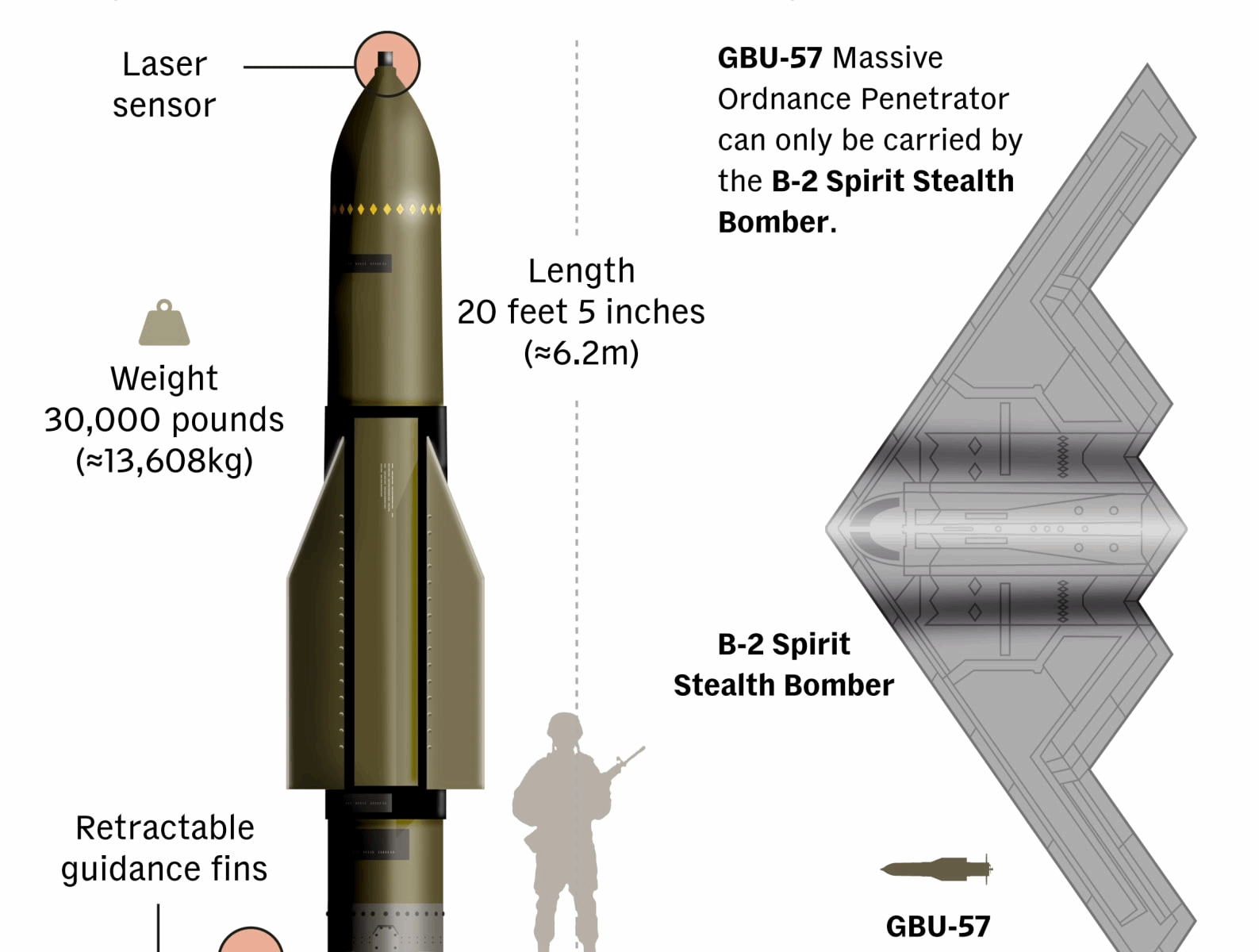
The GBU-57/A MOP, developed by Boeing for the U.S. Air Force, is the largest conventional bomb in the U.S. arsenal, weighing 30,000 pounds (13,600 kg) and carrying a 5,300-pound (2,400-kg) explosive warhead. Designed to destroy deeply buried and hardened targets, such as nuclear facilities and command bunkers, the MOP can penetrate up to 60 meters (200 feet) of moderately hard material, like 5,000-psi concrete, or 130 feet of rock before detonating. Its precision is ensured by a GPS and inertial navigation system (INS), coupled with a smart fuse that optimises detonation depth for maximum destruction. The MOP is exclusively deployed by the B-2 Spirit stealth bomber, with each bomber capable of carrying two bombs.
First Combat Use: Operation Midnight Hammer (June 22, 2025). The MOP’s combat debut occurred during Operation Midnight Hammer on June 22, 2025, targeting Iran’s nuclear facilities at Fordow and Natanz. Seven B-2 bombers dropped 14 MOPs, 12 on Fordow, a uranium enrichment facility buried 80–90 meters under a mountain, and two on an underground section of Natanz, located about 20 meters below the surface. The strikes were complemented by 30 Tomahawk cruise missiles launched from a U.S. Navy submarine, targeting surface infrastructure at Isfahan. The operation aimed to degrade Iran’s nuclear program, particularly Fordow, which was designed to withstand conventional attacks. U.S. officials, including General Dan Caine, claimed significant damage, with IAEA Director General Rafael Grossi noting “very significant” destruction to Fordow’s underground infrastructure. However, there are conflicting reports about the extent of damage.
Strategic Implications and Limitations. The MOP’s use against Iran underscored its role as a deterrent against adversaries with deeply buried facilities, such as North Korea and China. However, its limitations are notable. The MOP’s penetration depth is constrained by target composition. The reliance on B-2 bombers also exposes vulnerabilities to advanced air defences, and the risk of nuclear material release from struck facilities raises environmental and geopolitical concerns.
India’s Solution: A Missile-Based Bunker Buster
India’s DRDO is developing a bunker-busting missile based on the Agni series of surface-to-surface missiles. Unlike the nuclear-capable Agni-5, which has a range of over 5,000 km, this variant prioritises payload over distance, carrying a 7,500-kg (7.5-tonne) warhead with a reduced range of about 2,500 km. This design compensates for India’s lack of a strategic bomber, such as the B-2, by providing a cost-effective, missile-based solution.
The missile reportedly reaches hypersonic speeds (Mach 8–20), making it highly effective at evading ballistic missile defence systems. Equipped with advanced guidance systems, it achieves exceptional accuracy. Its 7,500-kg warhead, significantly larger than the GBU-57’s 2,400-kg payload, delivers potentially greater destructive power, though penetration depth varies based on warhead design and target material. The warhead can penetrate 80–100 meters of reinforced concrete or soil, targeting fortified underground structures like command centers, missile silos, and nuclear storage facilities.
Comparative Analysis: GBU-57/A vs. Agni-5 Variant
Delivery Mechanism. The GBU-57/A is deployed by B-2 stealth bombers, which use stealth technology to infiltrate defended airspace. However, the B-2 can carry only two Massive Ordnance Penetrators (MOPs) and remains vulnerable to advanced air defence systems. In contrast, the Agni-5 missile platform delivers its payload at hypersonic speeds, evading ballistic missile defences (BMD). With a 2,500-km range, it allows stand-off strikes, minimising exposure of manned aircraft to enemy defences.
Payload and Penetration. The GBU-57/A, weighing 30,000 pounds with a 5,300-pound explosive payload, can penetrate up to 60 meters of concrete or 130 feet of rock. However, deeper targets often require multiple strikes, as demonstrated in Operation Midnight Hammer. The Agni-5 Variant, carrying a 7,500-kg warhead, is designed to penetrate 80–100 meters, potentially outperforming the GBU-57 in depth capability. Its larger payload may increase its destructive power, although its performance has yet to be proven in combat.
Strategic Flexibility. The GBU-57/A is combat-proven but constrained by limited stockpiles, high costs, and its dependence on U.S. B-2 bombers, which restrict its use to U.S. operations or allied missions with U.S. support. Conversely, the Agni-5 Variant provides a cost-effective, independent solution. Its dual warhead options and missile-based delivery enhance versatility and resilience against regional BMD systems, offering greater strategic flexibility.
Analytical Perspective
Strengthened Deterrence. India’s Agni-5 missile, equipped with bunker-busting capabilities, is tailored to address regional threats. It provides a powerful conventional option to pre-emptively neutralise enemy targets. With the ability to strike deeply fortified underground sites, the Agni-5 helps India effectively counter strategic imbalances.
Controlled Escalation. These conventional deep-strike weapons offer a key advantage: they minimise escalation risks. While delivering destructive power comparable to nuclear strikes, they avoid the political, moral, and strategic consequences of nuclear weapons. This creates a new, intermediate step in the escalation ladder, providing policymakers with flexible response options during conflicts.
Strategic Impact in Modern Warfare. Deep-strike conventional weapons represent a shift in 21st-century warfare. They combine strategic-level impact with tactical precision, enabling deterrence, retaliation, and offensive strikes without the risks associated with nuclear conflict. By blurring the lines between conventional and strategic weaponry, these advancements challenge traditional arms control frameworks. Nations may now face increased pressure to enhance underground defences against non-nuclear threats, potentially sparking a new arms race focused on subterranean resilience.
Conclusion
The GBU-57/A MOP and India’s conventional Agni-5 variant represent the pinnacle of bunker-busting technology, designed to neutralise the growing threat of fortified underground facilities. The MOP’s combat use against Iran’s Fordow and Natanz facilities on June 22, 2025, demonstrated its power but also its limitations, as advanced bunker designs and limited stockpile size constrained its impact. India’s Agni-5 variant, with its hypersonic speed, 7,500-kg warhead, and dual configurations, offers a versatile, missile-based alternative, tailored to regional threats.
Please Add Value to the write-up with your views on the subject.
Information and data included in the blog are for educational & non-commercial purposes only and have been carefully adapted, excerpted, or edited from reliable and accurate sources. All copyrighted material belongs to respective owners and is provided only for wider dissemination.
References:-
Berbera, A. (2025, June 23). US launches massive strikes on Iran’s nuclear facilities with B-2 bombers and MOPs. Defence News.
Boeing. (n.d.). Massive Ordnance Penetrator (MOP). Boeing Defence, Space & Security.
CNN. (2025, June 24). U.S. strikes on Iran’s nuclear facilities: What we know. CNN International.
Cordesman, A. H. (2025). The Strategic Implications of U.S. Bunker Buster Strikes on Iran. Center for Strategic and International Studies.
Defence Research and Development Organisation. (2024). Annual report 2024: Advancements in missile technology. DRDO, Ministry of Defence, Government of India.
Hindustan Times. (2025, July 10). DRDO’s new Agni-5 variant: A conventional bunker buster for regional deterrence. Hindustan Times.
International Atomic Energy Agency. (2025, June 25). Statement by Director General Rafael Grossi on U.S. strikes on Iranian nuclear facilities. IAEA.