Pic Courtesy: Internet
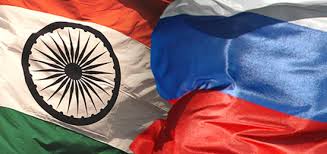
Geography and Geopolitics brought India and Russia (USSR) together and it developed into a time-tested close partnership.
Five phases of the relationship:-
-
- Engagement phase – pre-independence.
- Warm-up phase – Post Independence.
- Close phase – Cold War period.
- Preoccupation phase – Post USSR breakup.
- Rejuvenation phase – Current (Fresh Impetus required).
Pillars of the relationship:-
-
- Historical Trust.
- Defence cooperation.
- Economy and trade engagement.
- Cultural exchanges (Soft power).
- Mutual Geopolitical interests.
Historical Timelines.
-
- Post-Independence – Cordial relations.
- 1960 – Friendship declared, Military cooperation commenced.
- 1962 – Neutral stance in India-China war (China Brother – India Close Friend).
- 1966 – Facilitated Tashkent Treaty.
- 1971 – Treaty of Friendship and Cooperation. (USA sided Pakistan along with China.
- 1990 Testing times for both.
- 2000 – Strategic partnership finalised.
- 2010 – Upgraded to special and privileged partnership (Political, security, trade, economy, defence, science and technology and cultural cooperation).
Defence Cooperation
One of the main pillars of Indo-Russia cooperation.
1960’s – India needed defence equipment desperately.
The USA and West were closer to Pakistan and reliable supply was not assured.
USSR found it attractive strategically and geopolitically.
It was a mutually beneficial development. India needed military modernisation and the USSR saw a promising and strategic partner to counterbalance the USA, Pakistan and China.
India became the principal defence market of the USSR.
The military equipment was made available at a cheaper cost, with deferred payments, low-interest rates and easy payment options like payment in kind of finished goods and products.
Technology was also shared with the transfer of technology and allowing licensed production (Mig-21 licensed production).
At one time almost 80 % of the defence equipment in India was soviet origin. (some quoted figures indicate 60 % of Army equipment, 70 % of Navy equipment and 80% of IAF equipment).
Over the years, some of the Russian equipment includes T-90 tanks, Aircraft Carrier, Mig -21, SU-7, Mig-23, Mig 25, Mig 27, Mig 29, and SU-30 aircraft, MI-8, Mi17, Kamov and attack helicopters, a variety of AD weapons including recent S-400 system, An-32, IL-76 and IL-78, and maritime recce aircraft and several air to ground and air to air weapons.
The joint development of the BrahMos missile is a success story.
Almost for four decades (1960 to 2000) India was reliant on Russian for military needs.
Post-breakup of the USSR, Issues of Cost, Quality, Delays and Post-sale support cropped up.
For Russia, even the China market declined due to Chinese indigenisation.
However, India continued to be a reliable market. At one time almost 800 odd Russian defence production facilities were kept alive due to Indian contracts.
Defence cooperation was high with regular engagements, exchanges, exercises, sharing of knowledge and information and training.
Recent Times and Indian Compulsions.
In recent times, the threat to India has increased due to the rapid modernisation of the Chinese military, its belligerent attitude, aggressive behaviour and collusivity with Pakistan.
Having learnt the hard way, India is in desperate need to modernise and strengthen its security system and defence forces. It needs the latest technology induction.
The Indian approach to deal with the situation includes:-
-
- Promote self-reliance (Atmanirbharta) with indigenous R&D and manufacturing.
- Maintaining a minimum level of deterrence by procurement from outside.
- Diversification of sources (USA, France, Israel and Europe).
- Competitive bidding to get the best equipment and deal (maximum bang for the buck).
- Offer India as an alternative destination for “Make for the World”.
Indian Ideology and Engagements.
India continues to be a peace-loving country with no territorial ambitions or expansionist desire. It believes in Mutual growth and prosperity (One world – One family – One future)
Its concern is to safeguard its territory and political sovereignty.
Its international engagements are adapting to the changes taking place in the world. The policy of Non-alignment is transforming into a Policy of equidistance.
The engagements are Interest-based without joining any camp or military alliance (India to date has not joined any military alliance).
Indo-Russian Relations: Challenges and Opportunities.
Both Russia and India are in a similar situation with threats to their respective interests. From NATO and USA for Russia and China and Pakistan for India.
The prevailing circumstances and the geo-political world situation present both challenges and opportunities for cooperation.
The challenge is not to get drawn into the China-USA rivalry, resulting in divergent views and interests.
Opportunities include scope for closer cooperation, mutual growth and progress, collective security and sharing of resources, technology, knowledge, and information.
Mutually Common Concerns
-
- Non-traditional security threats
- Environmental degradation
- Organised crime network.
- Drug Trafficking.
- Human Trafficking and illegal migration.
- Religious/fundamental insurgencies.
- Cyber security.
- Nuclear terrorism and threats.
- Biological threats and pandemics.
Indo-Russian Cooperation: New Approach.
New impetus is required to revitalise the time-tested Indo-Russian friendship.
Avoid the trap of a “with us or against us” mindset.
Understand each other’s compulsions and reasons.
Not let the business dealings (Russia with China, and Pakistan and India with the USA) come in the way of mutual friendship.
Engage each other with the aim of mutual and joint development, modernisation, transformation and growth.
Strengthen the old pillars and explore and build on new pillars. Unanimity and agreement already exist concerning the following:-
-
- Nuclear Proliferation.
- Review of existing multilateral organisations.
- Trans-national crimes.
- Environmental degradation issues.
- Non-traditional security threats.
Indo-Russia Cooperation Way Ahead
Some of the suggested areas of cooperation are:-
Defence.
-
- Develop into a symbiotic partnership.
- Not see India as a defence market but as a development partner with joint R7D, development, design and production.
- Share defence technology and know-how.
- Support Indian endeavour of “Make in India” and “Make for the world”.
- Increase Interoperability with regular multi-service exercises.
- Assist each other in the mitigation of disaster situations arising out of enemy grey zone activities.
- Assist each other in information warfare (Info dominance and narrative formulation).
- Chart out an escalation ladder matrix of defence cooperation for political signalling.
- Joint ventures for unmanned platforms. Drones. Swarms and anti-drone systems.
- Address the concerns related to cost, Quality, Delay, and post-sale support.
Energy (Oil, Gas and Nuclear).
- Besides the import and export of oil and gas, maybe explore the possibility of joint exploration.
- Go beyond nuclear reactor building projects.
- Maybe form a consortium for making for the rest of the world.
Diplomatic/Political Support
-
- Continue mutual support in the common multilateral forum (UN, BRICS, RIC, G-20, SCO etc).
- Respect each other’s sensitivities.
- India has never joined and will not join any military alliance.
- Quad is not a military alliance, nor is it an Asian NATO (it is not anti-Russia).
Science and Technology.
-
- Joint R&D and manufacturing.
- Sharing of knowledge.
- Cyber security cooperation.
- Joint space programs and projects.
- Ares of Chips/semiconductors, high-pressure tools, medical equipment, telecom industry, maritime equipment and electronics.
Trade and economy.
-
- Further, increase bilateral trade (already touched 45bn US $ to reach 50 bn US $ soon).
- Make trade and business transactions attractive with “ease of doing business” policies.
- Regain and maintain trade balance.
- Besides Govt to Govt transactions, encourage Private sector (G2G and P2P) engagements.
- Improve connectivity for cargo and personnel (Multi-mode travel corridors)
- Review the Rupee-Rouble exchange system for trade to make it mutually beneficial. It could become a model for the rest of the world to emulate.
- India-Russia inter-government commission with two wings (to look after the trade, science & tech, and economy issues and a second one for military and military technology issues) is the right approach. Energise the commission.
- Two plus two dialogue is also a step in the right direction. Follow the top-down approach.
- A joint entrepreneur’s council is a good idea.
- Enhancing each other’s MRO (Maintenance, Repair and Overhaul) capabilities (for both civil and military aviation).
Cultural exchanges.
-
- Increase the number of exchanges and encourage tourism.
- Review the VISA rules to make them travel-friendly.
- Increase the travel facilities (Flights and sea travel).
- Encourage language studies.
- India’s skilled manpower can be effectively used to offset Russia’s demographic issues.
Infrastructure development. Besides making for each other, can explore the possibility of jointly making for the world (Africa could be one possible market).
Environmental concerns. Jointly develop and promote a globally acceptable carbon emission policy and monitoring system.
Other areas of possible cooperation are:-
-
- Diamond industry.
- Food security – Agro, meat and dairy products.
- IT and chip development and manufacture.
- Pharmaceutical industry.
- Biotech and pandemic mitigation.
- Natural resources.
Coming up:- A detailed write-up on the subject.
Question
Should India join the Western bloc or continue with its existing policy?
Opinion Poll
Russia identifies itself with:-
a) Europe
b) Asia
c) Both
d) Eurasia.
Suggestions and value additions are most welcome
For regular updates, please register here
References and credits
To all the online sites and channels.
Disclaimer:
Information and data included in the blog are for educational & non-commercial purposes only and have been carefully adapted, excerpted, or edited from sources deemed reliable and accurate. All copyrighted material belongs to respective owners and is provided only for purposes of wider dissemination.