Information and data included in the blog are for educational & non-commercial purposes only and have been carefully adapted, excerpted, or edited from reliable and accurate sources. All copyrighted material belongs to respective owners and is provided only for wider dissemination.
Article published on the REVA University Website on 15 Sep 25.
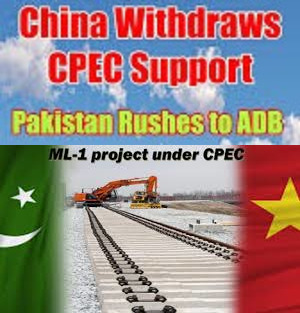
The China-Pakistan Economic Corridor (CPEC) is one of the China Belt and Road Initiative (BRI) crown jewels, which China intends to connect Xinjiang with Pakistan’s Gwadar Port through a 3,000-kilometer highway-pipeline-railway network. Worth over $60 billion, CPEC has assured Pakistan with revolutionary infrastructure. At the heart of it was the $6.7 billion Main Line-1 (ML-1) rail project, which was meant to modernise the 1,726-kilometer Karachi-Peshawar railway line. But China’s recent withdrawal from funding this “crown jewel” of CPEC has forced Pakistan to seek an Asian Development Bank (ADB) loan of $2 billion for the Karachi-Rohri section, a dramatic departure from China’s dominating hold on Pakistan’s infrastructure.
The ML-1 Project and Its Setbacks
The ML-1 railway was to upgrade the old rail infrastructure of Pakistan, doubling track, signalling upgrade, and increasing train speed to 165 km/h from 80 km/h, increasing capacity to 34 from more than 150 trains per day. This was needed to transport copper and gold from the Reko Diq mine in Balochistan, a priority project being developed by Barrick Gold. The success of the mine is reliant on solid logistics, which the existing railway is not capable of delivering.
China initially made a concessionary loan offer of 85% of the project’s cost, but talks fell through for nearly a decade. Costs fluctuated between $6.8 billion and $9.85 billion before eventually settling at $6.7 billion, capturing financial imponderables. Pakistan’s arrears of $1.5 billion to Chinese power producers and its requirement of an IMF bailout also caused concern. Security issues, including the killing of 21 Chinese nationals since 2021, were also a cause of Beijing’s suspicion.
Why China Pulled Back
China’s retreat is triggered by Pakistan’s economic weakness and security issues. Haroon Sharif of the Pakistan Regional Economic Forum went on to state that China revalued ML-1’s finances and Pakistan’s payment issues and determined the risks were too high. China’s foreign lending strategy is also transforming under the pressure of domestic economic constraints, reducing its appetite for foreign high-risk projects. CPEC power plant payments due for deferment, planned to relieve Pakistan’s energy crisis, have put a strain on confidence.
Geopolitically, China’s approach is shifting. Foreign Minister Wang Yi, on Aug. 21, 2025, signalled a readiness to allow third-party involvement in CPEC, in contrast to Beijing’s earlier sole-financing policy. This suggests that China would prefer to have Pakistan utilise foreign lenders like the ADB, limiting its exposure while maintaining strategic connections in place. Despite this, China reasserted its “ironclad” alliance with Pakistan, with emphasis on cooperation in sectors other than infrastructure.
Pakistan’s Turn to the ADB
With China exiting, Pakistan sought a $2 bilion loan from the ADB to upgrade the 480-kilometer Karachi-Rohri section. The ADB, after surveying the site in July 2025, consented in principle to fund it, the very first time that a priority CPEC project will rely on a multilateral lender. Unlike China’s low-interest loans, the ADB’s market-rate funding may contribute to Pakistan’s debt overhang. The initiative also comprises competitive bidding, introducing transparency but putting Pakistan’s project management abilities to the test.
ADB’s role does not end at ML-1, with $410 million for infrastructure pertaining to Reko Diq. A high government official predicted a “crisis” in the absence of ML-1 upgradation, since the current railway will not be able to carry the mine cargo, crucial for Pakistan’s export strategy.
Geopolitical and Economic Implications
CPEC has been delayed since its inception in 2015. Initial steam, like the Gwadar East Bay Expressway, was arrested by Pakistan’s economic troubles, security issues, and bureaucratic delays. The Prime Minister Shehbaz Sharif’s visit to China in 2025 secured $8.5 billion of non-infrastructure contracts but highlighted coordination gaps with his unilateral “CPEC 2.0” announcement.
Pakistani dependence on external finance—IMF, the Gulf states, and now the ADB—is its weakness. In the absence of reform, new loans risk making the debt trap irreversible. Indian objections to CPEC passing through contested Kashmir and global doubts over Pakistani finance create additional layers of complexity.
Conclusion
China’s retreat from the situation at the ML-1 project is an inflexion point for CPEC. For Pakistan, its approach towards the ADB is a necessity and also part of a wider shift towards multilateral financing. The necessity for loans from lenders like ADB, IDB and others may diversify its funding base, but ultimately, Pakistan will still require foreign bailouts in the future. Pakistan now has the prospect of a risky path that requires it to bridge its strategy with China, the U.S., and global lenders. Success with ML-1 and Reko Diq and other projects will depend on whether Pakistan can manage its debt, create security, and implement infrastructure to catalyse economic potential. Pakistan’s diplomacy now is less centred on China and it’s more a matter of global integration. However, this is not guaranteed.
Please Add Value to the write-up with your views on the subject.
For regular updates, please register your email here:-
Information and data included in the blog are for educational & non-commercial purposes only and have been carefully adapted, excerpted, or edited from reliable and accurate sources. All copyrighted material belongs to respective owners and is provided only for wider dissemination.