
This article is based on news about Optonic Shield in secondary sources (Couldn’t find any official announcement by DRDO).
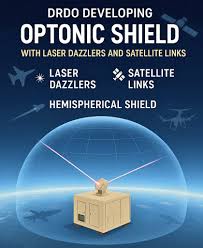
Reportedly, India’s Defence Research and Development Organisation (DRDO) is leading the way with a new defence system called Optonic Shield, which will revolutionise the nature of battles and security of essential assets. This indigenous system is likely to combine laser dazzlers, satellite communication, multifaceted electro-optical sensors and electronic warfare suites to create a hemispherical security shield. With the application of non-lethal DEWs, real-time intelligence sharing and AI-based analytical response, Optonic Shield will essentially respond to evolved threats like drones, missiles and swarm attacks.
Battlefield Transformation: Kinetic to Directed-Energy Dominance. The Optonic Shield basically would change the character of warfare by moving from traditional kinetic interceptors—guns and missiles—to a directed-energy response. It would have its core characteristics in the form of high-power laser dazzlers, which non-lethally blind or incapacitate optical sensors and guidance systems, providing a low-cost-per-shot solution with no limits to ammunition. This is especially critical in combating asymmetric threats, where low-cost UAVs and swarm UAVs, seen in recent wars, bypass conventional defences. The system’s capacity for extended engagements eliminates the numerical advantage of swarms, minimising attrition weariness on the defensive forces.
Hemispherical Coverage. Multispectral EO/IR sensors and satellite data links will provide full 360-degree panoramic situational awareness with no blind spots. Real-time coordination via secure satellite link also would enable immediate engagement, designation, and node integration. This is required for quick reaction to fast flying threats like hypersonic missiles or stealth drones, where conventional radars are often not able to track well. The Optonic Shield’s electro-optical tracking or glare detection and laser warning receivers make potential engagements possible at the speed of light, which improves accuracy while reducing overall reaction time.
Capability Enhancement. The Optonic Shield would enhance India’s deterrence by putting it alongside top countries like the US, China, Russia, and Israel in DEW capability. Its electronic warfare equipment would neutralise low-observable threats like stealth aircraft or guided munitions, enhancing defences against regional rivals with growing drone and missile capabilities. Imagery intelligence (IMINT) functions further enhance situational awareness, supporting dynamic response to threats in high-tempo, multi-domain operations.
Securing Critical Infrastructure. The Optonic Shield would provide coverage to essential assets with a paradigm shift from perimeter security to end-to-end aerial domes. High-value targets like airports, refineries, power stations, and energy installations, susceptible to drone penetration and saboteur attack, would get protection from the system. System’s 360-degree protection and laser dazzlers would disable hostile UAVs without endangering aircraft or passengers. EO/IR sensors would enable precise targeting in urban environments, where kinetic weapons could cause significant collateral damage. Satellite interface with air traffic control and national networks would facilitate quick threat remediation, as experienced in possible scenarios such as drone swarms interfering with flights. Data centers, which store critical digital content, are subject to hybrid threats from cyber and physical drone attacks. Jamming of communication and satellite signals, along with networked infrastructure, would work in tandem with cybersecurity features for complete protection. In urban and sensitive environments such as large-scale events, low collateral is necessary to maintain public safety, while operators make use of panoramic displays for effective monitoring.
Strategic Implications. The Optonic Shield represents local ingenuity, minimising foreign system dependence and support for national strategic autonomy priorities. Its modularity and scalability would enable customised deployments between borders, coasts, and metropolises. There are also deeper implications with denial-based deterrence; this could cause adversary states to reconsider their strategy of asymmetric warfare. The future versions may also leverage next-generation AI in the aspects of threat assessments and interfacing with missile defence, electronic warfare, or cyber domains.
Challenges and Limitations. Despite the promise of the Optonic Shield, challenges remain. Elements of the environment, such as rain, fog, or dust, multiply the laser beam; performance tests in India’s environment might be arduous. Beam control systems are in the process of development; however, it would be fair to say that a fair bit of innovation will be needed. High power requirements cause generation and cooling problems, especially for mobile platforms, making extended wartime operations difficult. Enemies may use countermeasures such as anti-laser paint or smoke screens that would force continuous advances in multi-spectral sensors and jamming technology. The timeline for deployment is another challenge. Complete Optonic Shield deployment, particularly satellite or aerial variants, could take years and involve a huge outlay. The reliance on satellites is indeed risky, with vulnerabilities to anti-satellite (ASAT) weapons from adversaries. Efficacy in real-life scenarios against hypersonics or stealth has to be demonstrated.
Conclusion. As the DRDO advances the Optonic Shield, India will be at the forefront of future defence. The Optonic Shield would be an indigenous multi-layered, non-lethal system with complex real-world connections which radically change the way hybrid threats are defended against in both combat and homeland environments. By continuing to pivot to new solutions and protect India’s economic and strategic interests, India will entrench itself as a world-leader in warfare capabilities, and the Optonic Shield will usher India into the age of dynamic, responsive defence.
Please Add Value to the write-up with your views on the subject.
For regular updates, please register your email here:-
References and credits
To all the online sites and channels.
Pics Courtesy: Internet
Disclaimer:
Information and data included in the blog are for educational & non-commercial purposes only and have been carefully adapted, excerpted, or edited from reliable and accurate sources. All copyrighted material belongs to respective owners and is provided only for wider dissemination.