

My Article was published in the July 2025 edition of the “Life of Soldier” Journal.
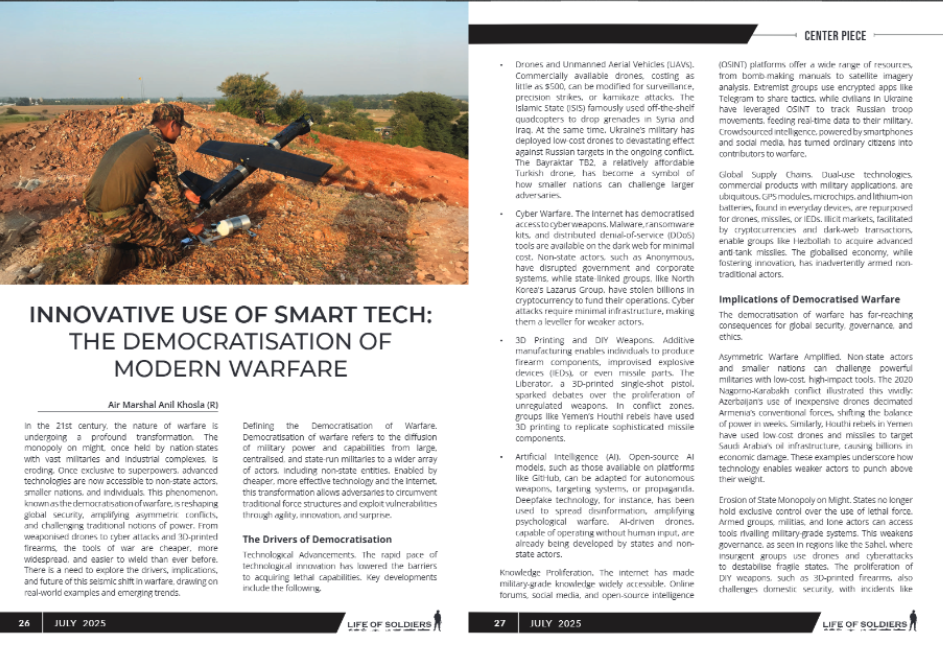
In the 21st century, the nature of warfare is undergoing a profound transformation. The monopoly on might, once held by nation-states with vast militaries and industrial complexes, is eroding. Once exclusive to superpowers, advanced technologies are now accessible to non-state actors, smaller nations, and individuals. This phenomenon, known as the democratisation of warfare, is reshaping global security, amplifying asymmetric conflicts, and challenging traditional notions of power. From weaponised drones to cyber attacks and 3D-printed firearms, the tools of war are cheaper, more widespread, and easier to wield than ever before. There is a need to explore the drivers, implications, and future of this seismic shift in warfare, drawing on real-world examples and emerging trends.
Defining the Democratisation of Warfare. Democratisation of warfare refers to the diffusion of military power and capabilities from large, centralised, and state-run militaries to a wider array of actors, including non-state entities. Enabled by cheaper, more effective technology and the internet, this transformation allows adversaries to circumvent traditional force structures and exploit vulnerabilities through agility, innovation, and surprise.
The Drivers of Democratisation
Technological Advancements. The rapid pace of technological innovation has lowered the barriers to acquiring lethal capabilities. Key developments include the following.
-
- Drones and Unmanned Aerial Vehicles (UAVs). Commercially available drones, costing as little as $500, can be modified for surveillance, precision strikes, or kamikaze attacks. The Islamic State (ISIS) famously used off-the-shelf quadcopters to drop grenades in Syria and Iraq. At the same time, Ukraine’s military has deployed low-cost drones to devastating effect against Russian targets in the ongoing conflict. The Bayraktar TB2, a relatively affordable Turkish drone, has become a symbol of how smaller nations can challenge larger adversaries.
-
- Cyber Warfare. The internet has democratised access to cyber weapons. Malware, ransomware kits, and distributed denial-of-service (DDoS) tools are available on the dark web for minimal cost. Non-state actors, such as Anonymous, have disrupted government and corporate systems, while state-linked groups, like North Korea’s Lazarus Group, have stolen billions in cryptocurrency to fund their operations. Cyber attacks require minimal infrastructure, making them a leveller for weaker actors.
-
- 3D Printing and DIY Weapons. Additive manufacturing enables individuals to produce firearm components, improvised explosive devices (IEDs), or even missile parts. The Liberator, a 3D-printed single-shot pistol, sparked debates over the proliferation of unregulated weapons. In conflict zones, groups like Yemen’s Houthi rebels have used 3D printing to replicate sophisticated missile components.
-
- Artificial Intelligence (AI). Open-source AI models, such as those available on platforms like GitHub, can be adapted for autonomous weapons, targeting systems, or propaganda. Deepfake technology, for instance, has been used to spread disinformation, amplifying psychological warfare. AI-driven drones, capable of operating without human input, are already being developed by states and non-state actors.
Knowledge Proliferation. The internet has made military-grade knowledge widely accessible. Online forums, social media, and open-source intelligence (OSINT) platforms offer a wide range of resources, from bomb-making manuals to satellite imagery analysis. Extremist groups use encrypted apps like Telegram to share tactics, while civilians in Ukraine have leveraged OSINT to track Russian troop movements, feeding real-time data to their military. Crowdsourced intelligence, powered by smartphones and social media, has turned ordinary citizens into contributors to warfare.
Global Supply Chains. Dual-use technologies, commercial products with military applications, are ubiquitous. GPS modules, microchips, and lithium-ion batteries, found in everyday devices, are repurposed for drones, missiles, or IEDs. Illicit markets, facilitated by cryptocurrencies and dark-web transactions, enable groups like Hezbollah to acquire advanced anti-tank missiles. The globalised economy, while fostering innovation, has inadvertently armed non-traditional actors.
Implications of Democratised Warfare
The democratisation of warfare has far-reaching consequences for global security, governance, and ethics.
Asymmetric Warfare Amplified. Non-state actors and smaller nations can challenge powerful militaries with low-cost, high-impact tools. The 2020 Nagorno-Karabakh conflict illustrated this vividly: Azerbaijan’s use of inexpensive drones decimated Armenia’s conventional forces, shifting the balance of power in weeks. Similarly, Houthi rebels in Yemen have used low-cost drones and missiles to target Saudi Arabia’s oil infrastructure, causing billions in economic damage. These examples underscore how technology enables weaker actors to punch above their weight.
Erosion of State Monopoly on Might. States no longer hold exclusive control over the use of lethal force. Armed groups, militias, and lone actors can access tools rivalling military-grade systems. This weakens governance, as seen in regions like the Sahel, where insurgent groups use drones and cyberattacks to destabilise fragile states. The proliferation of DIY weapons, such as 3D-printed firearms, also challenges domestic security, with incidents like the 2019 Dayton shooting highlighting the risks of unregulated tech.
Increased Instability and Terrorism. The spread of advanced capabilities heightens the risk of terrorism and regional conflicts. Drones, for instance, have been used in assassination attempts, such as the 2018 attack on Venezuelan President Nicolás Maduro. Cyberattacks, such as the 2021 Colonial Pipeline ransomware incident, disrupt critical infrastructure, resulting in widespread economic and social harm. These tools’ low cost and anonymity make them attractive to terrorist organisations and rogue actors.
Ethical and Legal Challenges. Democratised warfare raises complex questions about accountability and compliance with international law. Autonomous weapons, powered by AI, blur the lines of responsibility: Who is liable when a drone strikes civilians without human oversight? Cyberattacks, often untraceable, complicate attribution and retaliation. The Geneva Conventions, designed for state-centric warfare, struggle to address these new realities, leaving gaps in global governance.
Countermeasures and Challenges
Governments and international organisations are grappling with the implications of democratised warfare, but solutions are complex.
Regulation of Dual-Use Technologies. Efforts like the Wassenaar Arrangement aim to regulate the export of sensitive technology, but global supply chains and illicit markets undermine enforcement. Regulating 3D printing or AI development is equally challenging, as these technologies are deeply integrated into civilian economies.
Counter-Drone Systems. Militaries invest in anti-drone technologies like jammers, lasers, and radar systems. Israel’s Drone Dome and the U.S.’s Coyote system are examples, but these are expensive and not foolproof against swarming attacks.
Cyber Defence. States are bolstering cybersecurity through AI-driven threat detection and international cooperation. However, the rapid evolution of cyber tools outpaces defensive measures, and non-state actors often exploit vulnerabilities faster than they can be patched.
International Norms. Establishing rules for autonomous weapons and cyberattacks is crucial, but geopolitical rivalries hinder the formation of a consensus. The United Nations’ efforts to ban lethal autonomous weapons have stalled, leaving a regulatory vacuum.
The Future of Democratised Warfare
The democratisation of warfare is set to accelerate as technology advances.
-
- Swarm Technology. AI-driven drone swarms, capable of coordinated attacks, could overwhelm defences at low cost. China and the U.S. are testing swarm systems, but the underlying tech is increasingly accessible to others.
-
- Biotechnology. DIY bioengineering, enabled by tools like CRISPR, raises the spectre of biological weapons. While still nascent, the falling cost of biotech could mirror the proliferation of drones and cyber tools.
-
- Space Warfare. The commercialisation of space, led by firms like SpaceX, enables smaller actors to deploy satellites for communication or surveillance. CubeSats, costing as little as $10,000, could be weaponised to disrupt orbital infrastructure.
India’s Strategic Posture and Preparedness
Counter-Drone Capabilities. India must accelerate its deployment of counter-UAS systems to protect its borders, critical infrastructure, and VIPs. These include directed energy weapons, drone jammers, and AI-based tracking systems.
Harness OSINT and Cyber vigilance. India’s military must build capabilities to monitor, analyse, and respond to social media and digital threats in real time. Collaboration with private cybersecurity firms is crucial.
Legal and Regulatory Frameworks. A robust policy is needed to regulate dual-use technologies, such as drones, 3D printing, and encryption tools, while ensuring that innovation is not stifled.
Integration of Private Sector and Startups. India’s defence innovation must leverage startups, AI labs, and academic institutions to keep pace with rapid technological changes.
Conclusion
The democratisation of warfare is a double-edged sword. It empowers smaller nations and non-state actors to challenge entrenched powers. Yet, it also risks escalating conflicts, destabilising societies, and undermining global security. As drones, AI, and cyber tools become cheaper and more accessible, the line between combatants and civilians blurs, and the battlefield extends into homes, cities, and cyberspace. Addressing this challenge requires a delicate balance: fostering innovation while regulating proliferation, strengthening defences while upholding ethical norms. The future of warfare is no longer the domain of superpowers; it belongs to anyone with the tools and the will to fight. For countries like India, the path forward lies in embracing innovation, reforming security doctrines, investing in digital resilience, and recognising that future battles may be won not just on land, sea, or air, but also in the minds of people, in cyberspace, and through tools as ubiquitous as a smartphone.
Please Add Value to the write-up with your views on the subject.
For regular updates, please register your email here:-
References and credits
To all the online sites and channels.
Pics Courtesy: Internet
Disclaimer:
Information and data included in the blog are for educational & non-commercial purposes only and have been carefully adapted, excerpted, or edited from reliable and accurate sources. All copyrighted material belongs to respective owners and is provided only for wider dissemination.
References:-
Singer, P. W. Wired for War: The Robotics Revolution and Conflict in the 21st Century. Penguin Books, 2010.
- Kaldor, Mary. New and Old Wars: Organised Violence in a Global Era. 3rd ed., Stanford University Press, 2012.
- Arquilla, John, and David Ronfeldt. Networks and Netwars: The Future of Terror, Crime, and Militancy. RAND Corporation, 2001.
- Scharre, Paul. “The Democratisation of Destruction: Drones, 3D Printing, and the Future of Warfare.” Foreign Affairs, vol. 94, no. 5, September/October 2015, pp. 124–135.
- United Nations Institute for Disarmament Research (UNIDIR). “The Weaponisation of Increasingly Autonomous Technologies: Artificial Intelligence.” UNIDIR Resources, 2018.
- Center for Strategic and International Studies (CSIS). “The Role of Drones in Modern Warfare: Lessons from Nagorno-Karabakh.” CSIS Briefs,
- Gibbons-Neff, Thomas, and Eric Schmitt. “Cheap Drones Are Changing Modern Warfare, as Ukraine Shows.” The New York Times, March 15, 2022.
- Al Jazeera. “Yemen’s Houthis Claim Drone Attacks on Saudi Arabia, UAE.” Al Jazeera, January 17, 2022.
- Sanger, David E., and Nicole Perlroth. “Cyberattacks Show How Warfare Has Moved Beyond the Battlefield.” The New York Times, May 10, 2021.
- BBC News. “Venezuela’s Maduro Survives Drone Assassination Attempt.” BBC News, August 5, 2018.
- Wassenaar Arrangement Secretariat. “Wassenaar Arrangement on Export Controls for Conventional Arms and Dual-Use Goods and Technologies.” org, 2023.
- Open Source Intelligence (OSINT) Framework. “OSINT Tools and Resources.” com, accessed June 2025.
- Defence Advanced Research Projects Agency (DARPA). “OFFSET: Offensive Swarm-Enabled Tactics.” mil, 2021.
- Federation of American Scientists. “CubeSats: The Democratisation of Space.” org, 2022.
- Human Rights Watch. “Killer Robots: The Case for a Ban on Lethal Autonomous Weapons.” org, November 2021.
- FireEye (Mandiant). “Lazarus Group: North Korean Hackers and Cryptocurrency Heists.” com, 2020.
- Stockholm International Peace Research Institute (SIPRI). “Global Arms Trade and Technology Proliferation.” SIPRI yearbook 2025.
- Biddle, S. (2021). Nonstate Warfare: The Military Methods of Guerrillas, Warlords, and Militias. Princeton University Press.
- Conflict Armament Research. (2022). Weapon Components Manufactured by Non-State Actors Using 3D Printing.
- Stanford Internet Observatory. (2024). AI, Disinformation and the Weaponisation of Social Media.
- RAND Corporation. (2023). The Rise of Asymmetric Threats in a Networked World.
- Observer Research Foundation (ORF). (2024). India’s Drone Warfare and Counter-UAS Strategy.
- Institute for Defence Studies and Analyses (IDSA). (2024). India’s Cybersecurity Preparedness: Challenges and the Way Forward.
- CSIS (Center for Strategic and International Studies). (2024). The New Age of Warfare: Commercial Technology in Modern Conflicts.