
Pic Courtesy: Internet
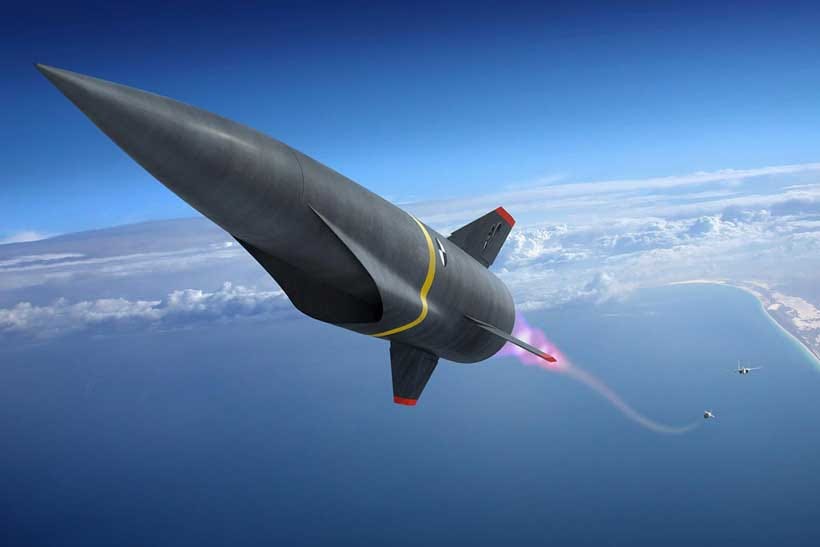
Hypersonic projectiles and platforms are emerging as a highly valued weapon system for militaries worldwide, due to their unique combination of attributes. The characteristics of hypersonic missiles include sustained high speed (five times the speed of sound), increased manoeuvrability, and a High altitude trajectory (in the upper atmosphere – higher than cruise missiles but lower than the apogee of ballistic missiles). These attributes make them difficult for the existing missile defence systems to intercept.
Hypersonic Weapons
The emerging class of missile technologies include manoeuvrable vehicles that carry warheads through the atmosphere at more than five times the speed of sound. Hypersonic glide vehicles (HGVs), like all weapons delivered by medium and longer-range rocket boosters, can travel at speeds of at least Mach 5, or about 1 mile per second. The key difference between missiles armed with HGVs and missiles armed with ballistic re-entry vehicles (i.e., those that travel on a ballistic trajectory throughout their flight) is not their speed, but their ability to manoeuvre and change course after they are released from their rocket boosters. Hypersonic weapons can be classified into two distinct categories:
- Hypersonic cruise missiles operate like typical subsonic and supersonic cruise missiles (using air-breathing engines to power themselves through the atmosphere) but fly at higher speeds. They cannot match the speeds or ranges achievable by boost-glide vehicles.
- Hypersonic boost-glide Vehicles. They are accelerated to extremely high velocities on rocket boosters like those used to launch ballistic missiles. They then proceed to glide, unpowered, through the upper atmosphere until reaching their target.
The flight of a hypersonic boost-glide vehicle is divided into six stages: boost, ballistic, re-entry, pull-up, glide, and terminal phases. In the boost phase, a rocket booster accelerates the missile carrying the hypersonic vehicle until the booster exhausts its fuel. At this point, it detaches from the glide vehicle and falls back to Earth. In the ballistic phase, the vehicle travels above the atmosphere on a ballistic trajectory under only the influence of gravity. Both of these phases are comparable to a ballistic missile launch. Hypersonic trajectories diverge from those of ballistic missiles in the re-entry and pull-up phases. Here, the vehicle pierces the upper atmosphere and then slows its descent to enter a stable glide trajectory. In the glide phase, the vehicle generates aerodynamic lift to sustain near-level flight. Finally, in the terminal phase, the glider dives toward its target.
These weapons outperform existing missiles in terms of delivery time and evasion of early warning systems. Their flight characteristics are distinct from those of typical ballistic missiles, which spend most of their flight above the atmosphere and are capable of only limited manoeuvrability, and those of subsonic or supersonic cruise missiles, which travel through the atmosphere but fly more slowly.
Effect on Warfare
Hypersonic missiles are commonly depicted as a “game changer and the unprecedented capabilities of these weapons portend a revolution in missile warfare. It is considered that the speed, accuracy, and manoeuvrability of hypersonic boost-glide weapons will fundamentally change the character of warfare. Developments in hypersonic propulsion will revolutionise warfare by providing the ability to strike targets more quickly. With unmatched speed, these weapons will likely hit over-the-horizon targets in a fraction of the time. This claimed speed advantage is ostensibly accompanied by near-immunity to detection, rendering hypersonic weapons “nearly invisible” to existing early warning systems. Together, these capabilities will significantly compress decision and response times.
War Fighting Utilisation Philosophy. Hypersonic missiles launched from planes or ships can reach targets further away than equivalent ground-based systems launched from mainland bases. More importantly, they can approach a target from a wider range of locations than if launched from a land-based system, compounding their ability to evade existing BMD systems. These weapons are most likely to be employed in the opening phases. Because of their speed and unique trajectory capabilities, hypersonic missiles can, as first-strike weapons, facilitate follow-on attacks by non-hypersonic strike systems by disabling an adversary’s air and missile defence systems. In future, they could be employed as a network of hypersonic UCAV swarms.
Hypersonic Threat Mitigation. A comprehensive missile defence strategy must deliver an integrated and practical capability to counter ballistic, cruise, and hypersonic missile threats. Some passive defensive measures against traditional missiles are also effective against hypersonic weapons; these include deception, dispersal, hardening, concealment, etc. The speed of hypersonic weapons leaves little time for computing a fire control solution, communicating with command authorities, and completing an engagement for active interception of these weapons. In the future, more active responses could encompass disrupting hypersonic data links and sensors, space-based sensors that can track missiles in the upper atmosphere, and novel technologies for interception during various phases of the weapon’s flight.
Hypersonic Race
The United States, China, and Russia are racing to develop these weapons, and each plans to field a wide array of hypersonic systems in the coming decades. The ongoing U.S., Russian, and Chinese development of HGVs and boost-glide weapons is an arms race as each nation seems to develop them and expand them to include short, medium, and long-range systems. Individually, each country claims to be developing them to meet its security needs and national objectives. These technologies are changing the nature of warfare, and they have the potential to destabilise the global security environment.
USA. The U.S. has pursued both hypersonic weapons technologies since the early 2000s. It has sought to develop longer-range systems that could reach deep into an adversary’s territory to attack defended, hardened, and time-urgent targets. The Department of Defence (DOD) is developing hypersonic weapons under the Navy’s Conventional Prompt Strike program and through several Air Force, Army, and DARPA programs. The Pentagon’s FY2022 budget request for hypersonic-related research is $3.8 billion, approximately 3 % of the total defence research and development budget.
Russia. Russia is reportedly the first nation to deploy a hypersonic missile. It characterises these weapons as a centrepiece of its security strategy and has extensively tested at least three distinct hypersonic systems. Russia’s HGV, known as Avangard, is equipped with a nuclear warhead and deployed on SS-19 long-range land-based ballistic missiles. Avangards reportedly feature onboard countermeasures and can manoeuvre in flight to evade ballistic missile defences. Russia conducted successful Avangard tests in 2016 and 2018. On December 27, 2019, the Russian military announced that it had activated two SS-19 missiles equipped with Avangard. Beginning of March this year, Russia launched its most significant aerial attack in its ongoing war with Ukraine. The attack comprised a variety of weapons, including the air-launched Kinzhal (literally ‘dagger’) hypersonic missiles with a speed of Mach 10 and a payload of 480kg. The Kinzhal is a modified version of the Russian Army’s Iskander short-range ballistic Missile (SRBM) truck-mounted weapons system. The Kinzhal version is launched at high altitude from modified MiG-31 aircraft to get maximum range.
China. As in the space race and other high-technology fields, China has made a significant effort to match Russian and U.S. capabilities. In the past, PRC research into the military potential of hypersonic technologies used to lag far behind that of Russia and the United States. However, China has invested heavily in new hypersonic research, development, test, and evaluation programs and facilities during the past decade. Now, her research may have surpassed that of the U.S. in some regards. China is also investing heavily in hypersonic development infrastructure and weapon systems, reportedly outpacing the United States in testing these technologies. China has developed an HGV known as the DF-ZF (previously referred to as the WU-14) and has tested it at least nine times since 2014. It is estimated that the HGV may be capable of performing extreme manoeuvres during flight, allowing it to evade ballistic missile defences. Unclassified reports indicate this glider would likely be equipped with conventional warheads, and when mated with the DF-17 booster, could travel to ranges of 1,800-2,500 kilometres. China is also developing the DF-41 long-range intercontinental ballistic missile, which could carry a nuclear hypersonic glide vehicle.
India. Realising the combat value of hypersonic weapons, India has been endeavouring to develop them independently. R&D on hypersonic weapons in India goes back to 2007. India’s primary hypersonic pursuit is premised on the remarkably successful medium-range, supersonic BrahMos missile. India’s Defence Research and Development Organisation (DRDO) successfully tested the Hypersonic Technology Demonstrator Vehicle (HSTDV) in September 2020. The HSTDV is an unmanned scramjet demonstration aircraft designed to cruise at hypersonic speeds. The successful test marked a significant advancement in India’s development of hypersonic capabilities. In addition to the HSTDV program, India is continuing its research and development efforts in various aspects of hypersonic technology, including propulsion systems, materials science, and guidance systems
Controls and Measures. These developments may pose new risks and exacerbate existing risks to regional stability and international peace and security. The advancements of and growing interest in hypersonic missile technology, primarily by China, Russia and the United States, but also increasingly by other states, threaten to spur new arms race dynamics. The proliferation of more established missile technology, particularly in Asia and the Middle East, continues quickly. These trends demand a serious re-evaluation of the existing international missile non-proliferation instruments. Without new missile arms control instruments on the horizon, it is important to explore to what extent existing ones are equipped to address these risks and challenges. The Missile Technology Control Regime (MTCR) and the Hague Code of Conduct against Ballistic Missile Proliferation (HCOC) have established necessary export control standards, transparency, and confidence-building measures. While both instruments face serious challenges and limitations, they have also taken strides towards more engagement with non-members and other relevant regimes, expansion of their coverage, transparency and sharing of good practices. Suitably reviewed and modified control regimes, instruments, and agreements must be implemented.
Technology is a good gadget, but a destructive weapon. Hypersonic weapons represent a significant advancement in military technology, offering unparalleled speed and manoeuvrability compared to traditional ballistic weapons. Several countries are actively developing and testing hypersonic weapons, including the United States, Russia, China, and others. The proliferation of hypersonic weapons could have significant strategic implications for international security and stability. Their speed and manoeuvrability could reduce decision-making time in crises and increase the risk of miscalculation. The development of hypersonic weapons has also raised concerns about a new arms race, as countries seek to maintain or gain military superiority in this area. The rapid pace of technological development and competition could exacerbate tensions between major powers. Appropriate checks and balances need to be put in place.
-
- Suggestions and value additions are most welcome
For regular updates, please register here:-
References and credits
To all the online sites and channels.
References:–
2.https://partyardmilitary.com/hypersonic-missiles-what-are-they-and-can-they-be-stopped/
3.https://www.drishtiias.com/daily-updates/daily-news-analysis/hypersonic-technology-2
4.https://spectrum.ieee.org/russia-china-the-us-who-will-win-the-hypersonic-arms-race
5.https://55nda.com/blogs/anil-khosla/2021/11/10/hypersonic-long-range-weapons/
7 https://gjia.georgetown.edu/2021/01/27/chinas-hypersonic-weapons/
09.https://www.uscc.gov/sites/default/files/Research/China%20and%20INF_0.pdf
10.https://www.atlanticcouncil.org/wp-content/uploads/2020/08/Hypersonics-Weapons-Primer-Report.pdf
11.https://www.defense.gov/Portals/1/Interactive/2018/11-2019-Missile-Defense-Review/The%202019%20MDR_Executive%20Summary.pdf
12.https://www.indiandefencereview.com/news/hypersonic-weapon-systems-for-india/#:~:text=India’s%20primary%20hypersonic%20pursuit%20is,land%20or%20ships%20and%20submarines.
Disclaimer:
Information and data included in the blog are for educational & non-commercial purposes only and have been carefully adapted, excerpted, or edited from sources deemed reliable and accurate. All copyrighted material belongs to respective owners and is provided only for purposes of wider dissemination.
