181: Knowing China Better:  Chinese Social Score System


China’s social credit system isn’t a world first but  it is unique.
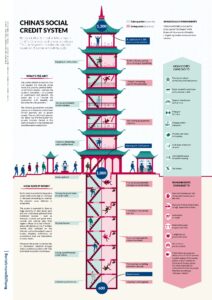
Pic courtesy:https://www.bertelsmann-stiftung.de/fileadmin/files/aam/Asia-Book_A_03_China_Social_Credit_System.pdf


The Social Credit System is part of Xi Jinping’s vision for data-driven governance. 


The goal of the China social credit system is to provide a holistic assessment of an individual or a company’s trustworthiness.


The China social credit system, is an extension of existing social rankings and ratings in China which have existed for millennia.


The Social Score is a system that collects all kinds of data about citizens and companies, sorts, analyses, evaluates, interprets and implements actions based on it.


In concrete terms, this means that if you wait at a red light, you get plus points. If you pay your taxes and bills on time, you get plus points. If you are socially involved and accept the rules, you also get plus points.


If you have a good Social Score, you get unsolicited benefits for your social behaviour. These include, for example, faster visa application processing and more freedom to travel. When dating online, algorithms higher prioritize the own profile. Banks offer lower interest rates for company loans or private real estate purchases. People with a high Social Score are promoted faster and get better job offers.


However, people who go red, cut off someone while driving, spit on the street or stick their chewing gum under their seat get minus points.


Anyone who criticizes the state in social media or pays their bills too late also receives minus points.


The consequences of a poor social credit score could be serious. It may affect travel prospects, employment, access to finance, and the ability to enter into contracts. On the other hand, a positive credit score could make a range of business transactions for individuals and corporations much easier.


It is essential that any foreign business consolidating or establishing their presence in China seek professional advice for managing a social credit score. This applies both to individual scores, and the corporate social credit score. 


Machine (AI) based Implementation

Every country has laws, cultural norms, social morals and social agreements. The police, courts, politicians, administrations, media and citizens are involved in a constant dialogue; it determines what we define as right or wrong.


In China, this task has partly been taken over by Artificial Intelligence based machine i.e. controlling and managing the society – with machines instead of people. The machine decides on correct and incorrect behaviour.


Inputs are obtained from:

  • Financial Data
  • Digital Data (Internet websites, apps, videos and pictures visited/browsed)
  • Mobile Data (Calls and messages)
  • Health Data


The data is used to make individual profiles (Behaviour, movement and content).


Based on the profile credit scores are allotted and reviewed.


Based on the credit score the privileges are granted or curbed.


Ethical Issues

This system raises a lot of ethical questions related to freedom and privacy.


  • Who monitors the score, who imports the data and who configures the system?


  • How ethical and moral aspects (if any) are integrated?


  • Who monitors the system to prevent manipulation, and abuse of power?


  • What data is collected? Who has access to it?


  • How is the privacy of citizens and companies ensured?


  • Are only Chinese citizens monitored or all people on Chinese territory?


  • Does the government also collect data on Chinese people abroad?


End piece

Collecting data and setting up administrative systems to ensure protection, freedom and security for all concerned is a legitimate tool for states. However, as surveillance increases, privacy must be respected as long as the welfare of society is not affected.


Titbits

In China everyone’s movements are monitored continuously. In the AI based monitoring system besides face recognition, even gait recognition has been introduced to make it more fool proof.


Question

Do you approve of such a system?


Suggestions and value additions are most welcome


For regular updates, please register here

Subscribe

References

 https://www.wired.co.uk/article/china-social-credit-system-explained

 https://merics.org/en/report/chinas-social-credit-system-2021-fragmentation-towards-integration

 https://nhglobalpartners.com/china-social-credit-system-explained/

 https://www.bertelsmann-stiftung.de/fileadmin/files/aam/Asia-Book_A_03_China_Social_Credit_System.pdf

180: Leadership Lessons from Hollywood War Movies: The Bridge of the River Kwai

Films have a huge impact on the human mind. Films can communicate, embody and articulate the effectiveness of behaviours of leadership.

Hollywood has a variety of award-winning films that portray the heroism and sacrifices   of different military leaders in battlefield.


The Bridge of the River Kwai

Film. The Bridge on the River Kwai was released in 1957, directed by David Lean and based on the novel Le Pont de la Rivière Kwaï (1952) by Pierre Boulle. The cast of this movie included William Holden, Jack Hawkins, Alec Guinness, and Sessue Hayakawa.


Plot. In early 1943, the Japanese Army prisoned British POWs in a camp of Burma. The commandant, Colonel Saito ordered to construct a railway bridge on the river Kwai to connect the Bangkok and Rangoon. The senior British officer, Lieutenant Colonel Nicholson, found this order as a complete violation of Geneva Convention and disagree to build the bridge. Saito threatened to have them shot, but Nicholson refuses to back down to work and Saito left the prisoners standing all day in the intense heat and locked Nicolson in an iron box. Temporarily, the prisoners worked as little as possible on bridgework and tried to delay the work. There was an obligation for Saito to finish the work by a deadline and if he missed the deadline, he would be obliged to commit ritual suicide. Nicholson was shocked by the poor job performance of his men. He ordered Captain Reeves and Major Hughes to design and build a proper bridge to maintain his men’s morale. The team found that the design of the Japanese Engineers was faulty and the construction site was selected poorly. They decided to build a new bridge downstream. Shears, an American Navy man, was compelled to volunteer to destroy the bridge by a British Major Warden. Shears and Joyce plant explosives on the bridge towers below the water line at night. However, by next morning the water level had dropped, uncovering the connecting wires of the explosives to the detonator.


Leadership Qualities

There are two dominant leadership roles displayed in this movie: Colonel Saito and Lieutenant Nicholson. Both Colonel Nicholson and Colonel Saito’s style of leadership could be described as task-motivated.

Colonel Saito as an authoritarian, directive, path-goal oriented leader. His only goal target was to complete the bridge in time with fear or rewards. This also falls under the category of transactional leadership.

Nicolson seems an indirect, path-goal oriented leader, with high ethics and moralities.


Recommendation


This film is recommended to be watched by the young military leaders.

Titbits

This film has won seven Academy Awards in multiple categories (oscar.org). According to American Film Institute (2007), in 1997, the film was deemed “culturally, historically, or aesthetically significant” and selected for preservation in the National Film Registry by the United States Library of Congress. It has been included on the American Film Institute’s list of best American films ever made. In 1999, the British Film Institute voted The Bridge on the River Kwai the 11th greatest British film of the 20th Century.

Value Additions are most welcome


For regular updates, please register here

Subscribe

References

Guibla, J. (2016). Leadership’s Lessons from “The Bridge of the River Kwai.” St. Cloud State University Master of Public Administration Program. Retrieved on December 22, 2018 from https://scsumpaprogram.wordpress.com/2016/12/26/leaderships-lessons-from-the- bridge-of-the-river-kwai/


Kapur, V., & Gahlot, S. (2012, October 08). Leadership Analysis: The Bridge on The River Kwai. Mbaskool.com. Retrieved on December 22, 2018 from https://www.mbaskool.com/businessarticles/human-resource/5169-leadership-analysis- the-bridge-on-the-river-kwai.html

Presidential Global Scholars. (2012). Leadership lens: Bridge on the River Kwai. Retrieved on December 23, 2018 from https://blogs.lt.vt.edu/pgs2012/2012/03/leadership-lens-bridge- on-the-river-kwai/

Kirkpatrick, T. (2017, May 18). 8 awesome enlisted leaders depicted in war movies. https://www.wearethemighty.com/articles/8-awesome- enlisted-leaders-depicted-in-war-movies.

Guthrie, K. L., & Jenkins, D. M. (2018). The role of leadership educators: Transforming learning. Charlotte, NC: Information Age Publishing.


Rajendran, D., & Andrew, M. (2014). Using film to elucidate leadership effectiveness models: Reflection on authentic learning experiences. Journal of University Teaching & Learning Practice, 11(1), 8.

176: Leadership Lessons from Hollywood War Movies: Schindler’s List


Films have a huge impact on the human mind. Films can communicate, embody and articulate the effectiveness of behaviours of leadership.


Hollywood has a variety of award-winning films that portray the heroism and sacrifices of different military leaders in battlefield.


Schindler’s List


Film. Schindler’s List is an American epic historical period drama film released in 1993, directed and co-produced by Steven Spielberg and written by Steven Zaillian. It is based on the novel Schindler’s Ark by Australian novelist Thomas Keneally.


Plot. Schindler’s List illustrates the profoundly nightmarish Holocaust. It re-creates a dark, frightening period during World War II, when Nazi-occupied Krakow first dispossessed Jews of their businesses and homes, then placed in ghettos and forced labour camps in Plaszow, and finally resettled in concentration camps for execution. Oskar Schindler, a German businessperson and an opportunist member of the Nazi party acquires a factory for the production of mess kits and cooking paraphernalia. Without prior experience, he gained a contact, Itzhak Stern, who has links with the underground Jewish business community in the ghetto. They loan him the money for the factory in return for a small share of products produced for trade in the black market. Schindler witnesses the horrifying visions of the Holocaust and the toll it takes on the Jewish people. Schindler’s motivations switch from profit to human sympathy and by lavishly bribing the SS officials; he is able to save over 1,100 Jews from death in the gas chambers.


Leadership Aspects

 Two distinct and extreme leadership pattern are visible for two characters in this movie.


Oskar Schindler is the transformational leader Schindler is a perceptive, charismatic businessperson who can do anything to make a fortune. Schindler slowly transforms to a courageous, sympathetic leader determined to use his power and persuasive charisma for the betterment of the Jews. Sacrificing his safety and wealth to help others, Schindler bravely stands up for what he believes in through bribing Nazi/SS commanders to protect his Jewish workers and keep his factory a safe “sub-camp” for them. Demonstrating courage, kindness, assertiveness, and charisma all in the face of one of history’s most ruthless regimes Schindler provides an extraordinary example of leadership.


Nazi commander Amon Goeth is an autocratic leader, using a ruthless, authoritarian leadership style to assert his power and control over the Jews of the Plaszów work camp. Deeply rooted in Nazi philosophy, Goeth rarely listens to input from others, refuses to admit he is wrong for fear of showing weakness and dictates all decisions in the camp–including shooting random prisoners from his Villa balcony for fun.

Recommendations

 In the war movies the heroes display different types of leadership ranging from transformational, ethical, and transactional to situational.


Young military leaders can benefit from watching these war films, because it helps in shaping their behaviour in professional roles.


Therefore, leadership educators should include different historic war films in their course curricula.


This film is highly recommended to be included in the list for leadership series.


Titbits.

 This movie is often listed among the greatest films ever made. It has won seven Academy Awards (out of twelve nominations), including Best Picture, Best Director, Best Adapted Screenplay, and Best Original Score, as well as numerous other awards (including seven BAFTAs and three Golden Globes). In 2007, the American Film Institute ranked the film 8th on its list of the 100 best American films of all time (American Film Institute, 2007). The Library of Congress (2004) selected it for preservation in the National Film Registry.


Which is your favourite war movie?


For regular updates, please register here

Subscribe


References

Lavella, N. (2013, February 25). Evaluating ethics and leadership in Schindler’s List. http://cronkitehhh.jmc.asu.edu/blog/2013/02/evaluating-ethics-and-leadership-in- schindlers-list/

Kirkpatrick, T. (2017, May 18). 8 awesome enlisted leaders depicted in war movies. https://www.wearethemighty.com/articles/8-awesome- enlisted-leaders-depicted-in-war-movies.


Guthrie, K. L., & Jenkins, D. M. (2018). The role of leadership educators: Transforming learning. Charlotte, NC: Information Age Publishing.


Meridian: Knowledge Solution. (2016, April 6). Leadership styles of characters from Quentin Tarantino movies. Retrieved on November 27, 2018 from https://www.meridianks.com/leadership-styles-of-characters-from-quentin-tarantino- movies/


Rajendran, D., & Andrew, M. (2014). Using film to elucidate leadership effectiveness models: Reflection on authentic learning experiences. Journal of University Teaching & Learning Practice, 11(1), 8.

English हिंदी