Indian Air Force celebrates its 94th anniversary on October 8, 2026.
Good wishes to all air warriors on AF Day.
The IAF is celebrating under the theme “Indian Air Force – Infallible, Impervious and Precise.”
The IAF has evolved from its October 8, 1932, origins (when it had a few Westland Wapiti biplanes and a handful of pilots) into a modern, network-centric, multi-domain strategic force.
A compilation of links to some of the posts on the Indian Air Force (from the blog “Air Marshal’s Perspective”) is listed below: –
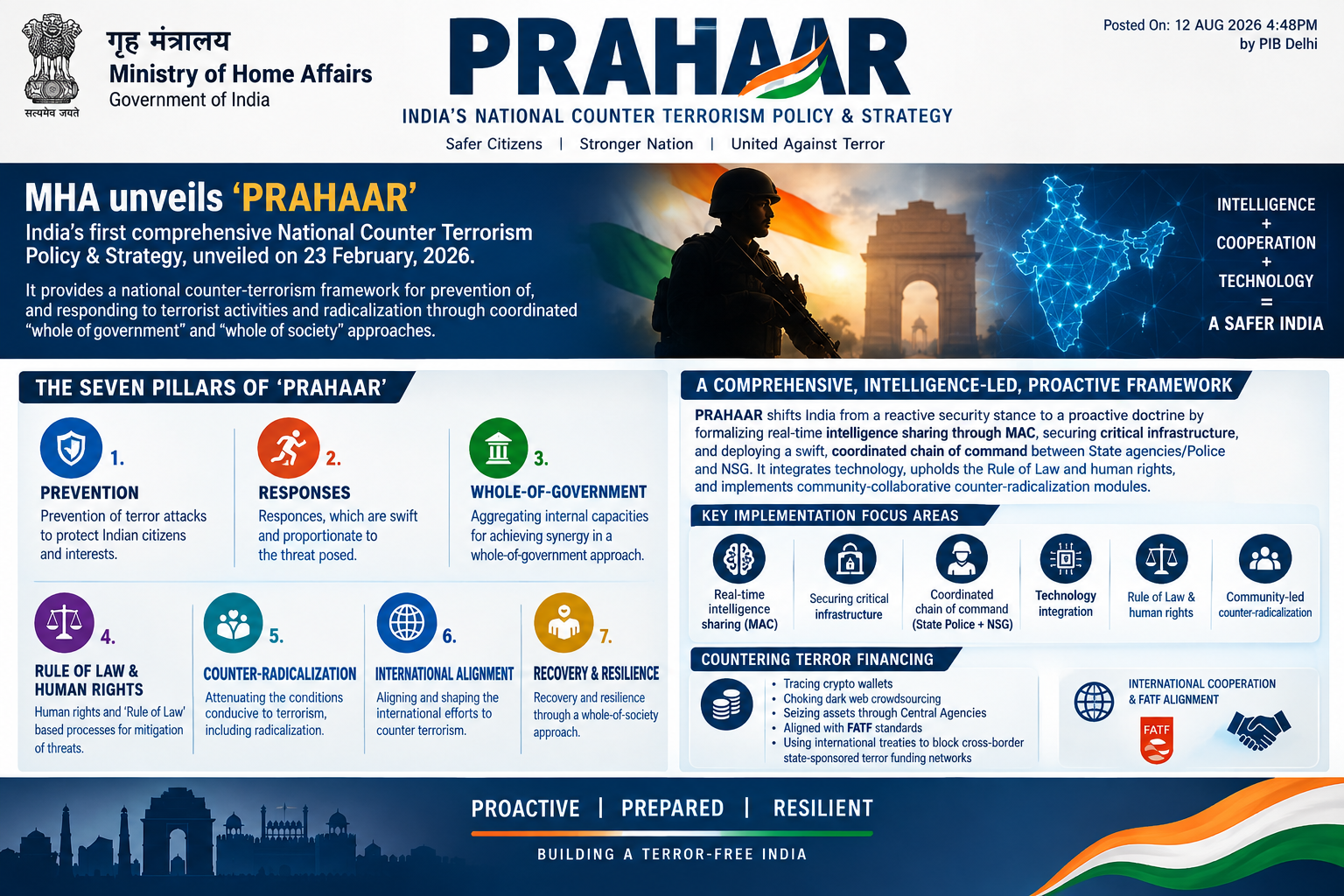
PRAHAAR, meaning “strike,” is India’s first comprehensive National Counter-Terrorism Policy and Strategy, released by the Ministry of Home Affairs on 23 February 2026. The eight-page document consolidates existing counter-terrorism practices into a formal, intelligence-led and proactive national framework. It declares “zero tolerance” for terrorism in all forms while explicitly avoiding any linkage of terrorism to a particular religion, ethnicity, nationality or civilisation. Its approach is based on both a whole-of-government and whole-of-society model.
The strategy is based on seven main pillars: the prevention of terrorist attacks; a quick and proportionate response; the pooling of domestic capabilities; respect for human rights and the rule of law; the reduction of conditions which lend themselves to terrorism; coordination and shaping of international efforts; and recovery and resilience via a whole-of-society approach. These pillars link together prevention, response, prosecution, de-radicalisation, international cooperation and post-attack recovery in one national framework. Together, they create a continuum from prevention and disruption through response and prosecution to recovery and long-term resilience.
The Seven Pillars of PRAHAAR
Prevention of Terror Attacks
Prevention is the foundation of PRAHAAR. It emphasises an intelligence-guided approach, with the rapid collection and dissemination of intelligence so that threats can be neutralised before they materialise.
The Multi-Agency Center (MAC) and Joint Task Force on Intelligence (JTFI) under the Intelligence Bureau are identified as important platforms for sharing counter-terrorism intelligence between central agencies and State police. Prevention also covers online propaganda and recruitment, overground worker networks, terrorist financing, illegal arms networks, cryptocurrency and dark-web financing, border security and critical infrastructure.
The strategy recognises the changing technological character of terrorism, including drones, encryption and cyber-enabled operations. Power, railways, aviation, ports, defence, space and atomic-energy infrastructure are identified as areas requiring enhanced technological protection. Effective implementation will require close Centre-State intelligence coordination and continued technological modernisation.
Swift and Proportionate Response
PRAHAAR establishes a multi-layered response mechanism. The local police act as the first responders and are assisted by the specialised State counter-terrorism units and the National Security Guard (NSG) in the case of major attacks. The Central Armed Police Forces can also offer support, and it is the National Investigation Agency (NIA) and the State police who carry out the investigations and prosecutions.
The Central, State and district authorities coordinate according to the Standard Operating Procedures and intelligence-sharing arrangements set out by the Ministry of Home Affairs, and the principle of proportionality enables responses to be adjusted in accordance with the nature and extent of an attack, while allowing for rapid escalation if needed.
This framework seeks to strengthen national coordination without eliminating the federal character of India’s security architecture, particularly because policing remains a State subject.
Aggregating Internal Capacities
The third pillar focuses on strengthening security and law-enforcement institutions through modern equipment, technology, and weaponry; improved training in areas such as tactics and urban combat; standardised counter-terrorism structures and procedures across States; and identification of resource gaps.
An important aim is to reduce differences in the capabilities of the various states and to enhance interoperability among the agencies. Continued funding, the upgrading of technology, and efficient coordination between agencies are still major challenges in terms of implementation.
Human Rights and Rule of Law
Human rights and the rule of law are clearly included in the strategic framework of PRAHAAR. The anti-terrorism measures provided for in laws such as the Unlawful Activities (Prevention) Act, 1967 and the new criminal codes are in line with the country’s commitment to the Protection of Human Rights Act, the Universal Declaration of Human Rights and the International Covenant on Civil and Political Rights.
The strategy places a strong emphasis on the use of legal actions, appeals, and supervision at all levels of the judiciary; it therefore seeks to combine effective counter-terrorism measures with respect for due process, although it remains difficult to maintain this balance when urgent security operations come into contact with broad anti-terror powers.
Addressing Conditions Conducive to Terrorism
PRAHAAR advocates combating radicalisation and terrorist recruitment by means of proportionate police responses, by using legal intervention when necessary, by engaging with community and religious leaders, with NGOs and moderate preachers, by involving youth and by providing de-radicalisation programmes in prisons.
It also identifies socio-economic factors (including poverty, unemployment, education, housing, employment opportunities, scholarships and women’s empowerment) as areas requiring attention in vulnerable communities.
This gives the strategy a preventive dimension beyond intelligence and security operations, with effectiveness depending on sustained community engagement and efforts to address radicalisation without stigmatising communities.
International Cooperation
Recognising the transnational aspect of terrorism, PRAHAAR advocates for the sharing of intelligence, the conclusion of Mutual Legal Assistance Treaties, the establishment of extradition arrangements, the creation of Joint Working Groups, the signing of MoUs and support for United Nations terrorist designations.
India also seeks cooperation through bilateral and multilateral forums to exchange best practices and build international consensus against state-sponsored terrorism, terrorist financing and safe havens.
The pillar reflects India’s broader effort to strengthen cooperation on financing, designations and technology-related threats.
Recovery and Resilience
The emphasis on counter-terrorism goes beyond prevention and response to include recovery and resilience. It is expected that civil administrations, professionals, NGOs, communities and private-sector partners should all help with the recovery after an attack, by providing reassurance, carrying out reconstruction and preparing for future threats.
The strategy also calls for technological investment and public-private partnerships to address emerging risks, including the misuse of information and communications technology for terrorism.
Comparative Analysis
China’s Counter-Terrorism Framework
India’s approach is very different from China’s counter-terrorism framework. China does not possess a single public strategy document analogous to PRAHAAR. Rather, its system is based on the 2015 Counter-Terrorism Law, the various amendments to it, the Criminal Law, the National Security Law, the local regulations, and the 2024 white paper, China’s Legal Framework and Measures for Counterterrorism.
The central conceptual difference lies in how the threat is defined. PRAHAAR focuses on terrorism, including cross-border and technology-enabled threats, while China’s framework is organised around the “three evils”: terrorism, separatism, and extremism. Extremism is treated as an important ideological driver of terrorism, with particular attention to separatism and religious extremism in Xinjiang.
There are also differences between the two systems in terms of their institutional arrangements. PRAHAAR operates within a federal democratic system and makes it clear that the protection of human rights and access to judicial remedies are strategic principles. By contrast, China’s approach is more centralised and involves special security agencies as well as wide-ranging state-directed social management; while official Chinese documents emphasise law-based counter-terrorism and the protection of rights, international critics have pointed out issues relating to surveillance, coercive controls, and re-education measures, particularly in Xinjiang.
Their methods of prevention are also different: India focuses on intelligence fusion, the disruption of terrorist financing and logistics, countering online propaganda, securing the borders, and applying graded responses to cases of radicalisation. China, on the other hand, places more emphasis on de-extremification, ideological education, surveillance, and state-directed social management. In both cases, international cooperation, intelligence sharing, counter-financing and actions taken to prevent terrorist organisations from getting safe havens are included.
The 2026 U.S. Counter-Terrorism Strategy
PRAHAAR can likewise be compared with the 2026 U.S. Counterterrorism Strategy, which was issued by the Trump administration on 6 May 2026. Although both documents are formal statements of national policy, they differ in their threat priorities, operational focus, and methods of institutional approach.
PRAHAAR is a concise, principles-based approach that concentrates on intelligence-led prevention, proportionate responses, capacity building, human rights, de-radicalization and resilience. The U.S. strategy is a document of 16 pages based on the ideas of “America First” and “Peace through Strength” and lists narcoterrorists and transnational gangs, as well as legacy Islamist terrorist organisations with the capability of carrying out operations abroad, and violent left-wing extremists as its main categories of threat. It stresses the need to dismantle terrorist networks, disrupt their financing, and enhance burden-sharing among partners.
The different threat priorities reflect distinct national security environments. PRAHAAR is strongly influenced by India’s experience of cross-border terrorism and Pakistan-based terrorist organizations, while also addressing jihadist networks, radicalization and emerging technological threats. The U.S. strategy places greater emphasis on narcoterrorism, transnational gangs, legacy Islamist organizations and violent left-wing extremism.
There are also differences between the two approaches as to the balance they strike between preventive, societal, and operational measures. PRAHAAR includes community engagement, socio-economic interventions, de-radicalisation and whole-of-society resilience; the American strategy, on the other hand, places more emphasis on operational disruption, the destruction of terrorist networks, applying financial pressure and protecting the homeland. Abroad, India stresses multilateral cooperation, UN designations, extradition and intelligence partnerships, whereas the U.S. strategy focuses on partner capacity and burden-sharing.
Comparison Summary. China’s method places a greater emphasis on centralised preventive control and on dealing with extremism and separatism, whereas the 2026 U.S. strategy focuses on homeland protection, network disruption, narcoterrorism, and burden-sharing. Although all three approaches stress prevention, intelligence, and disruption, they differ in the way they define threats, organise authority, and in the balance they strike between security and rights as well as social management.
PRAHAAR: Strategic Significance and Limitations
PRAHAAR is an attempt to provide India’s counter-terrorism system with a coherent strategic framework; its importance consists in integrating intelligence-led prevention, rapid response, institutional capacity, rule-of-law safeguards, de-radicalisation, international cooperation and societal resilience.
The distinguishing feature of PRAHAAR is its effort to incorporate hard security, legal protections, preventive social measures, and societal resilience into one national framework. It combines intelligence-led prevention, rapid response, institutional modernisation, de-radicalisation, international cooperation, and recovery.
At the same time, its principal limitation is its brevity. At eight pages, it is primarily a principles and policy framework rather than a detailed implementation plan. It provides limited agency-specific deliverables, operational metrics, or measurable targets. Implementation will therefore depend on sustained funding, Centre-State cooperation, technological modernisation, and the development of measurable outcomes, particularly in areas such as de-radicalisation and societal resilience.
The true significance of PRAHAAR cannot be assessed simply on the basis of its stated principles, since it will depend upon the effectiveness with which those principles are put into practice through coordinated institutions, and the attainment of concrete results.
Please Add Value to the write-up with your views on the subject.
For regular updates, please register your email here:-
Information and data included in the blog are for educational & non-commercial purposes only and have been carefully adapted, excerpted, or edited from reliable and accurate sources. All copyrighted material belongs to the respective owners and is provided only for wider dissemination.
References: –
Ministry of Home Affairs, Government of India. (2026, February 23). National counterterrorism policy & strategy: PRAHAAR. Ministry of Home Affairs – PRAHAAR PDF
Ministry of Home Affairs, Government of India. (2026, August 12). PRAHAAR. Press Information Bureau. Press Information Bureau – PRAHAAR
Government of India. (1967). The Unlawful Activities (Prevention) Act, 1967. India Code. India Code – Unlawful Activities (Prevention) Act, 1967
Government of India. (1993). The Protection of Human Rights Act, 1993. India Code. India Code – Protection of Human Rights Act
Government of India. (2023). The Bharatiya Nagarik Suraksha Sanhita, 2023. India Code. India Code – Bharatiya Nagarik Suraksha Sanhita
United Nations. (1948). Universal Declaration of Human Rights. United Nations – Universal Declaration of Human Rights
United Nations. (1966). International Covenant on Civil and Political Rights. United Nations Treaty Collection. United Nations Treaty Collection – ICCPR
State Council Information Office of the People’s Republic of China. (2024, January 23). China’s legal framework and measures for counterterrorism. The State Council of the People’s Republic of China. China’s Legal Framework and Measures for Counterterrorism
National People’s Congress of the People’s Republic of China. (2015). Counter-Terrorism Law of the People’s Republic of China (as amended 2018).
United Nations High Commissioner for Human Rights. (2022, August 31). OHCHR assessment of human rights concerns in the Xinjiang Uyghur Autonomous Region, People’s Republic of China.
Madhani, A. (2026, May 6). Trump’s new counterterrorism strategy makes targeting Western Hemisphere cartels the top priority. The Washington Post. The Washington Post – 2026 U.S. counterterrorism strategy
Tiwary, D. (2026, February 27). PRAHAAR: Why India’s new counterterrorism document is more intent than full-fledged strategy. The Indian Express. The Indian Express – PRAHAAR analysis
Pakistan-based, UN-designated terror group Jaish-e-Mohammed (JeM) has launched an online jihadist training programme titled Tufat al-Muminat. The initiative targeting women serves as the foundation course for JeM’s newly announced female militant wing (Jamat ul-Muminat). The course is reportedly led by Sadiya and Samaira Azhar, sisters of JeM founder Masood Azhar, and Afreera Farooq, wife of Umar Farooq, one of the terrorists behind the April 2025 Pahalgam attack in Jammu and Kashmir.
According to news reports, the online sessions are scheduled to begin on 08 Nov 2025. It will be conducted for 40 minutes daily through live video platforms. A nominal fee of PKR 500 is being charged to each participant. The sessions will likely focus on preaching extremist interpretations of Islam, emphasising women’s roles in jihad.
In the past, women played a minimal role in JeM’s activities. However, the development of a dedicated female wing and online training programs shows an increasing effort to involve women more actively. This is a significant change in JeM’s approach. It seems JeM is taking cues from other groups like ISIS, Boko Haram, and Hamas, which have a history of recruiting women for combat and even suicide missions.
Digital Jihad
In the digital age, warfare has moved beyond physical battlefields, infiltrating the virtual realm where ideas spread faster than bullets. Digital jihad is also called “electronic jihad” or “e-jihad.” It is an online version of jihadist ideology and activities in the cyber domain. The internet, with its enormous, anonymous, and interlinked nature, is being used to disseminate extremist ideologies, attract believers, and form worldwide connections. Digital jihad is practised in the darkness of social media, encrypted applications, and AI-generated content. The process of converting extremism into a digital form is now one of the key factors influencing global terrorism.
Evolution of Jihad in the Digital Era. The shift from traditional insurgencies to digital jihad began in the late 1990s when extremist groups recognised the internet’s potential as both an ideological and operational tool. Al-Qaeda led this change, using basic websites for fatwas and recruitment videos after 9/11. As social media grew, this evolved into complex digital systems in which recruitment, propaganda, indoctrination, and training became borderless, efficient, and viral. By the 2010s, ISIS took it further by creating a “virtual caliphate.” Social media gave jihadist organisations—including ISIS and al-Qaeda—the opportunity to connect with a worldwide audience with minimal expenses. ISIS revolutionised digital jihad through its propaganda films, magazines (Dabiq and Rumiyah), published in multiple languages. These publications served as tools for ideological indoctrination. Recent advances include “AI jihad,” where Hamas, al-Qaeda, and ISIS use generative AI for deepfakes and memes.
Mechanisms of Digital Jihad. Digital jihad works on several overlapping functions: propaganda, recruitment, training, funding, and coordinating activities. The most obvious one is propaganda, which is conveyed through multimedia messages, videos, GIFs, and memes that praise martyrdom and foster a sense of belonging to the world object. Emotional and ideological vulnerabilities of isolated, susceptible youth are being targeted online for recruitment. Encrypted networks have become the preferred option for jihadists to communicate and plan. They can coordinate across continents anonymously.
Ideological Narratives and Online Radicalisation. The ideological axis of digital jihad blends traditional Islamic discourse with modern grievance narratives—claiming to defend the ummah (global Muslim community) against alleged Western aggression. Online preachers and influencers exploit religious symbolism to justify violence morally. Digital content idealises jihad as an empowerment or a commandment of god that builds on the feelings of alienation of most migrants and diasporic young people. This narrative warfare was institutionalised in the media jihad by ISIS, which re-packaged jihad as not only a moral imperative but as an identity of lifestyle.
The Role of Technology and AI in Digital Jihad. Emerging artificial intelligence-based technologies have expanded the reach of digital jihad. Extremist content is now more visible than ever before. The extremist echo chambers are self-perpetuating, bombarding people with extremist content. The jihadist groups are utilising video editing software, bot networks, and data encryption to disguise operations within legitimate cyber traffic. The deep web and dark web serve as the extremist underworld—used for secure communications, recruitment screening, and financial transfers via cryptocurrencies. Virtual environments now replace physical training camps, providing tactical and ideological grooming.
Countermeasures and Digital Counter-Jihad. So far, the global response to digital jihad has been two-pronged—technological solutions and Counter-ideology campaigns. Technology is being used to develop automated tools to remove extremist content from various platforms. Artificial intelligence is progressively able to identify terrorist “clusters,” connecting pages, posts, and users to map networks and eliminate them. Yet, these roadblocks put up by the authorities and tech companies are not foolproof solutions in themselves. Initiatives for the counter-jihad movements also include online deradicalisation campaigns and educational outreach programs.
Ethical, Legal, and Strategic Challenges. Balancing security and freedom of expression remains one of the most controversial issues in countering digital jihad. Since online monitoring prevents threats, it also threatens privacy and civil liberties. In addition to that, the definition of terrorist propaganda is somewhat subjective and can be used as a means to stifle legitimate dissent. Discrepancies in jurisdictional law also threaten international cooperation, as the definition of online extremism varies from country to country. This conflict between private rights and collective security makes it more challenging to regulate the internet.
Future Trajectory. Digital jihad is transitioning to decentralised networks of self-governing cells that use encrypted communications rather than a hierarchical command-and-control structure. Cyberspace has taken on the characteristics of the new caliphate—unconfined, unformed, and resilient ideologically. The rapid development of artificial intelligence, deepfakes, and virtual reality will encourage the use of these technologies by digital jihad for recruitment and psychological operations. Consequently, governments need to consider the internet as an ever-changing battlefield that requires constant, flexible, and cooperative strategies among all state and non-state actors.
Conclusion
“Digital jihad” refers to the use of digital technologies and cyberspace by extremist groups to further their agenda. Dealing with digital jihad requires finding a delicate balance between using technology and applying legal measures, without infringing on human rights. The victory over digital jihad will be achieved through the application of more technologies and also through combating the causes of radicalisation worldwide that globalisation has brought about.
Please Add Value to the write-up with your views on the subject.
For regular updates, please register your email here:-
Information and data included in the blog are for educational & non-commercial purposes only and have been carefully adapted, excerpted, or edited from reliable and accurate sources. All copyrighted material belongs to respective owners and is provided only for wider dissemination.
References: –
India Today, “Pakistan terror hypocrisy exposed again: Jaish-e-Mohammed launches online jihad course for women in Islamabad”, 22 Sep 25. https://www.indiatoday.in/world/story/jaish-e-mohammed-online-course-launch-for-women-recruitment-pakistan-terror-masood-azhar-2806662-2025-10-22
Tom O’Connor, “Generating jihad: How ISIS could use AI to plan its next attack”, Newsweek, 19m Sep 2025. https://www.newsweek.com/isis-ai-terrorism-al-qaeda-attack-2132143
Soumya Awasthi, “Jihadi use of artificial intelligence: A growing threat in the digital age”, Observer Research Foundation, 18 Aug 2025. https://www.orfonline.org/expert-speak/jihadi-use-of-artificial-intelligence-a-growing-threat-in-the-digital-age
Ben Makuch, “AI-Generated Extremism: How Terror Groups Exploit New Tech” The Guardian, 08 July 2024.
Lakomy M, “In Mapping Digital Jihad: Understanding the Structure and Evolution of al-Qaeda’s Information Ecosystem on the Surface Web”, Perspectives on Terrorism, 18(2), 82–99, 2024.
Siegel D, “AI jihad: Deciphering Hamas, Al-Qaeda and Islamic State’s generative AI digital arsenal”, Global Network on Extremism and Technology (GNET), 2024.
Foreign Affairs, “The Cyber Caliphate Lives On”, Foreign Affairs, March 2024.
Montasari R, “Analysing ethical, legal, technical and operational challenges of the application of machine learning in countering cyber terrorism”, (pp. 123–145), Springer, 2024.
Siegel D & Chandra B, “The digital weaponry of radicalisation: AI and the recruitment nexus”, Global Network on Extremism and Technology (GNET), 2024.