Information and data included in the blog are for educational & non-commercial purposes only and have been carefully adapted, excerpted, or edited from reliable and accurate sources. All copyrighted material belongs to the respective owners and is provided only for wider dissemination.
Q1. What is the new balance of air power in the world today? Are fighter jets still the focus of warfare, or are drones beginning to take their place?
Fighter jets remain the backbone of air power, and that is not about to change. What has changed fundamentally is the ecosystem around them. A modern fighter operates in a networked environment comprising long-range strike weapons, unmanned systems, loitering munitions, airborne tankers, and space-based ISR.
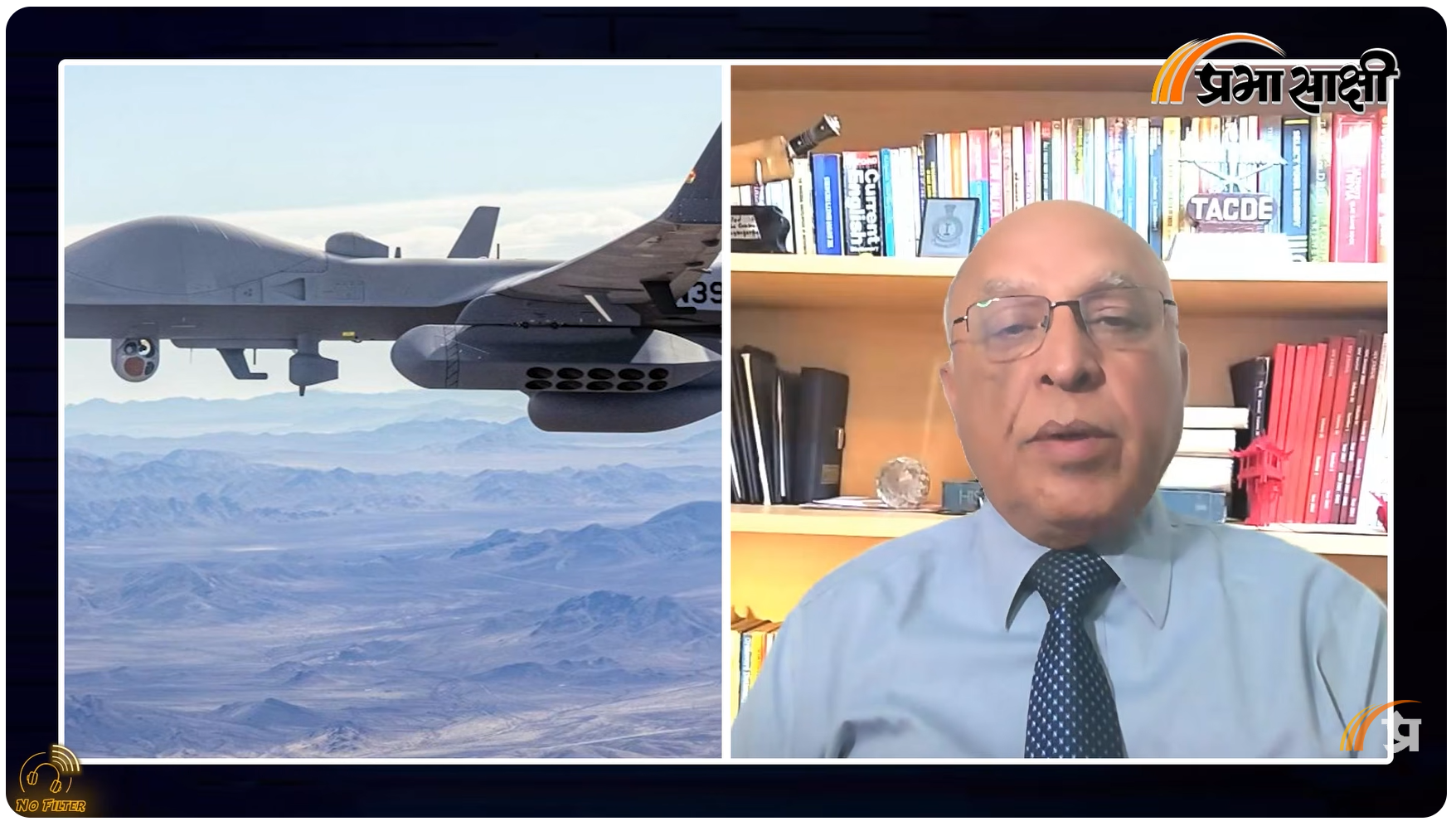
Drones are taking over the missions that are too risky, too repetitive, or too economically unjustifiable to warrant a manned sortie. They are not replacing the manned aircraft.
The prevailing trend favours a combination of manned and unmanned systems. Manned aircraft are focusing on contested, high-end missions that require judgment, adaptability, and versatile payloads. Concurrently, unmanned systems are being employed in persistent, attritable, and mass-effect roles.
The adaptation to this hybrid model is no longer merely a tactical requirement; it has become a strategic necessity.
Q2. Russia’s Su-57 and the US F-35 embody different philosophies — one emphasises air combat, the other network-centric warfare. Whose future will it be?
The Su-57 seems to reflect the traditional Russian emphasis on kinematic performance and super-manoeuvrability.
The F-35 is claimed to be built around sensor fusion and battlespace awareness. It is advertised as capable of detecting, classifying, and engaging the threat at beyond-visual-range distances through a data architecture spanning an entire networked force.
Future aerial combat is progressing towards a network-centric model. Contemporary air engagements are increasingly determined by the priority of achieving information and decision dominance, rather than by performance alone.
Compressing the sensor-to-shooter timeline is now as critical as speed or manoeuvrability. This is fundamentally a problem of decision architecture, not merely of technology.
The sixth-generation programmes are pushing emerging platforms toward multi-domain integration. Fusion of air, space, cyber, and electronic warfare into a single operational architecture will make the network-centric model more definitive.
Q3. China already has the J-20. Has India delayed the AMCA too long, or is it still possible to turn the situation around?
It is a fact that India’s timeline has slipped. The J-20 has been operational for nearly a decade. China is already iterating toward a sixth-generation capability, as evidenced by the prototypes that emerged publicly in late 2024.
AMCA is still working through prototype development. The gap is significant and widening. Reversal of the trend is a realistic necessity.
India can recover lost ground in fighter development if the programme is properly resourced, executed and politically backed.
A significant structural shift is also underway with the Ministry of Defence opening AMCA prototype development to private consortia rather than relying exclusively on the public-sector model.
The window to close the capability gap exists. It will not remain open indefinitely, and the margin for complacency on programme management is close to zero.
Q4. In the wars to come, will Artificial Intelligence and Loyal Wingman drones be more important than pilots?
The pilot does not become less important. His job changes, and in some respects becomes more demanding, not less.
Manned-unmanned combat air teams would have one crewed aircraft effectively commanding a tactical formation of attritable unmanned assets, absorbing risk that would otherwise fall on the manned platform, carrying missiles, jammers, decoys, or forward reconnaissance payloads.
What AI is changing is the speed and volume of decision-making below the human threshold.
AI-enabled satellites and sensors, capable of detecting, classifying, and cueing targets, can push that picture directly to the shooter over tactical data links, rather than routing it back through a ground station first. That is what compressing the sensor-to-shooter timeline. However, human intervention cannot be removed from the kill chain.
As of now, the human crew retains authority over decisions that carry lethal and political consequences, while AI absorbs the burden of processing, prioritising, and routing information faster than any human can.
So, AI and unmanned teaming will unquestionably become more important than they are today. But the human crew would remain relevant and in control.
The pilot of 2040 will be managing a far more complex battle picture, commanding a digital wolfpack rather than flying a single aircraft.
Q5. If India has the opportunity to purchase the F-35 or the Su-57, should we go ahead and purchase them, or stick to developing our own aircraft?
These are not competing choices, and treating them as such leads to a false dilemma.
The IAF’s squadron strength shortfall is real, immediate, and strategically significant. The Rafale has helped close that numerical gap, but has not closed it.
Further, there is a case for qualitative enhancement by the induction of fifth-generation aircraft.
The F-35 carries substantial geopolitical weight, end-use restrictions, and software dependency. Cost, delivery timelines, extended supply chains, Transfer of technology and trust deficit are other factors to be taken into account.
Russia has been a trusted partner, willing to share its technology to a certain extent and accepting Make in India. The Su-57 also raises several concerns besides the factors listed above. India had earlier walked out of the co-development program mainly due to concerns related to cost and technology sharing.
Neither platform offers a clean, dependency-free solution. The importance of self-reliance in defence production is a common lesson emerging from recent wars. The Indigenous program (AMCA) is some time away and urgently needs a technology infusion.
The logical answer is to plug the gap pragmatically by expanding the Rafale order and carefully reassessing the induction of fifth-generation aircraft, while protecting AMCA’s funding and schedule as a non-negotiable national priority.
The near-term interim acquisition and the long-term indigenous programme must be advanced concurrently. The contract should be negotiated in a manner that boosts the indigenous programme rather than undermining it.
Q6. Is engine technology still India’s biggest weakness today?
The answer is YES. The Tejas Mark 1A flies on the American GE F404. AMCA’s initial squadrons will likely depend on an imported engine in the ninety-kilonewton class. The latest news is that negotiations for the GE 414 engine for AMCA have hit rough weather due to a 300 per cent cost increase.
India still does not have a proven indigenous engine anywhere near the ninety to one hundred ten kilonewton range required for a credible fifth or sixth-generation fighter. The Kaveri programme, running since the mid-1980s, is the most visible illustration of how difficult this problem is. High-performance turbofan technology demands a combination of high-temperature metallurgy, single-crystal turbine blade manufacturing, precision tolerances, and decades of iterative test data that very few nations have accumulated.
Urgent need of the hour is a deal that includes a degree of co-production and technology transfer for engine manufacturing in India. Co-production extends the supply chain into India, but it does not give India the ability to independently design, test, and certify a clean-sheet high-thrust engine. Engine independence remains the single weakest link in the self-reliance story.
Q7. Will the export of fighter jets become an increasingly important geopolitical tool?
Fighter exports are already an important geopolitical tool, and their leverage is intensifying rather than diminishing.
Fighter exports create decades of dependency for the buyer. The seller retains influence over the buyer’s operational readiness (by supplying spares, software updates, weapons integration, training pipelines, and maintenance protocols). This dependency lasts for the life of the platform (often 30 to 40 years after the sale).
India’s own indigenous push is a deliberate effort to reduce exposure to precisely this kind of dependency. India’s active promotion of the Tejas and its indigenous missile systems in Southeast Asia, West Africa, and the Gulf reflects a clear understanding that defence exports are as much an instrument of foreign policy as of industrial economics. Future fighter sales will be negotiated as much on reliability of supply and strategic alignment as on cost or raw capability.
Q8. What are India’s greatest achievements and biggest challenges in defence self-reliance?
Tejas moving from a deeply troubled programme to a credible inducted fighter is, to a certain extent, an achievement. The development of indigenous rotary-wing platforms (Dhruv, Rudra, the Light Combat Helicopter Prachand) demonstrates that the industrial capacity extends beyond fast jets. The Astra beyond-visual-range missile and the continued maturation of the BrahMos supersonic cruise missile represent genuine capability in the weapons domain. The missile and space programs are doing comparatively well.
Perhaps most significantly, India’s defence production turnover has grown substantially over the past decade. The country has moved from being almost exclusively an arms importer to a growing exporter, which is a structural shift that would have seemed improbable fifteen years ago.
The challenges are equally tangible. Squadron strength remains well below the sanctioned forty-two. Force multipliers, tankers, airborne early warning and control platforms are inadequate in numbers for a force that needs to project across two frontiers simultaneously. Engine technology remains unresolved.
The achievements prove India can build technically demanding systems. What remains unproven is whether it can build them at the pace and scale that the threat environment now demands.
Q9. How will the Indian Air Force look in 2040, compared to today?
By 2040, assuming the squadron strength target is met or even meaningfully mitigated, the IAF should be a genuinely different force, operating on a different conceptual basis.
AMCA should be in serial production, forming the high-end backbone alongside an upgraded Rafale fleet and a substantially modernised Su-30MKI. The Tejas Mark 2 and the twin-engine deck-based fighter should round out the order of battle, bringing the indigenous content of the combat fleet to a level inconceivable at the beginning of this decade.
Loyal Wingman and unmanned systems would be standard formation elements rather than experimental adjuncts.
AI-assisted Space-based ISR would be integrated into the network.
The UCAV and other Unmanned platforms will significantly enhance airpower capabilities.
If the present trajectory and pace are sustained, by 2040 the IAF should be more networked, more integrated with the space and cyber domains, and far less dependent on foreign supply chains than anything currently in service.
Q10. If you had to identify one defining trend in air warfare over the next twenty years, what would it be?
The shift from platform-centric to weapon-centric airpower operating in a networked environment. The idea that the decisive factor in air combat is increasingly not which aircraft you fly, but how fast you can sense, decide, and act across a distributed force. Ada result:
The sensor-to-shooter timeline will get shortened further.
Space-based satellites with onboard AI capable of detecting, classifying, and cueing the targets will push that picture directly to the shooter.
Manned and unmanned systems will operate as a single collaborative entity rather than parallel fleets.
Mastery of the electromagnetic spectrum, with digital and cognitive dimensions layered on top, would become essential.
Stealth, hypersonics, manoeuvrability, drone swarms, and directed energy technologies/capabilities would follow this shift.
The air forces that adapt to it early will hold the operational advantage in 2040 and beyond. The ones that keep procuring better individual platforms while neglecting the architecture around them (i.e. modern equipment running on an outdated decision framework) will find themselves technologically current but operationally lagging.
Please Add Value to the write-up with your views on the subject.
For regular updates, please register your email here:-
Information and data included in the blog are for educational & non-commercial purposes only and have been carefully adapted, excerpted, or edited from reliable and accurate sources. All copyrighted material belongs to the respective owners and is provided only for wider dissemination.
My Article was published in the May edition of the “Life of Soldier” journal.
The evolution of military aviation has reached a revolutionary moment with the advent of sixth-generation fighter jets. These jets, representing a transformative leap in military aviation, are set to redefine air combat with their revolutionary technologies like advanced stealth, artificial intelligence (AI), hypersonic speeds, and networked warfare capabilities. As nations like the United States and China race to develop these next-generation platforms, the global balance of power is shifting, with significant implications for countries like India. This article explores what constitutes a sixth-generation fighter, delves into the specifics of the US’s Next Generation Air Dominance (NGAD) platform, compares it to the existing F-22, and assesses its potential to transform US defence. It also examines the intensifying US-China defence rivalry and India’s current standing amidst these global developments.
Sixth-Generation Fighter Jet
A sixth-generation fighter jet is the next evolutionary step beyond the current fifth-generation aircraft, such as the U.S.’s F-22 Raptor and F-35 Lightning II, the Russian SU-57 and the Chinese J-20. While fifth-generation jets introduced advanced stealth, supercruise (sustained supersonic flight without afterburners), and integrated sensor systems, sixth-generation fighters aim to push the boundaries further. Their defining features include:-
Enhanced Stealth. These jets will have an even lower radar cross-section than their predecessors, using advanced materials, coatings, and aerodynamic designs to become nearly invisible to enemy detection systems.
Artificial Intelligence (AI). AI will be deeply integrated, enabling real-time decision-making, autonomous operations, and coordination with unmanned systems, such as drones acting as “loyal wingmen.”
Hypersonic Speeds. Capable of exceeding Mach 5, these aircraft could drastically reduce response times and enhance their ability to penetrate contested airspace.
Directed-Energy Weapons. Innovations like laser systems could provide precise, cost-effective means to neutralise threats like missiles or enemy aircraft.
Advanced Networking. Sixth-generation jets will operate as nodes in a vast battlefield network, sharing data with satellites, ground stations, and other platforms to achieve total situational awareness.
Advanced Avionics and Sensors. They would incorporate superior sensor fusion for unparalleled situational awareness.
Optionally Manned Capabilities. These fighters will be flexible enough to operate with or without a pilot, adapting to mission requirements.
These capabilities mark a shift from traditional air combat to multi-domain warfare, a concept in which air, space, cyber, and electronic domains are seamlessly integrated. This integration allows for a more comprehensive approach to warfare, focusing on dominating future conflicts through technological superiority and adaptability.
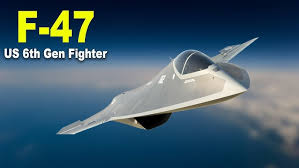
Speciality of the U.S.’s “F-47” Fighter Jets & Differences from the Existing F-22.
The F-22 Raptor, operational since 2005, is a fifth-generation stealth air superiority fighter renowned for its agility, stealth, and advanced avionics. However, after two decades, it faces limitations in an evolving threat era. The NGAD is envisioned as a “family of systems” rather than a single aircraft, comprising a manned fighter and supporting unmanned drones. It will differ significantly. The NGAD (F-47) fighter’s specialities would include:-
Next-Level Stealth. The F-22’s stealth is exceptional, but the NGAD will likely use next-generation materials and designs to achieve even greater invisibility, including against emerging radar technologies. Building on the F-22’s stealth technology, the NGAD will likely incorporate broadband stealth, reducing detectability across a broader range of radar frequencies.
AI and Autonomy. The F-22 relies on human pilots for all decisions, whereas the NGAD will integrate AI to handle complex tasks, potentially reducing pilot workload or enabling autonomous missions. The jet may feature AI systems that manage flight, combat, and coordination with unmanned drones, potentially allowing for unmanned variants.
Hypersonic Capability. The F-22 can supercruise at Mach 1.5, but the NGAD may reach hypersonic speeds (Mach 5+), vastly improving its ability to strike and evade. While specifics are classified, the NGAD could achieve speeds far exceeding the F-22’s Mach 1.5 supercruise, possibly entering the hypersonic realm.
System Integration. The F-22 has limited data-sharing capabilities compared to the NGAD, which will operate within a highly networked environment, linking with other assets for real-time battlefield awareness. The NGAD is not just a standalone aircraft but part of a broader “family of systems,” including drones, advanced sensors, and cyber tools, all working together to dominate the battlespace. The NGAD could control or be supported by unmanned drones, expanding its operational flexibility.
Range, Endurance and Payload. The F-22 has a range of approximately 1,850 miles with external tanks, whereas NGAD is engineered for greater range, endurance and potentially larger weapon capacity. It will be designed for long-range missions critical for operations in expansive regions like the Indo-Pacific.
Flexible Architecture. Its modular design could enable rapid upgrades and mission-specific configurations, ensuring longevity and adaptability. The NGAD is a forward-looking platform designed for future warfare, while the F-22, though formidable, reflects the priorities of an earlier era. These features position the NGAD as a revolutionary platform designed to address the challenges of modern warfare against technologically advanced adversaries.
Likely Game Changer for U.S. Defence
The Next-Generation Air Dominance (NGAD) program can redefine U.S. defence strategy, ushering in a new era of air superiority, enhanced deterrence, and reinforced multi-domain integration. The anticipation and excitement surrounding this potential transformation are palpable.
Air Superiority. The NGAD is designed to outperform near-peer adversaries like China’s J-20 and Russia’s Su-57. Its cutting-edge stealth, enhanced range, and AI-driven capabilities will allow the U.S. to dominate contested airspaces, even in heavily defended environments.
Deterrence. A formidable leap in air combat technology, the NGAD will discourage potential adversaries from challenging U.S. air dominance. Knowing they face a next-generation fighter capable of overwhelming their defences, adversaries may be deterred from aggressive actions.
Multi-Domain Dominance. The NGAD is not just a fighter but a networked system that integrates with space, cyber, and land-based forces. This interconnectivity allows it to act as a force multiplier, relaying battlefield intelligence and coordinating attacks with other assets, thus extending its impact far beyond traditional air combat.
Air Dominance. Successfully fielding the NGAD will ensure U.S. air dominance and reaffirm the nation’s position as the global leader in military innovation. Its advancements in AI, unmanned teaming, and next-gen propulsion could have spillover benefits for civilian aerospace, cyber warfare, and autonomous systems, instilling a sense of pride and confidence in the audience.
Despite its promise, the NGAD faces significant hurdles, including a projected per-unit cost of hundreds of millions of dollars and the challenge of integrating multiple breakthrough technologies. However, if these obstacles are overcome, the NGAD will shape the future of U.S. airpower for decades, ensuring its dominance in a rapidly evolving strategic landscape.
China’s Sixth-Generation Stealth Fighter and U.S.-China Competition.
China is also advancing its sixth-generation stealth fighter, with reports of prototypes being sighted. China’s program remains shrouded in secrecy, and the details are limited. The recent flying of sixth-generation prototypes suggests it is committed to matching or surpassing U.S. capabilities. This development coincides with the U.S. Pentagon’s NGAD efforts, highlighting fierce competition between these two powers.
Both nations are pouring resources into AI, hypersonics, and stealth, aiming to deploy sixth-generation fighters first and gain a strategic edge. A sixth-generation jet would enhance China’s influence in the Asia-Pacific, particularly in disputed areas like the South China Sea and near Taiwan. The U.S.-China rivalry extends beyond military hardware, shaping economic and diplomatic alignments worldwide. This competition drives rapid innovation and escalates tensions, with both nations seeking to outpace each other in defence technology. This close contest shapes global defence dynamics, influencing nations like India.
Impact on India
The US-China rivalry in sixth-generation fighters has significant implications for India, which faces opportunities and challenges. India faces threats from China and Pakistan, both of which are modernising their air forces. A Chinese sixth-generation fighter could tip the balance in regional conflicts, pressuring India to modernise its air force. India must counter Beijing’s growing military strength. India balances ties with the US and Russia while pursuing indigenous programs.
India’s airpower combines legacy and modern systems, reflecting its multi-source procurement strategy. It includes Russian Su-30MKI, MiG-29, French Mirage-2000, Rafale and indigenous Tejas fighters. The AMCA aims to deliver fifth-generation capabilities, though it’s still years from operational service. India’s fleet is smaller and comparatively less advanced, lacking operational fifth-generation fighters. It trails in AI, stealth, and hypersonic research. India is modernising through foreign purchases (Rafale), indigenous efforts (Tejas Mk2, AMCA), and partnerships with the U.S., France, and Israel. Limited resources spread across multiple programs hinder rapid progress. However, it must accelerate to keep pace with its rivals.
India’s reliance on Russian aircraft and systems risks U.S. sanctions, straining its ties with Washington despite a growing partnership. India must diversify its defence suppliers to reduce foreign dependence while boosting indigenous programs like the Advanced Medium Combat Aircraft (AMCA). The U.S.-China race underscores the urgency for India to enhance its technological and military capabilities to safeguard its interests.
India has defence deals with the U.S., but has not purchased U.S. fighter jets. Discussions about acquiring the F-35 Lightning II, a fifth-generation stealth fighter, are being speculated. The F-35 could bolster its air force, but its expense and restrictions might divert resources from the AMCA, India’s fifth-generation fighter in development. With China advancing rapidly, India cannot afford delays but needs a cost-effective, strategically aligned solution.
The NGAD, however, remains a U.S.-exclusive program, a highly classified initiative focused on developing a sixth-generation fighter for the U.S. Air Force. Its sensitive technologies and strategic importance make it unlikely to be shared with foreign partners soon.
Conclusion
As exemplified by the U.S.’s NGAD and China’s emerging platform, sixth-generation fighter jets are set to redefine air combat with unprecedented technology. For the U.S., the NGAD will ensure air dominance, while China’s efforts signal its rise as a military superpower. India, caught between these giants, faces a complex path. It lacks direct involvement with NGAD but must leverage U.S. ties, navigate CAATSA, and decide on deals like the F-35, all while pushing indigenous development.
India’s air power is at a crossroads in a world of rapid geopolitical and technological change. Modernisation is underway, but closing the gap with China will require strategic focus, investment, and innovation. The sixth-generation race is not just about jets—it’s about the future of warfare, and India must position itself to thrive in this new era.
Please Do Comment.
For regular updates, please register your email here:-
Information and data included in the blog are for educational & non-commercial purposes only and have been carefully adapted, excerpted, or edited from reliable and accurate sources. All copyrighted material belongs to the respective owners and is provided only for wider dissemination.
References:-
Krepinevich, Andrew. The Evolution of Air Dominance: Sixth-Generation Fighters and the Future of Air Combat. Center for Strategic and Budgetary Assessments, 2023.
Gunzinger, Mark, and Bryan Clark. The Role of NGAD in Sustaining U.S. Air Superiority in the Pacific. Center for Strategic and International Studies, 2024.
RAND Corporation. Next-Generation Fighter Aircraft: Strategic Considerations for the U.S. Air Force. RAND, 2023.
Mehta, Aaron. U.S. Airpower in the Indo-Pacific: The NGAD’s Role in Detering China. Atlantic Council, 2024.
Callaghan, John. “Sixth-Generation Fighter Jets and the Shift in U.S. Defence Strategy.” Journal of Strategic Studies 47, no. 1 (2024): 33-58.
Holbrook, Sarah. “AI and Human-Machine Teaming in Next-Gen Fighters: Tactical Advantages and Challenges.” Air & Space Power Journal 38, no. 2 (2023): 45-70.
Miller, James. “The Role of NGAD in Joint All-Domain Operations (JADO).” Military Review 104, no. 3 (2023): 22-41.
Roberts, Ethan. “Geopolitical Implications of America’s Next Fighter Jet in the Indo-Pacific.” Defence and Security Analysis 40, no. 4 (2024): 90-112.
Boeing Defence. Stealth, AI, and the Future of Sixth-Generation Fighters. Chicago, IL: Boeing Corporation, 2024.
Northrop Grumman. Multi-Domain Warfare and NGAD: A Defence Industry Perspective. Falls Church, VA: Northrop Grumman, 2024.
Jane’s Defence Weekly. Sixth-Generation Fighters: Key Developments and Program Milestones. London: Jane’s Information Group, 2024.
Trevithick, Joseph. “What We Know About the U.S. Air Force’s Secret Sixth-Gen Fighter.” The War Zone (The Drive), January 18, 2024.
Insinna, Valerie. “America’s NGAD Program and the Future of Air Superiority.” Defence News, February 7, 2024.
Mizokami, Kyle. “The Air Force’s Future Fighter Jet: How the F-47 Will Change U.S. Airpower.” Popular Mechanics, March 5, 2024.
Axe, David. “The Cost and Strategy Behind NGAD.” Forbes Defence, April 12, 2024.
Thompson, Loren. The Aerospace Revolution: How Next-Generation Fighters Will Change Warfare. Washington, D.C.: Lexington Institute, 2023.