
Shared my thoughts on the subject with the news channel.
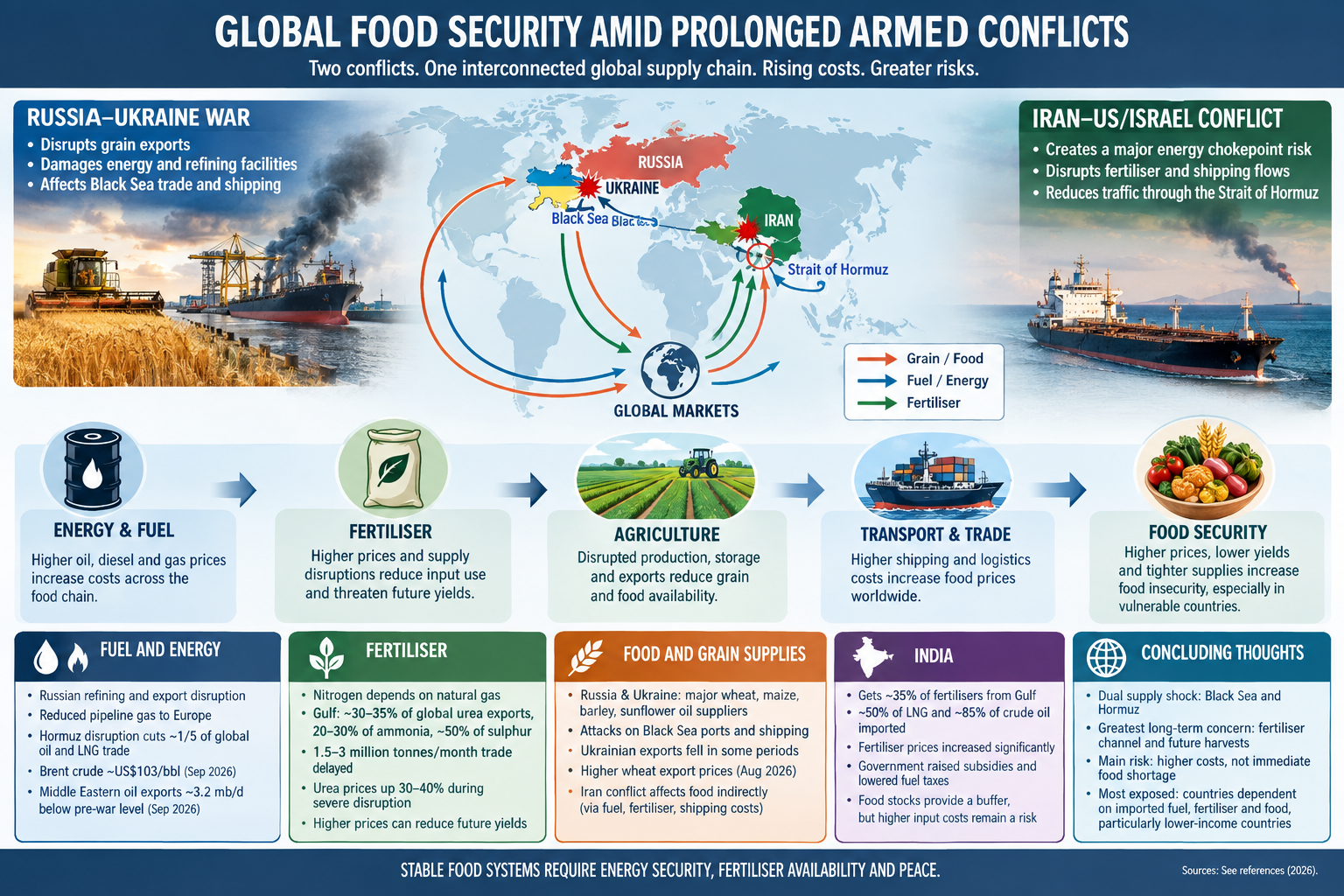
The ongoing Russia–Ukraine war and the 2026 Iran–US/Israel conflict are creating a compounding shock across global food, fuel and fertiliser markets. The two conflicts affect different parts of the supply chain: the Russia–Ukraine war has primarily disrupted grain exports, energy supplies and Black Sea trade, while the Iran conflict has created a major energy, fertiliser and shipping shock centred on the Strait of Hormuz. Together, they raise production and transport costs while increasing the risk of lower agricultural yields and tighter food supplies.
Fuel and Energy
Russia–Ukraine War. The war has disrupted Russia’s exports of energy and caused damage to its refining facilities. Attacks by Ukraine on Russian refineries have lowered the amount of fuel that can be processed and have thus led to more strained global markets for diesel and gasoline, while Russia’s limitations on fuel exports have increased the pressure on the supply side. Earlier cuts in Russia’s pipeline gas exports to Europe also meant that global energy markets had to depend more on liquefied natural gas.
Iran–US and the Strait of Hormuz. The Iran conflict has added a much larger chokepoint risk. The Strait of Hormuz normally carries roughly one-fifth of global oil and LNG trade and is also critical for Gulf fertiliser shipments. Conflict, attacks, insurance problems and shipping restrictions have sharply reduced traffic through the strait. Reportedly, Middle Eastern oil exports in September 2026 remained around 3.2 million barrels per day below their February pre-war level, while Brent crude was around $103 a barrel at the end of September.
Combined effect. The two conflicts therefore reinforce one another. Russian refining and export disruption and Hormuz disruption result in tighter fuel markets. Higher oil, diesel and gas prices manifest as higher costs for farming, irrigation, harvesting, processing and transportation. Fuel is a cross-cutting cost because virtually every stage of the food chain depends on it.
Fertiliser
Fertiliser is arguably the most important connection between the energy conflicts and future food supplies. Nitrogen fertiliser production depends heavily on natural gas. When gas and energy become more expensive or unavailable, fertiliser production becomes more expensive or is curtailed. Farmers then face a choice between paying much higher prices or reducing fertiliser application.
Russia–Ukraine. Russia remains a major exporter of nitrogen, phosphate and potash fertilisers. The war, sanctions, export restrictions and attacks on plants, ports and transport infrastructure have periodically tightened these supplies and forced importing countries to find alternative sources.
Iran–US and the Gulf. The Middle East is even more important for some fertiliser products. Gulf countries account for approximately 30–35% of global urea exports, 20–30% of ammonia and about 50% of sulphur exports. Sulphur is particularly important for phosphate fertilisers. The Hormuz disruption has therefore had an effect on both the production and transport of fertilisers. Plants in the Gulf have suffered production interruptions, and shipments of urea, ammonia and sulphur have been delayed or halted. Prices for fertilisers have gone up sharply, with urea prices rising by about 30–40% during periods of severe disruption. FAO has reported that 1.5–3 million tonnes of monthly fertiliser trade had been delayed by the disruption. The crucial effect is that the higher fertiliser prices today can translate into lower crop yields later. This makes fertiliser potentially more consequential for future harvests than the immediate effect of the energy shock itself.
Food and Grain Supplies
The two conflicts affect food supplies in different ways.
Russia–Ukraine. Russia and Ukraine are major suppliers of wheat, maize, barley, sunflower oil and other agricultural commodities. The war has disrupted farmland, ports, storage, processing facilities, vessels, and Black Sea shipping. Attacks on Black Sea infrastructure and shipping have intensified in 2026. Ukrainian agricultural exports have consequently fallen substantially in some periods, while attacks on Russian infrastructure have also affected grain and energy logistics.
Iran–US conflict. The Iran conflict initially affects food more indirectly. Its principal impact is through fuel, gas, fertiliser and shipping costs rather than a direct loss of major global grain production. Farmers facing unaffordable fertiliser may reduce application or switch to less fertiliser-intensive crops. The resulting reduction in yields could affect wheat, maize, rice and other crops in subsequent growing seasons.
The Compounding Effect. The two wars are affecting different links of the same agricultural chain at the same time. The key difference is that Russia–Ukraine has directly affected agricultural output and exports, while the Iran conflict has delivered a particularly severe energy and fertiliser shock. Together, however, they create a feedback loop in which higher energy costs make fertiliser more expensive, expensive fertiliser reduces agricultural input use, and reduced input use can eventually reduce food production.
Effect on India
India is on the receiving end of both aspects of this shock since its energy and fertiliser needs are largely met through imports, and at the same time it has a big agricultural sector that makes heavy use of these imports. It is reported that India obtains about 35% of its fertilisers from the Gulf. Fertiliser prices have increased significantly. In response, the government has increased its fertiliser subsidies and lowered fuel taxes, but this means that part of the external price shock is passed on to the public finances.
India does have an important buffer in the form of food stocks. Government warehouses held substantial quantities of wheat and rice, providing some protection against an immediate food shortage. However, this stockpile does not eliminate the longer-term problem of higher fertiliser, fuel and transport costs, particularly if weather conditions reduce domestic agricultural production.
Concluding Thoughts
The result of wars is a dual supply shock. The Russia–Ukraine war constrains important agricultural and energy flows through the Black Sea and Russian infrastructure, while the Iran conflict constrains energy and fertiliser flows through the Strait of Hormuz. The greatest longer-term concern is the fertiliser channel because today’s shortage or high prices can translate into lower harvests in subsequent growing seasons.
The principal risk is not necessarily that the world immediately runs out of food. The more significant risk is a sustained increase in the cost of producing, transporting and processing food.
The countries most exposed are those that are simultaneously dependent on imported fuel, fertiliser and food, particularly lower-income countries with limited fiscal capacity to subsidise these imports.
Please Add Value to the write-up with your views on the subject.
For regular updates, please register your email here:-
References and credits
To all the online sites and channels.
Pics Courtesy: Internet
Disclaimer:
Information and data included in the blog are for educational & non-commercial purposes only and have been carefully adapted, excerpted, or edited from reliable and accurate sources. All copyrighted material belongs to the respective owners and is provided only for wider dissemination.
References:-
Arita, S., Wang, M., & Glauber, J. How fertilizer policies could exacerbate Hormuz price shocks. International Food Policy Research Institute. (2026, May 22).
Food and Agriculture Organization of the United Nations. Global agrifood implications of the 2026 conflict in the Middle East: Impacts on energy and fertilizer trade, and food security. 2026
Glauber, J., & Arita, S. How are fertilizer markets coping with the continued closure of the Strait of Hormuz? International Food Policy Research Institute. IFPRI article, 18 Sep 2026.
International Energy Agency. Oil market report – June 2026. (2026, June 17).
International Energy Agency. How global oil supplies have readjusted to help fill the huge gap left by the Strait of Hormuz shock. (2026, June 22).
Ministry of Chemicals and Fertilizers, Government of India. 15 vessels safely cross Strait of Hormuz; India’s fertilizer stocks set to rise. Press Information Bureau, Government of India. (2026, July 5).
Pal, B. D., Kumar, A., Sirohi, S., Sainath, B., Sharma, K., & K. V., P. (Iran war supply chain disruptions: Impacts on India’s economy. International Food Policy Research Institute. 2026, June 25).
United Nations Conference on Trade and Development. From gas to grain: Fertilizer disruptions raise risks for food security and trade. UNCTAD. 30 Mar 26.
Welsh, C., Curtis, E., & Glauber, J. How do the latest Black Sea attacks affect global food security? Center for Strategic and International Studies. (2026, September 11).
Food and Agriculture Organization of the United Nations. FAO Chief Economist warns of severe global food security risks from disruption to Strait of Hormuz trade corridor. (2026, March 26).
Food and Agriculture Organization of the United Nations. Strait of Hormuz crisis: FAO Director-General outlines risks, actions and policy responses. 28 Apr 26.
Food and Agriculture Organization of the United Nations. Export prices of wheat, maize and rice generally increased in August 2026, despite weaker Black Sea quotations. 14 Sep 26.