
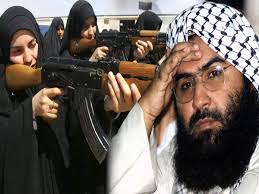
767: JAISH-E-MOHAMMED LAUNCHES “TUFAT AL-MUMINAT”: DIGITAL JIHAD FOR WOMEN’S RADICALISATION


Pakistan-based, UN-designated terror group Jaish-e-Mohammed (JeM) has launched an online jihadist training programme titled Tufat al-Muminat. The initiative targeting women serves as the foundation course for JeM’s newly announced female militant wing (Jamat ul-Muminat). The course is reportedly led by Sadiya and Samaira Azhar, sisters of JeM founder Masood Azhar, and Afreera Farooq, wife of Umar Farooq, one of the terrorists behind the April 2025 Pahalgam attack in Jammu and Kashmir.


According to news reports, the online sessions are scheduled to begin on 08 Nov 2025. It will be conducted for 40 minutes daily through live video platforms.​ A nominal fee of PKR 500 is being charged to each participant.  The sessions will likely focus on preaching extremist interpretations of Islam, emphasising women’s roles in jihad.


In the past, women played a minimal role in JeM’s activities. However, the development of a dedicated female wing and online training programs shows an increasing effort to involve women more actively. This is a significant change in JeM’s approach.  It seems JeM is taking cues from other groups like ISIS, Boko Haram, and Hamas, which have a history of recruiting women for combat and even suicide missions.


Digital Jihad


In the digital age, warfare has moved beyond physical battlefields, infiltrating the virtual realm where ideas spread faster than bullets. Digital jihad is also called “electronic jihad” or “e-jihad.” It is an online version of jihadist ideology and activities in the cyber domain. The internet, with its enormous, anonymous, and interlinked nature, is being used to disseminate extremist ideologies, attract believers, and form worldwide connections. Digital jihad is practised in the darkness of social media, encrypted applications, and AI-generated content. The process of converting extremism into a digital form is now one of the key factors influencing global terrorism.


Evolution of Jihad in the Digital Era. The shift from traditional insurgencies to digital jihad began in the late 1990s when extremist groups recognised the internet’s potential as both an ideological and operational tool. Al-Qaeda led this change, using basic websites for fatwas and recruitment videos after 9/11. As social media grew, this evolved into complex digital systems in which recruitment, propaganda, indoctrination, and training became borderless, efficient, and viral. By the 2010s, ISIS took it further by creating a “virtual caliphate.” Social media gave jihadist organisations—including ISIS and al-Qaeda—the opportunity to connect with a worldwide audience with minimal expenses. ISIS revolutionised digital jihad through its propaganda films, magazines (Dabiq and Rumiyah), published in multiple languages. These publications served as tools for ideological indoctrination. Recent advances include “AI jihad,” where Hamas, al-Qaeda, and ISIS use generative AI for deepfakes and memes.


Mechanisms of Digital Jihad. Digital jihad works on several overlapping functions: propaganda, recruitment, training, funding, and coordinating activities. The most obvious one is propaganda, which is conveyed through multimedia messages, videos, GIFs, and memes that praise martyrdom and foster a sense of belonging to the world object. Emotional and ideological vulnerabilities of isolated, susceptible youth are being targeted online for recruitment. Encrypted networks have become the preferred option for jihadists to communicate and plan. They can coordinate across continents anonymously.


Ideological Narratives and Online Radicalisation. The ideological axis of digital jihad blends traditional Islamic discourse with modern grievance narratives—claiming to defend the ummah (global Muslim community) against alleged Western aggression. Online preachers and influencers exploit religious symbolism to justify violence morally. Digital content idealises jihad as an empowerment or a commandment of god that builds on the feelings of alienation of most migrants and diasporic young people. This narrative warfare was institutionalised in the media jihad by ISIS, which re-packaged jihad as not only a moral imperative but as an identity of lifestyle.


The Role of Technology and AI in Digital Jihad. Emerging artificial intelligence-based technologies have expanded the reach of digital jihad. Extremist content is now more visible than ever before. The extremist echo chambers are self-perpetuating, bombarding people with extremist content. The jihadist groups are utilising video editing software, bot networks, and data encryption to disguise operations within legitimate cyber traffic. The deep web and dark web serve as the extremist underworld—used for secure communications, recruitment screening, and financial transfers via cryptocurrencies. Virtual environments now replace physical training camps, providing tactical and ideological grooming.


Countermeasures and Digital Counter-Jihad. So far, the global response to digital jihad has been two-pronged—technological solutions and Counter-ideology campaigns. Technology is being used to develop automated tools to remove extremist content from various platforms. Artificial intelligence is progressively able to identify terrorist “clusters,” connecting pages, posts, and users to map networks and eliminate them. Yet, these roadblocks put up by the authorities and tech companies are not foolproof solutions in themselves. Initiatives for the counter-jihad movements also include online deradicalisation campaigns and educational outreach programs.


Ethical, Legal, and Strategic Challenges. Balancing security and freedom of expression remains one of the most controversial issues in countering digital jihad. Since online monitoring prevents threats, it also threatens privacy and civil liberties. In addition to that, the definition of terrorist propaganda is somewhat subjective and can be used as a means to stifle legitimate dissent. Discrepancies in jurisdictional law also threaten international cooperation, as the definition of online extremism varies from country to country. This conflict between private rights and collective security makes it more challenging to regulate the internet.


Future Trajectory. Digital jihad is transitioning to decentralised networks of self-governing cells that use encrypted communications rather than a hierarchical command-and-control structure. Cyberspace has taken on the characteristics of the new caliphate—unconfined, unformed, and resilient ideologically. The rapid development of artificial intelligence, deepfakes, and virtual reality will encourage the use of these technologies by digital jihad for recruitment and psychological operations. Consequently, governments need to consider the internet as an ever-changing battlefield that requires constant, flexible, and cooperative strategies among all state and non-state actors.


Conclusion

“Digital jihad” refers to the use of digital technologies and cyberspace by extremist groups to further their agenda. Dealing with digital jihad requires finding a delicate balance between using technology and applying legal measures, without infringing on human rights. The victory over digital jihad will be achieved through the application of more technologies and also through combating the causes of radicalisation worldwide that globalisation has brought about.


Please Add Value to the write-up with your views on the subject.


1879
Default rating

Please give a thumbs up if you  like The Post?


For regular updates, please register your email here:-

Subscribe


References and credits

To all the online sites and channels.

Pics Courtesy: Internet

Disclaimer:

Information and data included in the blog are for educational & non-commercial purposes only and have been carefully adapted, excerpted, or edited from reliable and accurate sources. All copyrighted material belongs to respective owners and is provided only for wider dissemination.


References: –

  1. India Today, “Pakistan terror hypocrisy exposed again: Jaish-e-Mohammed launches online jihad course for women in Islamabad”, 22 Sep 25. https://www.indiatoday.in/world/story/jaish-e-mohammed-online-course-launch-for-women-recruitment-pakistan-terror-masood-azhar-2806662-2025-10-22
  1. Tom O’Connor, “Generating jihad: How ISIS could use AI to plan its next attack”, Newsweek, 19m Sep 2025. https://www.newsweek.com/isis-ai-terrorism-al-qaeda-attack-2132143
  1. Soumya Awasthi, “Jihadi use of artificial intelligence: A growing threat in the digital age”, Observer Research Foundation, 18 Aug 2025. https://www.orfonline.org/expert-speak/jihadi-use-of-artificial-intelligence-a-growing-threat-in-the-digital-age
  1. Ben Makuch, “AI-Generated Extremism: How Terror Groups Exploit New Tech” The Guardian, 08 July 2024.
  1. Lakomy M, “In Mapping Digital Jihad: Understanding the Structure and Evolution of al-Qaeda’s Information Ecosystem on the Surface Web”, Perspectives on Terrorism, 18(2), 82–99, 2024.
  1. Siegel D, “AI jihad: Deciphering Hamas, Al-Qaeda and Islamic State’s generative AI digital arsenal”, Global Network on Extremism and Technology (GNET), 2024.
  1. Foreign Affairs, “The Cyber Caliphate Lives On”, Foreign Affairs, March 2024.
  1. Montasari R, “Analysing ethical, legal, technical and operational challenges of the application of machine learning in countering cyber terrorism”, (pp. 123–145), Springer, 2024.
  1. Siegel D & Chandra B, “The digital weaponry of radicalisation: AI and the recruitment nexus”, Global Network on Extremism and Technology (GNET), 2024.

679: OP SINDOOR: ASIM MUNIR – SWORD OF HONOUR TO DISGRACING THE SWORD


My Article was published on “The Eurasian Times” website on 12 Jun 25.


Syed Asim Munir Ahmed Shah, once celebrated as a decorated and promising officer of the Pakistan Army, has emerged as a deeply polarising figure. His career, which began with distinction marked by the rare honour of winning the Sword of Honour as an Officers Training School (OTS) graduate, now faces harsh criticism amid accusations of ideological zealotry, political manipulation, and strategic failures. The transformation from a respected military leader to one accused of “disgracing the sword” is a compelling narrative that encapsulates the complexities and contradictions of Pakistan’s civil-military relations, the role of religious ideology in the armed forces, and the nation’s fraught political landscape.


Early Life.  Born in 1968 in Rawalpindi, Pakistan, Asim Munir came from a family with deep religious roots. His father, Syed Sarwar Munir, was a school principal and an imam at Masjid-al-Quraish in Rawalpindi’s Dheri Hassanabad, delivering Friday sermons that likely influenced Munir’s worldview. Unlike many of his peers from elite military families, Munir’s background was modest, with his family having migrated from Jalandhar, India, during the 1947 partition. His early education at the Markazi Madrasah Dar-ul-Tajweed, an Islamic seminary, instilled a strong religious foundation, significantly shaping his leadership style and raising concerns about religious ideology’s influence in the military.


Entry and Military Career.  Unlike many senior officers who rose through the prestigious Pakistan Military Academy (PMA) ranks, Munir was commissioned via the Officers Training School (OTS) in Mangla, an alternative path often viewed as less prestigious. He graduated in 1986, earning the Sword of Honour for his exceptional performance. Commissioned into the 23rd Battalion of the Frontier Force Regiment, he quickly established himself as a promising officer. His career included diverse roles, such as serving as a military attaché in Saudi Arabia, where he memorised the Quran, earning the title of Hafiz-e-Koran, and commanding troops in strategic locations. Munir’s academic credentials are equally impressive, with an MPhil in Public Policy and Strategic Security Management from the National Defence University in Islamabad, alongside training at military institutions in Japan and Malaysia.


Rise in the Pakistan Army and Governance. Several high-profile intelligence and command assignments marked Munir’s career. He served as Director-General of Military Intelligence (MI) and later as head of the Inter-Services Intelligence (ISI). However, his term as ISI chief was short-lived, reportedly due to differences with then-Prime Minister Imran Khan, especially over corruption reports implicating the latter’s close aides. This fallout would later shape Munir’s implicit role in the military’s manoeuvring to oust Khan from power. Munir also served as commander of the Force Command Northern Areas (FCNA) in Gilgit-Baltistan and the XXX Corps in Gujranwala. By 2021, he had become Quartermaster General at GHQ Rawalpindi, a key logistical and administrative post. On November 29, 2022, Munir was appointed Chief of Army Staff, becoming the first Hafiz-e-Quran to lead the Pakistan Army. His selection came amid intense political turmoil, and his tenure immediately saw an aggressive consolidation of military influence over civilian institutions. This aggressive consolidation could weaken civilian governance structures and entrench military control in Pakistan’s political landscape. Munir became the central figure in Pakistan’s governance, overshadowing the Prime Minister and the judiciary in decision-making.


My Way or the Prison Way: Vindictive Attitude. Former Prime Minister of Pakistan Imran Khan has been imprisoned since August 2023. He claims that Munir harbours personal animosity, stemming from Khan’s decision to remove him as ISI chief in 2019. Khan also alleges that Munir has retaliated by targeting his wife, Bushra Bibi, leading to her 14-month detention under harsh conditions, including solitary confinement and restricted family access. Khan’s narrative, amplified by PTI supporters and a Times Square billboard campaign branding Munir a “Fraud Marshal,” portrays the general as orchestrating a broader crackdown on PTI to suppress dissent. Khan’s calls for judicial inquiries into these actions face challenges from a judiciary he claims is aligned with the military. The critics see a pattern of politically motivated persecution, highlighting the highly vindictive character of Munir.


‘Jihadi Mullah General’ with Religious Ideology. Munir’s worldview blends military strategy with Islamic theology, reminiscent of General Zia-ul-Haq’s Islamisation policies in the 1970s and 1980s. He overtly infuses religious ideology into military affairs. In a speech to a grand jirga in Peshawar, Munir explicitly stated that the Pakistan Army operates under the principles of “imaan, taqwa, and jihad fi sabeelillah.” He declared, “We are waging jihad in the path of Allah and success will be ours, Inshallah.” These statements are more in line with militant organisations than modern militaries. Munir’s rhetoric has emboldened radical groups and blurred the line between conventional military operations and religious militancy. The term ‘jihadi general’ began to circulate in international media and think tanks, raising concerns about Pakistan’s nuclear command under such ideological leadership. Internally, his policies led to greater appeasement of hardline clerics and religious political factions, weakening Pakistan’s secular democratic institutions.


Mullah-Military Alliance Doctrine. Munir’s speeches frequently invoke the two-nation theory, emphasising irreconcilable differences between Muslims and Hindus. On April 16, 2025, addressing a Pakistani diaspora audience in Islamabad, he stated, “Our forefathers believed we are different from the Hindus in every aspect of life. Our religions, customs, traditions, thoughts, and ambitions differ.” He described Kashmir as Pakistan’s “jugular vein,” a phrase perceived as a signal to terror proxies, preceding the April 22 Pahalgam attack that killed 26 civilians. Munir’s ideology aligns with a mullah-military alliance, where the army positions itself as the defender of Pakistan’s ideological frontiers, not just its borders. His leadership has seen the military provide state funerals for senior terrorists and align rhetoric with groups like Lashkar-e-Taiba and Jaish-e-Mohammed, raising concerns about state-sponsored terrorism. Unlike his predecessor Bajwa, who advocated for geo-economics and a 2021 ceasefire with India, Munir has not uttered a word of peace, focusing instead on jihadist rhetoric and military escalation. His strained relations with Indian leadership and refusal to engage diplomatically contrast with past generals like Zia-ul-Haq and Pervez Musharraf, who maintained channels with Indian counterparts. The long-term effects of this shift in policy could lead to increased tensions with India and further destabilisation within Pakistan as the military’s focus shifts from conventional defence to ideological warfare.


Self-Promotion: A Disgrace. During India’s Operation Sindoor in May 2025, Pakistan suffered considerable economic, diplomatic, and military setbacks. Indian airstrikes damaged key military installations, whereas Pakistan’s retaliatory efforts lacked cohesion. Moreover, international isolation deepened due to Pakistan’s perceived role in harbouring terror proxies. Despite this humiliation, Munir self-promoted himself to the rank of Field Marshal, the first such elevation since Ayub Khan in 1965. In the face of significant national challenges, this act of self-promotion raises critical questions about Munir’s leadership and priorities.


The “Failed Marshal” Narrative. Munir’s overreach into civil governance is backfiring. His alliance with the fragile coalition government has led to widespread public resentment. The crackdown on political opponents, media censorship, and manipulation of the judiciary has further alienated the citizenry. Economic conditions have deteriorated as foreign investments have dried up. Pakistan’s regional and global reputation has also suffered under Munir’s leadership. Relations with the U.S. have remained lukewarm, while ties with China have grown increasingly transactional. Meanwhile, his harsh rhetoric against India, especially communal remarks linking Hindus to historical grievances, is considered incitement of terror attacks. Domestically, Munir’s legitimacy is being questioned. Civil society has begun to refer to him as a “failed marshal,” suggesting that his promotion was not earned through strategic brilliance but political manipulation. The military’s internal cohesion also reportedly weakened, with factionalism surfacing within the ranks. Some officers allegedly opposed the overt ideological and political shift under Munir’s command.


Conclusion. Asim Munir’s career arc, from a Sword of Honour cadet to a disgraced Field Marshal, reflects broader themes in Pakistan’s military and political evolution. His initial promise as a disciplined, devout officer has led to a tenure marked by ideological rigidity, strategic miscalculations, and political entanglement. The sword of honour that once symbolised Asim Munir’s excellence and promise now stands metaphorically tarnished by the controversies of his later years. His transformation, from a highly respected officer to a leader accused of disgracing the military institution, underscores the complex interplay of ambition, ideology, and power in Pakistan’s armed forces.


Please Add Value to the write-up with your views on the subject.


1879
Default rating

Please give a thumbs up if you  like The Post?


Link to the article oin the website:-

From Sword Of Honor To Disgracing The Sword, How Most Powerful Man In Pakistan, Asim Munir, Has Dented Country’s Credibility: OPED


For regular updates, please register your email here:-

Subscribe


References and credits

To all the online sites and channels.

Pics Courtesy: Internet

Disclaimer:

Information and data included in the blog are for educational & non-commercial purposes only and have been carefully adapted, excerpted, or edited from reliable and accurate sources. All copyrighted material belongs to the respective owners and is provided only for broader dissemination.


References: –

  1. Khan, Aqil Shah. The Army and Democracy: Military Politics in Pakistan. Harvard University Press, 2014.
  1. International Crisis Group. “Pakistan’s Military and the Islamist Militant Landscape,” Asia Report No. 307, 2021.
  1. Stratfor Analysis, 2023. “Asim Munir and the Changing Face of Pakistan’s Army.”
  1. The Diplomat. “Pakistan’s Army Chief Asim Munir: Between Religion and Strategy,” May 2023.
  1. BBC News. (2022, November 29). “Who is Pakistan’s new army chief, Asim Munir?” BBC News.
  1. Al Jazeera English (2025, May 18). “India-Pakistan tensions flare after Pahalgam attack.” Al Jazeera.
  1. Carnegie Endowment for International Peace. “Pakistan’s Civil-Military Relations: Past, Present, and Future,” 2024.
  1. Institute of Peace and Conflict Studies (IPCS), New Delhi. “Pakistan’s Military Leadership and Regional Stability,” 2023.
  1. Brookings Institution. “Pakistan’s Military: The Growing Influence of Religion,” 2023.
  1. Ahmad, J. (2024). Faith and Force: The Role of Religion in Pakistan’s Military Leadership. Islamabad: Institute of Policy Studies.
  1. Haider, S. (2025, May 15). “Pakistan’s new Field Marshal: Asim Munir’s rise and the Munir Doctrine.” The News International.
  1. The Indian Express. (2025, April 20). “Pakistan army chief’s ‘jugular vein’ remark on Kashmir escalates tensions.” The Indian Express.
  1. Khan, M. (2023). Pakistan’s Military Elite: Power and Politics. Karachi: Oxford University Press.
  1. Siddiqui, N. (2018, October 10). “Asim Munir removed as ISI chief after eight months.” Geo News.
  1. Yusuf, H. (2025, June 1). “Operation Bunyan-um-Marsoos: Pakistan’s military response to India.” Strategic Studies Quarterly, 43(2), 12–25.
English हिंदी