820: ARTEMIS II AND THE SECOND SPACE RACE FOR THE LUNAR RESOURCES


Article published in the jun 26 edition of the News Analytics Magazine


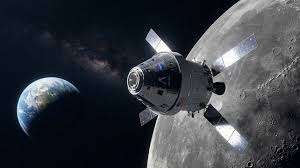
On April 1, 2026, the Space Launch System ignited at Launch Pad 39B at Kennedy Space Centre and punched the Orion spacecraft into a clear Florida sky. Onboard were Commander Reid Wiseman, Pilot Victor Glover, Mission Specialist Christina Koch, and Canadian Space Agency astronaut Jeremy Hansen. Ten days and 1.4 million kilometres later, having looped around the far side of the Moon on a free-return trajectory and broken the distance record set by Apollo 13, they splashed down in the Pacific off San Diego. Artemis II was complete.

It is humanity’s first crewed journey to the vicinity of the Moon in more than fifty years. It was also the first test of Orion’s life-support systems with humans aboard in deep space. The Orion capsule’s computers ran 20,000 times faster than those used during Apollo, while the European Service Module, built by ESA, provided propulsion, power, water, and oxygen throughout. The Space Launch System, generating roughly 15 per cent more thrust than the Saturn V, performed without issue. Technicians were already beginning work on the hardware for Artemis III before the recovery ships reached the crew.

But the mission’s significance goes far beyond the engineering feat. Artemis II is a move in a geopolitical contest. The stakes are much higher than Apollo’s. The second space race has started, and this time the prize is not prestige alone.

From Apollo to Artemis. The first space race was about ideology. The United States claimed a symbolic victory over the Soviet Union when Neil Armstrong stepped onto the Moon in July 1969. Then the urgency collapsed for several reasons. These included budget constraints, a shift toward the Space Shuttle and low-Earth orbit, and the thawing of the Cold War. The pace became a domain of cautious cooperation, culminating in the International Space Station. Even that era is over now. The Artemis programme, announced in 2017, has revived lunar ambition on entirely different terms.  The Artemis Program is built around a sustained presence and a plan to use the Moon as a proving ground for Mars.

Racing Blocs. The geopolitical architecture of the second space race is hardening into two distinct coalitions.


    • The American-led bloc is around the Artemis Accords. It has now been signed by 61 nations, establishing principles for transparency, interoperability, and the legality of resource extraction under existing international law. The partners include Canada, ESA member states, Japan, the UK, Australia, and the UAE.


    • China’s answer is the International Lunar Research Station, co-founded with Russia in 2021. Russia has become a junior partner in a China-led programme. China has recruited 13 countries to the ILRS framework, including Pakistan, Belarus, South Africa, and Venezuela, and is aggressively expanding that list through a “5-5-5” initiative. The initiative aims to enrol 50 nations, 500 institutions, and 5,000 researchers in lunar science by the early 2030s. Beijing is offering low-interest loans for ground stations, technology transfer guarantees and payload slots on Chinese missions.
    • India occupies the middle ground. India has signed the Artemis Accords while simultaneously building indigenous capability. While joining the Accord, India is not a direct participant in the NASA-led Artemis Programme’s mission-driven hardware development, but rather a partner in its guiding principles. By joining, India aligns with international principles for space exploration. These include transparency, interoperability, and the peaceful use of space resources. The agreement fosters strengthening space cooperation between the Indian Space Research Organisation (ISRO) and NASA.

South Pole: Ground Zero for the Next Space Race. Every major programme (Artemis, the Chinese Lunar Exploration Program, and Chandrayaan) targets the same narrow strip of terrain. The reason is water ice, preserved for billions of years in permanently shadowed craters at temperatures around -173°C. Through electrolysis, that ice can be split into hydrogen and oxygen (which are useful for rocket propulsion). A reliable South Pole water supply could turn the Moon into what planners call a gas station in the sky. There is also helium-3 stock, deposited by solar wind over billions of years. It is estimated at around one million tonnes across the lunar surface. Helium-3 holds promise as a fuel for aneutronic fusion reactions that produce far less radioactive waste than conventional fission. The South Pole’s value is as much strategic as it is geological. Both Artemis and the ILRS are fixated on the same area.

US Increasing the Pace. The Artemis programme, announced in 2017, is built around a sustained presence around the moon. Artemis II was the crewed proof of concept for that ecosystem. Artemis III will test lunar landing equipment in Earth orbit in 2027. Artemis IV, carrying the first crew actually to land at the South Pole, is targeted for 2028. Each member of the accord is contributing hardware or expertise (Canada’s Canadarm3 for the Gateway, ESA’s service modules, and Japan’s logistics). The programme also integrates the private industry. SpaceX holds the Artemis IV lander contract, and Blue Origin holds the Artemis V contract. Intuitive Machines and Firefly Aerospace are conducting robotic precursor missions under NASA’s Commercial Lunar Payload Services programme.

China Maintaining the Momentum. In roughly two decades, the China National Space Administration has gone from launching its first taikonaut in 2003 to landing a rover on the lunar far side, returning samples from the surface, operating its own space station, and sending a rover to Mars. The Chang’e programme has been methodical: Chang’e-4 became the first mission to soft-land on the far side in 2019; Chang’e-5 returned near-side samples in 2020; Chang’e-6 brought back far-side samples in 2024,  the first time that had been done. Chang’e-7, scheduled for late 2026, will survey the south pole for water ice. Chang’e-8, in 2028, will test in situ source utilisation. China is targeting a crewed landing by 2030. The crewed mission will adopt a dual-launch architecture. The Long March 10 rocket will carry the Mengzhou spacecraft, which will carry three taikonauts. Another one will deliver the Lanyue lander. The two vehicles will rendezvous in lunar orbit. Two crew members will descend to the surface while a third remains above. The ILRS envisions a permanent facility near the Lunar South Pole being built and operationalised in three phases—reconnaissance through 2025, construction from 2026 to 2035, and full utilisation from 2036.

Indian Effort. India’s space programme has, in a short span, moved from ambition to achievement. In August 2023, Chandrayaan-3’s soft landing near the lunar south pole was a landmark moment. No nation had touched down on that terrain before. The feat placed the Indian Space Research Organisation in a category, until then occupied only by the United States, the Soviet Union, and China, in terms of demonstrated lunar landing capability. The follow-up mission, Chandrayaan-4, targets the MM-4 site on Mons Mouton at nearly 84 degrees south latitude. The return mission planned for 2028  will push India’s indigenous capability further still.

The Stakes. The Apollo contest was primarily a demonstration of ideological and technological superiority. The Artemis contest is about infrastructure and norms. Leadership in space is not symbolic. It shapes standards, partnerships and long-term strategic influence. Whoever builds the first permanent presence at the South Pole gains the standing to set the terms for everyone who follows.  These include docking interfaces, communication protocols, and resource-extraction norms. The United States set them for the internet. China is making a methodical bid for the lunar space. The stakes are much higher than in the 1960s race. The logic is simple. Resources are needed to sustain presence, but presence is needed to access resources. What matters is who reaches first.


What Next. The Artemis programme is moving, but so is China’s IRLS. The ILRS coalition continues to add members. Artemis II proved the hardware works with people inside. The Orion heat shield held, the SLS performed, and the European Service Module delivered. Work on Artemis III and IV is already underway. On the other hand, China’s Chang’e-7 is planned for launch later in 2026 to map resources at the South Pole. The Long March 10 crewed vehicle is approaching its maiden flight. The window to set multilateral governance frameworks before the first permanent infrastructure goes into the ground is closing.


The Moon that humanity walked away from after Apollo 17 in December 1972 is returning to the centre of global attention. This time, not as a destination for brief visits but as a domain to be occupied, developed, and contested. The second space race is not a metaphor or a rhetorical convenience. It is a structural feature of twenty-first-century great-power competition. The race, playing out at a quarter-million miles, is just warming up.


Please Add Value to the write-up with your views on the subject.

1942
Default rating

Please give a thumbs up if you  like The Post?


For regular updates, please register your email here:-

Subscribe


References and credits

To all the online sites and channels.

Pics Courtesy: Internet

Disclaimer:

Information and data included in the blog are for educational & non-commercial purposes only and have been carefully adapted, excerpted, or edited from reliable and accurate sources. All copyrighted material belongs to the respective owners and is provided only for wider dissemination.


References: –

  1. NASA, “Artemis II: First crewed Orion & SLS flight test”, 2026. https://www.nasa.gov/mission/artemis-ii
  1. NASA, “NASA’s plan for sustained lunar exploration and development”, 2017. https://www.nasa.gov/artemis
  1. NASA, “The Artemis Accords”, 2020. https://www.nasa.gov/artemis-accords
  1. China National Space Administration, “China and Russia sign a MoU to construct the International Lunar Research Station”, CNSA, 2021. http://www.cnsa.gov.cn
  1. China Manned Space Agency, “Long March 10 and crewed lunar mission architecture”, 2026. http://www.cmse.gov.cn
  1. Jones A, “Chang’e-6 returns first samples from the Moon’s far side”, Space News, 25 Jun 2024. https://spacenews.com
  1. Indian Space Research Organisation, “Chandrayaan-3 mission: Successful soft landing on lunar south pole”, 2023. https://www.isro.gov.in/Chandrayaan3
  1. Indian Space Research Organisation, “Chandrayaan-4: Site selection for sample return at Mons Mouton”, Apr 2026.  https://www.isro.gov.in
  1. Ministry of External Affairs, GOI, “Joint statement from the United States and India: A partnership for the 21st century”, 2023. https://www.mea.gov.in
  1. Lowy Institute, “Artemis II and the geopolitics of the second space race”, Apr 2026. https://www.lowyinstitute.org
718: INDIA’S HUMAN SPACEFLIGHT REVIVAL: A STRATEGIC LEAP IN THE GLOBAL SPACE RACE


Article Published in the Aug 25 edition of

the “News Analytics” Journal.


On June 25, 2025, India marked a historic milestone in its space exploration journey when Group Captain Shubhanshu Shukla, a distinguished Indian Air Force (IAF) test pilot, soared into orbit aboard the Axiom-4 (Ax-4) mission. As the second Indian astronaut to reach space and the first to visit the International Space Station (ISS), Shukla’s achievement, 41 years after Wing Commander Rakesh Sharma’s 1984 flight aboard a Soviet Soyuz, signifies India’s triumphant return to human spaceflight. The Ax-4 mission, a collaborative effort involving NASA, the Indian Space Research Organisation (ISRO), the European Space Agency (ESA), and Axiom Space, underscores India’s ambition to become a global space power. This milestone is a pivotal step for the Gaganyaan program, India’s first indigenous human spaceflight initiative, and reflects its broader strategic vision in a rapidly evolving space race.


Shubhanshu Shukla: A National Icon. Born on October 10, 1985, in Lucknow, Group Captain Shukla is a seasoned IAF test pilot with over 2,000 hours of flight experience on aircraft like the Su-30 MKI, MiG-21, and Jaguar. Commissioned in 2006 after graduating from the National Defence Academy with a Bachelor’s in computer science, he later earned a Master’s in aerospace engineering from the Indian Institute of Science. As the mission pilot for Ax-4, launched on a SpaceX Falcon 9, Shukla monitored flight systems, supported docking, and ensured crew safety during the 28-hour journey to the ISS.

Axiom-4: A Landmark in Collaboration. Launched from NASA’s Kennedy Space Centre, Ax-4, led by veteran astronaut Peggy Whitson, included mission specialists from Poland and Hungary, marking their return to human spaceflight after decades. The 14 – to 21-day mission involves over 60 experiments from 31 countries. India’s seven experiments focus on microgravity plant growth (fenugreek and green gram), microbial behaviour, muscle regeneration, and tardigrade resilience, advancing space agriculture, biotechnology, and health sciences for long-duration missions and Earth applications. The mission reflects a shift toward commercial spaceflight. A 2024 U.S.-India agreement allocated a NASA seat to ISRO, enabling NASA to prioritise deep-space missions while Axiom Space manages low Earth orbit operations. For India, Ax-4 provides operational experience, de-risking Gaganyaan and enhancing ISRO’s capabilities.


The New Space Race: A Multipolar Frontier

The 21st century has transformed space from a realm of scientific exploration into a strategic arena of geopolitical rivalry, commercial opportunity, and national interest. Once dominated by superpowers vying for prestige through moon landings, space is now a multipolar landscape where the United States, China, Russia, India, and private entities compete for influence, profit, and security. The stakes are high, encompassing military capabilities, resource extraction, and technological supremacy, as nations and companies race not just to explore but to shape the future.

Military Stakes: The Weaponisation. Space is increasingly militarised, with nations developing anti-satellite (ASAT) weapons, directed energy systems, and cyber tools to disrupt critical assets like GPS, reconnaissance, and communication satellites. The U.S., China, and Russia have tested ASAT capabilities, while India demonstrated its prowess with a 2019 ASAT test. The doctrine of “space deterrence” is now integral to defence strategies, with satellite resilience and redundancy becoming priorities. Orbital debris from such tests poses a threat to commercial satellites and international cooperation, yet the absence of binding global norms heightens the risk of escalation.

Long-Term Gains: Technology, Resources, and Influence. Space exploration drives innovation in AI, robotics, materials science, and propulsion, bolstering national competitiveness. Breakthroughs in hypersonics, nuclear propulsion, and in-situ resource utilisation (ISRU) could revolutionise defence and interplanetary travel, with civilian applications enhancing industrial leadership. Resources like lunar helium-3, a potential fusion fuel, and asteroid metals critical for electronics offer economic promise. Diplomatically, space power translates to geopolitical influence. Navigation systems like GPS, Galileo, and BeiDou confer strategic leverage.

Commercial Momentum: A New Gold Rush. The commercialisation of space is a transformative trend. Companies like SpaceX, Blue Origin, Virgin Galactic, and OneWeb are pioneering technologies that redefine access to orbit. Reusable rockets have slashed launch costs, satellite mega-constellations like Starlink provide resilient communication, and space tourism is becoming a reality. Lunar and asteroid mining, although still in its early stages, promises access to resources such as helium-3 and rare metals, potentially reshaping the global economy. The 2015 U.S. Commercial Space Launch Competitiveness Act, allowing private entities to claim celestial resources, has sparked debates over international space treaties, raising concerns about monopolisation and governance.


Global Players in the Space Race

United States: Sustained Dominance. The United States has maintained its space superiority since the Apollo era. However, its focus has shifted from symbolic missions to systemic control in recent years. NASA’s Artemis program, which aims to return astronauts to the Moon and eventually launch a mission to Mars, reflects scientific ambition and a strategic desire to secure permanent infrastructure beyond Earth. At the same time, the U.S. Space Force, established in 2019 as the sixth branch of the U.S. military, demonstrates an explicit acknowledgement that space is now a warfighting domain. Beyond governmental initiatives, U.S. strategy heavily relies on public-private collaboration. SpaceX, in particular, has revolutionised launch technology with reusable rockets, significantly reducing costs and increasing launch frequency. These capabilities not only benefit commercial goals but also provide logistical and tactical advantages in a military context. The deployment of Starlink,  A satellite internet constellation, offers dual-use utility, with the potential to provide secure communications during terrestrial conflicts, as seen in Ukraine.

China: The Strategic Challenger. China has emerged as the most formidable challenger to U.S. dominance in space. With the Chinese Communist Party’s state-backed, long-term strategic planning, space is central to China’s ambitions to become a global superpower. The China National Space Administration (CNSA) has launched missions to the Moon (Chang’e series), Mars (Tianwen-1), and built its space station, Tiangong, in low Earth orbit. China’s doctrine emphasises “civil-military fusion,” integrating civilian scientific missions with military readiness. The BeiDou satellite navigation system is a clear example, providing independence from U.S.-controlled GPS and enhancing the precision of China’s missile systems. China has also demonstrated anti-satellite (ASAT) capabilities, raising concerns about the weaponisation of space. In 2007, its successful ASAT test against one of its satellites marked a turning point in the strategic perception of space conflict.

Russia: Resilient Legacy. Russia’s space program, led by Roscosmos, builds on its Soviet-era legacy with reliable Soyuz rockets and extensive experience in crewed missions. The Luna-25 mission, though unsuccessful in 2023, reflects ongoing lunar ambitions, while partnerships with China on the International Lunar Research Station signal strategic alignment. Russia’s anti-satellite (ASAT) capabilities and GLONASS navigation system underscore its focus on maintaining military and technological influence in space.


India: The Cost-Effective Contender

India has become a rising space power through its cost-effective and technologically ambitious missions. The Indian Space Research Organisation (ISRO) has demonstrated its capacity with landmark missions such as Chandrayaan (Moon), Mangalyaan (Mars), and most recently, Chandrayaan-3, which made India the first country to land on the Moon’s South Pole. With its 2019 Mission Shakti ASAT test, India joined the exclusive club of nations capable of disabling satellites in orbit, underscoring its intention not only to explore space but also to defend its national interests there. As India plans its first crewed mission (Gaganyaan), its space ambitions are increasingly aligned with long-term geopolitical calculus.

Gaganyaan: India’s Indigenous Leap. Scheduled for 2027, Gaganyaan aims to send three astronauts to a 400-kilometer orbit for three days, showcasing India’s independent human spaceflight capability. Shukla, alongside Group Captains Prasanth Balakrishnan Nair, Ajit Krishnan, and Angad Prathap, trained in Russia and Bengaluru. ISRO’s development of a human-rated launch vehicle (HLVM3), life support systems, and precursor missions, such as the Space Docking Experiment (SpaDeX) and PS4-Orbital Experiment Module (POEM-4), ensures readiness. Shukla’s Ax-4 docking experience will refine Gaganyaan’s operations.

Strategic Vision and Global Impact. Gaganyaan is a cornerstone of India’s ambitions, including the establishment of the Bharatiya Antariksh Station (BAS) by 2035, with its first module launching in 2028, and a lunar mission by 2040. Engaging over 500 Micro, Small, and Medium Enterprises (MSMEs), ISRO aims to capture 8% of the global space market by 2033, building a $44 billion space economy and positioning India among elite spacefaring nations. Ax-4 reflects India’s strategy of balancing indigenous development with international collaboration. The mission’s hands-on experience prepares ISRO for BAS and lunar goals while elevating India’s global standing.


Conclusion

Space is no longer a remote frontier of science fiction; it is the ultimate high ground in a multipolar world. Whether through state actors racing to establish dominance, private companies transforming exploration into enterprise, or militaries securing orbital advantage, the dynamics of space are shaping the 21st-century balance of power. Group Captain Shubhanshu Shukla’s Ax-4 mission marks a new chapter in India’s space journey. By carrying the Indian flag to the ISS, he paves the way for Gaganyaan, BAS, and lunar ambitions. Rooted in global collaboration and strategic vision, the mission positions India as a rising space power. As Shukla declared, “This is the beginning of India’s human spaceflight,” a call to action for a nation poised to touch the stars with glory.


Please Add Value to the write-up with your views on the subject.


1942
Default rating

Please give a thumbs up if you  like The Post?


For regular updates, please register your email here:-

Subscribe


References and credits

To all the online sites and channels.

Pics Courtesy: Internet

Disclaimer:

Information and data included in the blog are for educational & non-commercial purposes only and have been carefully adapted, excerpted, or edited from reliable and accurate sources. All copyrighted material belongs to respective owners and is provided only for wider dissemination.


References:-


  1. Johnson, M. (2024, August 15). NASA and ISRO Announce Joint Collaboration on Axiom-4 Mission. NASA Press Release.


  1. Indian Space Research Organisation (ISRO). (2025). Gaganyaan Programme: Human Spaceflight Mission.


  1. Press Trust of India. (2025, June 26). Group Captain Shubhanshu Shukla Becomes Second Indian in Space Aboard Ax-4 Mission—The Times of India.


  1. European Space Agency (ESA). (2025). Ax-4 Mission: International Collaboration and Scientific Experiments.


  1. The Hindu. (2025, June 25). Shukla’s Space Journey: From Lucknow to the ISS.


  1. SpaceX. (2025). Falcon 9 and Dragon: Axe-4 Mission Profile and Falcon 9 and Dragon spacecraft: Technical specifications.


  1. Indian Institute of Science (IISc). (2025). Microgravity Experiments for Ax-4 Mission.


  1. Press Information Bureau, Government of India. “Cabinet Approves India’s First Human Space Flight Programme Gaganyaan.” Press Release, December 28, 2018.


  1. Prasad, N. (2025, June 27). Group Captain Shukla’s Ax-4 mission: A milestone for India’s Gaganyaan. The Hindu.


  1. Kumar, S. (2025, June 26). Shubhanshu Shukla’s historic flight: India’s return to human spaceflight. The Times of India.


  1. Economic Times. “ISRO Gearing Up for Gaganyaan, Conducts Successful Tests of Crew Module Systems.” ETTech, February 2024.


  1. NDTV Science. “Gaganyaan Mission to be Launched in 2025, Says ISRO Chief.” NDTV.com, January 2025.


  1. United Nations Office for Outer Space Affairs (UNOOSA). “International Cooperation in the Peaceful Uses of Outer Space: India’s Contributions.” UNOOSA Annual Report, 2023.


  1. Xinhua News Agency. (2024, December 10). China’s space ambitions: Tiangong and beyond.


  1. Aliberti, M., & Tugnoli, M. (2016). The Chinese space programme in the public and private spheres. European Space Policy Institute.


  1. Lele, A. (2020). India’s evolving space strategy: From technology demonstration to strategic autonomy. Journal of Asian Security and International Affairs, 7(2), 145–162.


  1. Bharadwaj, A. (2023). India’s rise as a space power: Strategy and symbolism. Observer Research Foundation.

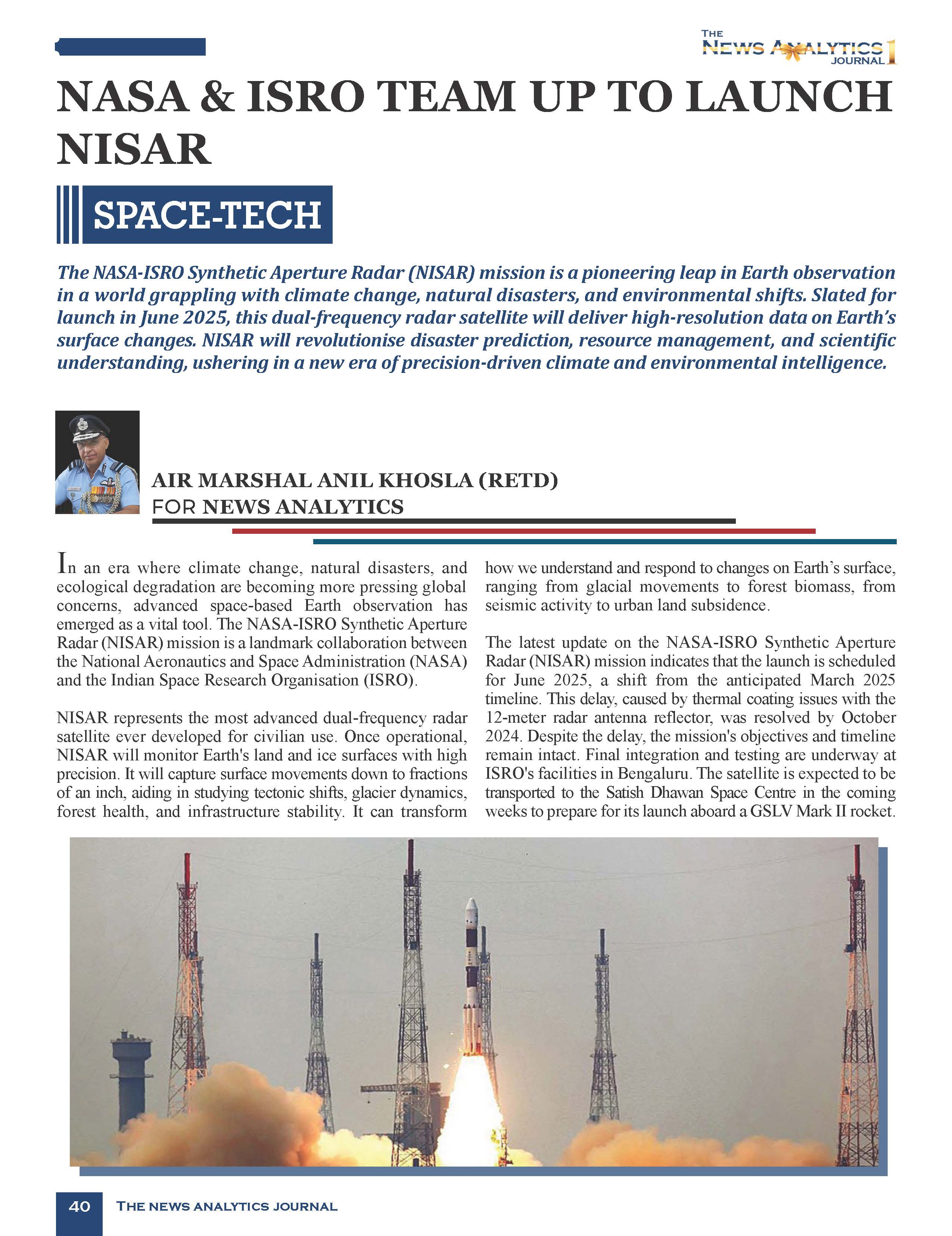
677: NISAR: MAPPING THE FUTURE AND REVOLUTIONISING CLIMATE AND DISASTER INTELLIGENCE


My article was published in the Jun edition of the

News Analytics Journal


In an era where climate change, natural disasters, and ecological degradation are becoming more pressing global concerns, advanced space-based Earth observation has emerged as a vital tool. The NASA-ISRO Synthetic Aperture Radar (NISAR) mission is a landmark collaboration between the National Aeronautics and Space Administration (NASA) and the Indian Space Research Organisation (ISRO).

NISAR represents the most advanced dual-frequency radar satellite ever developed for civilian use. Once operational, NISAR will monitor Earth’s land and ice surfaces with high precision. It will capture surface movements down to fractions of an inch, aiding in studying tectonic shifts, glacier dynamics, forest health, and infrastructure stability.​ It can transform how we understand and respond to changes on Earth’s surface, ranging from glacial movements to forest biomass, from seismic activity to urban land subsidence.

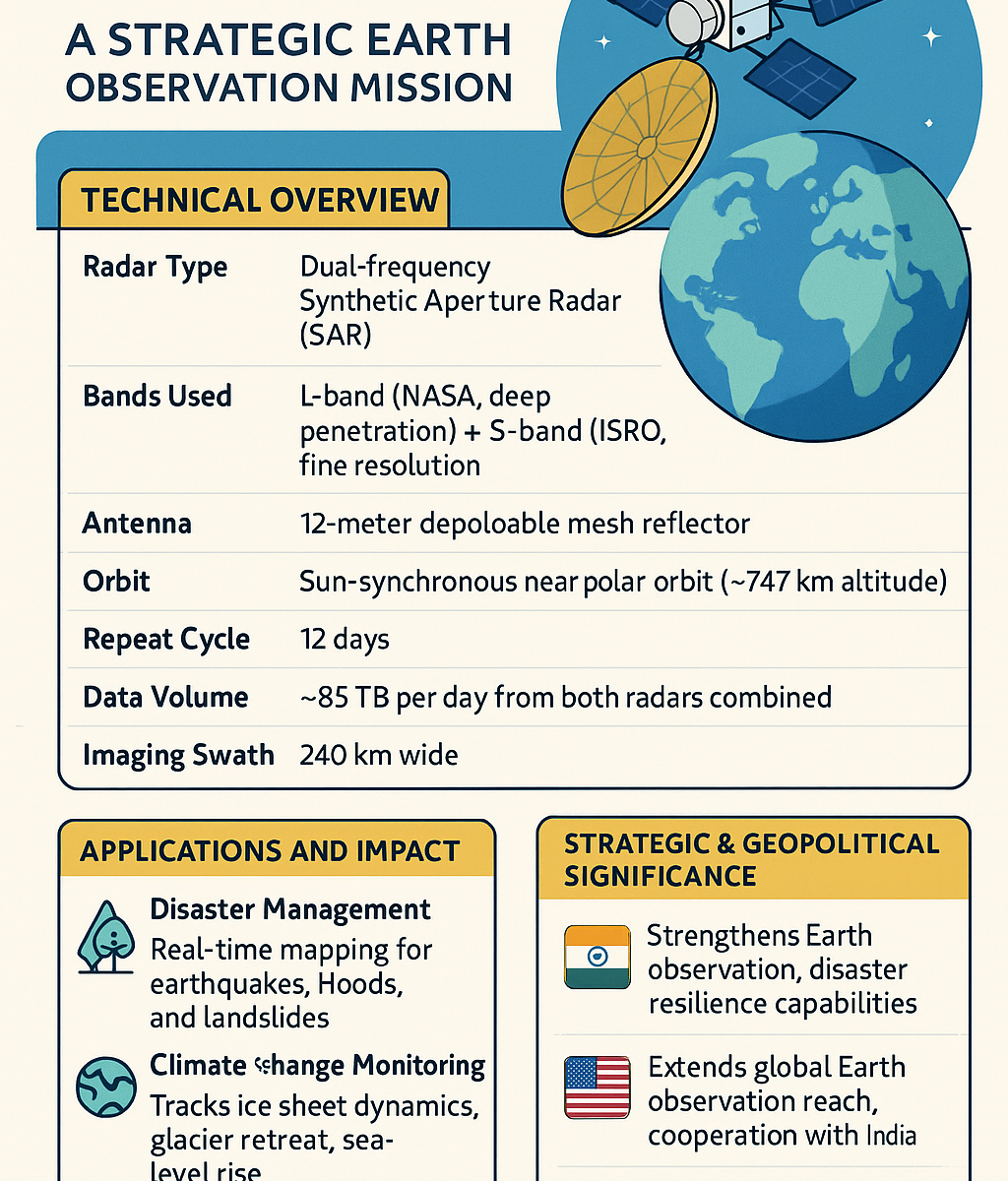
The latest update on the NASA-ISRO Synthetic Aperture Radar (NISAR) mission indicates that the launch is scheduled for late May to June 2025, a shift from the anticipated March 2025 timeline. This delay, caused by thermal coating issues with the 12-meter radar antenna reflector, was resolved by October 2024. Despite the delay, the mission’s objectives and timeline remain intact. Final integration and testing are underway at ISRO’s facilities in Bengaluru. The satellite is expected to be transported to the Satish Dhawan Space Centre in the coming weeks to prepare for its launch aboard a GSLV Mark II rocket.​


NISAR Project: Collaborative Effort


Genesis. The NISAR mission concept emerged from NASA’s 2007 Decadal Survey, which called for advanced SAR data to address gaps in Earth science. Formalised in 2014 with a partnership agreement, the project has progressed through rigorous design, testing, and integration phases. NASA’s Jet Propulsion Laboratory (JPL) and ISRO’s Space Applications Centre have worked closely to refine the mission’s science plan and hardware.

Project Details. The NISAR mission is designed to provide unprecedented global radar imagery using L-band and S-band synthetic aperture radars. NASA has provided the L-band radar system, high-rate communication subsystem, GPS receivers, and payload data systems. ISRO is contributing the S-band radar, satellite bus, and launch services via the GSLV Mk II from the Satish Dhawan Space Centre. The satellite will be placed in a sun-synchronous polar orbit at about 747 kilometres and revisit the exact location on Earth every 12 days. The SAR payload will produce radar images with a resolution of 5–10 meters and a swath of 240 kilometres, enabling wide-area monitoring of Earth’s surface with high precision. The unique dual-band system of NISAR allows it to penetrate vegetation, ice, and soil more accurately than single-frequency satellites, making it a game-changer in Earth observation. The L-band is particularly effective for tracking subsurface movement and biomass, while the S-band is more sensitive to finer surface features.

Collaboration. The NISAR partnership exemplifies international cooperation in space exploration. NASA’s investment, estimated at $1.118 billion, covers the L-band radar and critical subsystems, while ISRO’s contribution, approximately ₹788 crore ($92 million), includes the S-band radar, spacecraft bus, and launch services. This division of responsibilities optimises costs and expertise, building on NASA’s legacy of SAR missions (e.g., SEASAT in 1978) and ISRO’s advancements in satellite technology (e.g., the Chandrayaan missions). The collaboration extends beyond hardware. Joint workshops, working groups, and the NISAR Utilisation Programme announced by ISRO in July 2023 engage the global scientific community, fostering data analysis and application development. The mission’s open data policy aligns with the principles of transparency and collaboration, setting a precedent for future NASA-ISRO endeavours, including potential Mars exploration missions.


Mission Objectives and Scientific Impact

NISAR’s primary goal is to make global measurements of land surface changes, detecting movements as small as a centimeter. By mapping the globe every 12 days, the satellite will generate spatially and temporally consistent data, offering insights into complex Earth processes. Its objectives span three key domains: deformation, ecosystem structure, and ice dynamics. NISAR will monitor seismic zones, volcanic activity, and landslide-prone areas for deformation, providing early warning signs for natural disasters. In ecosystem studies, it will track forest extent, vegetation biomass, and agricultural patterns, aiding sustainable resource management. NISAR will measure glacier flow rates and ice-sheet stability for ice dynamics, contributing to our understanding of climate change and sea level rise.

All NISAR data will be freely available within one to two days of observation or hours for emergencies like natural disasters. This accessibility and NISAR’s high-resolution imagery (5-10 meters) will empower scientists, policymakers, and disaster response teams worldwide. The data can enhance infrastructure monitoring, improve agricultural management, and inform rapid disaster response, potentially saving lives and property. The open data policy also encourages collaboration and innovation, allowing for the development of new applications and tools to further leverage NISAR’s capabilities.


Applications

Natural Disaster Monitoring and Response. NISAR will be critical in mapping the aftermath and precursors of earthquakes, floods, volcanic eruptions, and landslides. The radar’s ability to detect minute ground deformations will help forecast and emergency response, reducing the human and economic cost of such events.

Climate Change Observation. The satellite will track ice sheet movement in Antarctica and Greenland, glacial retreat in the Himalayas, and coastal subsidence, all critical indicators of global climate change. NISAR data will also assist in modelling sea level rise and understanding the behaviour of the permafrost regions, which store vast amounts of greenhouse gases.

Agriculture and Forestry. NISAR’s radar can estimate biomass and crop yield, making it invaluable for food security planning and carbon stock assessment. It will monitor deforestation, forest degradation, and land-use changes, helping countries meet international commitments such as those under the Paris Agreement and REDD+ initiatives.

Urban Infrastructure Monitoring. Urban planners and disaster mitigation agencies can use NISAR to monitor growing cities’ subsidence, groundwater depletion, and infrastructure stress. Its precise deformation measurements can help predict building collapses, dam failures, and roadbed weaknesses.

Scientific and Tectonic Research. Scientists will use NISAR to understand better plate tectonics, fault line dynamics, and volcano formation. The L-band radar, in particular, is ideal for detecting ground movements as small as a few millimetres, critical for early warnings in earthquake-prone regions.

Strategic Significance

The NISAR mission is a scientific milestone and a strategic symbol of the growing India-US partnership in space technology. It reflects significant technological trust and collaborative capacity-building, especially as China expands its space and Earth observation programs.

For India, the mission provides access to advanced radar imaging technology, enhances its global space diplomacy profile, and contributes to developing disaster management and environmental monitoring capacity. For the U.S., NISAR extends Earth observation to low-latitude and tropical regions, which are difficult to monitor from NASA’s polar-focused satellites.


Conclusion

NISAR stands at the intersection of science, diplomacy, and strategic policy. As the world’s most advanced Earth-observing radar satellite, it will provide a detailed, dynamic picture of the planet’s changing surface. Whether helping farmers optimise irrigation, supporting relief efforts after natural disasters, or aiding climate scientists in tracking global warming, NISAR will become an indispensable part of humanity’s Earth-monitoring infrastructure.

By combining ISRO’s cost-effective engineering and operational expertise with NASA’s deep technological experience, NISAR heralds a new era in Earth observation and exemplifies the international collaboration required to tackle global challenges.


Please Add Value to the write-up with your views on the subject.

1942
Default rating

Please give a thumbs up if you  like The Post?


For regular updates, please register your email here:-

Subscribe


References and credits

To all the online sites and channels.

Pics Courtesy: Internet

Disclaimer:

Information and data included in the blog are for educational & non-commercial purposes only and have been carefully adapted, excerpted, or edited from reliable and accurate sources. All copyrighted material belongs to respective owners and is provided only for wider dissemination.


References: –

  1. Indian Space Research Organisation. (2024). NASA-ISRO SAR (NISAR) Mission Overview. Retrieved from https://www.isro.gov.in
  1. NASA Earth Science Division. (2023). NISAR Mission Overview. https://nisar.jpl.nasa.gov
  1. NASA Jet Propulsion Laboratory. (2024). NISAR: NASA-ISRO Synthetic Aperture Radar. https://nisar.jpl.nasa.gov
  1. ESA Earth Observation Portal. (2023). Synthetic Aperture Radar Applications in Climate and Disaster Monitoring.
  1. United Nations Office for Disaster Risk Reduction (UNDRR). (2023). Role of Earth Observation in Risk Reduction.
  1. Sharma, A. & Kumar, R. (2022). “India-US Space Cooperation: Strategic Implications.” ORF Occasional Paper, Observer Research Foundation.
  1. Ray, P. (2023). “Climate Resilience through Satellite Monitoring in South Asia.” Nature Climate Policy, 15(3), 410-417.
  1. Rosen, P. A. (2021). The NASA-ISRO Synthetic Aperture Radar (NISAR) Mission – Technologies and Techniques for Earth Science. NASA Technical Reports Server. https://ntrs.nasa.gov
  1. Ramachandran, R. (2024). “Thermal coating issue fixed on NASA-ISRO NISAR mission.” The Hindu Science & Tech. https://www.thehindu.com
  1. Nayak, A., & Kumar, P. (2023). “SAR Technology for Earth Observation: Advances with the NISAR Mission.” Current Science, 125(9), 1463–1471.
  1. Prasad, S., & Mehta, K. (2022). “Earth Observation and Indian Disaster Management.” Journal of Geospatial Technologies, 14(2), 91–104.
English हिंदी