
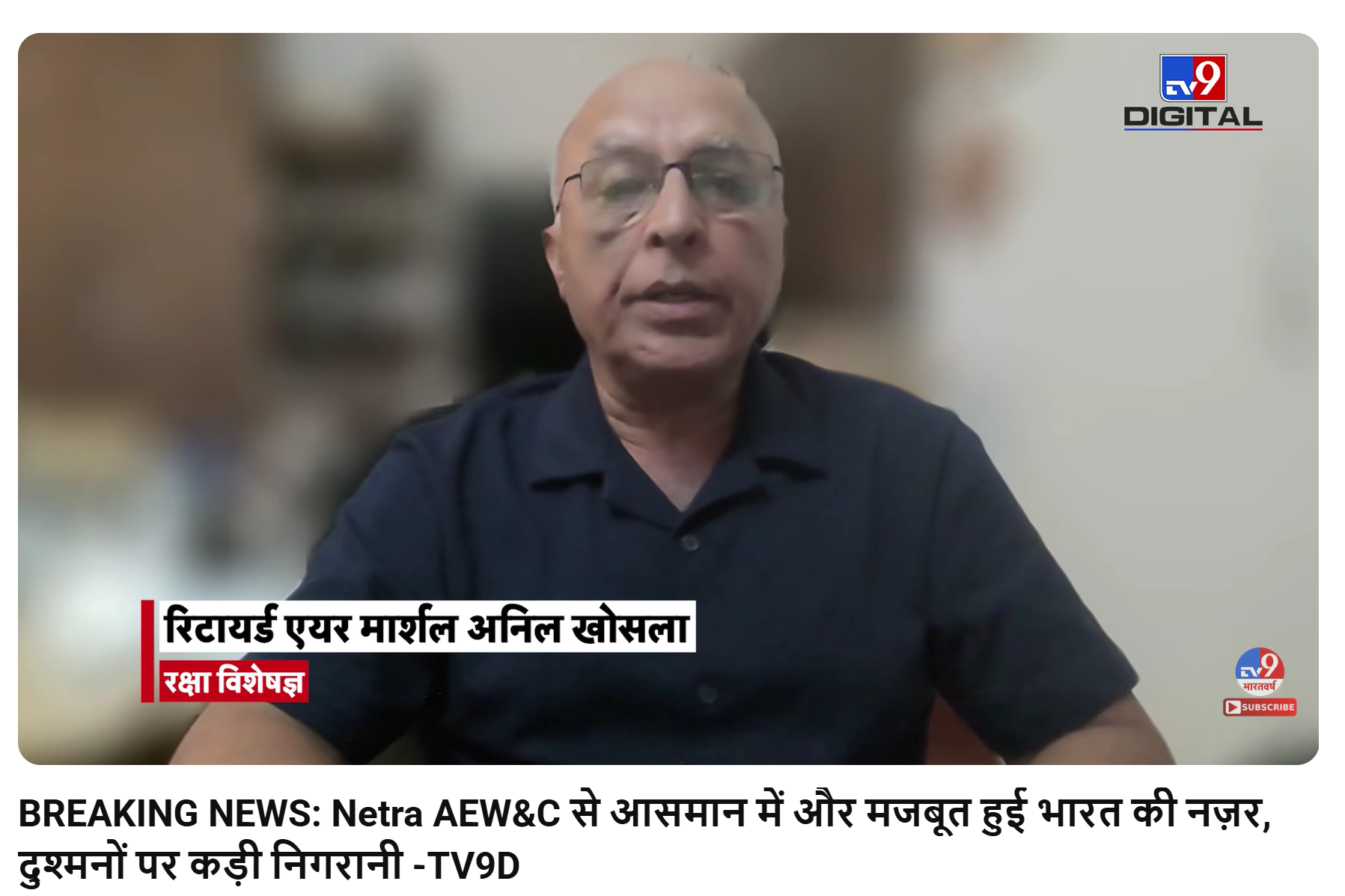
Provided video bytes and inputs on the subject to TV 9
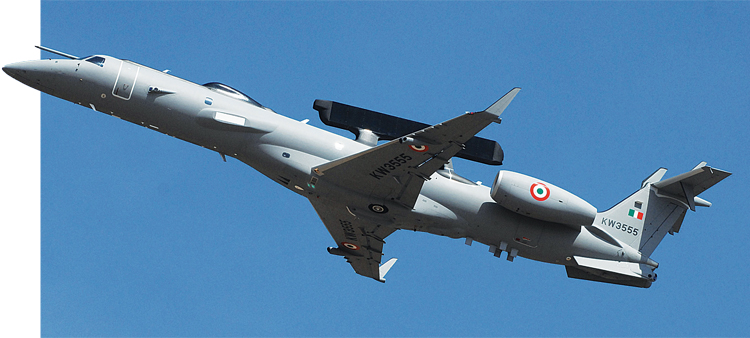
On 25 June 2026, the Defence Research and Development Organisation formally conveyed Final Operational Clearance for the Netra Airborne Early Warning and Control system to the Indian Air Force at the Centre for Airborne Systems in Bengaluru. The occasion was noted in official circles with measured satisfaction. It deserved rather more. Nine years elapsed between Initial Operational Clearance in 2017 and this milestone.
India has operated the Netra on Embraer ERJ-145 platforms for several years. The aircraft flew in support of operations following the 2019 Balakot strikes and has participated in operational exercises that tested its ability to sustain surveillance in contested electromagnetic environments.
FOC represents the stage at which a developmental platform relinquishes its limitations and transforms into a fully operational instrument of air power. It signifies unrestricted deployment and comprehensive integration within the Indian Air Force (IAF) operational frameworks.
The Netra, developed indigenously, allows India to control the radar parameters, mission software, ESM configurations, and data link protocols. In an era when adversary electronic warfare suites are specifically engineered to exploit known platform signatures and communication patterns, this freedom of customisation is not a convenience; it is a strategic necessity and an asset.
Capabilities
The Netra’s Active Electronically Scanned Array radar, mounted in a dorsal fairing on the ERJ-145, reportedly provides 240-degree surveillance coverage with detection ranges ranging from 250 to 375 kilometres, depending on the target’s radar cross-section. Operating at altitude, it overcomes the fundamental limitation of ground-based radar (the curvature of the earth and the masking effects of terrain). A cruise missile flying at 30 metres above the surface of the earth will be invisible to a ground radar station 150 kilometres away. It won’t be invisible to Netra.
This capability matters enormously in the threat environment India now faces. The conflicts in Ukraine and the Middle East have demonstrated that cruise missiles and drone swarms are no longer the preserve of great powers. Pakistan has invested substantially in loitering munitions and cruise missile capabilities. China’s inventory of precision standoff weapons is extensive and growing. India’s adversaries have, in effect, made low-observable, low-altitude attack the standard opening move of any escalatory exchange.
Netra’s signal processing architecture is designed to address this. Advanced moving-target indication algorithms filter out ground clutter and extract the signatures of slow-moving, low-radar-cross-section targets (armed UAVs and loitering munitions) from the background noise that defeats simpler systems. This is not a straightforward technical problem. Ground clutter at low altitude is dense and variable. The ability to distinguish a drone flying at 200 metres from weather returns, terrain features, and electronic noise is what separates a capable AEW system from an expensive radar platform.
The Force Multiplication Calculus
An airborne early warning platform does not shoot anything down. Its value lies in compressing decision cycles across the joint force. Netra fuses data from its primary radar, secondary surveillance radar, and ESM suite. She transmits a real-time tactical picture via secure data links to IAF fighters, surface-to-air missile batteries, and the Integrated Air Command and Control System. A pilot, upon receiving that picture, knows where the threat is, what it is, and which other friendly assets are addressing it before the threat enters his own sensor range. An Akash battery operator is cued to an incoming cruise missile while it is still 40 kilometres away, rather than learning of it from the engagement radar at 10km.
This compression of the sensor-to-shooter timeline is the operative measure of Netra’s contribution. In a high-tempo, multi-axis conflict, the difference between a twelve-minute warning and a four-minute warning is the difference between a coordinated intercept and a reactive scramble. FOC gives the IAF assurance that Netra will perform this function at full capacity, without degradation due to developmental limitations, during sustained combat operations.
The Expansion Imperative
India currently operates three Netra aircraft. Against a two-front operational requirement spanning the northern and western theatres simultaneously, three platforms represent a starting point, not a final solution. Sustained AEW coverage over two active fronts demands continuous on-station presence, which in turn demands rotation cycles and adequate reserve. Three aircraft cannot credibly provide this. The FOC must therefore be viewed as the formal beginning of a programme of scale.
Achieving FOC for the Mk-1 accelerates the case for funding and fielding these variants. It demonstrates to the defence acquisition apparatus that DRDO can deliver a complex, software-intensive, operationally demanding platform to the IAF’s qualitative requirements. The developmental pathway is defined. The Netra Mk-1A incorporates enhanced processing for low-observable target detection. The Mk-2, proposed on the Airbus A321 platform, would carry a larger radar array with 300 to 360-degree coverage, substantially increasing both the surveillance footprint and the battle management capacity of each airborne asset.
The Indigenisation Dividend
India’s defence self-reliance agenda has produced a mixed record. In some domains, the trajectory has been positive even when timelines have slipped. In others, dependence on imported platforms has persisted despite stated policy intent. Netra’s FOC represents a genuine indigenisation success in one of the most technically demanding categories of military aviation. These include integration of complex sensor fusion, real-time data processing, and secure communications in an airborne environment. The significance extends beyond the platform itself. The Centre for Airborne Systems has, over two decades, built the engineering and systems integration competence required to deliver and sustain an AEW capability.
Concluding Thoughts
The FOC for Netra is strategically significant for three reasons. First, it removes the last formal constraints on the full operational deployment of an indigenous airborne early warning platform. Second, it positions India to accelerate the Mk-1A and Mk-2 variants at a moment when the regional threat environment makes expanded AEW capacity an operational necessity rather than a procurement aspiration. Third, it validates the DRDO-industry pathway for delivering advanced airborne systems and strengthens the argument for funding the next generation of indigenous surveillance and battle management platforms.
Modern air power is, at its core, an information contest. The side that sees first, identifies first, and coordinates first holds the initiative. Netra, fully cleared and operationally deployed, moves India measurably closer to holding that initiative over the contested airspace that will define any future conflict with regional adversaries.
Please Add Value to the write-up with your views on the subject.
For regular updates, please register your email here:-
References and credits
To all the online sites and channels.
Pics Courtesy: Internet
Disclaimer:
Information and data included in the blog are for educational & non-commercial purposes only and have been carefully adapted, excerpted, or edited from reliable and accurate sources. All copyrighted material belongs to the respective owners and is provided only for wider dissemination.