58: INTERESTING TIDBIT ABOUT: GENESIS OF BOYD’S OODA LOOP THEORY

John Richard Boyd (January 23, 1927 – March 9, 1997) was a United States Air Force fighter pilot and Pentagon consultant in the second half of the 20th century.

Boyd’s key concept was that of the decision cycle or OODA loop, the process by which an entity (either an individual or an organization) reacts to an event.


Genesis

In the era of 1950s air warfare, there was a peculiar anomaly. In dog fights between MiG-15s and F-86s, the plane that was expected to win (the MiG-15) constantly lost. To explore this, Colonel John Boyd (one of the best Air Force pilots in history) decided to research and get to the root of the situation. The question was, how could an inferior aircraft win so decisively?


Boyd’s Analysis: The reason, he concluded, was something that nobody had thought was particularly important. It was the fact that the F-86 Sabre had a hydraulic flight stick whereas the MiG-15 had a manual flight stick. Without hydraulics, it took slightly more physical energy to move the MiG-15 flight stick than it did the F-86 flight stick. Even though the MiG-15 would turn faster (or climb higher) once the stick was moved, the amount of energy it took to move the stick was greater for the MiG-15 pilot. With each iteration, the MiG-15 pilot grew a little more fatigued than the F-86 pilot. And as he got more fatigued, it took just a little bit longer to complete his OODA loop. The MiG-15 pilot didn’t lose because he got outfought. He lost because he got out-OODAed.


These insights lead us to Boyd’s Theory of OODA LOOP. In the aerial dogfight, the loop looks like this…

Observe the other aircraft

Orient yourself by analyzing the situation

Decide what to do

Act (steer or fire)


OODA Cycle Theory.
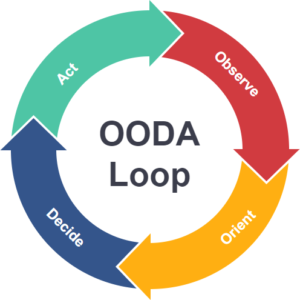
Boyd hypothesized that all intelligent organisms and organizations undergo a continuous cycle of interaction with their environment. Boyd breaks this cycle down to four interrelated and overlapping processes through which one cycles continuously:

  • Observation: the collection of data by means of the senses
  • Orientation: the analysis and synthesis of data to form one’s current mental perspective
  • Decision: the determination of a course of action based on one’s current mental perspective
  • Action: the physical playing-out of decisions


This decision cycle is thus known as the OODA loop. Boyd theorized that large organizations such as corporations, governments, or militaries possessed a hierarchy of OODA loops at tactical, grand-tactical (operational art), and strategic levels. It is relevant to any kind of competitive environment: business, politics, sports, even the struggle of organisms to survive.


References:

https://www.linkedin.com/pulse/research-reveals-four-steps-learn-faster-better-than-everyone

https://en.wikipedia.org/wiki/John_Boyd_(military_strategist)

Pic Courtesy: https://online.visual-paradigm.com/knowledge/decision-analysis/what-is-ooda-loop/

 

55: FIRST GENERATION FIGHTER AIRCRAFT

Categorization of fighter jets in generations is a classification system used around the world. The basic classification into five generations is widely accepted and recognized. Some accounts have subdivided the 4th generation into 4 and 4.5, or 4+ and 4++.


First generation subsonic jet fighters (mid 1940s to mid 1950s)

  • This category comprised of the earliest subsonic jet fighters that appeared during and after the last years of World War II.


  • They were similar in most respects to their piston-engine contemporaries, having generally straight wings and being of wood and/or light alloy construction.


  • The main feature of Gen 1 fighter was their advance in speed over its piston-engine predecessors. Introduction of the swept wing allowed transonic speeds to be reached, but controllability was often limited at such speeds. The jet engines did not have afterburners and the aircraft operated in the subsonic regime.


  • They had basic avionic They had no radars or self- protection countermeasures, and were armed with machine guns or cannons, as well as unguided bombs and rockets.


  • These aircraft were typically aimed at the air-superiority interceptor role.

According to available sources, fighters in this generation include the following:-

  • Messerschmitt Me 262 Schwalbe
  • Heinkel He 162 Salamander
  • Messershmitt Me 162 Komet
  • Gloster Meteor
  • de Havilland Vampire
  • de Havilland Venom
  • Hawker Siddeley/Armstrong Whitworth Sea Hawk
  • Supermarine Attacker
  • Supermarine Swift
  • Lockheed P-80 (F-80) Shooting Star
  • Republic F-84 Thunderjet / Thunderstreak
  • North American F-86 Sabre
  • Northrop F-89 Scorpion
  • Lockheed F-94 Starfire
  • McDonnell FH-1 Phantom
  • Vought F6U Pirate
  • Vought F7U Cutlass
  • North American FJ (F-1) Fury
  • McDonnell F2H (F-2) Banshee
  • McDonnell F3H (F-3) Demon
  • Douglas F4D (F-6) Skyray
  • Grumman F9F (F-9) Panther / Cougar
  • Douglas F3D (F-10) Skyknight
  • Mikoyan Gurevich MiG-15
  • Mikoyan Gurevich MiG-17
  • Lavochkin La-15
  • Yakovlev Yak-15
  • Yakovlev Yak-17
  • Yakovlev Yak-23
  • Dassault Ouragan
  • Dassault Mystčre
  • Saab J21R
  • Saab J29
  • Saab Lansen
  • Avro Canada CF-100 Canuck


Coming Up: Generation wise description (2nd – 6th)

References:

https://www.airforce-technology.com/features/top-sixth-generation-fighter-jets/

https://www.sldinfo.com/wp-content/uploads/2014/05/Air-Combat-Seminar-summary-AndrewMcL.pdf

https://www.fighterworld.com.au/az-of-fighter-aircraft/five-generations-of-jets

http://www.codeonemagazine.com/archives/2005/articles/oct_05/

https://en.wikipedia.org/wiki/Fifth_generation_fighter

https://www.airforce-technology.com/features/top-sixth-generation-fighter-jets/?utm_source=Army%20Technology&utm_medium=website&utm_campaign=Must%20Read&utm_content=Image

https://migflug.com/jetflights/fighter-jet-generations/

http://www.aerospaceweb.org/question/history/q0182.shtml


Comments and value additions are most welcome

54: CLASSIFICATION OF JET FIGHTERS: GENERATIONS

Categorization of fighter jets in generations is a classification system used around the world. I have always maintained that this is a broad concept with hazy demarcation lines. Although dependent upon the advancement of technology it does not define specific features or capabilities and has a large scope for difference of opinion. Recent discussion with Former CAS, Air Chief Marshal NC Suri, triggered the quest for further research and study of the subject. Sharing few of the related aspects.

Classification.  Relevant aspects are as follows:

  • This method of categorization is unofficial because there is no authorized classification concept based on features or performance of aircraft.


  • There is no clearly defined line between successive generations. Different authorities have identified different technology jumps as the key ones, dividing fighter development into different numbers of generations.


  • Each category represents a certain class of technology used in the aircraft: avionics, systems, design, features, engines and weapons etc. Higher generation means a more technologically advanced aircraft.


  • A Generational shift in jet fighter aircraft occurs when a technological innovation cannot be incorporated into an existing aircraft through upgrades and retrospective fit-outs.


  • The criteria for the various generations are not universally accepted and are subject to differing opinions.

Genesis.

  • The origin of the generational categorization of jet combat aircraft is debatable.


  • The usage appears to have first appeared in Russia during the mid-1990s when officials were planning a competitor to the American Joint Strike Fighter. They categorized previous fighters into four categories and concluded that the next one would be in the fifth generation.


  • Aviation Week correspondent Bill Sweetman claims it originated from within Lockheed Martin’s business development machine shortly after the X-35 was declared the successful JSF solution in 2001.


Previous attempts at Classification

  • In 1990 air historian Richard P. Hallion proposed a classification of jet fighters into six generations up to that time. Some others classified them into five generations up to around the same period.


  • Taylor and Guilmartin named four classifications based on the maximum speed; subsonic, transonic, supersonic and Mach 2, and added a fifth “new” generation with multi-mission capability.


  • Russian and Chinese observers also categorize aircraft into generations, albeit with differing and broader definitions across fewer generations that relate more towards their own platforms and capabilities.

Accepted Classification Norms. In 2004 Aerospaceweb listed division into five generations. The basic classification into five generations has since been widely accepted. Regardless of their origins Five generations are now widely recognised, with development of a sixth under way. Some accounts have subdivided the 4th generation into 4 and 4.5, or 4+ and 4++.


Coming Up: Generation wise description

References:

https://www.airforce-technology.com/features/top-sixth-generation-fighter-jets/

https://www.sldinfo.com/wp-content/uploads/2014/05/Air-Combat-Seminar-summary-AndrewMcL.pdf

https://www.fighterworld.com.au/az-of-fighter-aircraft/five-generations-of-jets

http://www.codeonemagazine.com/archives/2005/articles/oct_05/

https://en.wikipedia.org/wiki/Fifth_generation_fighter

https://www.airforce-technology.com/features/top-sixth-generation-fighter-jets/?utm_source=Army%20Technology&utm_medium=website&utm_campaign=Must%20Read&utm_content=Image

https://migflug.com/jetflights/fighter-jet-generations/

http://www.aerospaceweb.org/question/history/q0182.shtml


Comments and value additions are most welcome

English हिंदी