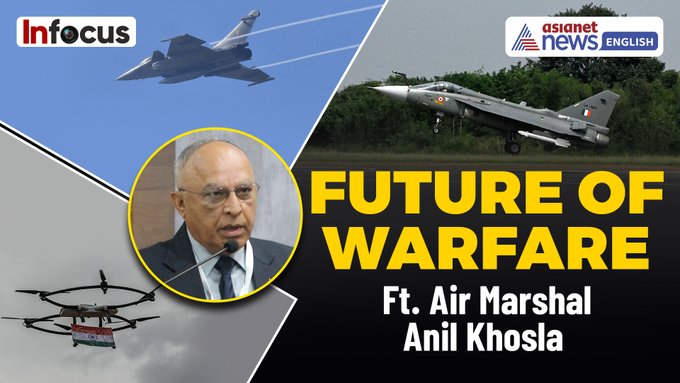
The most consequential and least publicly debated development in contemporary strategic competition is not the size of nuclear arsenals or the speed of delivery systems — it is the progressive blurring of the boundary between conventional and nuclear warfare. What was once a relatively clear firebreak — a conceptual and operational boundary separating nuclear from non-nuclear conflict — is being systematically eroded, with consequences that existing deterrence theory is only partially equipped to address.
Conventional-Nuclear Integration.
CNI refers to the deliberate intertwining of conventional and nuclear forces, capabilities, command structures, and operational planning, making the two domains increasingly difficult to distinguish in real time.
Historical Context. During the Cold War, nuclear and conventional forces operated in largely distinct domains. Nuclear weapons were instruments of strategic deterrence. They were designed to prevent large-scale war through the theory of mutually assured destruction. On the other hand, the conventional forces handled limited conflicts and regional engagements. This separation between the two domains was reinforced by centralised political control over nuclear weapons and decentralised military command of conventional forces. Signalling mechanisms were used to avoid accidental escalation. The end of the Cold War clearly separated the two domains. However, there was a reversal in the trend in the 2010s. Countries have developed long-range dual-capable systems and doctrines specifically designed to exploit the gap between the two domains. CNI has become an overt strategy.
Integration Dimensions. CNI manifests across four distinct but interconnected dimensions.
-
- Dual-use Delivery Systems. Platforms and missiles have become capable of delivering either conventional or nuclear warheads. There is no externally observable difference between them. A launch detected by an adversary’s early warning system is indistinguishable in its initial phase. The adversary must decide whether to absorb the hit and assess, or respond according to the worst-case assumption. This decision has to be made in minutes, under maximum psychological stress, with incomplete information.
-
- Co-mingled Force Postures. The nuclear and conventional forces are being physically based in proximity. They are using the same infrastructure, C2 structures, and logistics chains. The attacker cannot surgically eliminate the conventional threat without simultaneously threatening the nuclear one. Targeting these bases in a conventional campaign carries unavoidable nuclear implications.
-
- Integrated Command and Control. The same communications network, battle management system, and command node are shared by both the conventional and nuclear weapon systems. Any attack on C2 infrastructure may be interpreted as a deliberate attack on nuclear capability. This may trigger a nuclear response. Equally, cyberattacks intended for conventional purposes could be misread as attempts to turn off nuclear deterrence entirely.
-
- Doctrinal Integration. Maintaining an ambiguous boundary between conventional and nuclear forces has become a deliberate strategic policy norm. This also involves openly incorporating nuclear options into conventional operational planning, and vice versa.
Analytical Perspective
Integration Justifications. CNI is not an accident of technological development — it is a deliberate strategic choice driven by identifiable incentives that differ by power competition. The growing effect is a strategic environment in which every major nuclear power has rational incentives to pursue CNI.
-
- For states with inferior conventional forces, integration offers a force multiplier. The threat of nuclearising any conventional action extends the nuclear deterrence to the battlefield level conventional domain. Pakistan’s Nasr tactical nuclear weapon is being explicitly projected as a weapon of choice to offset India’s conventional superiority.
-
- For states with superior conventional forces, integration creates strategic ambiguity. This complicates the adversary’s planning because it cannot determine whether a given strike package carries conventional or nuclear munitions. It must plan for the worst case — constraining its own conventional operations and extending deterrence value beyond what the nuclear arsenal alone would provide.
-
- For states facing precision conventional strike threats to their nuclear forces, integration is a survivability strategy. Dispersing nuclear assets among conventional forces makes them harder to target in a disarming first strike. China’s co-location of conventional and nuclear brigades within the PLA Rocket Force reflects precisely this logic.
Stability Implications. The strategic stability consequences of CNI can be seen at three levels.
-
- Crisis Instability. CNI compresses decision-making timelines. The nuclear deterrence model assumed that decision-makers would have hours, if not days, to assess an adversary’s intentions and respond. Dual-use missiles with short flight times have reduced that window to a few minutes. A decision-maker facing an incoming ballistic-missile salvo must choose quickly between waiting for an impact assessment and responding before the command structure is destroyed. CNI structurally favours the latter choice, which increases the risk of unintended escalation. Hypersonic glide vehicles, travelling at speeds exceeding Mach 5 on unpredictable trajectories, compress this timeline further still.
-
- Arms Race Instability. CNI generates poorly understood action-reaction dynamics. Conventional military improvements developed for entirely non-nuclear purposes (precision strike, long-range ballistic missiles, advanced ISR, etc) are perceived by adversaries as threats to nuclear survivability. Neither side may consciously be pursuing nuclear advantage, but the conventional competition produces nuclear instability as a byproduct. This dynamic is currently not being managed.
-
- Extended Deterrence Instability. CNI complicates alliance management in many ways. The credibility of the extended deterrence guarantee depends on whether the alliance would respond to a conventional strike with nuclear force when an ally faces a dual-capable missile threat. CNI makes this threshold question permanently ambiguous. The challenge of synchronising this politically across multiple capitals, where public understanding of CNI remains limited, is substantial.
Indian Context. India and Pakistan’s deterrence dynamic has evolved to the point where the conventional and nuclear domains are deeply intertwined. The Stability-Instability Paradox is at its most dangerous in this dynamic. At the same time, CNI removes the buffer zone that previously separated the two levels of conflict. The existence of nuclear weapons paradoxically encourages more intense conventional hostility. Pakistan has created a force structure in which the tactical nuclear weapons are dispersed in the field. The 2019 Balakot airstrikes and the 2025 Operation Sindoor highlighted the dependence of de-escalation on communication channels and leadership restraint. These cannot be assumed in all scenarios.
Managing CNI.
The policy responses to CNI are genuinely difficult because the drivers of integration are perceived as rational from each state’s perspective; however, the systemic effects are destabilising.
Challenges. Arms control approaches face a fundamental verification problem — dual-use systems cannot be meaningfully constrained without intrusive inspection regimes that states are unwilling to accept. Declaratory approaches — no-first-use pledges, negative security assurances — are undermined by doctrinal ambiguity and the credibility problems inherent in any commitment that is hard to verify and costly to honour under fire.
Suggested Actions. The more promising near-term mitigations focus on risk reduction rather than elimination. These include: –
-
- Establishment of direct military-to-military communication channels specifically designed for CNI-related crisis management.
-
- Notifying adversaries when conventional strikes approach nuclear-sensitive facilities by agreed protocols.
-
- Separation of nuclear and conventional assets, to reduce entanglement.
-
- Renewed investment in strategic stability dialogues that explicitly address the conventional-nuclear interface rather than treating nuclear issues in isolation from conventional military competition.
Concluding Thought.
The fundamental intellectual challenge is that CNI requires deterrence theory to be substantially rebuilt for the prevailing environment. The goal of CNI should not be to make nuclear war easier to fight, but to make conventional war too dangerous to start. That rebuilding is urgently needed. It has barely begun.
Please Add Value to the write-up with your views on the subject.
For regular updates, please register your email here:-
References and credits
To all the online sites and channels.
Pics Courtesy: Internet
Disclaimer:
Information and data included in the blog are for educational & non-commercial purposes only and have been carefully adapted, excerpted, or edited from reliable and accurate sources. All copyrighted material belongs to the respective owners and is provided only for wider dissemination.
References:
- Freedman, L. (2003). The evolution of nuclear strategy (3rd ed.). Palgrave Macmillan.
- Acton, J. M. (2018). Escalation through entanglement: How the vulnerability of command-and-control systems raises the risks of an inadvertent nuclear war. Carnegie Endowment for International Peace.
- Posen, B. R. (1991). Inadvertent escalation: Conventional war and nuclear risks. Cornell University Press.
- Lieber, K. A., & Press, D. G. (2017). The new era of counterforce: Technological change and the future of nuclear deterrence. International Security, 41(4), 9–49.
- Speier, R., Nacouzi, G., Lee, C., & Moore, R. (2017). Hypersonic missile nonproliferation: Hindering the spread of a new class of weapons. RAND Corporation.
- Narang, V. (2014). Nuclear strategy in the modern era: Regional powers and international conflict. Princeton University Press.
- Dalton, T., & Krepon, M. (2016). A normal nuclear Pakistan. Stimson Center.