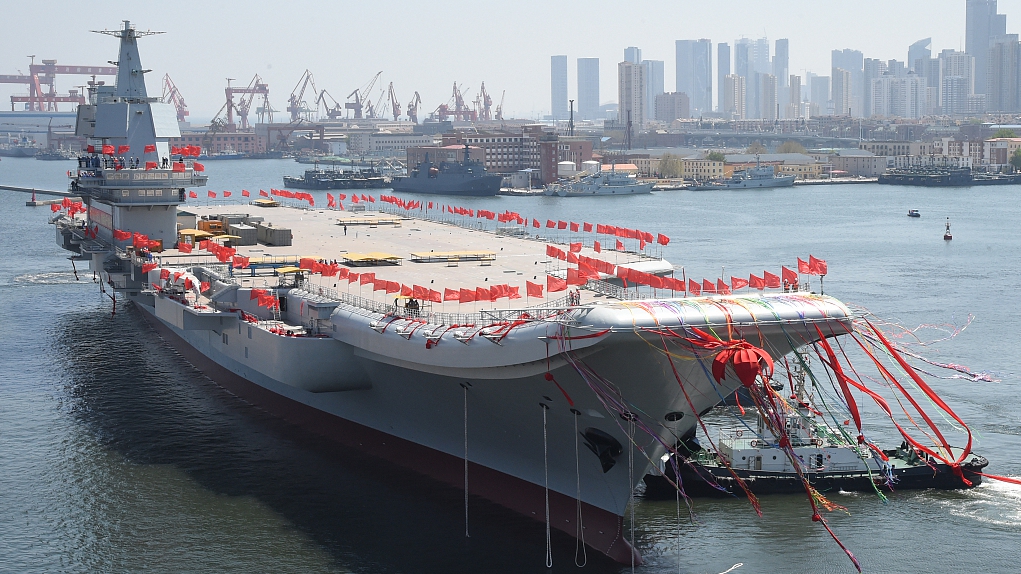
Over the next couple of years, the People’s Liberation Army Navy (PLAN) will undertake intensive trials of its third aircraft carrier, the Fujian (Type-003), to bring it into service. China has been intent on building its carrier capacity since the 1970s. The last five decades have been a journey of discovery and determination for a country with no previous experience.
The Chinese effort accelerated in the 1980s under Liu Huaqing, commander-in-chief of the navy, who subsequently served on the Central Military Commission. He is widely credited as the father of the modern Chinese navy and its carrier capability.
First Step. Beijing’s early moves were surreptitious and creative. China closely studied the decommissioned Australian aircraft carrier HMAS Melbourne, sold for scrap to a Chinese company in 1985 with a surprising amount of its aircraft-operating equipment – catapults, arresting gear, mirror landing sights and flight deck arrangements – left intact. The ship was not dismantled for many years after it arrived in China.
First Carrier with Soviet Role. In the 1990s, China gambled on the purchased ex-Soviet hybrid carriers Kiev and Minsk and the incomplete hull of the larger Varyag (which would have been a sister ship to the Soviet and then Russian navy’s Admiral Kuznetsov), supposedly to turn them into floating hotels or casinos. China reportedly also bought eight truckloads of detailed design drawings of the ship. While two of them, after extensive evaluation, took on their civilian role, the ex-Varyag was completed in China as the PLAN’s prototype carrier Liaoning.
Gaining Experience. The effort allowed the PLAN to gain rapid early experience in carrier operations at sea (ship handling and maintenance skills), carrier air operations and integration into a task-group formation. Chinese planners carefully studied the practices of other navies (particularly those of the US Navy). Two months after the PLAN commissioned the Liaoning, it carried out the first landing and take-off of a J-15 fighter at sea. The PLAN also adapted US flight-deck procedures and organisations, including colour-coding uniforms to denote the role of personnel.
Carrier Capability Development. Beijing declared the Liaoning ‘combat ready’ in November 2016 and an initial operating capability for the carrier and its task group in May 2018. China’s second carrier, the Shandong, a domestically built improved version, was commissioned in December 2019 and supposedly achieved initial operating capability the following year. Given its challenges, the PLAN’s development of carrier capabilities was relatively cautious, and the operational capability remains limited. The carriers only recently have embarked on more extended deployments further from Chinese home waters.
Carrier Air Operations: Teething Problems. The PLAN’s carrier fighter, the J-15 is an unlicensed development of the Russian Su-33. It has shortcomings due to its size, weight and operational characteristics. Carrier-capable fighters are in relatively short supply and barely sufficient for two carrier air groups. The size and design of the existing carriers, especially the lack of a catapult launching system, significantly constrain aircraft range and payload. More complex operational flying at sea, including night-time operations, remains a work in progress. Pilot training is another area of concern.
Fujian (Type-003). The arrival of the Fujian addresses some of the earlier issues. The ship represents a significant advance on the navy’s first two carriers, the Liaoning and Shandong. The indigenous design is larger than its predecessors and equipped with an electromagnetic catapult launch system rather than a ‘ski ramp’ for aircraft launches, enabling a larger and more capable air group. While that requires a step change in the PLAN’s capacity to support the operation of such a vessel, it will bring the PLAN closer to its ambition for a fully capable carrier force.
Carrier Air Operations: Work in Progress. Fujian is expected to introduce electromagnetic catapult system technology. Operationalisation of the system has its challenges. While upgrading the J-15 aircraft, China is developing a carrier-compatible variant of the J-35 aircraft, a variant of the J-31. At least three prototypes of the twin-engine J-35 are undergoing flight testing. Along with the J-35, the PLAN is supporting the development of the KJ-600 airborne early warning platform for carrier operations, with several airframes under consideration.
Future Trajectory. The PLAN’s experience of fielding the Fujian will influence the further development of its carrier force. PLAN appears intent on having a force of at least six carriers sometimes (maybe by the 2030s). While a fully-fledged carrier force may still be some way off, with a decade of experience in carrier operations, the PLAN appears to have mastered a limited degree of power projection capability. Future ships may be larger with nuclear propulsion.
The International Institute for Strategic studies, “The Military Balance 2024”.
Disclaimer:
Information and data included in the blog are for educational & non-commercial purposes only and have been carefully adapted, excerpted, or edited from sources deemed reliable and accurate. All copyrighted material belongs to respective owners and is provided only for purposes of wider dissemination.
The PLA Central Military Commission (CMC) underwent a reshuffle in 2022 following the 20th National Party Congress, and a new cabinet and defence minister were appointed in early 2023 at the 14th National People’s Congress in Beijing. A number of these officials, hand-picked by President Xi Jinping for their positions in the CMC, have since been implicated in an anti-corruption investigation in China.
The PLA Rocket Force (PLARF). PLARF oversees China’s land-based nuclear missiles and the Equipment Development Department. PLARF’s commander and its political commissar were replaced in August 2023. Vice Admiral Wang Houbin (PLAN) replaced the PLARF commander and General Xu Xisheng (former deputy political commissar of the Southern Theatre Command) replaced the PLARF political commissar. Both replacements were drawn from outside the PLARF.
Defence Minister. Defence Minister Li Shangfu was ousted from his role. General Li previously served as the head of the PLA’s Equipment Development Department. The Equipment Development Department stated on its social media account that it was investigating corruption allegations related to procurement bids and the formation of private cliques within the armed forces at high levels that resulted in cronyism and a lack of focus on the core task of building combat readiness. Former defence minister Wei Fenghe (formerly commanded the PLARF) also disappeared from public view, reportedly under investigation.
Comments.
Corruption alone is an unlikely explanation for the removal by Xi of top military officials that he had appointed just months earlier, raising the possibility that intelligence leaks may have triggered the action.
The leadership changes also suggest that despite Xi’s calls for absolute loyalty and a zero-tolerance approach to corruption, problems within the PLA persist.
PLA Army.
PLA Army is studying and analysing the lessons emerging out of the Ukraine war. Some of the areas, being looked into are as follows:-
The heavy use of UAVs by both Russia and Ukraine is likely behind the higher prominence accorded to the discussion of the concept of ‘low altitude control and dominance’ by the PLA Army.
The protracted nature of the fighting in Ukraine is likely to drive the PLA Army to re-examine operational plans for long-term industrial and logistic sustainment, as well as for casualty evacuation and treatment.
Review of the recruitment process, and policies related to conscription and reservists. In 2023, the PLA revised its existing regulations covering the recruitment of civilian and military personnel, including conscripts.
Russia’s struggles to mobilise personnel for service in Ukraine would influence the CMC’s ability to conduct wartime mobilisation.
In 2023, the PLA continued to roll out new armour, artillery and air-defence platforms to its combined arms units, and the re-equipment of combined arms regiments in Xinjiang Military District now appears to be nearing completion.
PLA is continuing the re-equipment of aviation brigades with the Z-20 medium helicopter, with priority to PLA Army’s air assault formations assigned to the Eastern and Western theatre commands, as well as the Xinjiang and Tibet military districts.
Comments
Given the scale of a 2017 army reorganisation, a new round of major force-structure changes within the regular service is unlikely in the short term.
The PLA Reserve Force may attract greater attention.
A review of the recruitment process seems to be aimed at the goal of enlisting and retaining greater numbers of high-quality recruits, particularly college graduates and those with key scientific and engineering skill sets.
Significant changes to the army’s re-equipment plan are unlikely before the start of the next five-year plan in 2026.
PLA Navy.
Assertiveness. China’s naval and maritime security arms became increasingly assertive in their activities. China’s navy increased operations in the waters around Taiwan, while the Chinese coast guard undertook activities that bordered on aggressiveness. Beijing’s maritime militia assets, which purport to be part of its fishing fleet, conducted operations in the waters disputed with the Philippines around the Spratly Islands and in Vietnam’s exclusive economic zone.
Force Development.
Surface Ships. The PLAN in 2023 added the eighth Type-055 (Renhai) cruiser to its operational fleet along with additional Type-054A frigates. It also launched its new Type-054B frigate, which appears to be larger and considerably more capable. The new frigate promises to be a major addition to the PLAN’s blue-water fleet as a component of future task-group deployments.
Aircraft Carrier. China is progressing with its third indigenous aircraft carrier, the Fujian (Type-003). It is claimed to be more potent and capable than the existing Liaoning (Type-001) and the Shandong (Type-002) aircraft carriers. The new carrier is expected to be commissioned in 2025.
Submarines. PLAN’s focus has increased towards developing sub-surface forces. Those efforts include the development of the new-generation Type-095 nuclear-powered attack submarine and Type-096 nuclear-powered ballistic-missile submarine. It is assessed that the PLAN has equipped its Type-094 ballistic missile boats with a longer-range submarine-launched ballistic missile, the JL-3 (CH-SS-N-20). That would represent a significant step up in capability.
Amphibious Capability. PLA Navy appears to be strengthening its LHD forces. It launched the fourth Type-075 Yushenclass LHD in December. The navy has also added at least two new Zubr-class air-cushion landing craft to its inventory, as well as other landing craft.
Force Deployment. PLAN is expanding its pattern of long-range deployments.
The PLA Navy continued to develop its bluewater deployment capabilities, including with more significant formations. Units led by Type-075 (Yushen) amphibious assault ships (LHDs) made two forays into the Western Pacific, including waters near Japan.
PLA Navy also gradually pushed carrier operations further out with the Liaoning and Shandong sailing out towards Guam and undertaking more intense air operations. The PLAN, in September 2023, carried out a further large-scale carrier exercise in the Western Pacific.
The PLAN carried out exercises with Russia and Iran and with Russia and South Africa, port visits in the United Arab Emirates and Pakistan, and a rare foray to Africa’s Atlantic coast with a port visit to Nigeria. Another set of manoeuvres with Russia off Alaska in August 2023 further underscored that the.
Comments.
The PLAN is now regularly and widely hyped as ‘the world’s largest navy’.
While the PLAN’s fleet has evolved to be more modern, it still lags behind the US Navy in terms of total tonnage and capability. The gap seems to be narrowing.
PLAN, despite its increasing emergence in the world’s oceans, is still significantly concentrated in waters closer to home.
PLA Air Force
The PLA Air Force (PLAAF) received considerable numbers of combat aircraft in 2023, in part from an unexpected source. Along with the new-build Chengdu J-10C Firebird, Shenyang J-16 Flanker N and Chengdu J-20 multi-role fighter aircraft, the service received upward of 200 tactical combat aircraft from the PLAN. Many of the transferred aircraft are unlikely to be retained in the medium term. The initial version of the Xi’an JH-7, the JH-7 Flounder A, as well as the even older Shenyang J-8 Finback, may be retired.
Maritime Air. The PLAN appears to be divesting itself of almost all its land-based multi-role fighters, ground attack aircraft, bomber aircraft and numerous air bases. The PLAAF appears to be taking on the roles of the transferred formations. The PLA Air Force would, therefore, be responsible for land-based maritime strike tasks, requiring considerable coordination with the PLAN. The addition of the PLAN aircraft will bolster the PLAAF’s inventory of modern aircraft types.
J-20 Aircraft. The J-20 heavy multi-role fighter is the premier combat aircraft in PLAAF service, introduced in 2017–18. China had built around 200 J-20s by the fourth quarter of the year and operates six operational brigades equipped with it. An upgraded J-20 is undergoing flight tests. The aircraft’s forward fuselage has been modified with a revised cockpit profile and a raised fuselage section to the rear of the cockpit. The aircraft may have been fitted with the Shenyang WS-15 afterburning turbofan engine. The WS-15 offers more power than the previously used Shenyang WS-10.
Other Aircraft.
The PLAAF continued to induct Shenyang’s two-seat J-16 Flanker aircraft, enhancing its long-range surface-attack capability. As an air-to-air platform, it is likely to carry under development PL-17 (CH-AA-X-12) very long-range air-to-air missile.
PLAAF’s low-observable bomber, the Xi’an H-20 continues to be under development.
The roles of the PLAAF bomber force continued to expand. The Xi’an H-6 carries the air-launched Mach 3+ WZ-8 reconnaissance UAV that, post-release, climbs to an altitude of up to 100,000 feet to fly its mission profile. The WZ-8 has now entered service.
Comments
There is an important lesson to be learnt (Indivisibility of airpower) from China’s reorganisation and placing all the air assets and roles under the PLAAF.
China’s aviation industry is well established.
PLAAF is expanding rapidly in numerical strength.
Doubts still exist about the stated and claimed capabilities of its aircraft.
PLA Rocket Force
The PLA Rocket Force (PLARF) has been enhancing and expanding its capabilities across all ranges, at varying qualitative and quantitative paces. The PLARF’s capabilities are evolving most rapidly through the introduction of intermediate-range ballistic missiles (IRBMs) to replace some medium-range ballistic missiles (MRBMs) that are being retired.
DF-26 with Swappable Warheads. Variants of the DF-21 (CH-SS-5) MRBM, including the nuclear-armed DF-21A (CH-SS-5 Mod 2) and conventional DF-21C (CH-SS-5 Mod 4), are being swiftly replaced by the longer-range DF-26 (CH-SS- 18) IRBM. The DF-26 is designed to allow crews to rapidly swap conventional and nuclear warheads and to conduct precision strikes against land and maritime targets up to the second island chain.
Hypersonic Glide Vehicle (HGV). The PLARF is also developing and inducting an IRBM armed with a hypersonic glide vehicle (HGV) that appears to be similar to the DF-26 and is known as the DF-27 (CH-SS-X-24). The PLARF is re-equipping some of its brigades (in eastern China) with the DF-17 (CH-SS-22) medium-range missile carrying an HGV. The DF-17’s HGV is more manoeuvrable and therefore more capable of evading adversary missile defences than traditional ballistic missiles of similar ranges. Its features suggest the weapon was developed to strike high-value targets such as air and missile defences at the outset of a conflict, opening the way for less manoeuvrable systems to reach their objective with a lower probability of being intercepted.
ICBMs with MIRV. China continues to modernise its intercontinental ballistic missile (ICBM) forces. The DF-41 (CH-SS-20) is the PLARF’s newest ICBM and is equipped with multiple independently targetable re-entry vehicles (MIRVs), thereby providing China with a higher number of warheads with a smaller force. The DF-41 brigades will be equipped with fewer launchers than with the DF-31.
Enhancement of Survivability and Responsiveness. PLARF is upgrading the DF-31A (CH-SS-10 Mod 2) to the more mobile and responsive DF-31AG configuration with an integrated transport erector launcher that is off-road capable. The PLARF is also expanding a small number of silos for the older DF-5 (CH-SS-4) ICBM at several locations. A 2021 report also revealed that China was building three large ICBM silo fields (in the. western part of the country), to enhance survivability and responsiveness.
Comments.
The DF-26’s so-called hot-swappable warhead would introduce a potential escalation dilemma, adversaries targeted with the weapon may be unsure if they are under nuclear or conventional attack before the warhead detonates.
Hypersonic weapons and MIRV capability will change the dynamics of warfare and start a new arms race.
China may be moving from a stated policy of nuclear no-first-use and a minimum credible deterrent to a launch-on-warning posture.
The International Institute for Strategic Studies, “The Military Balance 2024”.
To all the online sites and channels.
Disclaimer:
Information and data included in the blog are for educational & non-commercial purposes only and have been carefully adapted, excerpted, or edited from sources deemed reliable and accurate. All copyrighted material belongs to respective owners and is provided only for purposes of wider dissemination.
References:-
The International Institute for Strategic studies, “The Military Balance 2024”.
Information and data included in the blog are for educational & non-commercial purposes only and have been carefully adapted, excerpted, or edited from sources deemed reliable and accurate. All copyrighted material belongs to respective owners and is provided only for purposes of wider dissemination.