
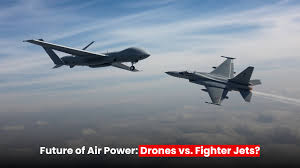
The Russian-Ukrainian war and the US-Israel-Iran War have reignited the debate about the cost-benefit analysis of fighter jets vis-à-vis long-range vectors and drones. Some analysts feel that the fighter aircraft have become obsolete.
The Cost-Benefit Reality
The approximate cost of various air platforms and weapon systems is as follows: –
-
- A modern aircraft would cost anywhere between 100 and 120 million dollars.
- A loitering munition would cost approximately 20,000–50,000 dollars.
- A cruise missile would cost around 2 million dollars.
On a per-unit cost basis, the cost asymmetry among fighter aircraft, loitering munitions, and cruise missiles is stark. However, the cost-benefit analysis in warfare is not purely a function of unit cost. It depends on the effect achieved (Bang for Buck). It is measured across the full mission profile, including survivability, reusability, flexibility, and escalation management.
Fighter jets are reusable. A modern fighter that completes a strike mission and returns to base amortises its $100 million price tag across every sortie it flies over a 30-year service life. A cruise missile or kamikaze drone is single-use. When you factor in sortie economics across a full operational life, the per-strike cost of a modern multi-role fighter often competes favourably with standoff missiles for missions that don’t require deep penetration of layered air defences.
The greater cost-benefit advantage of long-range vectors and drones lies in scenarios with high attrition risk. This is the genuine strategic logic behind standoff weapons. It is not that they are cheaper in absolute terms, but that they preserve the most expensive and irreplaceable asset in the equation, i.e. the trained pilot. It takes a decade and an enormous investment to produce a combat-ready fighter pilot. A cruise missile battery can be replenished within months if the industrial base is functioning.
Drones depend on datalinks, GPS navigation, and communications. In a sophisticated EW environment, these dependencies become vulnerabilities. Fighter jets, on the other hand, with onboard avionics, EW self-protection suites, and pilot judgment, prove to be more robust.
Obsolescence / Relevance Deliberation
The short answer is that the recent wars have not signalled the obsolescence of fighter aircraft. However, they have issued a clear warning about the utilisation pattern.
The Ukraine conflict has demonstrated that surface-launched systems can achieve kill rates against aircraft. It makes conventional air operations near the front line prohibitively expensive. The aircraft do not become irrelevant, but they are forced to operate at the outer edge of the threat envelope. They serve as a standoff launch platform.
The drone utilisation in the war in Ukraine is revolutionary. Cheap FPV drones could destroy air and ground platforms worth millions. They could disrupt logistics and even impose psychological costs.
The US-Israel-Iran exchanges offer a different set of lessons. This is the cost-benefit problem in reverse: defending against mass drone and missile attacks with expensive interceptors is fiscally unsustainable in repeated exchanges.
The broader conclusion these conflicts bring out is that fighter jets have not become obsolete. However, their employment methodology has evolved. They are not the sole instrument of the kill chain of air combat.
Noteworthy Changes to be Adapted
Three things have genuinely changed, and air forces need to absorb them.
-
- First, forward basing of high-value aircraft is more dangerous than ever. The logic of static forward basing is being superseded by the demands of survivability, dispersal, and mobility.
-
- Second, electronic warfare and EW resilience are now as important as kinetic capability. Investment in the electromagnetic dimension of air combat is no longer optional.
-
- Third, the cost-comparison (between incoming projectiles and defence weapons) problem is real and demands a structural response. The answer is to develop a layered response that places cheap effectors against cheap threats and reserves expensive ones for high-value targets.
Fighter jets remain the most flexible, survivable, and capable instruments of air power available for high-end contested environments.
Fighter jets are the most capable instruments of air power. However, no single platform or vector can win the modern air war. The answer lies in integrating manned fighters, Long-range standoff weapons, drones, and layered air defences into a coherent operational architecture.
The air forces that will prevail in future conflicts are not those with the most aircraft, nor those that have replaced aircraft with drones. The ones that will prevail are the ones that have integrated the full spectrum of air power tools under a doctrine sophisticated enough to deploy them appropriately.
Please Add Value to the write-up with your views on the subject.
For regular updates, please register your email here:-
References and credits
To all the online sites and channels.
Pics Courtesy: Internet
Disclaimer:
Information and data included in the blog are for educational & non-commercial purposes only and have been carefully adapted, excerpted, or edited from reliable and accurate sources. All copyrighted material belongs to the respective owners and is provided only for wider dissemination.