
802: AIR WARFARE IN THE 2026 IRAN WAR (ANALYTICAL SUMMARY WITH LESSONS)


(Facts and figures are from open sources. These could have been inflated or repressed as part of the propaganda/Information warfare. A clearer picture would emerge with the passage of time)


900 strikes in 12 hours. Supreme Leader eliminated on Day 1. 15,000 targets struck by Day 14. Six weeks and Iran is still fighting.

Tactical dominance does not mean a strategic outcome.


The Opening Salvo

  • US and Israel launched (on 28 Feb) the most intensive air campaign since Iraq 2003.
  • Israel flew about 200 fighters, including F-35I Adirs. The IAF’s largest combat sortie in history.
  • US committed B-2 Spirits, B-1Bs, B-52s, carrier aircraft, F-15Es, and hundreds of Tomahawks.
  • Approximately 200 Iranian air defence systems were struck in the opening hours. Air control over western Iran to central Tehran was established within 24 hours.
  • John Warden’s five-ring model was applied in planning and execution.
  • Theory was sound, Execution was technically flawless, but the strategic outcomes did not match the expectations.

Air power can destroy (punish). It cannot always compel.


Coalition Air Campaign

The scale was extraordinary. 60% of mission-capable B-1s flew from RAF Fairford. Two carriers operated in the theatre. Some relevant aspects for consideration are: –

  • Munitions Scalability. After Day 10, JDAM-class munitions were used instead of the standoff weapons. Precision munitions deplete faster than assumed during planning. Numbers matter as much as quality. Ukraine taught the lesson, and Iran has confirmed it.  Indigenous production capacity must match operational tempo.
  • Basing Vulnerability. Iran struck Prince Sultan Air Base — destroying an E-3G AWACS and multiple KC-135 tankers. Forward bases are lucrative targets. Depth, dispersion, and resilience are important. (The Indian Air Force’s own 2022 dispersal doctrine has been validated — in someone else’s war).
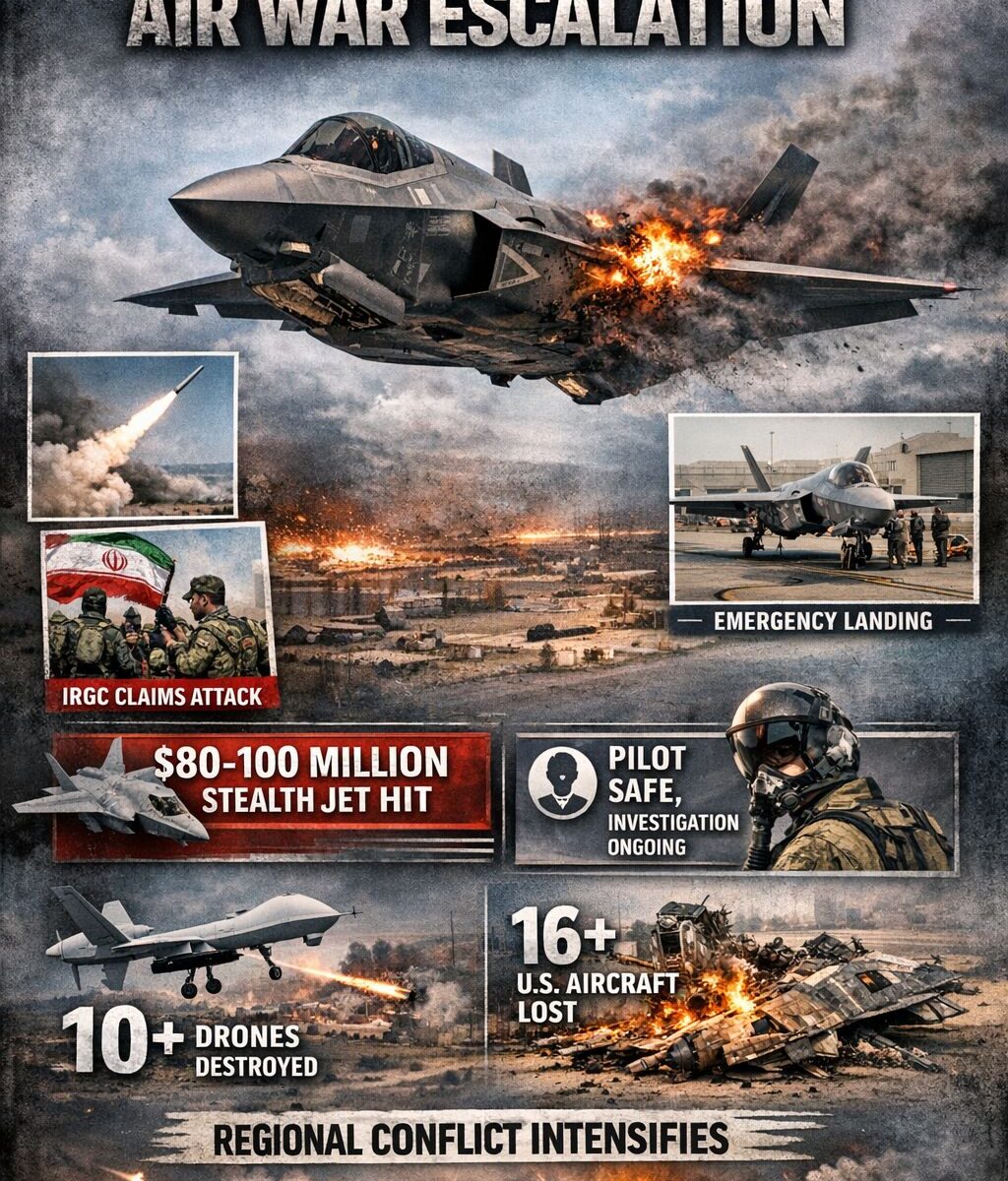
  • Losses. Reportedly, 4 F-15Es were lost (3 in a friendly fire incident, a coalition coordination). 1 F-35A damaged. 1 A-10C shot down. 17 MQ-9s downed by Iranian air defences. Poorly integrated air defence networks with limited combat experience cost lives.
  • Inter-service jointness failures are not unique to any one military. Jointness failures are doctrinal and training failures, not technical ones.

The F-35 being tracked is the campaign’s most significant disclosure. Stealth does not mean invisibility. The margin is further narrowing as detection technology proliferates. Air warfare is gradually shifting from platform-centric to weapon-centric. Any air plan built around the stealthy penetration capability of new-generation platforms requires reassessment.


Iran’s IADS

  • Iran’s IADS is a hybrid, layered network. It consists of the S-300 (long-range), Bavar-373, Khordad-15 (medium-range), and point-defence platforms (short-range).
  • Three traits made it resilient. layered architecture, mobility, and redundancy.


Air superiority is not binary in nature; there are shades. It exists on a spectrum. The prevailing conditions across the spectrum determine the operational options. An honest assessment of that position is vital for planners.


Mosaic Defence (Reason for Decapitation Failure)

The strategic shock was not that Iran’s air defences survived. It was that Iran’s will and capacity to fight survived the killing of its supreme leader.

  • Mosaic Defence was formalised under Gen Mohammad Jafari in 2005. It was stress-tested for the first time.
  • IRGC restructured into 31 autonomous provincial commands. Each with independent weapons, intelligence, and command systems.
  •  Successors were already named three ranks deep for every position. Decapitation activated resilience mechanisms specifically engineered for exactly this contingency.
  • Iran’s Foreign Minister stated it directly on 1 Mar: “Bombings in our capital have no impact on our ability to conduct war. Decentralised Mosaic Defence enables us to decide when and how war will end.”

China’s systems destruction warfare operates on precisely the same logic. It has designed its offensive capability to execute decapitation (at numerous levels). For India, planning against both adversaries simultaneously makes this aspect the defining operational challenge.


Iran’s Air Campaign (Asymmetry Counter Air)

  • Iran’s conventional air force could not survive in contested airspace. Most were destroyed on the ground.
  • Ballistic missiles and Shahed-style drones ensured strategic achievement. Multi-speed attacks, i.e., slow drones first to saturate the radar network, followed by ballistic missiles.
  • Coalition claimed an interception rate of 80–90% by networked Patriot, THAAD, Arrow, and Aegis.
  • The ballistic missile launches declined by approximately 90% by mid-March. But drone attacks persisted.  Drones can be manufactured in civilian facilities from commercially available components faster than they can be expended or suppressed. Quantity is a quality of its own.
  • The exchange economics: –
  • Shahed drone: Approx cost $20,000,
  • Patriot interceptor: $4 million
  • Arrow 3 interceptor: significantly more
  • Exchange ratio: decisively favourable to the attacker
  • It reiterates the need for destroying the launch capability besides neutralising the incoming projectiles.

This is the democratisation of warfare made operational. It is an era of low-cost systems as the primary weapons of air warfare. The drone swarms and loitering munitions in adequate numbers are a must. Counter-drone capabilities that do not rely on expensive interceptors as the primary response are equally urgent. Project Kusha points in the right direction. The counter-drone dimension needs equivalent investment.


Strait Of Hormuz

  • 20% of the world’s oil passes through the Strait. Closure is creating a global energy crisis.
  • Iran is still dominating the Strait despite the destruction of its Navy. Thousands of airstrikes on Iranian territory have not reopened 20 miles of water.
  • Geographic chokepoints confer an asymmetric defensive advantage.

India’s energy security depends substantially on hydrocarbons from the Gulf. Closure of the Strait has direct and severe economic consequences for India. It is a wake-up call. Energy security requires a holistic review (sources, supply routes, alternative energy, and indigenous capabilities).


Some Tactical Aspects

  • In all the contemporary air campaigns, non-kinetic offensive action has preceded the kinetic attacks.  The cyber and EW warfare offensives create chaos by disabling enemy sensors and C2 centres.
  • AI-driven battle management systems enable coordination among multiple stakeholders at speeds beyond human-led cycles.
  • ISR dominance (SIGINT, HUMINT, real-time intelligence) is the key to an effective air campaign.
  • Underground and Hardened Assets are essential for survival. Iran stored its missiles in dispersed underground storage facilities. The tunnel entrances to these storage facilities can be targeted, but deeply buried assets remain safe.


What the Campaign Could Achieve: –

  • Destruction of Infrastructure on a large scale.
  • Suppression of conventional IADS.
  • Elimination of Leadership with precision.
  • Establishment and holding of Air superiority.

What the Campaign Couldn’t Achieve: –

  • Translation of dominance into collapse (Regime change).
  • Complete elimination of dispersed, mobile, production-capable war-fighting capabilities.
  • Reopening of a maritime chokepoint.
  • Forcing a political outcome against a prepared adversary


The Bottom Line


Iran apparently spent 20 years studying American air power and designing a system specifically to absorb its most devastating application.

India must study this campaign (along with other contemporary ones) with rigour.

The lessons are glaring. Institutional will is required to learn and implement them rather than relearning the hard way.


Please Add Value to the write-up with your views on the subject.


1879
Default rating

Please give a thumbs up if you  like The Post?


For regular updates, please register your email here:-

Subscribe


References and credits

To all the online sites and channels.

Pics Courtesy: Internet

Disclaimer:

Information and data included in the blog are for educational & non-commercial purposes only and have been carefully adapted, excerpted, or edited from reliable and accurate sources. All copyrighted material belongs to the respective owners and is provided only for wider dissemination.
 

793: IRAN WAR: MANY QUESTIONS, DIVERSE PERCEPTIONS (PART 3)


The answers are collated from open sources. Information warfare and propaganda are generally active, as in any other war. Bias in the answers cannot be ruled out.


GEOPOLITICAL & STRATEGIC

  1. How did the conflict affect US relations with Gulf Arab states?

Iran’s decision to strike across nine countries — including previously neutral Gulf states such as Oman and Qatar — has had the paradoxical effect of pushing Gulf governments into closer alignment with the US-Israeli security architecture, even as they publicly demand restraint. Iran’s widening of attacks to encompass all GCC states has demonstrated that passive neutrality offers no protection, underscoring that regional threats are better countered collectively. Intelligence-sharing and covert security cooperation between Israel and Gulf neighbours would deepen.


  1. Did the conflict accelerate or derail Israel-Saudi normalisation?

The conflict has deepened covert alignment but left formal normalisation frozen. The Palestinian issue — dramatically amplified in the Arab public sphere by the Gaza war — remains a fundamental political obstacle that shared threat perception of Iran cannot simply override. Arab governments already obtain meaningful security benefits from covert cooperation with Israel without assuming the domestic political risk of formal recognition. US officials, including Senator Graham, have publicly framed the post-war period as a “historic opportunity” to revive normalisation once Iranian pressure recedes, but the structural obstacles remain formidable.


DIPLOMACY & CEASEFIRE

  1. What diplomatic efforts were made to prevent full-scale war, and why did they fail?

Oman led indirect nuclear negotiations in Geneva in February 2026, with Iran reportedly agreeing to forgo stockpiling enriched uranium and accept permanent, full IAEA verification — significant concessions that represented a near-breakthrough. Oman’s Foreign Minister publicly declared peace “within reach.” The US and Israel launched Operation Epic Fury regardless, with Oman’s mediator expressing he was “dismayed” that active negotiations had been overridden by military action. The deeper failure of diplomacy traces to accumulated mistrust, Iran’s reconstitution of its programme after the 2025 setback, the IAEA’s discovery of hidden HEU in February 2026, and an Israeli/US assessment that a narrow preemption window was closing.


  1. What were the terms of any ceasefire agreements, and what role did mediators play?

The June 2025 Twelve-Day War ended in a US-brokered ceasefire on 24 June 2025. No comparable agreement has been reached in the ongoing 2026 conflict. Khamenei’s assassination has shattered the established rules of engagement, leaving the conflict without clear diplomatic off-ramps and deepening into a war of attrition. Oman served as the primary channel for both the 2025 ceasefire and the aborted 2026 nuclear talks. Qatar hosted US military assets while simultaneously coming under Iranian attack — a contradictory position that constrained its mediating role. Egypt maintained a relative distance. China is positioning itself as the primary post-conflict stabiliser, dispatching diplomatic envoys while warning publicly against spreading “flames of war.”


CONSEQUENCES & LONG-TERM OUTLOOK

  1. How significantly has Iran’s military capability been degraded?

Severely. Israel claims approximately 60–90% of Iran’s estimated 500 ballistic missile launchers have been destroyed or disabled. Over 100 air defence systems and 120 detection systems were eliminated in the opening 24 hours. More than 1,700 military industrial assets have been struck, with the campaign working systematically through Iran’s missile production chain. Over 50 naval vessels have been destroyed, effectively decimating Iran’s navy. Nuclear infrastructure is severely damaged. IRGC command nodes and leadership have been targeted. Iran retains core enrichment knowledge, some dispersed material, and the institutional will to reconstitute — but its conventional military power has been fundamentally degraded.


  1. What is the long-term trajectory of Iran-Israel relations?

Persistent, entrenched hostility is the most probable outcome. Iran perceives the conflict as existential and has shown no interest in an off-ramp, calculating that a prolonged war of attrition may eventually favour it. The appointment of Mojtaba Khamenei — widely described as more hardline than his father and closely tied to the IRGC — signals continuity of confrontational posture rather than moderation. The most dangerous near-term risks are an Iranian nuclear dash to weaponise as the ultimate deterrent, or asymmetric revenge operations through reconstituted proxy networks or cyber means. A long-term “new normal” of uneasy, diminished-Iran deterrence is possible if the regime survives in weakened form; outright regime collapse would open a different and highly unpredictable set of outcomes.


  1. Has the conflict changed the doctrine of deterrence in the Middle East?

Profoundly. The killing of a sitting Supreme Leader has shattered red lines that were previously considered inviolable, signalling that no leader or asset is beyond reach for a sufficiently capable and determined adversary. The conflict has validated the superiority of offensive preemption combined with layered defence over passive deterrence-by-denial, and has demonstrated that proxy networks are unreliable against determined state-on-state military action. The perverse global signal, noted by RAND analysts, is that states without nuclear weapons remain existentially vulnerable to decapitation strikes, which may accelerate proliferation among states watching the outcome and drawing their own conclusions.


  1. What are the military lessons for nations like India from this conflict?

The conflict carries direct and urgent lessons for Mission Sudarshan Chakra and India’s broader defence doctrine. First, layered, integrated air defence, combining short-, medium-, and long-range systems with real-time intelligence, is essential against mixed salvos of ballistic missiles, cruise missiles, and drones — validating India’s multi-layered architecture. Second, interceptor stockpile depth is as critical as interception technology itself; saturation rapidly depletes inventories, making directed-energy weapons an operational necessity for economically defeating cheap drone swarms. Third, offensive counter-strikes on launcher and C2 infrastructure are force multipliers — pure defence is strategically and financially unsustainable against a determined adversary, validating the offensive-defensive integration at the heart of Mission Sudarshan Chakra. Fourth, space-based early warning and AI-driven command and control are now operational necessities, not aspirational future capabilities. Fifth, allied interoperability — the US-Israeli model — multiplies system effectiveness in ways that no single national architecture can replicate, underscoring the importance of India deepening defence technology partnerships with the US and Israel in particular.


(More to follow)


Please Add Value to the write-up with your views on the subject.


1879
Default rating

Please give a thumbs up if you  like The Post?


For regular updates, please register your email here:-

Subscribe


References and credits

To all the online sites and channels.

Pics Courtesy: Internet

Disclaimer:

Information and data included in the blog are for educational & non-commercial purposes only and have been carefully adapted, excerpted, or edited from reliable and accurate sources. All copyrighted material belongs to the respective owners and is provided only for wider dissemination.


543: RUSSIAN USE OF THE ORESHNIK MISSILE AND ITS STRATEGIC IMPLICATIONS


Sputnik News,  a Russian news agency and radio broadcast  service, sought inputs on the Analakshya Project.


Article on the subject:-


RUSSIAN USE OF THE ORESHNIK MISSILE AND ITS STRATEGIC IMPLICATIONS


The development and deployment of the Oreshnik missile, a hypersonic, intermediate-range ballistic missile (IRBM) by Russia, marks a significant shift in global military power dynamics. First publicly revealed in November 2024 during a strike on Ukraine, the Oreshnik has been described as a highly advanced missile capable of carrying both conventional and nuclear warheads with hypersonic speeds exceeding Mach 10. The missile’s introduction highlights Russia’s continued push towards leveraging next-generation military technology to assert its influence, challenge adversaries, and fortify its strategic deterrence capabilities​


Oreshnik Missile


Hypersonic Speed and Manoeuvrability. The Oreshnik missile stands out for its hypersonic velocity, with reports indicating speeds of around 2.5 to 3 kilometers per second (Mach 10). This speed renders it nearly immune to current air defence systems, as interception at such velocities requires cutting-edge detection and response technologies. Hypersonic missiles like Oreshnik can also perform mid-flight manoeuvres, making their trajectory unpredictable and further complicating interception efforts​.


Multiple Independently Targetable Reentry Vehicles (MIRVs). Oreshnik reportedly carries multiple independently targetable warheads (MIRVs), with estimates ranging from three to six warheads per missile. These MIRVs can be programmed to strike different targets simultaneously or overwhelm defence systems through sheer volume. The MIRV capability enhances the missile’s destructive potential, especially in scenarios where multiple high-value targets are prioritized​.


Intermediate Range and Versatility. The missile’s range is believed to fall between 3,000 and 5,000 kilometers, making it an intermediate-range ballistic missile (IRBM). This range covers a significant portion of Europe and parts of Asia, but falls short of reaching the United States. However, this strategic range allows Russia to maintain a strong regional deterrence posture, capable of targeting European NATO members and other adversaries within proximity.

Operational Deployment and Combat Testing. Russia’s first known operational use of the Oreshnik missile occurred in November 2024, when it was deployed against the Ukrainian city of Dnipro. According to reports, this strike served as a combat test for the missile in a non-nuclear configuration. Russian President Vladimir Putin claimed that the test was successful, with the missile reaching its intended target without interception. The deployment was designed to demonstrate Russia’s capability to strike with precision and lethality, even in high-pressure combat environments. This deployment signals a shift in Russian military doctrine, emphasising the operational use of hypersonic weapons for both deterrence and offensive purposes. By using Oreshnik in combat, Russia showcased its ability to field advanced missile systems under real-world conditions, sending a clear message to both adversaries and allies regarding its military prowess.


Strategic Implications


Strengthening Regional Deterrence. The Oreshnik missile significantly enhances Russia’s ability to deter regional adversaries. Its intermediate range allows Russia to project power across Eastern Europe, the Middle East, and parts of Central Asia, creating a buffer zone of influence where neighbouring countries must consider the risk of hypersonic strikes. This capability provides Russia with a powerful bargaining chip in diplomatic negotiations, particularly in contexts involving NATO expansion, territorial disputes, and geopolitical tensions​.


Challenging NATO’s Defence Systems. NATO’s current air defence systems are primarily designed to intercept traditional ballistic and cruise missiles. The deployment of Oreshnik, with its hypersonic speed and manoeuvrability, presents a significant challenge to these systems. NATO countries may be forced to accelerate the development of hypersonic defence systems or pursue alternative deterrent measures, increasing military expenditures and deepening the arms race between Russia and Western powers​.


Arms Control Frameworks. The introduction of Oreshnik further undermines the already fragile state of global arms control agreements. In 2019, both Russia and the United States withdrew from the Intermediate-Range Nuclear Forces (INF) Treaty, which previously prohibited the development of missiles with ranges between 500 and 5,500 kilometers. The Oreshnik missile, with its intermediate range and potential nuclear capability, exacerbates concerns over the proliferation of such systems and the absence of regulatory frameworks to mitigate their deployment​.


Global Reactions and Countermeasures


United States and NATO. In response to the growing hypersonic threat, the United States and NATO have intensified efforts to develop next-generation missile defence systems. Programs focusing on space-based sensors, directed-energy weapons, and hypersonic interceptors are being accelerated to counteract Russia’s advancements. Additionally, NATO may consider deploying more conventional deterrents, such as forward-deployed forces and ballistic missile defence systems in Eastern Europe​.


China’s Perspective. China, a close military partner of Russia, may view the Oreshnik missile as an opportunity for technological collaboration. Given its own hypersonic weapon developments, China could seek to integrate lessons from Oreshnik’s deployment into its missile programs. Alternatively, the missile’s success might prompt China to accelerate its efforts to match or surpass Russian capabilities, potentially increasing regional tensions in Asia​.


India’s Strategic Calculations. For India, the development of the Oreshnik missile poses both a strategic challenge and an opportunity. India’s focus on developing its own hypersonic weapons, such as the Hypersonic Technology Demonstrator Vehicle (HSTDV), aligns with the need to counter future threats from China. Furthermore, India may consider enhancing its missile defence systems and investing in early-warning systems capable of detecting hypersonic threats.


Broader Implications for Global Stability


Escalation of the Hypersonic Arms Race. The successful deployment of Oreshnik signals the start of a new era in missile technology, prompting other nations to accelerate their hypersonic weapons programs. This arms race could destabilize existing power balances, increasing the likelihood of miscalculations and accidental escalations during geopolitical conflicts​.


Shift in Military Doctrine. The introduction of hypersonic missiles like Oreshnik is reshaping military doctrines worldwide. Traditional reliance on nuclear deterrence is now supplemented by hypersonic weapons, capable of delivering swift and precise strikes without the political fallout associated with nuclear weapons. This shift is likely to result in the development of new tactical doctrines.


Conclusion. The Oreshnik missile represents a bold leap in Russia’s military capabilities, reflecting the country’s commitment to leveraging advanced technologies for strategic dominance. Its deployment in Ukraine served as a clear demonstration of Russia’s readiness to use hypersonic missiles in both conventional and nuclear contexts, reshaping the global security landscape. As nations around the world grapple with the implications of this new weapon, the Oreshnik missile underscores the urgent need for renewed international dialogue on arms control and missile defence. Without such measures, the risk of a hypersonic arms race escalating into broader conflict remains a profound concern for global stability.


Inputs:-

(The views expressed are of the Individual, not IAF or GOI).

    • The missile’s ability to carry multiple homing warheads and reach extreme temperatures of 4,000°C presents a significant threat to conventional missile defence systems.
    • India’s military establishment would likely view Russia’s Oreshnik missile with a strategic interest.
    • India may closely study the technology behind Oreshnik’s hypersonic speed, multi-warhead capabilities, and extreme heat resistance.
    • India might assess this development in terms of its missile defence upgrades and hypersonic capabilities development programs.
    • This could drive India to accelerate its hypersonic programs, such as the HSTDV (Hypersonic Technology Demonstrator Vehicle), and enhance its missile defence systems.
    • This could influence India’s strategic partnerships and technology acquisition efforts, particularly bolstering its Ballistic Missile Defence and hypersonic deterrence programs.
    • India would be careful about directly acquiring the Oreshnik missile due to its commitment to Indigenous defence development under Atmanirbhar Bharat.
    • India may seek technology partnerships with friendly nations to develop home-grown versions of similar advanced missile systems while maintaining strategic independence.


Your valuable comments are most welcome.


1879
Default rating

Please give a thumbs up if you  like The Post?


For regular updates, please register your email here:-

Subscribe


References and credits

To all the online sites and channels.

References:-


  1. BelTA News. (2024). Oreshnik: A Precision Weapon Comparable to Nuclear Strike Capability.


  1. Asia Times. (2024). Russian Oreshnik Missile: A Warning to NATO, US, and Ukraine.


  1. Komsomolskaya Pravda via BelTA. (2024). Military Expert Commentary on the Oreshnik Missile’s Impact in Ukraine.


  1. Global Security Review. (2024). Hypersonic Missiles and Modern Warfare: The Russian Edge.


  1. Military Balance Report (2024). International Institute for Strategic Studies.


Disclaimer:

Information and data included in the blog are for educational & non-commercial purposes only and have been carefully adapted, excerpted, or edited from reliable and accurate sources. All copyrighted material belongs to respective owners and is provided only for wider dissemination.

English हिंदी