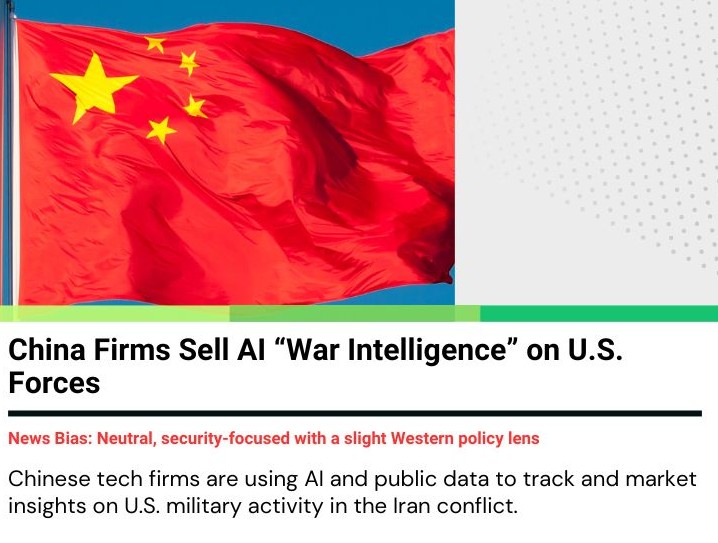
Chinese private firms like MizarVision are using artificial intelligence to transform open-source data into real-time battlefield intelligence. They are reportedly selling what they claim is real-time intelligence on U.S. forces in the Iran war, using satellite data and AI tools.
Inputs to the questionnaire related to the subject
Q1. “Chinese private firms marketing US wartime data from the Iran war”: Is it covert warfare?
Short Answer
Yes, to some extent, but more accurately, it is grey-zone warfare conducted through commercial proxies. Chinese firms like MizarVision use AI to blend open-source data into real-time battlefield intelligence. They sell it openly while advancing Chinese state interests under the guise of plausible deniability. It surpasses traditional covert warfare in scale, persistence, and reach.
Comprehensive Inputs
It is something more sophisticated and more durable than traditional covert warfare — and the distinction matters enormously for how states should respond.
Classical covert warfare involves a state using deniable means (intelligence officers, front organisations, recruited agents, proxy forces) to advance its strategic interests while concealing its involvement. What Chinese private firms are doing in the Iran conflict fits that template in some respects and structurally exceeds it in others.
Firms such as MizarVision and Jing’an Technology are using artificial intelligence to fuse open-source intelligence into near-real-time battlefield intelligence products. They use commercial satellite imagery from constellations like Jilin-1, ADS-B flight-tracking data, AIS shipping logs, social media geolocation data, and commercially available signal monitoring. The collated information is converted into intelligence, such as carrier movements, aircraft deployments, refuelling patterns, base activity, and CSAR package assembly. These products are then marketed commercially, sometimes advertised openly on social media, and sold to any paying customer.
It fits the covert warfare template in that the firms provide Beijing with plausible deniability. China publicly calls for ceasefires and peace talks while private companies advertise “US force exposure” products. Beijing can credibly claim it does not direct private commercial intelligence companies, that data brokerage is a legal commercial activity, and that it cannot be held responsible for what its private sector does in international markets. Some of these firms hold National Military Standard certifications. They operate within the ambit of China’s civil-military fusion ecosystem. However, none of this provides the clear attribution needed to justify a formal state involvement. The deniability is thin but legally and diplomatically tenable.
It exceeds classical covert warfare in three critical respects. First, the scale is potentially unlimited. Commercial data aggregation faces none of the manpower constraints of a traditional intelligence operation. Second, it is persistent. Data once collected, analysed, and sold cannot be unrecovered. It will be studied, operationalised, and built upon for years after any ceasefire. Third, and most significantly, it operates through the global commercial system rather than around it.
The most precise characterisation is grey-zone operations conducted through commercial proxies. It can be classified as a form of intelligence warfare that is covert in its state attribution but entirely overt in its commercial operation. The firms are not hiding that they sell wartime intelligence. They are hiding only that they are instruments of the Chinese state strategy. If this data reaches Iranian targeting systems — enabling missile or drone cueing against US assets, or revealing the assembly pattern of a CSAR package like the one that extracted the downed F-15E weapons officer — it crosses from commercial analytics into functional asymmetric support.
Q2 What does it indicate about the changing nature of global warfare?
Short Answer
The battlefield has expanded permanently into the domain of the data layer. Military superiority no longer guarantees information superiority. The distinction between war and peace, state and commercial activity, espionage and business, has been dissolved.
Comprehensive Inputs
This episode is not one of a kind, but an indication of the changes in 21st-century conflict.
The commercialisation and democratisation of intelligence. The state monopoly on strategic intelligence — historically derived from dedicated satellite constellations, signals interception networks, and human intelligence operations that only governments could afford — has been broken. A Chinese private firm can now synthesise commercial satellite imagery, publicly available tracking data, unclassified radio emissions, and social media geolocation into a product of genuine strategic value. This was structurally impossible twenty years ago. It is routine today. More importantly, the data Chinese firms collect and sell does not remain in China. It enters a commercial market accessible to Iran’s allies, North Korea’s procurement networks, Russia’s defence industry, and non-state actors with sufficient resources. US operational data from the Iran campaign — how the F-15E performs in contested airspace, what electronic countermeasures it deploys, how CSAR packages are assembled and timed — becomes simultaneously available to every adversary through a single commercial transaction. This is the “Uberisation” of intelligence: a capability that once required a superpower’s resources is now available as a subscription service.
The weaponisation of the private-state boundary. China has systematically developed the capacity to use nominally private entities as instruments of state strategy. It has regularly resorted to technology transfer through commercial joint ventures, infrastructure influence through Belt and Road contractors, data collection through consumer applications, and now wartime intelligence through commercial data brokers. China’s civil-military fusion model allows private firms to serve as frontline sensors and information warfare units without the legal or political friction that would accompany overt military intelligence operations.
The data layer is a new domain of warfare. Land, sea, air, and cyber were the recognised domains of modern conflict. What Chinese firms marketing US wartime data represent is distinct from all four: the weaponisation of the data economy itself as a strategic domain. Every military operation generates a data exhaust that is collectable, aggregable, and analysable by adversaries operating commercially and legally. The military’s extraordinary intelligence signature no longer needs a spy network to exploit. As one analyst framed it: war is no longer defined solely by who shoots — it is defined by who sees, who knows, and who shares information fastest.
The end of the temporal and geographic battlefield. Traditional warfare had relatively clear boundaries — it began with a declaration or a first strike, ended with a ceasefire, and took place within a defined theater. The commercial intelligence data collection and analysis operation against an adversary has no beginning, no end, and no geography. This is warfare conducted at the speed of commerce, with the deniability of the market, and the persistence of digital storage. There are no frontlines in this domain, no ceasefire provisions that apply to it, and no arms control framework that addresses it.
The erosion of traditional neutrality. States earlier stayed out of conflicts by not deploying troops or weapons. Now they can stay out while meaningfully shaping battlefield outcomes through data, technology, and commercial supply chains. China’s posture in the Iran war — publicly neutral, privately enabling information flows that enhance one side’s situational awareness — illustrates a new model of belligerence without formal participation. This has profound implications for international law, which has no adequate framework for a state that influences the outcome of a war it officially opposes through commercial data products sold by private firms.
Counter-strategies are structurally constrained. US response options in this case are genuinely limited. Sanctions require attribution that Beijing’s deniability deliberately forecloses. Diplomatic protests are met with denials. Military retaliation against a commercial data firm is neither legal nor justified. The most effective counter-strategies are reducing the electromagnetic and data signatures of operations, developing operations security doctrine for the digital age, hardening commercial data ecosystems against hostile aggregation, and investing in AI-driven denial and deception.
Q3. Does this mean that MizarVision/China was aware of US wartime preparations even before Epic Fury started?
Short Answer
These firms operate continuously, monitoring commercial data streams. They become operationally significant once the conflict starts. The military buildups generate distinctive data signatures. The AI systems detect and interpret it as a pattern of escalation. It is not a foolproof indication of the outbreak of hostilities. The military buildup can be a part of strategic coercion or political signalling.
Comprehensive Inputs
MizarVision and similar firms were not activated by the outbreak of Operation Epic Fury. They were operating continuously before it began, monitoring the same commercial data streams — satellite imagery, ADS-B flight tracking, AIS shipping logs, electromagnetic signatures — that became operationally significant once the conflict started. The pre-war military buildup that preceded Epic Fury would have been, from a data-collection standpoint, arguably more visible than the conflict itself. The movement of carrier strike groups into the Gulf, the surge in tanker and logistics aircraft activity at regional bases, the repositioning of electronic warfare and SEAD assets, the unusual concentration of HH-60W CSAR helicopters at forward staging points — all of this generates a distinctive data signature that AI systems are specifically designed to detect and interpret as a pattern of escalation.
This is precisely what makes the civil-military fusion model so strategically potent. A traditional intelligence operation requires tasking — someone must decide to collect against a specific target. Commercial AI-driven OSINT systems collect everything continuously and retrospectively identify the patterns that matter. MizarVision did not need to know that Epic Fury was coming to collect the data that would reveal its arrival. The system was watching regardless, and the pre-conflict build-up wrote its own signature into the data record.
The further implication is that China — and potentially Iran, if it were a customer for these products — had strategic warning of US military preparations that Washington may have believed it was concealing through operational security measures designed for a previous technological era. The diplomatic and strategic consequences of that asymmetry are significant. If Iran had reliable intelligence that a US-Israeli military campaign was imminent, its own preparations — dispersal of assets, activation of mosaic defence provincial commands, pre-delegation of launch authority — would have begun before the first strike. The effectiveness of the opening campaign’s decapitation logic would have been degraded before a single aircraft crossed the border.
This is the deepest strategic implication of the commercial intelligence phenomenon: it potentially eliminates strategic surprise as a US operational advantage against any adversary that is either a customer of these services or allied with the state that produces them. The build-up to every future US military operation will be observed, analysed, and potentially shared with the intended target before the operation begins — not by spies, but by algorithms running continuously on commercially available data that no classification system can suppress and no operational security protocol can fully conceal.
The Strategic Bottom Lines
The era in which military superiority translated automatically into information superiority is structurally over.
Every military operation is simultaneously a kinetic event and an intelligence event harvested by commercial actors.
The distinction between war and peace, state and commercial activity, espionage and business, has been dissolved.
The battlefield is no longer only land, air, sea, and cyber. It is also data (ambient, persistent, commercially mediated, and available).
Please Add Value to the write-up with your views on the subject.
For regular updates, please register your email here:-
References and credits
To all the online sites and channels.
Pics Courtesy: Internet
Disclaimer:
Information and data included in the blog are for educational & non-commercial purposes only and have been carefully adapted, excerpted, or edited from reliable and accurate sources. All copyrighted material belongs to the respective owners and is provided only for wider dissemination.
References:
- “Chinese firms market Iran war intelligence ‘exposing’ U.S. forces”, The Washington Post, 04 Apr 2026.
- (2024–2025). Reports on Chinese commercial satellite firms and defence-linked AI analytics.
- Michael C. Horowitz, & Paul Scharre
Horowitz, M. C., & Scharre, P. (2021). AI and the future of warfare. International Security, 46(2), 130–167.
- Mazarr, M. J. (2015). Mastering the grey zone: Understanding a changing era of conflict. RAND Corporation.
- Kania, E. B. (2017). Civil-military fusion and the PLA’s pursuit of dominance. Center for a New American Security.
- Center for Security and Emerging Technology
(2020). Open-source intelligence and AI: Transforming analysis.
- Atlantic Council. (2022). The weaponisation of data in modern conflict.