The IAF will celebrate its 94th anniversary on 08 Oct 2026.
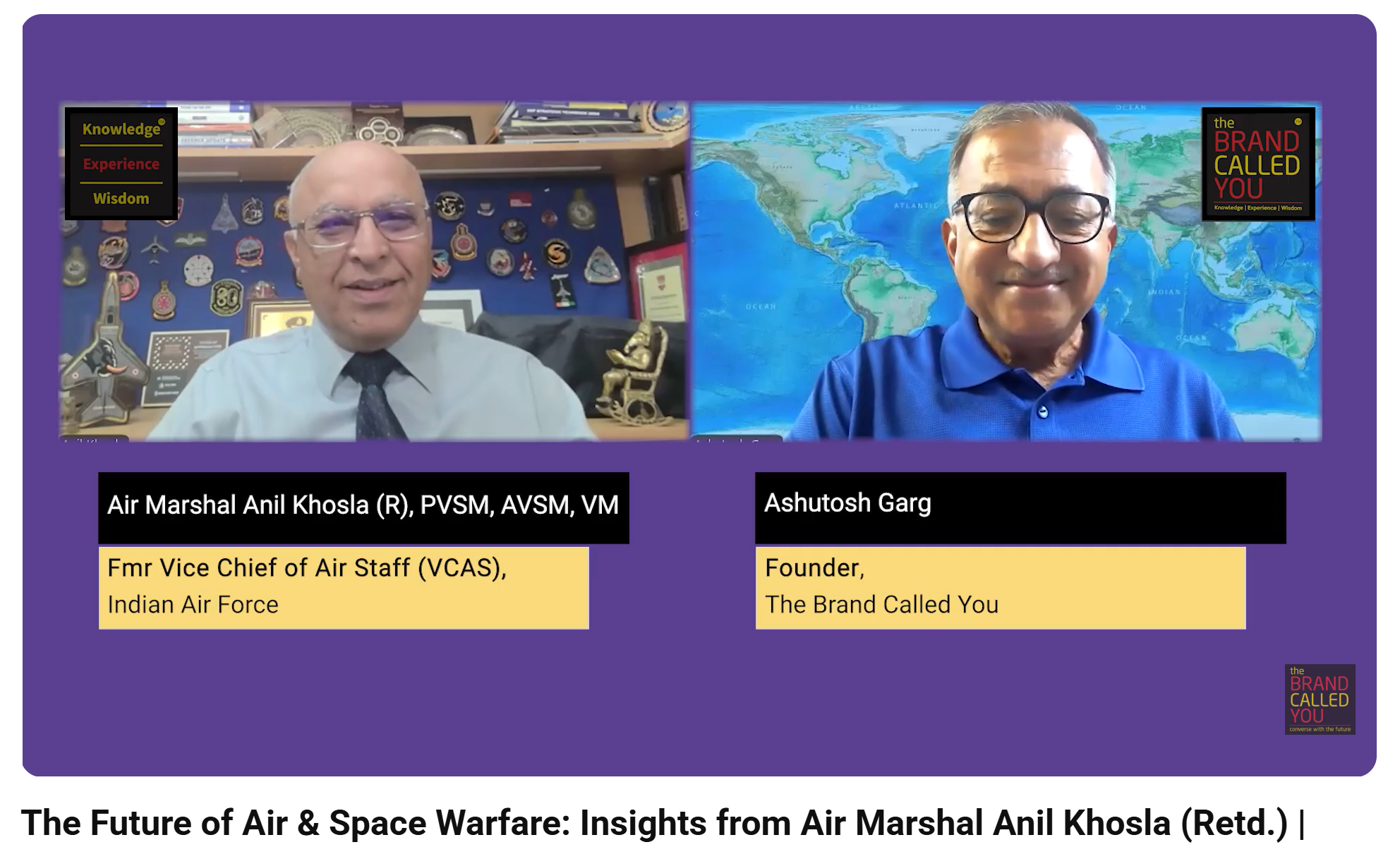
Shared my views on some of the aspects the media highlighted.
- You have discussed India’s air power and the challenges beyond the border on both sides, as well as China’s extensive modernisation. What challenges has the IAF faced in your time in pushing for modernisation? Has it been enough? What would you have liked to see done in your time?
Perspective: China is rapidly modernising its defence forces. It is in competition with the USA and pulling way ahead of us. In the process, they are also pulling along their ally Pakistan, narrowing the gap with India. Of late, both have been belligerent.
India’s Past Approach to Military Modernisation. Until about a decade back, India’s approach was incremental. It was phased and reactive, with war-triggered acquisitions and reforms. It aimed to replace the legacy systems rather than prepare for the future.
Fresh Impetus. In the last decade or so, the approach has shifted to a more proactive stance, driving defence modernisation, self-reliance, and the development of the defence production ecosystem.
Past Challenges:
-
- Budgetary Constraints. In the past, India did not spend enough on enhancing the capabilities of its defence forces.
- Prolonged Procurement Cycles. Procurement processes were tedious and time-consuming, involving approvals, evaluations, trials, negotiations, clearances, and scrutiny.
- Self-Reliance. The approach towards self-reliance was a step in the right direction. Unfortunately, the leapfrog method didn’t work due to several reasons. A classic example is the Tejas story.
- Defence Production Ecosystem. The components of the defence production ecosystem worked in individual silos. Further, DPSUs faced no competition because the protectionist approach prevented private-sector participation.
Adequacy of Modernisation. Over the years, the IAF has grown in capability (high-altitude ops, Day, night, and all-weather ops, Precision, standoff, reach, strategic airlift, Combat support ops, etc.). However, its capacity to endure (e.g., the number of fighter squadrons and combat support aircraft) has not kept pace with the perceived threats.
- Since your tenure as VCAS, there have been considerable changes in how AI, and specifically LLMs, are used in warfare, with the most recent example being Iran-US and Anthropic. What challenges might the IAF face in adopting such autonomous systems? Is it outdated training, or is it domestic capacity and data security?
AI has made a significant impact on the aviation sector, including defence aviation. All three factors mentioned are important.
-
- Data Security. AI-enabled fusion of sensors, platforms, and weapons has become central to airpower. The effectiveness of the fusion depends upon software, algorithms, and data. They need comprehensive protection.
- Training and Doctrine. Air crew, ground crew, and commanders need training to operate in an AI-enabled environment. Synthetic training environments and advanced simulation have become essential. Training exercises need to include operations in degraded environments. Further, Air Forces need to incorporate institutional mechanisms for experimentation, contingency handling, and converting lessons into doctrine.
- Indigenous Capability. This is the most important aspect to retain strategic autonomy. It also offers scalability when needed.
Broader Challenges. Beyond the challenges above, broader challenges remain.
-
- Change of Mindset. The mindset needs to shift from platform-centric (bean-counting) to developing a comprehensive combat ecosystem.
- Technology Absorption Cycle. Technological development outpaces procurement cycles. A two-speed mechanism is required. Long-term procurement cycles for platforms, systems, and weapons, and a faster (Experimental and adaptive) cycle for technology absorption.
- MUM-T Challenge. Manned-unmanned teaming is the future of combat. The loyal wingman concept is already being developed. Beyond the advantages, it also brings associated challenges. The vulnerabilities related to communications, electronic warfare, cyber aspects, and decision support systems need to be addressed.
- Interconnected Domains. Operations in space, cyber, electronic, and information domains are interconnected. These operations require organisational adaptation. China combined all four domains into a single service. However, after a decade-plus, it realised the drawbacks and reverted to the US model of independent commands for each domain. India has agencies for space, cyber and special forces ops.
- Extent of Autonomy. The world is still grappling with this question. Technology allows humans to be removed from the kill chain. The bigger question is about responsibility, legality, and ethics.
- It has been 94 years since the formation of the IAF, and nearly 8 decades since Indian sovereign skies have been protected. You have talked about different “eras” in the force’s life (pilot, platform, weapon); what comes next? AI and LLMs?
Air warfare has continuously changed in how air operations are conducted. It has changed from a pilot-centric era to a platform-centric one, and now to a weapon-centric one.
In my opinion, the next will be the era of three Cs. That is the era of Coherent, Collaborative Combat. Air combat will take place in an environment where all components (sensors, platforms, systems, and weapons) of airpower (ground-, air-, and space-based; manned and unmanned) work as a coherent combat ecosystem.
The acronym RADIANT summarises the characteristics of such a system.
-
- Resilience. Can sustain ops even under degraded conditions.
- Autonomous. With human oversight, accruing the advantage of mass and persistence.
- Distributed. Ability to generate airpower from multiple, maybe mobile locations.
- Indigenous. Allowing strategic freedom with the advantage of scalability.
- Adaptive. Ability to adapt to changes rapidly.
- Networked. Coherent and resilient architecture.
- Technology Absorptive. Ability to develop and integrate new technology rapidly.
- From Operation Safed Sagar (part of Op Vijay) to Operation Sindoor, the IAF has carried out multiple direct strikes to protect its sovereignty. How have you seen the IAF’s operational capacity and strategy change to address direct and ubiquitous threats? Or has it been a mentality of “if not broken, don’t fix it”?
Proactive Approach. IAF’s approach to modernisation and capability enhancement has been proactive and continuous. Its air strategy has evolved over time.
Historical Evolution. The IAF was formed during the British era. It was tactical, supporting ground forces. It remained reactionary post-partition. Post-partition, it grew, with its role expanded to include border and airspace protection. 1971 war saw air campaigns being conducted in parallel. The IAF modernised in the last two decades of the previous century, inducting advanced platforms, systems, and weapons. During the Kargil War, the IAF demonstrated the capability to apply air power innovatively at high altitudes. Over the last two-plus decades, the IAF has transformed into a capable strategic air force.
Doctrinal Adaptation. The IAF has also been evolving doctrinally. It has published three Doctrines. The first, published in 1995, was a basic doctrine on airpower, the importance of combat support ops, and modernisation. The second doctrine, published in 2012, linked airpower to the national objectives. It included airpower’s role in combating terrorism, as well as space ops, HADR, and the IAF’s role in nation-building. The last one was published in 2022, signalling a shift from airpower to aerospace power, with an emphasis on Multidomain ops and technology absorption.
- With gender parity in forces a major focus these days, and AVM Shakti Sharma becoming ACAS Education, do you think women fighter pilots will also see themselves elevated to senior ranks soon? Will the IAF see its first woman Chief of Air Staff before completing 100 years of operations?
The induction of women in the IAF has been gradual. From the medical branch to supporting services, then to combat and command roles. 1992, women officers were inducted into the admin branch for the first time. Thereafter, they were inducted into the flying branch (helicopters and transport aircraft) and eventually began flying fighters from 2015 onwards. From initial induction into the short service commission, they were granted a permanent commission. They are now even being utilised for combat and command roles. Now, women are joining the training institutions (NDA and Sainik schools) and being inducted into the non-officer ranks.
The IAF has led the integration of Women in the service. It has the highest percentage of women officers. The IAF has a good track record of balancing their individual aspirations with organisational goals. The IAF’s policies are gender-neutral, providing equal opportunities with no differentiation in performance or standards.
They have already started reaching the senior officer ranks. Someday, one of them may become Chief of the Air Staff. However, becoming CAS by the IAF’s 100th anniversary may not be possible, as they would not reach that seniority within the next six years.
Views are personal.
Please Add Value to the write-up with your views on the subject.
For regular updates, please register your email here:-
References and credits
To all the online sites and channels.
Pics Courtesy: Internet
Disclaimer:
Information and data included in the blog are for educational & non-commercial purposes only and have been carefully adapted, excerpted, or edited from reliable and accurate sources. All copyrighted material belongs to the respective owners and is provided only for wider dissemination.