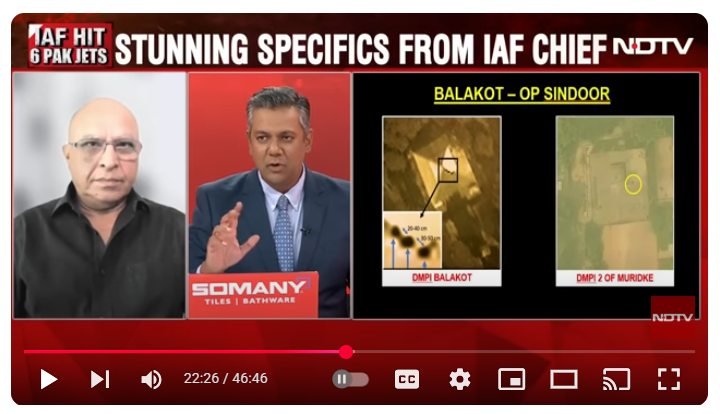
682: OP SINDOOR: INDIA’S POLICY OF PUNITIVE DETERRENCE AGAINST PAKISTAN-SPONSORED TERRORISM


My article was published on the “Life of Soldier” and the IIRF  website

on 14 Jun 25.


India’s national security strategy has been profoundly shaped by the persistent threat of Pakistan-sponsored terrorism, particularly in the contested region of Kashmir. For decades, Pakistan has been employing terrorism as a state policy to destabilise India, primarily through proxy groups like Lashkar-e-Taiba (LeT), Jaish-e-Mohammed (JeM), and Hizbul Mujahideen. In response, India has transitioned from a policy of strategic restraint to one of punitive deterrence, aiming to impose significant costs on Pakistan for its support of terrorist activities.

Necessity for Change of Approach. The origins of Pakistan-sponsored terrorism against India lie in the 1947 invasion of Jammu and Kashmir by tribal militias backed by Pakistan, sparking the first Indo-Pakistani war. Over the decades, Pakistan’s Inter-Services Intelligence (ISI) has been implicated in supporting militant groups targeting India, with major attacks including the 2001 Parliament attack, the 2008 Mumbai attacks, the 2016 Uri attack, and the 2019 Pulwama bombing. Pakistan’s overt nuclearisation in 1998 emboldened its strategy, as it leveraged its nuclear arsenal to shield its proxy warfare, believing India would refrain from conventional retaliation due to the risk of nuclear escalation. This dynamic allowed Pakistan to exploit the sub-conventional space, sustaining low-intensity conflict without triggering full-scale war. India’s initial restraint, while diplomatically prudent, failed to deter Pakistan’s persistent sponsorship of terrorism, necessitating a shift toward a more assertive approach.


Evolution of Punitive Deterrence

In the last decade, India began adopting punitive deterrence, a strategy designed to deter Pakistan by demonstrating a willingness to escalate in response to terrorist provocations. This approach combines conventional military actions, diplomatic pressure, and economic measures to raise the costs of Pakistan’s actions, challenging its reliance on nuclear deterrence to shield proxy warfare.

2016 Surgical Strikes. The Uri attack, which killed 19 Indian soldiers, prompted India to conduct surgical strikes across the Line of Control (LoC) targeting terrorist launch pads in Pakistan-occupied Kashmir (PoK). These strikes marked a shift from restraint, signalling India’s readiness to respond militarily. However, their limited scope had a modest impact on Pakistan’s strategic behaviour.

2019 Balakot Airstrikes. The Pulwama attack led to airstrikes on a JeM training camp in Balakot, Pakistan. As the first Indian airstrikes on Pakistani soil since 1971, Balakot represented a significant escalation, demonstrating India’s willingness to cross the LoC and strike deep inside Pakistan. The operation temporarily reduced terrorist activity in Kashmir.

Operation Sindoor (2025).  Launched on May 7, 2025, in response to the April 22, 2025, Pahalgam attack that killed 26 civilians, Operation Sindoor was a high-intensity military operation targeting nine terrorist facilities in Pakistan and PoK. Unlike previous operations, Sindoor was publicly declared, reinforcing India’s commitment to punitive deterrence and challenging Pakistan’s nuclear blackmail. The operation’s scale and transparency marked a doctrinal shift toward mainstreaming conventional retaliation as a response to terrorism.


Strategic Framework and Analysis of Punitive Deterrence

India’s policy of punitive deterrence is a strategic doctrine aimed at dissuading Pakistan from sponsoring cross-border terrorism by imposing credible costs through calibrated military responses. Rooted in the need to break the cycle of provocation and restraint, this policy combines political resolve, precision strikes, and international diplomatic engagement to establish red lines. As exemplified by earlier responses, it marks a shift from reactive to proactive counter-terrorism. This framework underscores India’s intent to reshape adversary behaviour, strengthen national security, and reinforce deterrence without escalating into full-scale war, thereby maintaining strategic stability in South Asia. India’s punitive deterrence policy has several facets.

Conventional Response to Sub-Conventional Threats. India now treats Pakistan-sponsored terrorism as an act of aggression equivalent to conventional warfare, justifying military retaliation. Operation Sindoor framed Pakistan’s proxy attacks as the initiation of hostilities, placing the burden on Pakistan to prevent such actions to avoid escalation.

Public Declaration of Intent. By openly announcing Operation Sindoor, India established a “tripwire strategy,” setting clear red lines to deter future attacks. This transparency strengthens domestic support and signals resolve to international audiences, reducing Pakistan’s ability to deny involvement.

Targeting Terrorist Infrastructure. India focuses on disrupting terrorist networks, including training camps and launch pads, while avoiding civilian targets. Operation Sindoor’s inclusion of air bases marked a bold escalation, signalling that India could target strategic assets if provoked.

Diplomatic and Economic Pressure. India has complemented military actions with non-kinetic measures. Post-Pahalgam, India suspended the Indus Waters Treaty (IWT), demanding that Pakistan cease terrorism as a condition for reinstatement. India has also isolated Pakistan diplomatically,  condemning its actions at the United Nations and multilateral organisations.

Psychological Deterrence. By targeting air bases and demonstrating escalation dominance, India aims to undermine Pakistan’s confidence in its nuclear shield, forcing its military to reassess the costs of proxy warfare.

Legitimacy India’s airstrikes during Operation Sindoor were firmly rooted in international law and the UN Charter, which upholds the right to self-defence. The operation targeted terror camps of Jaish-e-Mohammed and Lashkar-e-Taiba in Pakistan and PoK. India presented a detailed dossier, backed by satellite imagery and intelligence inputs, confirming the presence and activity of terror infrastructure. The precision of the strikes, aimed at minimising civilian casualties, further reinforced India’s commitment to lawful action. These elements collectively underscored the legitimacy and proportionality of India’s response.

Acceptance and Reactions. Operation Sindoor elicited varied international reactions. The United States and European Union expressed concern over escalation risks but acknowledged India’s right to self-defence, urging both nations to exercise restraint. China, Pakistan’s ally, condemned the operation as a violation of sovereignty, while Russia adopted a neutral stance, advocating dialogue. The UN Security Council’s failure to issue a unified statement highlighted the global divide, with India leveraging its growing geopolitical clout to deflect criticism. India’s rejection of third-party mediation, insisting on bilateral resolution, underscored its assertive diplomatic posture.

Challenges and Limitations. India’s punitive deterrence policy faces significant challenges.

    • Escalation Risks. Targeting air bases in Operation Sindoor raised fears of nuclear escalation, given Pakistan’s low nuclear threshold. While a ceasefire was achieved, the operation highlighted the delicate balance India must maintain to avoid catastrophic conflict.
    • Commitment Traps. Public declarations create domestic expectations, where failure to respond to future attacks could erode government credibility. This dynamic risks forcing India into disproportionate responses to minor provocations.
    • Pakistan’s Resilience. Pakistan’s military views anti-India violence as a core strategic objective, making it resistant to deterrence. Despite economic pressures and FATF scrutiny, Pakistan resumed proxy attacks as conditions improved.
    • International Dynamics. Western calls for restraint, driven by nuclear fears, allow Pakistan to deflect accountability. India’s unilateral approach risks diplomatic isolation if not balanced with strategic outreach.
    • Attribution Challenges. Pakistan’s denials and the difficulty of conclusively linking attacks to its state apparatus complicate India’s justification for retaliation. Operation Sindoor’s preemptive approach reflects a shift toward acting on intent rather than exhaustive evidence, but it invites criticism.

Effectiveness and Outcomes. The policy’s effectiveness is mixed. The Balakot strikes reduced terrorist activity from 2019 to 2024, but the resurgence of attacks thereafter, including Pahalgam, indicates deterrence was not sustained. Operation Sindoor re-established India’s resolve, with the ceasefire suggesting Pakistan may recalibrate its strategy. However, the ideological commitment of Pakistan’s military to proxy warfare remains a persistent challenge. The policy has created a distinct operational space below the nuclear threshold, allowing India to impose costs without triggering all-out war.

Future Implications. For India’s policy of punitive deterrence to remain effective in the future, several strategic actions are essential. First, India must maintain credible military capabilities, including precision strike assets, advanced surveillance systems, and real-time intelligence networks to enable swift, proportionate responses. Second, seamless civil-military coordination and decision-making agility are critical to capitalise on narrow windows of opportunity. Third, India must invest in modern technologies such as unmanned systems, AI-driven targeting, and cyber capabilities to expand its deterrence toolkit. On the diplomatic front, continuous engagement with global powers is necessary to reinforce the legitimacy of India’s actions under international law and counter Pakistan’s disinformation campaigns. Furthermore, India should proactively expose terror infrastructure through satellite imagery and dossiers, shaping global opinion. Finally, internal resilience through adequate border security, counter-infiltration measures, and societal preparedness is vital to blunt future attacks. Together, these measures will sustain deterrence, minimise escalation risks, and reinforce India’s strategic credibility.

Conclusion

India’s policy of punitive deterrence marks a paradigm shift from strategic restraint to assertive coercion in countering Pakistan-sponsored terrorism. From the 2016 surgical strikes to the Balakot airstrikes and Operation Sindoor, India has demonstrated its willingness to escalate militarily, diplomatically, and economically to deter Pakistan’s proxy warfare. While effective in signalling resolve and disrupting terrorist infrastructure, the policy faces challenges in managing escalation risks, sustaining deterrence, and navigating international dynamics. As India refines its approach, balancing military decisiveness with diplomatic engagement will be critical to securing long-term stability and countering Pakistan’s use of terrorism as a tool of statecraft.


Please Add Value to the write-up with your views on the subject.


1879
Default rating

Please give a thumbs up if you  like The Post?


Link to the article on the website:-

OP SINDOOR: INDIA’S POLICY OF PUNITIVE DETERRENCE AGAINST PAKISTAN-SPONSORED TERRORISM

OP SINDOOR: INDIA’S POLICY OF PUNITIVE DETERRENCE AGAINST PAKISTAN-SPONSORED TERRORISM

For regular updates, please register your email here:-

Subscribe


References and credits

To all the online sites and channels.

Pics Courtesy: Internet (Kashmir Scan)

Disclaimer:

Information and data included in the blog are for educational & non-commercial purposes only and have been carefully adapted, excerpted, or edited from reliable and accurate sources. All copyrighted material belongs to the respective owners and is provided only for broader dissemination.


For regular updates, please register your email here:-

Subscribe


References and credits

To all the online sites and channels.

Pics Courtesy: Internet

Disclaimer:

Information and data included in the blog are for educational & non-commercial purposes only and have been carefully adapted, excerpted, or edited from reliable and accurate sources. All copyrighted material belongs to the respective owners and is provided only for wider dissemination.


References:-

  1. Bhaumik, Anirban. “Operation Sindoor: India’s Bold Strike Against Terror.” The Hindu, May 8, 2025.
  2. Chaudhury, Dipanjan Roy. “India Suspends Indus Waters Treaty Amid Rising Tensions.” The Economic Times, April 28, 2025.
  3. Fair, C. Christine. Fighting to the End: The Pakistan Army’s Way of War. Oxford: Oxford University Press, 2014.
  4. Ganguly, Sumit, and S. Paul Kapur. India, Pakistan, and the Bomb: Debating Nuclear Stability in South Asia. New York: Columbia University Press, 2010.
  5. Kapur, S. Paul. “India’s Surgical Strike and the Logic of Punitive Deterrence.” Journal of Strategic Studies 40, no. 4 (2017): 567–589.
  6. Ministry of External Affairs, Government of India. “Statement on Operation Sindoor and India’s Counter-Terrorism Policy.” May 7, 2025.
  7. Pant, Harsh V., and Kartik Bommakanti. “India’s National Security Strategy: The Shift to Punitive Deterrence.” ORF Issue Brief No. 392, Observer Research Foundation, June 2025.
  8. Rajagopalan, Rajeswari Pillai. “Balakot Airstrikes: A Case Study in Escalation Dynamics.” Strategic Analysis 43, no. 6 (2019): 512–526.
  9. Riedel, Roberta. Avoiding Armageddon: America, India, and Pakistan to the Brink and Back. Washington, DC: Brookings Institution Press, 2013.
  10. Singh, Sushant. “From Restraint to Retaliation: India’s Evolving Counterterrorism Strategy.” India Today, May 15, 2025.
  11. United Nations Security Council. “Press Statement on India-Pakistan Tensions Post-Pahalgam Attack.” April 25, 2025.
  12. Tellis, Ashley J. “India’s Emerging Strategic Doctrine: From Restraint to Proaction.” Carnegie Endowment for International Peace, July 2020.
  13. Joshi, Yogesh, and Anit Mukherjee. “From Denial to Punishment: The Evolution of India’s Military Strategy.” India Review 18, no. 3 (2019): 283–308.
  14. Swami, Praveen. “The Return of Terror: Pakistan’s Proxy War in Kashmir.” Frontline, March 15, 2025.

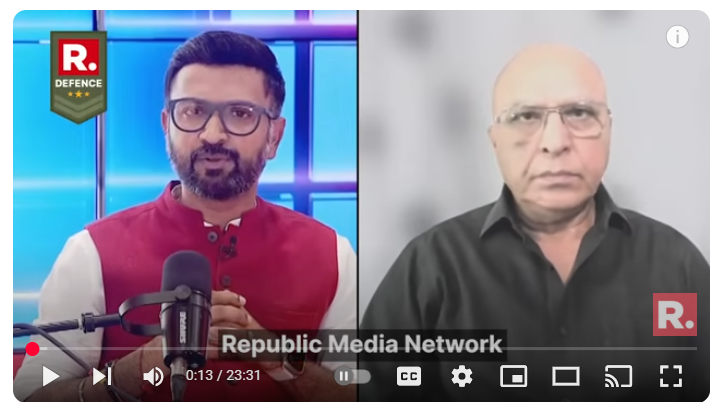
679: OP SINDOOR: ASIM MUNIR – SWORD OF HONOUR TO DISGRACING THE SWORD


My Article was published on “The Eurasian Times” website on 12 Jun 25.


Syed Asim Munir Ahmed Shah, once celebrated as a decorated and promising officer of the Pakistan Army, has emerged as a deeply polarising figure. His career, which began with distinction marked by the rare honour of winning the Sword of Honour as an Officers Training School (OTS) graduate, now faces harsh criticism amid accusations of ideological zealotry, political manipulation, and strategic failures. The transformation from a respected military leader to one accused of “disgracing the sword” is a compelling narrative that encapsulates the complexities and contradictions of Pakistan’s civil-military relations, the role of religious ideology in the armed forces, and the nation’s fraught political landscape.


Early Life.  Born in 1968 in Rawalpindi, Pakistan, Asim Munir came from a family with deep religious roots. His father, Syed Sarwar Munir, was a school principal and an imam at Masjid-al-Quraish in Rawalpindi’s Dheri Hassanabad, delivering Friday sermons that likely influenced Munir’s worldview. Unlike many of his peers from elite military families, Munir’s background was modest, with his family having migrated from Jalandhar, India, during the 1947 partition. His early education at the Markazi Madrasah Dar-ul-Tajweed, an Islamic seminary, instilled a strong religious foundation, significantly shaping his leadership style and raising concerns about religious ideology’s influence in the military.


Entry and Military Career.  Unlike many senior officers who rose through the prestigious Pakistan Military Academy (PMA) ranks, Munir was commissioned via the Officers Training School (OTS) in Mangla, an alternative path often viewed as less prestigious. He graduated in 1986, earning the Sword of Honour for his exceptional performance. Commissioned into the 23rd Battalion of the Frontier Force Regiment, he quickly established himself as a promising officer. His career included diverse roles, such as serving as a military attaché in Saudi Arabia, where he memorised the Quran, earning the title of Hafiz-e-Koran, and commanding troops in strategic locations. Munir’s academic credentials are equally impressive, with an MPhil in Public Policy and Strategic Security Management from the National Defence University in Islamabad, alongside training at military institutions in Japan and Malaysia.


Rise in the Pakistan Army and Governance. Several high-profile intelligence and command assignments marked Munir’s career. He served as Director-General of Military Intelligence (MI) and later as head of the Inter-Services Intelligence (ISI). However, his term as ISI chief was short-lived, reportedly due to differences with then-Prime Minister Imran Khan, especially over corruption reports implicating the latter’s close aides. This fallout would later shape Munir’s implicit role in the military’s manoeuvring to oust Khan from power. Munir also served as commander of the Force Command Northern Areas (FCNA) in Gilgit-Baltistan and the XXX Corps in Gujranwala. By 2021, he had become Quartermaster General at GHQ Rawalpindi, a key logistical and administrative post. On November 29, 2022, Munir was appointed Chief of Army Staff, becoming the first Hafiz-e-Quran to lead the Pakistan Army. His selection came amid intense political turmoil, and his tenure immediately saw an aggressive consolidation of military influence over civilian institutions. This aggressive consolidation could weaken civilian governance structures and entrench military control in Pakistan’s political landscape. Munir became the central figure in Pakistan’s governance, overshadowing the Prime Minister and the judiciary in decision-making.


My Way or the Prison Way: Vindictive Attitude. Former Prime Minister of Pakistan Imran Khan has been imprisoned since August 2023. He claims that Munir harbours personal animosity, stemming from Khan’s decision to remove him as ISI chief in 2019. Khan also alleges that Munir has retaliated by targeting his wife, Bushra Bibi, leading to her 14-month detention under harsh conditions, including solitary confinement and restricted family access. Khan’s narrative, amplified by PTI supporters and a Times Square billboard campaign branding Munir a “Fraud Marshal,” portrays the general as orchestrating a broader crackdown on PTI to suppress dissent. Khan’s calls for judicial inquiries into these actions face challenges from a judiciary he claims is aligned with the military. The critics see a pattern of politically motivated persecution, highlighting the highly vindictive character of Munir.


‘Jihadi Mullah General’ with Religious Ideology. Munir’s worldview blends military strategy with Islamic theology, reminiscent of General Zia-ul-Haq’s Islamisation policies in the 1970s and 1980s. He overtly infuses religious ideology into military affairs. In a speech to a grand jirga in Peshawar, Munir explicitly stated that the Pakistan Army operates under the principles of “imaan, taqwa, and jihad fi sabeelillah.” He declared, “We are waging jihad in the path of Allah and success will be ours, Inshallah.” These statements are more in line with militant organisations than modern militaries. Munir’s rhetoric has emboldened radical groups and blurred the line between conventional military operations and religious militancy. The term ‘jihadi general’ began to circulate in international media and think tanks, raising concerns about Pakistan’s nuclear command under such ideological leadership. Internally, his policies led to greater appeasement of hardline clerics and religious political factions, weakening Pakistan’s secular democratic institutions.


Mullah-Military Alliance Doctrine. Munir’s speeches frequently invoke the two-nation theory, emphasising irreconcilable differences between Muslims and Hindus. On April 16, 2025, addressing a Pakistani diaspora audience in Islamabad, he stated, “Our forefathers believed we are different from the Hindus in every aspect of life. Our religions, customs, traditions, thoughts, and ambitions differ.” He described Kashmir as Pakistan’s “jugular vein,” a phrase perceived as a signal to terror proxies, preceding the April 22 Pahalgam attack that killed 26 civilians. Munir’s ideology aligns with a mullah-military alliance, where the army positions itself as the defender of Pakistan’s ideological frontiers, not just its borders. His leadership has seen the military provide state funerals for senior terrorists and align rhetoric with groups like Lashkar-e-Taiba and Jaish-e-Mohammed, raising concerns about state-sponsored terrorism. Unlike his predecessor Bajwa, who advocated for geo-economics and a 2021 ceasefire with India, Munir has not uttered a word of peace, focusing instead on jihadist rhetoric and military escalation. His strained relations with Indian leadership and refusal to engage diplomatically contrast with past generals like Zia-ul-Haq and Pervez Musharraf, who maintained channels with Indian counterparts. The long-term effects of this shift in policy could lead to increased tensions with India and further destabilisation within Pakistan as the military’s focus shifts from conventional defence to ideological warfare.


Self-Promotion: A Disgrace. During India’s Operation Sindoor in May 2025, Pakistan suffered considerable economic, diplomatic, and military setbacks. Indian airstrikes damaged key military installations, whereas Pakistan’s retaliatory efforts lacked cohesion. Moreover, international isolation deepened due to Pakistan’s perceived role in harbouring terror proxies. Despite this humiliation, Munir self-promoted himself to the rank of Field Marshal, the first such elevation since Ayub Khan in 1965. In the face of significant national challenges, this act of self-promotion raises critical questions about Munir’s leadership and priorities.


The “Failed Marshal” Narrative. Munir’s overreach into civil governance is backfiring. His alliance with the fragile coalition government has led to widespread public resentment. The crackdown on political opponents, media censorship, and manipulation of the judiciary has further alienated the citizenry. Economic conditions have deteriorated as foreign investments have dried up. Pakistan’s regional and global reputation has also suffered under Munir’s leadership. Relations with the U.S. have remained lukewarm, while ties with China have grown increasingly transactional. Meanwhile, his harsh rhetoric against India, especially communal remarks linking Hindus to historical grievances, is considered incitement of terror attacks. Domestically, Munir’s legitimacy is being questioned. Civil society has begun to refer to him as a “failed marshal,” suggesting that his promotion was not earned through strategic brilliance but political manipulation. The military’s internal cohesion also reportedly weakened, with factionalism surfacing within the ranks. Some officers allegedly opposed the overt ideological and political shift under Munir’s command.


Conclusion. Asim Munir’s career arc, from a Sword of Honour cadet to a disgraced Field Marshal, reflects broader themes in Pakistan’s military and political evolution. His initial promise as a disciplined, devout officer has led to a tenure marked by ideological rigidity, strategic miscalculations, and political entanglement. The sword of honour that once symbolised Asim Munir’s excellence and promise now stands metaphorically tarnished by the controversies of his later years. His transformation, from a highly respected officer to a leader accused of disgracing the military institution, underscores the complex interplay of ambition, ideology, and power in Pakistan’s armed forces.


Please Add Value to the write-up with your views on the subject.


1879
Default rating

Please give a thumbs up if you  like The Post?


Link to the article oin the website:-

From Sword Of Honor To Disgracing The Sword, How Most Powerful Man In Pakistan, Asim Munir, Has Dented Country’s Credibility: OPED


For regular updates, please register your email here:-

Subscribe


References and credits

To all the online sites and channels.

Pics Courtesy: Internet

Disclaimer:

Information and data included in the blog are for educational & non-commercial purposes only and have been carefully adapted, excerpted, or edited from reliable and accurate sources. All copyrighted material belongs to the respective owners and is provided only for broader dissemination.


References: –

  1. Khan, Aqil Shah. The Army and Democracy: Military Politics in Pakistan. Harvard University Press, 2014.
  1. International Crisis Group. “Pakistan’s Military and the Islamist Militant Landscape,” Asia Report No. 307, 2021.
  1. Stratfor Analysis, 2023. “Asim Munir and the Changing Face of Pakistan’s Army.”
  1. The Diplomat. “Pakistan’s Army Chief Asim Munir: Between Religion and Strategy,” May 2023.
  1. BBC News. (2022, November 29). “Who is Pakistan’s new army chief, Asim Munir?” BBC News.
  1. Al Jazeera English (2025, May 18). “India-Pakistan tensions flare after Pahalgam attack.” Al Jazeera.
  1. Carnegie Endowment for International Peace. “Pakistan’s Civil-Military Relations: Past, Present, and Future,” 2024.
  1. Institute of Peace and Conflict Studies (IPCS), New Delhi. “Pakistan’s Military Leadership and Regional Stability,” 2023.
  1. Brookings Institution. “Pakistan’s Military: The Growing Influence of Religion,” 2023.
  1. Ahmad, J. (2024). Faith and Force: The Role of Religion in Pakistan’s Military Leadership. Islamabad: Institute of Policy Studies.
  1. Haider, S. (2025, May 15). “Pakistan’s new Field Marshal: Asim Munir’s rise and the Munir Doctrine.” The News International.
  1. The Indian Express. (2025, April 20). “Pakistan army chief’s ‘jugular vein’ remark on Kashmir escalates tensions.” The Indian Express.
  1. Khan, M. (2023). Pakistan’s Military Elite: Power and Politics. Karachi: Oxford University Press.
  1. Siddiqui, N. (2018, October 10). “Asim Munir removed as ISI chief after eight months.” Geo News.
  1. Yusuf, H. (2025, June 1). “Operation Bunyan-um-Marsoos: Pakistan’s military response to India.” Strategic Studies Quarterly, 43(2), 12–25.

674: CLAWS Seminar on Operation Sindoor


CLAWS conducted a Seminar on  “Operation Sindoor”  on 08 May 25.


Link to the webinar:-

Please Add Value to the subject with your views and Comments.


1879
Default rating

Please give a thumbs up if you  like The Post?


For regular updates, please register your email here:-

Subscribe

References and credits

To all the online sites and channels.

Pics Courtesy: Internet

Disclaimer:

Information and data included in the blog are for educational & non-commercial purposes only and have been carefully adapted, excerpted, or edited from reliable and accurate sources. All copyrighted material belongs to respective owners and is provided only for wider dissemination.

English हिंदी